


Working Capital Loan Requirements: Comparing Unsecured vs. Secured Options in 2026
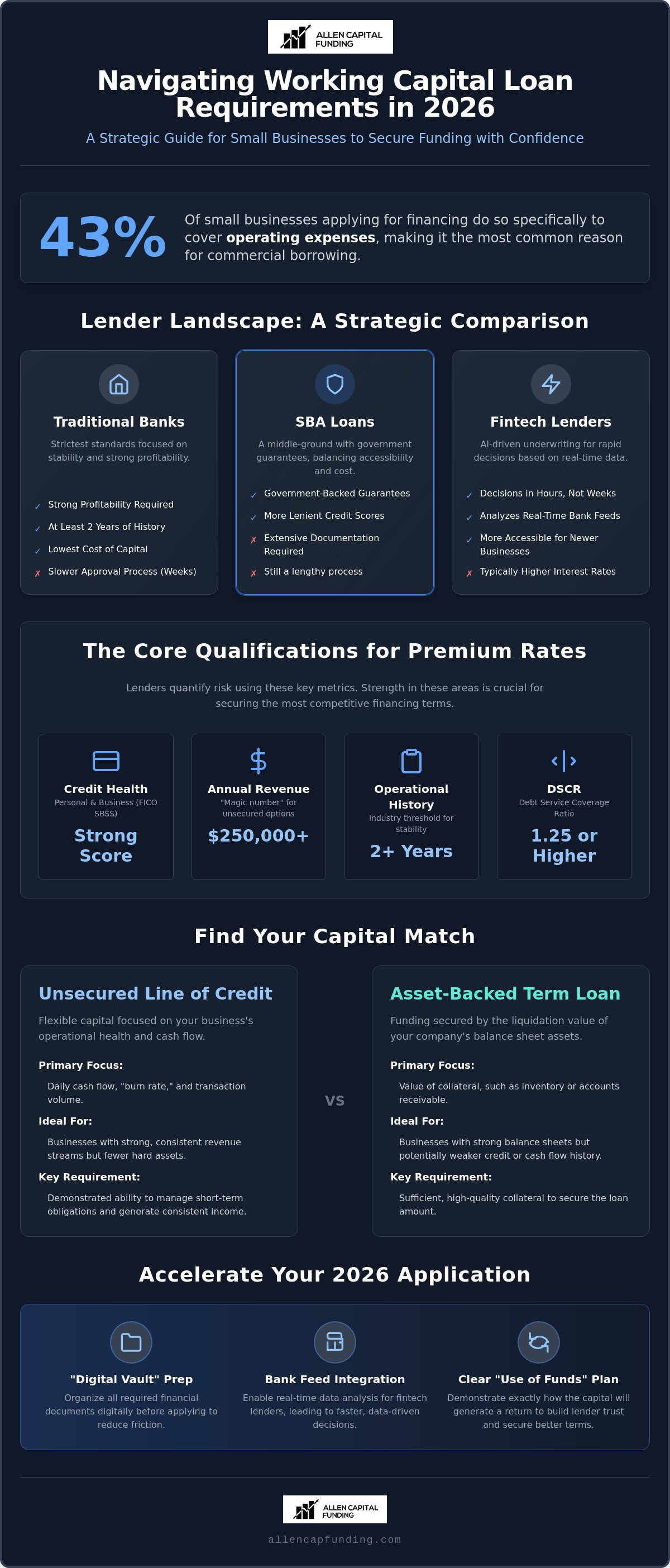
Forty-three percent of small businesses that applied for financing recently did so specifically to cover operating expenses, making it the most common reason for commercial borrowing. Despite this high demand, meeting specific working capital loan requirements often feels like solving a puzzle with missing pieces. You likely feel the frustration of slow bank approvals or worry that multiple applications might damage your credit score. It's difficult to maintain momentum when the path to capital is blocked by confusing lender appetites and rigid paperwork.
We are here to provide the strategic clarity and expert guidance you need to secure funding with confidence. This guide simplifies the complex landscape of business finance by comparing flexible unsecured lines against traditional secured loans. You'll get a clear checklist of the metrics and documents required to qualify in 2026. We'll show you how to bypass the trial and error of bank applications and find a faster path to the capital that matches your business's unique risk profile.
Table of Contents
Understanding Working Capital Loan Requirements as a Strategic Filter
At its core, working capital represents the lifeblood of your daily operations. Lenders view working capital loan requirements as a strategic filter to measure how effectively your business manages its short-term obligations. These benchmarks aren't just arbitrary hurdles. They serve as a diagnostic tool to assess your liquidity and your capacity to repay debt without compromising growth. By 2026, the criteria for "qualifying" have become more nuanced, moving beyond simple credit scores to a more holistic view of financial health.
Requirements vary significantly across the lending spectrum. Traditional banks often maintain the strictest standards, typically seeking businesses with at least two years of operational history and strong profitability. In contrast, SBA loans offer a middle ground with government-backed guarantees that might allow for slightly lower credit scores but require extensive documentation. Private fintech lenders have shifted the landscape by using AI-driven underwriting. This technology analyzes real-time data, such as bank feeds and transaction volume, to make decisions in hours rather than weeks. While these faster options are accessible, meeting the more rigorous working capital loan requirements of traditional or SBA lenders can significantly lower your total cost of capital by securing more favorable interest rates.
The Role of Requirements in Debt vs. Asset-Based Funding
Understanding the difference between cash-flow lending and asset-backed solutions is vital for your strategy. Working capital loans usually prioritize your "burn rate" and daily operational health. They look at how much cash moves through your business. Conversely, asset-based lending for small business focuses on the liquidation value of collateral, such as inventory or accounts receivable, rather than historical cash flow. This distinction allows businesses with weaker credit but strong balance sheets to still access necessary liquidity.
Why 'Soft' Requirements Matter as Much as 'Hard' Data
In 2026, lenders increasingly look at "soft" data to round out your profile. Your industry-specific risk rating now plays a major role in approval odds. Lenders also evaluate your online presence and reputation to gauge business stability. Providing a clear, documented "use of funds" plan is another critical factor. When you can demonstrate exactly how the capital will generate a return, you remove friction from the approval process and build trust with your funding partner. This transparency often leads to faster approvals and better terms from private lenders who value strategic clarity.
The Core Qualifications: Credit, Revenue, and Operational History
Lenders rely on a specific set of metrics to quantify risk. While every institution has its own appetite, the fundamental working capital loan requirements remain consistent across the board. These benchmarks allow lenders to predict your future performance based on your historical behavior. To qualify for the most competitive rates, your business must demonstrate strength in three primary areas: credit health, revenue volume, and operational longevity.
Understanding the difference between your personal FICO and the FICO SBSS is critical. Most small business owners don't realize that the SBA and many traditional banks use the Small Business Scoring Service (SBSS) to pre-screen applications. This score blends your personal credit data with your business credit history and financial data. If you're aiming for premium unsecured options, the "magic number" for annual gross revenue is often $250,000. This volume suggests your business has reached a scale where it can absorb new debt payments without stalling growth. Additionally, the two-year mark remains the industry's primary threshold for stability. Statistics show that businesses surviving past this point are significantly less likely to default.
Lenders also use the Debt Service Coverage Ratio (DSCR) to see if you can afford the payments. This formula divides your net operating income by your total annual debt obligations. Most lenders look for a ratio of 1.25 or higher, meaning you have 25% more income than you need to cover your debts. Meeting these Business Loan Requirements is the first step toward a successful funding round. A proactive financial check-up can help you identify which of these metrics needs improvement before you submit an official application.
Credit Score Nuances in 2026
Personal credit acts as a proxy for business character in unsecured lending because there's no physical collateral to seize if things go wrong. If your credit is challenged, you can still access specialized working capital by focusing on revenue-based solutions that prioritize cash flow over FICO scores. To qualify for a premium unsecured business line of credit in 2026, lenders typically require a minimum personal FICO score of 680.
Revenue Consistency and Bank Statements
Lenders look for consistent monthly deposits rather than just a high annual total. A business that earns $20,000 every month is often more attractive than one that earns $240,000 in a single quarter and nothing for the rest of the year. Frequent "NSF" (Non-Sufficient Funds) occurrences are a major red flag that can lead to instant rejection. Seasonal businesses can often meet requirements through specialized bridge capital products designed to smooth out these predictable cash flow gaps.
Unsecured Business Line of Credit vs. Term Loans: A Requirement Comparison
Choosing between a revolving line of credit and a fixed term loan often comes down to how your business meets specific working capital loan requirements. These two paths offer distinct advantages, but they demand different levels of transparency and security. A term loan provides a lump sum of capital with a predictable repayment schedule, yet it frequently requires specific asset pledges. In contrast, an unsecured line of credit offers revolving access to funds without tying up your equipment or real estate. This flexibility usually comes with a trade-off: lenders will scrutinize your credit score and cash flow much more closely because they lack physical collateral to fall back on.
Collateral requirements represent a major divide in these two funding models. Most unsecured options utilize a "blanket lien," which is a general claim on business assets rather than a "specific asset pledge" like a mortgage or equipment lien. While this sounds less intrusive, it can still impact your ability to secure other financing later. The speed of access is also heavily influenced by these requirements. If you have your digital documentation ready, an unsecured line can often be approved and ready for its first draw within 48 hours. Traditional term loans, particularly those exceeding $350,000, often trigger more exhaustive documentation hurdles that can extend the wait time to several weeks.
When an Unsecured Line is the Superior Strategic Choice
Service-based businesses with high margins but few physical assets are the ideal candidates for this model. An unsecured business line of credit provides a vital safety net for inventory surges or unexpected payroll gaps. To keep these lines healthy, many lenders enforce a "Zero Balance" requirement. This means you must pay the line down to zero for a specific period, typically 30 consecutive days each year, to prove your business isn't overly dependent on revolving debt for basic survival.
The True Cost of Lower Requirements
It's a fundamental rule of finance that easier qualification usually leads to a higher cost of capital. "Low-doc" loans trade speed and ease for higher factor rates or APRs. When you compare a five-year term loan to a revolving line, the total interest paid on the term loan might be higher, but the effective annual rate on the line could be steeper if not managed correctly. Working with an expert broker helps you navigate these working capital loan requirements without bias. We help you weigh the immediate need for speed against the long-term impact on your bottom line.
Documentation and Digital Readiness: Preparing Your 2026 Application
The landscape of business lending has moved beyond paper folders and fax machines. In 2026, meeting working capital loan requirements depends heavily on your digital readiness. Lenders now utilize AI-driven underwriting systems that demand instant access to clean, verified data. Creating a "Digital Vault" is no longer optional. This secure, cloud-based repository should house your tax returns, P&L statements, and balance sheets. It's the baseline for any serious application. If your records are scattered, your approval will be delayed.
One of the most significant shifts in modern lending is the use of bank feed integration. By granting lenders read-only access to your business accounts, you provide a real-time view of your liquidity. Industry data suggests this integration can accelerate approval times by up to 72% compared to manual document uploads. Beyond financials, your legal checklist must be current. Lenders will verify your Articles of Incorporation, Operating Agreements, and valid Business Licenses. Additionally, 2026 regulations require strict "Beneficial Ownership" reporting to ensure transparency regarding who actually controls the company. Missing these compliance details can stall even the strongest application.
Organizing Your Financial Statements
Your Year-to-Date (YTD) P&L statement must be current, ideally no more than 30 days old. Lenders want to see how your business is performing right now, not how it looked six months ago. We often help clients identify "add-backs," such as one-time equipment repairs or non-cash depreciation, to show a higher true cash flow. This adjustment can be the difference between a denial and an approval. Clean accounts receivable aging reports are critical for working capital approvals because they prove your customers pay on time and your future revenue is reliable.
The Role of the Strategic Financial Check-Up
AI underwriting systems are efficient but rigid. A single typo in your legal name or an inconsistent address across documents can trigger an automatic denial. This is where a strategic financial check-up becomes your greatest advantage. We identify these red flags before a lender ever sees your file. Our process also prepares you for the "Lender Interview." When a specialist calls to verify your data, you'll have the confidence to speak clearly about your debt-to-income ratio and growth projections. Preparing your documentation correctly ensures you meet working capital loan requirements without the frustration of repeated rejections.
Navigating Complex Requirements with Allen Capital Funding
Meeting strict working capital loan requirements shouldn't feel like a solo mission. While direct lenders offer a single "box" to fit into, our brokerage model provides access to a national network of diverse partners. This approach removes the trial and error often associated with commercial finance. One application connects you to dozens of potential matches, ensuring you don't waste time on lenders whose appetites don't align with your industry or risk profile. We act as a dedicated guide, simplifying the path to capital so you can focus on running your company.
We tailor every funding package to highlight your specific business strengths. Algorithms often miss the context behind a seasonal dip or a recent expansion cost. Our specialists look beyond the automated underwriting to build a narrative that lenders understand. This human touch is vital for large-scale capital draws or businesses in transition. We provide a strategic roadmap for your entire growth lifecycle, moving seamlessly between Credit Lines, Equipment Financing, and SBA Loans as your needs evolve. Our goal is to remove barriers and accelerate your success through precise financial matching.
Why a 'No' from a Bank Isn't the End
A rejection from a traditional institution often stems from a narrow view of your data. When traditional working capital loan requirements aren't met, we pivot to alternative solutions that focus on different assets. For example, we've successfully secured funding for businesses by leveraging Purchase Order Financing or Factoring. These methods prioritize the quality of your customers and outstanding orders rather than just your historical credit scores. Our national network includes niche lenders who specialize in specific industries, providing you with options that traditional banks often overlook.
Your Next Steps to Accelerated Success
Securing the right capital requires a proactive strategy and clear documentation. Book an online consultation with an Allen Capital Funding specialist to begin your journey. To ensure a fast-paced and efficient experience, have your digital vault ready with your most recent tax returns and a Year-to-Date P&L statement. We'll use this information to perform a strategic financial check-up and identify the most efficient capital source for your unique profile. Ready to see which options you qualify for? Consult with our funding experts today to find your perfect capital match.
Unlocking Your Business's Next Capital Milestone
Strategic capital is the fuel that drives operational expansion and resilience. You've seen how working capital loan requirements serve as a vital filter to match your business with the most efficient funding source. Success in 2026 requires a blend of digital readiness, revenue consistency, and a clear understanding of the trade-offs between secured and unsecured debt. By organizing your financials and focusing on your debt service coverage ratio, you position your company for premium rates and faster approvals.
Allen Capital Funding acts as your proactive, solution-focused ally throughout this process. We provide expert guidance to help you navigate the complex maze of SBA and private lending partners. Our brokerage model ensures you receive tailored funding options that highlight your business's specific strengths rather than just its credit score. We're here to remove the friction of traditional bank applications and provide a steady hand in your financial journey. It's time to stop guessing and start growing with a partner dedicated to your success.
Secure Your Strategic Funding Consultation with Allen Capital Funding
Your path to accelerated success starts with a single strategic decision. We look forward to helping you unlock the capital your business deserves.
Frequently Asked Questions
What is the minimum credit score for a working capital loan in 2026?
Minimum credit scores vary significantly depending on the lender you choose. Traditional banks typically require a score of 680 or higher, while SBA loans generally accept scores of 650 and above. Online lenders offer the most flexibility, often accepting scores as low as 600 or even 500 for revenue-based products. Meeting the higher end of these working capital loan requirements ensures you access the most competitive interest rates and favorable terms.
Can I get a working capital loan if my business is less than a year old?
Yes, you can secure funding even if your business has been operating for less than a year. While traditional banks usually require two years of history, many online and alternative lenders consider businesses with as little as three to six months of data. These lenders prioritize your recent monthly revenue and cash flow consistency over long-term history to determine your eligibility for capital and your ability to manage repayment.
What is the difference between a secured and unsecured working capital loan?
The primary difference lies in whether you must pledge specific assets as collateral. A secured loan is backed by physical assets like real estate or equipment, which the lender can seize if you default. An unsecured loan doesn't require specific physical collateral but often relies on a blanket lien or a personal guarantee. Because of the increased risk to the lender, unsecured options usually carry stricter credit and revenue benchmarks for approval.
How much revenue does my business need to show to qualify for an unsecured line of credit?
Most premium unsecured options require at least $250,000 in annual gross revenue to qualify for the best rates. However, some lenders offer smaller facilities for businesses generating at least $10,000 to $15,000 in monthly deposits. Lenders look for consistency in these deposits to ensure your business can handle revolving debt payments without straining your daily operations or compromising your liquidity during slower months.
Do I need to provide a personal guarantee for a working capital loan?
Yes, a personal guarantee is a standard requirement for most working capital loans, especially those that are unsecured. This legal agreement makes you personally responsible for the debt if the business is unable to pay. It provides lenders with an extra layer of security and demonstrates your commitment to the success of the business. Most lenders require this for any owner with a 20% or greater stake in the company.
How long does the approval process take for an unsecured business line of credit?
Approval times for an unsecured business line of credit are typically very fast, ranging from a few hours to a couple of days. If you use digital tools like bank feed integration, some fintech lenders can provide a decision and initial funding on the same day. This speed is a major advantage for businesses needing to address immediate inventory surges, unexpected repairs, or urgent payroll needs without waiting weeks for bank processing.
What documents are absolutely required for a small business loan application?
You must provide three to six months of business bank statements, your most recent tax returns, and a current Year-to-Date P&L statement. Additionally, you'll need legal documents like your Articles of Incorporation and a valid business license. Having these documents ready in a digital format is essential for meeting modern working capital loan requirements and ensuring a smooth underwriting process that doesn't get stalled by missing or outdated paperwork.
Will applying for a working capital loan hurt my credit score?
Applying for a loan typically involves a "hard pull" on your credit, which can cause a small, temporary dip in your score. However, many alternative lenders and brokerages use a "soft pull" for the initial pre-qualification phase, which has no impact on your credit score. We recommend checking with your funding specialist to understand which type of credit inquiry will be used before you submit a formal application to protect your credit profile.


Comments