


How to Secure a Business Loan for Equipment in 2026
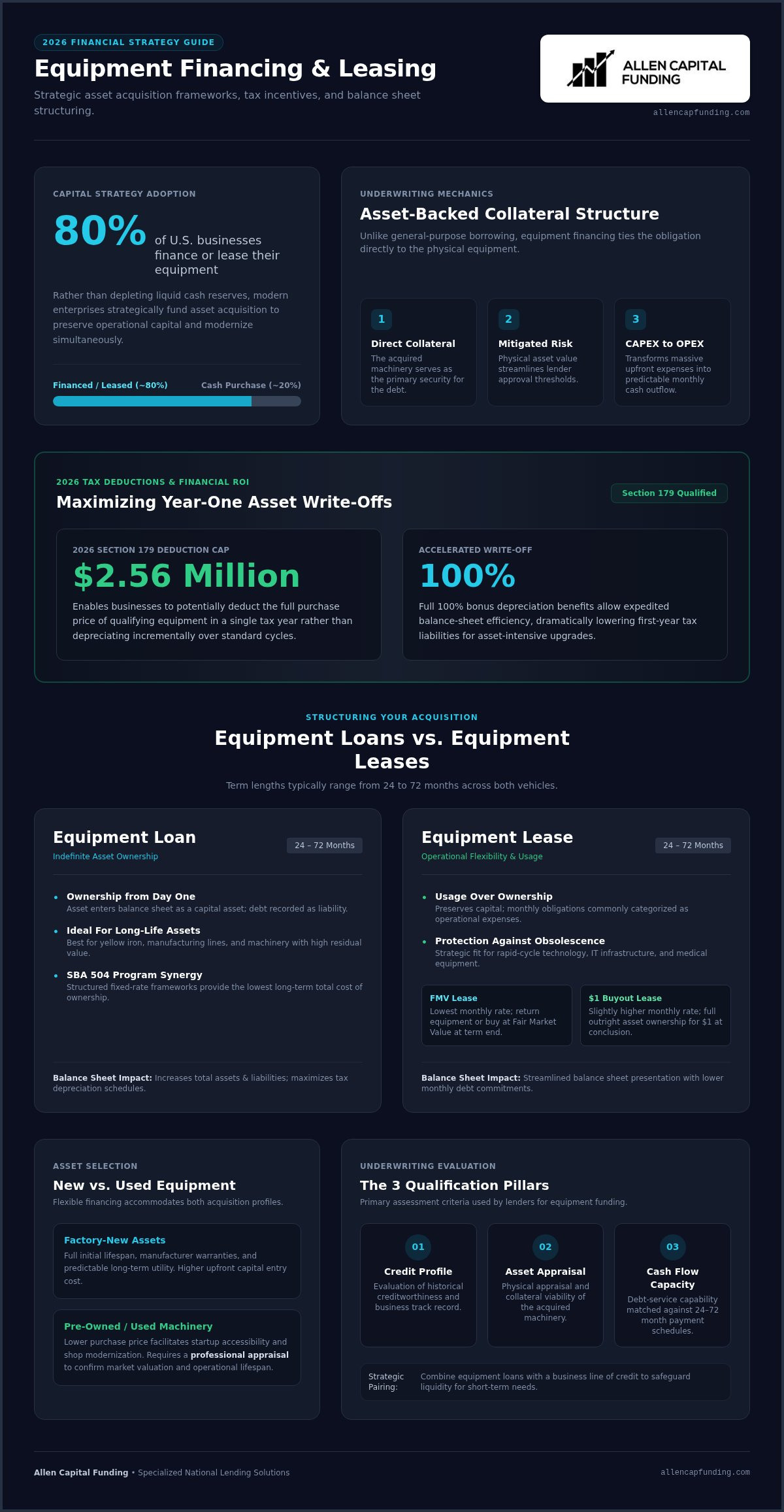
Nearly 80% of U.S. businesses choose to finance or lease their assets rather than buying them with cash. This isn't just a trend; it's a strategic move to keep liquidity high while operations modernize. Even so, it's natural to feel a bit of anxiety over fluctuating interest rates or the strict credit requirements often found at traditional banks. You want to grow, but you don't want to drain your reserves or get trapped in a confusing contract.
We're here to help you master the process of securing a business loan for equipment in 2026. By the end of this guide, you'll know exactly how to acquire essential assets using tailored financing that preserves your cash flow. We'll explore the massive $2.56 million Section 179 deduction limit, explain the benefits of 100% bonus depreciation, and clarify the often-blurry line between leasing and financing. It's time to replace confusion with a predictable roadmap for your company's next stage of success.
Table of Contents
The Strategic Role of Equipment Loans in Business Growth
Scaling a business requires the right tools, but purchasing those tools shouldn't paralyze your bank account. Equipment financing is a strategic funding vehicle that allows businesses to acquire essential tangible assets while preserving vital cash flow for daily operations. Unlike a general-purpose term loan, a business loan for equipment is specifically tied to the asset you're purchasing. This targeted approach ensures that your capital stays liquid while your operational capacity expands.
The machinery or vehicle you acquire serves as the primary collateral for the debt. This structure often simplifies the approval process because the lender's risk is mitigated by the physical value of the equipment. By spreading the cost of an expensive asset over its useful life, you convert a massive capital expenditure (CAPEX) into a predictable monthly payment. This shift allows you to align your expenses with the revenue the new equipment generates, creating a self-sustaining cycle of growth.
Preserving Working Capital for Operations
Using cash to buy large machinery creates significant operational risk. When you tie up hundreds of thousands of dollars in a depreciating asset, you lose the ability to respond to emergencies or sudden market shifts. This creates a high opportunity cost; that same cash could have funded a marketing campaign or a new hire. For a truly balanced financial strategy, many entrepreneurs pair equipment loans with a Business Line of Credit Pillar to ensure they have flexible capital available for short-term needs. Protecting your liquidity is the best way to maintain a steady hand during periods of rapid expansion.
Financing New vs. Used Equipment
You aren't restricted to brand-new machinery when seeking a business loan for equipment. Lenders frequently provide capital for pre-owned assets, which can be a game-changer for startups or businesses looking to lower their entry costs. Used equipment offers a lower purchase price, though it typically requires a professional appraisal to verify its market value and remaining lifespan.
Whether you choose new or used, the legal structure of your agreement matters. Many businesses utilize finance lease agreements to gain the benefits of ownership while enjoying flexible repayment terms. Financing used gear allows you to modernize your shop or fleet without the premium price tag of factory-fresh models. This flexibility ensures that every business, regardless of its current stage, can access the high-quality assets needed to compete in a demanding market.
Comparing Equipment Financing Options: Loans vs. Leases
Choosing between a loan and a lease depends entirely on your long-term goals for the asset. A business loan for equipment is structured for those who intend to own the asset indefinitely. Conversely, a lease is designed for businesses that prioritize using the equipment over owning it. Most of these agreements feature term lengths ranging from 24 to 72 months, allowing you to match the repayment schedule to the expected lifespan of the machinery.
The financial impact on your balance sheet also differs. With a loan, you record the equipment as a capital asset and the debt as a liability. Leasing can sometimes offer a more streamlined balance sheet, as monthly payments are often treated as operating expenses rather than long-term debt. Within the leasing world, you'll encounter two primary paths: Fair Market Value (FMV) leases and $1 buyout options. An FMV lease provides the lowest monthly payments and the choice to return the gear or buy it at its current value at the end of the term. A $1 buyout lease functions more like a loan; you pay a bit more each month but own the asset outright for a single dollar once the term concludes.
When to Choose an Equipment Loan
Loans are the superior choice for assets with high residual value and long operational lives, such as yellow iron or manufacturing lines. Because you own the asset from day one, you can take full advantage of depreciation schedules to lower your tax burden. For those seeking structured, long-term support for major purchases, the SBA 504 loan program provides an excellent framework for fixed-rate financing. This path is ideal for established businesses with steady credit that want the lowest total cost of ownership over several years.
The Flexibility of Equipment Leasing
Leasing is often the strategic winner for technology, IT infrastructure, or medical devices that risk becoming obsolete within a few years. It offers a lower monthly commitment than a traditional business loan for equipment, which keeps more cash available for other growth initiatives. When the term ends, you can simply upgrade to the latest model without the headache of selling old, outdated machinery. If you're unsure which path aligns with your 2026 growth strategy, you can request a financial check-up to weigh the pros and cons of each structure. This tailored approach ensures your financing supports your operations rather than straining them.
Qualifying for an Equipment Loan: Requirements and Checklist
Securing a business loan for equipment depends on three foundational pillars: your credit profile, your time in business, and the asset itself. Because the equipment serves as the primary collateral, its resale value heavily influences the lender's final decision. Assets with long lifespans and high demand, like medical devices or construction machinery, often lead to more favorable terms. You should also prepare for a down payment, which typically ranges from 0% for established companies with top-tier credit to 20% for newer ventures or specialized gear.
Financial Documentation You Will Need
Documentation is the engine that drives a fast approval. You'll need to provide at least three to six months of recent business bank statements to prove consistent cash flow and the ability to cover monthly payments. Most importantly, lenders require a formal quote or invoice from your equipment vendor. This document specifies the asset's make, model, and price, allowing the lender to verify its value. For larger loan amounts, be ready to provide your most recent tax returns and a year-to-date profit and loss statement. Following the IRS guidelines in Publication 946 can help you understand how specific assets are classified, which often dictates the loan terms a lender is willing to offer.
The Role of Personal and Business Credit
Your personal credit score remains a significant factor in determining the interest rate for a business loan for equipment. A higher score typically unlocks lower rates and more flexible terms. However, equipment financing is often more accessible for those with challenged credit compared to unsecured working capital. Since the asset acts as security, lenders are often more willing to work with a dedicated guide to find a solution that fits a less-than-perfect credit history. You can find deeper insights into leveraging your credit for growth in our Strategic Business Equipment Financing Guide.
Your Ready-to-Apply Checklist
Use this checklist to ensure your application moves through the pipeline without unnecessary delays:
Business Identification: Legal business name and Tax ID (EIN).
Cash Flow Proof: 3-6 months of recent business bank statements.
Asset Details: Official vendor quote, invoice, or purchase agreement.
Ownership Info: Personal identification and financial statements for owners with a 20% stake or more.
Financial Performance: Current Profit and Loss statement and Balance Sheet for larger requests.
Maximizing ROI: Section 179 and the Financial Impact
One of the most powerful tools in your financial arsenal for 2026 is the Section 179 tax deduction. This provision acts as a primary incentive for business investment by allowing you to deduct the full purchase price of qualifying equipment in the very year it is placed in service. For the 2026 tax year, the IRS has set the Section 179 deduction limit at $2,560,000. This is a substantial ceiling that enables most small to mid-sized enterprises to write off their entire equipment spend immediately. The phase-out for this benefit only begins once your total equipment purchases exceed $4,090,000, ensuring that the incentive remains accessible for growing firms.
When you secure a business loan for equipment, you don't need to have paid off the loan balance to claim the full deduction. This creates a unique financial advantage where your first-year tax savings might actually exceed the total of your loan payments for that year. It effectively lowers the "real" cost of the capital you've borrowed. Because tax laws are subject to change and specific eligibility depends on your business structure, you should always consult with a tax professional to confirm how these 2026 limits apply to your situation.
Calculating the Net Cost of Equipment
Standard depreciation typically forces you to write off an asset's value slowly over several years. However, by leveraging Section 179 alongside the 100% bonus depreciation available in 2026, you can realize the entire tax benefit upfront. Imagine purchasing a $200,000 piece of machinery; instead of small annual deductions, you reduce your 2026 taxable income by the full $200,000. This produces an immediate cash-flow boost that can be reinvested into other areas of your operations. This "front-loaded" savings approach often offsets a significant portion of the interest costs associated with your business loan for equipment, making high-end assets far more affordable than they appear on paper.
Future-Proofing Your Business Assets
Strategic financing allows you to acquire higher-quality, more efficient equipment that might otherwise be out of reach. Investing in modern technology reduces long-term maintenance costs and increases your total output, leading to a much higher return on investment. Many savvy owners time their purchases for the end of the fiscal year to align with these tax benefits, ensuring they start the new year with modernized capabilities. By choosing the right equipment now, you protect your business against obsolescence and gain a competitive edge in your market. Speak with an expert today to see how a tailored equipment loan can maximize your 2026 tax advantages.
Navigating the Funding Process with Allen Capital Funding
Traditional banks often utilize a rigid underwriting framework that ignores the nuances of your specific industry. If your application doesn't fit their narrow criteria, the process stops. Allen Capital Funding removes these barriers. We operate as a national brokerage, connecting you with a diverse range of lending partners who understand the value of your assets. This national reach allows us to support businesses in every corner of the country, regardless of their local banking environment.
The Broker Advantage: Access to Multiple Lending Partners
The primary benefit of our model is the ability to bypass the limitations of a single-bank application. While a local bank might only offer one set of terms, we source solutions from specialized lenders who focus on equipment-heavy sectors. This specialization leads to more flexible structures and a higher likelihood of securing a business loan for equipment that aligns with your cash flow. We also navigate the complexities of federal programs for you. Exploring the SBA Loan Brokerage Benefits can be particularly helpful for businesses seeking long-term, fixed-rate support for major assets. Our team acts as your advocate, ensuring you aren't just another file in a stack.
Getting Started: Your Online Consultation
We value your time and prioritize a fast-paced, efficient origination process. Our journey begins with a strategic financial check-up conducted through an online consultation. This isn't a high-pressure sales pitch. It's a professional dialogue designed to identify the best funding path for your unique situation. We provide dedicated support from the initial inquiry through to the final funding, maintaining a register of calm efficiency throughout. Our goal is to act as a facilitator that simplifies the path to progress. You'll receive expert guidance on document preparation and lender requirements, reducing the anxiety often associated with strict bank credit standards.
Your business deserves modern tools and a partner that understands your vision for growth. Book your consultation with Allen Capital Funding today to discover how a tailored business loan for equipment can accelerate your success.
Accelerate Your Growth with Strategic Asset Financing
Securing the right tools shouldn't mean compromising your operational liquidity. By utilizing a business loan for equipment, you've learned how to modernize your fleet or facility while keeping your cash reserves intact. We've explored how the $2,560,000 Section 179 limit and 100% bonus depreciation can significantly lower your net costs in 2026. Whether you choose a loan for long-term ownership or a lease for technological flexibility, the goal remains the same: sustainable, efficient growth.
You don't have to navigate these complex financial decisions alone. Allen Capital Funding provides expert financial guidance and tailored capital solutions designed to remove barriers to your progress. With our national funding reach, we connect you to specialized lenders that traditional banks often overlook. It's time to transform your capital expenditures into revenue-generating engines. Secure your business equipment financing with Allen Capital Funding and take the next step toward your future goals with confidence. Your success is within reach, and the right financing is the bridge that gets you there.
Frequently Asked Questions
What is the typical interest rate for a business loan for equipment in 2026?
Interest rates for Tier 1 borrowers currently range from 6.00% to 8.50% APR. Mid-market loans typically fall between 7.00% and 14.00% APR. These rates are influenced by the WSJ Prime rate, which sits at 6.75% as of September 2026. Your specific rate depends on your credit profile and the asset's liquidation value. Working with a brokerage allows you to compare these market rates across multiple specialized lending partners simultaneously.
Can I get equipment financing with a low credit score?
You can often secure a business loan for equipment with a credit score as low as 600. Lenders are frequently more flexible with asset-backed financing because the equipment itself serves as collateral. This reduces the risk compared to unsecured working capital. While a lower score may result in a higher interest rate or a larger down payment, it doesn't automatically disqualify you from getting the machinery your business needs to grow.
How long does it take to get approved for an equipment loan?
Approval times typically range from three days to four weeks depending on the lender type. Streamlined fintech lenders can often provide a decision and funding within 3 to 7 days for smaller requests. Traditional banks and SBA files usually require 1 to 4 weeks for a full review. Preparing your vendor quote and bank statements in advance is the best way to accelerate this timeline and ensure a smooth origination process.
Is a down payment always required for business equipment financing?
A down payment isn't always required; Tier 1 borrowers frequently qualify for 0% down on new assets. Most other agreements require an initial investment between 5% and 20% of the equipment's purchase price. This payment reduces the lender's risk and can lower your monthly commitment. The specific amount depends on your credit history, the type of equipment, and whether you're purchasing new or pre-owned gear for your operations.
What happens to the equipment if my business cannot make the payments?
If a business defaults on its payments, the lender typically repossesses the equipment to recover the outstanding loan balance. Because the asset is the primary collateral, this often limits the impact on your other business assets. However, a default will damage your credit score and may trigger a personal guarantee if one was part of the original agreement. Communicating with your lender early can sometimes lead to restructured payment terms during cash flow challenges.
Can I finance used or refurbished equipment for my business?
You can absolutely finance used or refurbished machinery. Many lenders specialize in the pre-owned market because it lowers the entry cost for startups and expanding firms. You'll likely need a professional appraisal to verify the asset's market value and remaining useful life before the loan is finalized. Financing used gear is a strategic way to modernize your operations while keeping your total debt load manageable and preserving your working capital.
What is the difference between an equipment loan and an SBA 7(a) loan for equipment?
A standard business loan for equipment is a specialized product where the asset serves as the primary collateral. In contrast, an SBA 7(a) loan is a versatile government-backed option that can cover equipment, working capital, or debt refinancing. SBA 7(a) rates for late 2026 range from 9.75% to 14.75%, while standard equipment loans often offer faster funding and simpler paperwork. The right choice depends on your long-term growth strategy and immediate cash needs.


Comments