


Business LOC: The Strategic Guide to Flexible Capital in 2026
Waiting for a traditional bank loan to fund a sudden opportunity is often the fastest way to lose your competitive edge. A business loc isn't just a backup plan for lean months. It's a strategic liquidity tool that gives you the agility to act faster than your competitors. When you have capital ready, you can pivot instantly to capture market share and secure your position.
You likely understand the stress of cash flow volatility or the frustration of missing a bulk inventory discount because your capital is tied up in unpaid invoices. Rigid bank requirements often make it feel like the system is working against your momentum. We're here to bridge that gap. This guide will help you master the mechanics of a business loc so you can secure the flexible capital your company deserves.
You'll learn how to gain on-demand access to cash, pay interest only on what you use, and strengthen your business credit profile. We'll break down the qualification process for 2026 and show you how to position your company for maximum financial flexibility and accelerated success.
Table of Contents
What is a Business LOC and Why is it Essential for Growth?
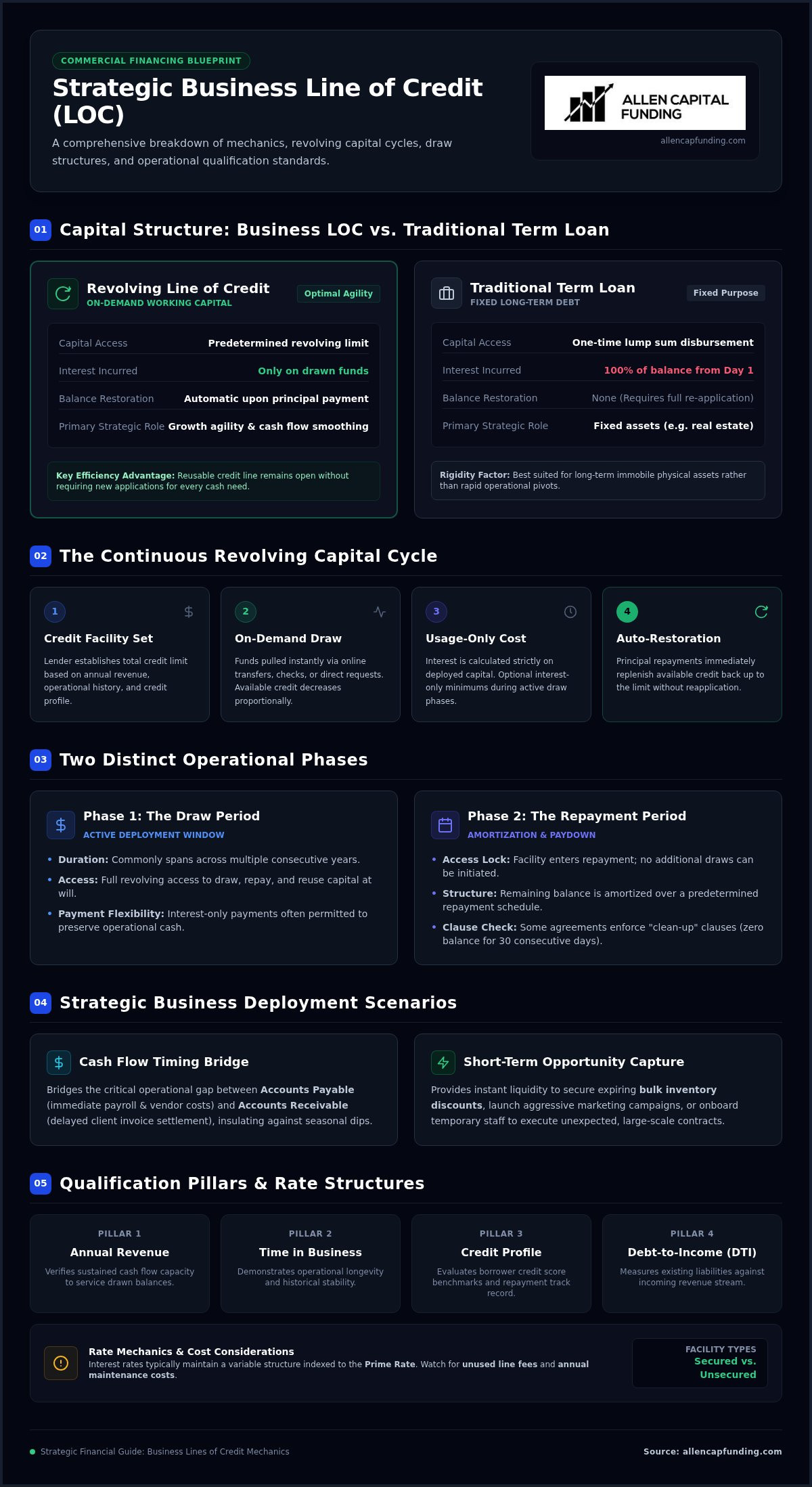
A line of credit is a revolving credit facility that allows a company to draw funds up to a predetermined limit as needed. Unlike a term loan where you receive a lump sum and pay interest on the full amount from day one, a business loc offers a pool of capital you can tap into at your discretion. You only pay interest on the specific portion of the funds you've actually drawn. This structure makes it an incredibly efficient tool for managing liquid assets without incurring unnecessary debt costs.
Many business owners view credit only as an emergency parachute. While it functions well in a crisis, the most successful firms use it as a growth accelerator. A term loan is great for a fixed, long-term asset like a building. However, it's often too rigid for the fast-moving needs of daily operations. A credit line provides the flexibility to pivot. It allows you to fund a project, pay it back, and then use that same credit limit again for the next objective.
The Strategic Safety Net: Managing Cash Flow Volatility
Cash flow timing rarely aligns perfectly. You might need to pay your staff or suppliers weeks before your clients settle their invoices. This gap between accounts payable and accounts receivable can stall your progress. A credit line acts as a bridge, ensuring you can handle seasonal dips or slow-paying clients without disrupting your internal workflow. A business loc serves as a reliable mechanism for maintaining operational continuity during inevitable market fluctuations.
Capitalizing on Short-Term Opportunities
Growth often depends on speed. If a supplier offers a significant discount on a bulk inventory order that expires in a few days, you need capital immediately to capture that margin. You don't have time for a lengthy bank approval process. Using a credit line allows you to fund an aggressive marketing campaign or hire temporary staff for a large, unexpected contract. This agility ensures you don't leave money on the table. It transforms your business into a proactive force that can outmaneuver slower, cash-strapped competitors.
How a Business Credit Line Works: Limits, Draws, and Repayment
A business loc functions through a revolving cycle that mirrors the flexibility of a credit card but with the higher limits required for commercial operations. When you draw funds, your available credit decreases. As you make payments toward the principal, that credit restores automatically. This structure ensures you don't have to reapply every time you need capital. It's a permanent resource that stays ready for your next move.
Most facilities are divided into two distinct phases: the draw period and the repayment period. During the draw period, which often lasts several years, you have full access to your credit limit. Once this period ends, the line may enter a repayment phase where you can no longer pull new funds and must pay back the outstanding balance over a set schedule. In 2026, most interest rates remain variable and are typically indexed to the Prime Rate. Monitoring Federal Reserve credit data can help you stay ahead of these fluctuations and manage your cost of capital effectively. Accessing your funds is usually instantaneous through online transfers, business checks, or direct draw requests to your lender.
Understanding Credit Limits and Draw Terms
Lenders determine your initial credit limit by evaluating three primary factors: your annual revenue, time in business, and credit history. While a high revenue stream is vital, your debt-to-income ratio also plays a significant role in the final offer. It's also important to watch for unused line fees or annual maintenance costs. Some institutions charge these fees to keep the line open even if you aren't currently using it. As your company scales and your revenue increases, you can proactively request limit increases to support larger projects. If you want to ensure your business is positioned for the highest possible limit, scheduling a financial check-up with a strategic ally can help identify areas for improvement before you apply.
Repayment Structures and Minimum Payments
One of the most significant benefits of this funding type is the interest-only payment option. During the draw period, many lenders only require you to pay interest on the funds you've used. This keeps your monthly overhead low and preserves your cash for other operational needs. However, you should also be aware of "clean-up" clauses. Some agreements require you to bring the balance to zero for a consecutive 30-day period once a year. This proves to the lender that the business isn't overly dependent on the debt for basic survival. Regularly cycling through draws and repayments doesn't just provide liquidity; it also builds a robust history of responsible credit use that strengthens your overall business profile.
Comparing Your Options: Unsecured vs. Secured Business Lines of Credit
Every company has a unique financial footprint. Your choice between an unsecured or secured business loc depends largely on your current assets and your long-term goals. While one offers speed, the other offers scale. Understanding these trade-offs ensures you don't overpay for capital or limit your growth potential prematurely. We act as a bridge to help you determine which structure aligns with your specific vision for the coming year.
The Pros and Cons of Unsecured Financing
Speed is the primary driver for unsecured financing. Because there's no collateral to appraise, the approval process is streamlined and efficient. This makes it a perfect fit for service-based firms or tech companies with minimal physical assets. However, lenders compensate for the increased risk by charging higher interest rates and offering lower credit limits. Since there's no collateral to fall back on, your personal credit history becomes the primary anchor for the deal. Strong personal credit is non-negotiable for these options. To learn more about the strategic use of these tools, see our Business Line of Credit: The Strategic Guide to Flexible Capital in 2026.
Leveraging Assets for Larger Credit Lines
When you need access to larger amounts of capital, leveraging your balance sheet is the most effective strategy. Secured lines use assets like accounts receivable or inventory to back the facility. This structure often allows for lower interest rates because the lender's risk is mitigated by tangible value. It's a powerful alternative for businesses that don't meet the "gold standard" FICO scores required for unsecured bank lines. Lenders are often more flexible on credit scores when high-quality assets are involved.
Asset-based lending turns your existing resources into immediate liquidity. For example, factoring accounts receivable can act as a pseudo-line of credit, giving you cash the moment an invoice is generated. You can also use equipment or warehouse stock to secure a lower-cost business loc. This approach is ideal for manufacturers or wholesalers with high inventory turnover who need to maintain a steady flow of working capital. For a more detailed look at these options, explore Asset-Based Lending for Small Business: Unlocking Balance Sheet Liquidity in 2026.
Your decision should reflect your company's risk tolerance and capital requirements. Unsecured lines offer agility without putting specific assets on the line. Secured lines provide the heavy-duty funding necessary for aggressive expansion or large-scale inventory plays. We provide the expert guidance needed to navigate these choices and secure a solution tailored to your company's growth trajectory.
Qualifying for a Business LOC: Requirements and Best Practices
Lenders look for stability and predictability when reviewing an application for a business loc. They focus on three primary pillars: your credit score, your time in business, and your annual revenue. While every institution has its own internal metrics, a FICO score of 680 or higher is generally considered the gold standard for securing the most competitive bank-grade rates. If your score is lower, you aren't necessarily disqualified; however, you may need to look toward asset-based options or alternative lenders who prioritize cash flow over credit history.
Most lenders require at least one to two years of operational history to verify that your business model is sustainable. They also want to see consistent annual revenue, often starting at $100,000 or more, to ensure you have the capacity to handle repayments. To verify these numbers, you'll need to have the following documentation ready:
Your Federal Tax ID (EIN)
The last two years of business and personal tax returns
At least three to six months of recent business bank statements
A current profit and loss statement
Most agreements also include a personal guarantee. This is a legal promise that you'll personally repay the debt if the business cannot. This reduces the lender's risk and often leads to more favorable terms for the borrower.
Preparing Your Financial Profile for Approval
Success starts long before you submit the paperwork. Take the time to clean up both your personal and business credit reports by disputing any inaccuracies. Lenders look for consistent positive cash flow, so ensure your bank statements don't show frequent overdrafts or erratic spending patterns. If your profile has some weak spots, working with a capital specialist can help. They know how to package your application to highlight your strengths, making it easier for underwriters to approve the request.
The Application Process in 2026
The application landscape in 2026 is faster than ever. Digital platforms have largely replaced the slow, paper-heavy processes of the past. Many lenders now use secure API connections to link directly to your business bank accounts. This allows them to analyze your real-time financial health and provide a decision in hours rather than weeks.
While speed is a benefit, applying to multiple lenders on your own can lead to a fragmented financial strategy. This is where the broker advantage becomes essential. By working with an expert firm, you gain access to a diverse network of funding products that extend far beyond traditional banks. We act as your strategic consultant to simplify the path to capital. If you're ready to secure a business loc tailored to your growth goals, apply for a credit line today to start your expert consultation.
Securing the Right Capital: The Allen Capital Funding Advantage
Traditional banks often operate with a rigid, one-size-fits-all mentality that doesn't account for the nuances of your specific industry. We take a different approach. Allen Capital Funding acts as a strategic consultant rather than a simple lender. We focus on understanding your long-term vision before suggesting a specific capital product. This ensures that the business loc you secure isn't just a temporary fix but a sustainable tool for accelerated success.
Our national network of diversified capital partners allows us to look beyond the limited criteria of institutional banks. We bridge the gap between your current financial state and your future goals by providing access to specialized funding that prioritizes your company's potential. Every partnership begins with a comprehensive Financial Check-Up. This diagnostic tool helps us evaluate your cash flow and credit profile to determine the exact mix of capital that will fuel your growth without overextending your resources.
Tailored Solutions for Every Business Stage
Whether you're a startup looking for equipment financing or a mature firm ready for commercial real estate acquisition, we provide expert guidance for every stage of the business lifecycle. For companies seeking government-backed stability, our SBA Loan Brokers: Strategic 2026 Funding Guide offers a deep dive into long-term capital options. We customize your draw and repayment terms to match the specific cycles of your industry. This tailored approach prevents the cash flow bottlenecks often caused by the generic repayment schedules found at traditional retail banks.
How to Get Started with a Strategic Consultation
Securing your financial future starts with a single, intentional step. Booking an online consultation with our funding experts is a simple process designed to respect your time. To make your first strategy session as efficient as possible, please have your recent bank statements and basic financial reports ready for review. This allows us to move quickly from analysis to action.
We pride ourselves on being a proactive ally that removes barriers to progress. You don't have to manage the complexities of capital acquisition alone. Our team is dedicated to simplifying the path to capital and ensuring you have the flexible resources needed to outpace your competition. Take the first step toward financial flexibility and secure the business loc your company deserves today.
Empowering Your Growth with Strategic Capital
Mastering the mechanics of a business loc transforms capital from a source of stress into a strategic advantage. You now understand how revolving credit and interest-only payments provide the liquidity needed to capture short-term opportunities while managing cash flow volatility. By preparing your financial profile and choosing between secured and unsecured options, you position your company for long-term stability and accelerated success.
Don't let rigid bank requirements or slow approval times stall your momentum. We act as your proactive, solution-focused ally, offering access to a wide range of national capital partners and expert guidance tailored to your specific business goals. Our team is ready to help you navigate the complexities of modern finance with clarity and confidence. Book your strategic funding consultation with Allen Capital Funding today. We're committed to helping you reach your future goals with the right capital mix and the professional support you deserve.
Frequently Asked Questions
What is the difference between a business LOC and a business loan?
A traditional loan provides a one-time lump sum with interest accruing on the entire balance immediately. In contrast, a business loc is a revolving credit facility. You draw only what you need and pay interest solely on that portion. Once you repay the principal, the credit becomes available again. It's designed for ongoing operational needs; loans are generally better for fixed, long-term investments like heavy machinery.
How much credit can my business qualify for in 2026?
Qualification limits in 2026 typically reflect a percentage of your annual gross revenue. Most lenders offer lines between 10% and 20% of your yearly sales. Your cash flow consistency and existing debt levels also play a role in the final offer. While entry-level lines might start at $10,000, established firms with high revenue can secure much larger facilities. We help you analyze your financials to target the most appropriate limit.
Can I get a business line of credit with a lower credit score?
You can certainly qualify with a lower score by leveraging other strengths. While a 680 FICO is the standard for bank-grade lines, alternative lenders prioritize your business's revenue and cash flow. You might consider a secured line backed by assets like accounts receivable or equipment. This provides the capital you need today while helping you build a stronger credit history for more competitive options in the future.
What are the typical fees associated with a business credit line?
You should expect fees such as origination charges, annual maintenance costs, and draw fees. Some agreements also include an unused line fee if the facility remains inactive for several months. It's vital to check for document preparation fees or late payment penalties in the fine print. We focus on providing clear, expert guidance so you can compare the total cost of capital across different national lending partners without any surprises.
How quickly can I access funds from my business LOC?
Modern digital applications allow you to access funds almost immediately. After the initial approval and setup of your business loc, you can request a draw through a secure online portal. Funds are typically transferred to your business bank account within one to two business days. This rapid turnaround ensures you have the agility to seize time-sensitive opportunities or handle unexpected expenses without the long wait times of traditional financing.
Is a personal guarantee always required for a business line of credit?
Most small to mid-sized businesses will need to provide a personal guarantee. This is a standard requirement that ensures the lender has a secondary path to repayment, which often results in more flexible terms. While corporate-only lines exist, they're usually reserved for very large firms with extensive financial histories. We help you understand these obligations and work to secure the most favorable terms while protecting your company's strategic interests.
How does a revolving line of credit help build business credit?
A revolving line of credit is an excellent tool for establishing a strong financial reputation. When you make regular draws and on-time payments, lenders report this activity to major business credit bureaus. Maintaining a low credit utilization ratio further improves your score. This proactive management shows future creditors that you're a reliable borrower, eventually opening doors to larger funding products like SBA loans or commercial real estate financing.
What happens if I don't use the funds in my credit line?
If your line remains untouched, you won't incur any interest charges. This makes it a cost-effective safety net for your company. You might still pay a small annual fee to keep the facility open, but the primary cost only triggers when you actually use the money. Having this capital on standby ensures you're never forced to pass on a bulk discount or a strategic hire because of a temporary cash shortage.


Comments