


Commercial Equipment Loan Guide: Strategic Asset Financing in 2026
What if the most expensive way to grow your business is actually using your own cash? While it feels safer to buy machinery or technology outright, depleting your reserves often leaves you vulnerable to market shifts or unexpected repairs. You likely worry about predatory interest rates and the risk of your new gear becoming obsolete before you've even finished paying for it. We understand that modern lending requirements feel increasingly complex and intimidating.
Securing a commercial equipment loan shouldn't feel like a gamble with your company's future. By mastering these strategic financial solutions, you can acquire essential business assets while preserving your vital working capital. Our goal is to help you maintain liquidity and modernize your operations through predictable monthly payments that fit your budget. This guide provides a clear path through the 2026 financing landscape. We will explore how to meet current lending standards, avoid common pitfalls, and use asset financing as a bridge to reach your growth goals with confidence.
Table of Contents
What is a Commercial Equipment Loan and Why Does it Matter?
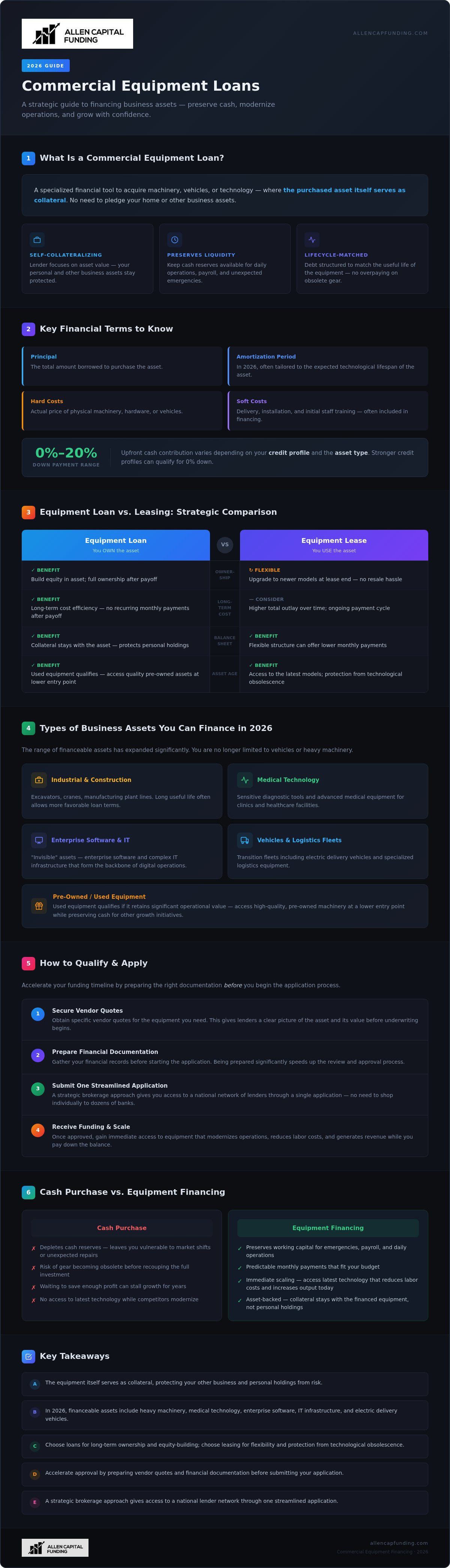
A commercial equipment loan is a specialized financial tool designed to help you acquire the machinery, vehicles, or technology your business requires to function. Unlike a general business loan, this is a form of asset-backed financing where the purchase itself serves as the collateral. This self-collateralizing nature is a significant advantage. It means the lender focuses on the value of the equipment rather than requiring you to pledge your personal home or other business assets to secure the funding.
Choosing a commercial equipment loan over a cash purchase is often a strategic decision to protect your liquidity. By financing the asset, you keep your cash reserves available for unexpected emergencies or daily operating expenses. While a general line of credit provides flexibility for short-term needs like payroll or inventory, a dedicated equipment loan is structured specifically for the lifecycle of a long-term asset. This ensures your debt matches the useful life of the equipment, preventing you from over-extending your revolving credit limits on fixed assets.
The Role of Equipment Financing in Business Growth
Waiting to save enough profit for a major purchase can stall your progress for years. Financing allows for immediate scaling, giving you access to the latest technology that reduces labor costs and increases output today. Modern equipment often pays for itself through these efficiency gains, allowing you to generate revenue while you pay down the balance. Asset-backed financing serves as a vital tool for accelerated success by bridging the gap between your current capacity and your future potential. Using equipment financing ensures you aren't left behind by competitors who are already utilizing more advanced tools to streamline their operations.
Key Financial Terms You Need to Know
Understanding the mechanics of your agreement is essential for long-term planning. The principal is the total amount you borrow, while the interest rate and amortization period determine your monthly commitment. In 2026, amortization periods are often tailored to the expected technological lifespan of the asset to prevent you from owing money on obsolete gear. Many lenders offer flexible structures that account for both hard costs and soft costs.
Hard Costs: The actual price of the physical machinery, hardware, or vehicles.
Soft Costs: Additional expenses like delivery, installation, and initial staff training.
Down Payment: The upfront cash contribution, typically ranging from 0% to 20% depending on your credit profile and the asset type.
These strategic financial solutions allow you to manage your balance sheet effectively while securing the tools necessary for your industry. By partnering with experts who understand these nuances, you can focus on running your business while we handle the complexities of the funding structure.
Types of Business Assets You Can Finance in 2026
The variety of assets eligible for financing has expanded significantly as industries evolve. Modern business owners are no longer limited to just vehicles or heavy machinery. Today, a commercial equipment loan can cover everything from tangible "yellow iron" in the construction sector to sensitive diagnostic tools in a medical facility. We see a growing trend in financing "invisible" assets as well. This includes enterprise software and complex IT infrastructure that serve as the backbone of digital operations. Even specialized logistics needs, such as transition fleets of electric delivery vehicles, fall under these strategic financial solutions.
Flexibility is a hallmark of current lending standards. You aren't restricted to brand-new models; used equipment often qualifies for financing if it retains significant operational value. This allows you to acquire high-quality, pre-owned machinery at a lower entry point while still preserving your cash for other growth initiatives. By working with a strategic partner, you can identify which assets will provide the best return on investment for your specific industry.
Industrial and Construction Machinery
Acquiring heavy-duty assets like excavators, cranes, or manufacturing plant lines requires a deep understanding of asset durability. These machines are built to last, which often allows for more favorable loan terms that reflect their long useful lives. Utilizing commercial equipment loans for fleet expansion ensures your team has the power required for large-scale contracts without the burden of a massive upfront capital expenditure. Whether you're upgrading a single unit or an entire production line, the right financing structure keeps your projects moving forward.
Technology and Office Infrastructure
Technology assets require a different strategic approach due to rapid obsolescence. Financing for server stacks, specialized workstations, and proprietary software systems is often structured with shorter cycles to ensure you can upgrade before the equipment becomes a liability. We've seen a shift where some businesses explore "as-a-service" models, yet traditional ownership through a commercial equipment loan remains a powerful way to build equity in your core infrastructure. For those who qualify, SBA loan programs for business equipment can also provide a reliable path to securing high-tech tools with competitive structures.
Every industry has unique requirements, and the assets you choose will define your operational capacity for years to come. If you're ready to explore how these tools can accelerate your success, our team can provide a financial check-up to align your equipment needs with your long-term growth strategy.
Equipment Loan vs. Leasing: A Strategic Comparison
Deciding between a commercial equipment loan and a lease is a foundational strategic choice for your business. Many owners believe waiting to pay cash is the safest route, but this often leads to missed opportunities and stagnant growth. Financing allows you to acquire assets immediately, letting the equipment generate the revenue needed to pay for itself. This approach preserves your cash for other critical areas like marketing or payroll.
Ownership through a loan provides long-term stability and builds equity in the machine or vehicle. Once the term ends, you own the asset outright, which can be a significant advantage for items that retain their value. Leasing offers flexibility and lower upfront costs, but it can lead to higher long-term expenses if you continuously cycle through agreements without ever gaining ownership. Understanding these trade-offs is a key part of our strategic business equipment financing guide.
From a balance sheet perspective, a loan appears as both an asset and a liability. While it increases your debt-to-equity ratio, it also demonstrates tangible asset growth. Leasing often treats the obligation as an operating expense, which can be beneficial for certain financial reporting requirements or for businesses that need to keep debt off their books. Choosing the right path depends on your specific goals for liquidity and expansion.
When to Choose a Commercial Equipment Loan
A loan is typically the superior choice for assets with a long operational life, such as heavy industrial machinery or construction equipment expected to last 10 years or more. It's the ideal path for businesses that want to build tangible value within their company infrastructure. Over time, ownership is more cost-effective than multiple lease cycles because you avoid the trap of permanent monthly payments. For those exploring federal options, U.S. Small Business Administration loan programs offer structured paths to ownership for qualified applicants who meet specific criteria.
Tax Implications and Section 179 Benefits
The tax advantages of a commercial equipment loan are a major driver for strategic financing. Under current tax codes like Section 179, many businesses can deduct the full purchase price of qualifying equipment in the first year rather than depreciating it over a long period. This creates an immediate tax shield that can significantly offset the initial cost of the loan. It's a powerful way to accelerate your success by reinvesting tax savings back into your operations.
You should also distinguish between interest expense deductions and standard depreciation schedules. While interest is generally fully deductible, depreciation allows you to recover the cost of the asset over its useful life. We recommend scheduling a financial check-up with a tax professional to ensure you're maximizing these benefits for your specific situation. This consultative approach ensures your financing strategy aligns perfectly with your broader fiscal goals.
How to Qualify and Apply for Equipment Funding
Applying for a commercial equipment loan requires a methodical approach to ensure your business presents the strongest possible profile. While traditional banks often move slowly, modern strategic financial solutions prioritize efficiency and clarity. Following a structured preparation phase will significantly increase your chances of a rapid approval and competitive terms.
Success begins with four essential steps. First, obtain an exact quote or invoice from your equipment vendor. Lenders need to know the precise value and specifications of the asset. Second, prepare your financial statements, including your Profit and Loss (P&L) statements, Balance Sheets, and the last two years of business tax returns. Third, review both your personal and business credit profiles for any inaccuracies that could hinder your progress. Finally, consult with a brokerage partner. This allows you to match your unique financial profile to the right lender from a national network rather than being limited to a single bank's rigid criteria.
What Lenders Look for in 2026
Lending standards in 2026 focus on three primary pillars: Credit, Cash Flow, and Collateral. Your credit score demonstrates reliability, while your cash flow proves you can sustain the monthly payments without straining your working capital. The equipment itself serves as the collateral, which often makes these loans more accessible than unsecured debt. Startups can still find funding paths by providing a clear "use of funds" statement. This document should explain exactly how the new equipment will generate revenue or reduce costs. Demonstrating a direct link between the asset and your company's growth helps build the lender's confidence in your success.
Streamlining the Application Process
The speed of modern fintech has transformed how you secure capital. Digital document gathering allows for rapid scanning and submission, often leading to approvals in a fraction of the time required by legacy institutions. However, common mistakes can still cause delays. Ensure your financial data is consistent across all documents and that no pages are missing from your tax returns. A proactive ally acts as a facilitator who removes barriers and simplifies the path to progress. By handling the complexities of the application, we allow you to remain focused on your daily operations.
If you are ready to modernize your business, you can start your equipment financing application today to see which strategic options best fit your growth goals.
Why Partner with Allen Capital Funding for Equipment Needs?
Choosing the right partner for your commercial equipment loan is as critical as selecting the equipment itself. Most retail banks operate with rigid, outdated criteria that prioritize automated credit scoring over actual business potential. Allen Capital Funding takes a different path. We act as a strategic brokerage partner, providing you with a single point of entry to an expansive national network of specialized lenders. This model means you only need to complete one application to unlock multiple financing options. We handle the heavy lifting of lender matching so you can stay focused on your daily operations.
Our team brings a level of expertise to the table that generic financial institutions simply cannot match. We understand that a medical practice has vastly different capital requirements than a heavy construction firm. By positioning ourselves as a dedicated guide, we offer expert guidance through complex funding products. We don't just see a transaction; we see a partnership. This approach allows us to look beyond a simple credit score to find solutions that align with your long-term strategy and cash flow needs.
A Tailored Approach to Capital
We believe every commercial equipment loan should be as unique as the business it supports. This involves customizing loan terms to match the specific revenue-generating life of your new assets. Whether you're interested in the structured support of SBA loans or the flexibility of asset-based lending, we provide the tools to unlock balance sheet liquidity. Our accelerated success model focuses on the removal of barriers. We simplify the path to progress by acting as a bridge between your current needs and your future expansion goals. Our national focus ensures we can find the right fit for your industry, regardless of your location.
Ready to Modernize Your Operations?
The business landscape in 2026 is moving faster than ever. Delaying an equipment upgrade often means falling behind competitors who are already utilizing more efficient technology. You need a proactive ally who understands the urgency of your situation and can deliver results with speed. We invite you to explore our strategic financial solutions today to see how we can facilitate your next phase of growth.
Starting your funding journey is a straightforward process. You can begin by booking a consultation with our expert team. We will conduct a thorough financial check-up to understand your objectives and identify the best path forward. Let us handle the complexity of the lending market while you focus on building your legacy. Contact Allen Capital Funding today to secure the assets your business deserves.
Secure Your Competitive Edge with Strategic Financing
The business landscape in 2026 demands a shift from simple debt management to strategic asset leverage. Choosing a commercial equipment loan allows you to acquire the latest technology while keeping your working capital intact for daily operational needs. By utilizing the tax benefits of ownership and the efficiency of asset-backed collateral, you position your company for long-term stability and rapid growth.
You don't have to manage these financial complexities alone. Our team provides expert guidance on SBA and commercial loans through a strategic brokerage network designed to secure competitive terms. We focus on your accelerated business success by matching your unique profile to the right funding partners. Book a consultation with Allen Capital Funding to explore your tailored equipment financing options.
Your next phase of innovation is within reach. We are ready to help you bridge the gap between your current capacity and your future goals with confidence and clarity.
Frequently Asked Questions
What is the typical down payment for a commercial equipment loan?
Most lenders require a down payment ranging from 0% to 20% of the total purchase price. Your specific requirement depends on your credit profile, time in business, and the type of asset you are financing. Stronger credit often leads to lower upfront costs. This allows you to preserve more of your working capital for daily operations while still acquiring the high-value tools your business needs to grow.
Can I finance used equipment for my business?
You can certainly finance used equipment provided the asset retains significant operational value and a verifiable remaining lifespan. Lenders often look at the age and condition of the machinery to determine the loan term. Financing pre-owned assets is a smart way to reduce your total debt while still gaining the capacity of specialized tools. It's a common strategy for industries like construction where heavy machinery maintains value for decades.
How long does it take to get approved for equipment financing?
Approval times have accelerated significantly due to modern digital document processing. You can often receive an initial decision within 24 to 48 hours after submitting a complete application. While traditional banks might take weeks, a strategic brokerage partner streamlines this process by connecting you with responsive lenders. Having your vendor invoice and financial statements ready beforehand ensures the fastest possible path to funding your new equipment.
Does equipment financing require personal collateral?
In most cases, a commercial equipment loan does not require you to pledge personal assets like your home because the equipment itself serves as the collateral. This self-collateralizing structure protects your other holdings and simplifies the lending process. However, some lenders may still require a personal guarantee. This is a standard industry practice to ensure the business owner remains committed to the repayment schedule throughout the loan term.
What happens to the loan if the equipment breaks or becomes obsolete?
You remain responsible for the loan payments even if the equipment breaks or becomes technologically obsolete. This is why we recommend aligning your loan term with the expected useful life of the asset. Regular maintenance is essential to protect your investment and ensure the machinery continues to generate revenue. For high-tech assets that age quickly, shorter financing cycles or leasing options might be a more strategic choice to avoid debt on outdated gear.
Is it better to lease or buy equipment in 2026?
The choice between leasing and buying depends on your long-term operational goals and cash flow needs. Buying through a loan is often better for assets you plan to keep for many years because it builds equity and offers tax benefits. Leasing provides more flexibility for equipment you might need to upgrade frequently. We help you evaluate these strategic financial solutions to determine which path provides the greatest advantage for your balance sheet.
Can a new business or startup qualify for an equipment loan?
How does Section 179 work with financed equipment?
Section 179 allows you to deduct the full purchase price of qualifying equipment from your gross income in the year you put it into service. This applies even if you financed the purchase with a commercial equipment loan and haven't paid off the balance yet. It creates a powerful tax shield that can significantly lower the true cost of your acquisition. You should consult a tax professional to confirm current deduction limits and eligibility.


Comments