


2026 Equipment Financing Rates: Business Growth Guide
Businesses are currently financing more than 75% of their equipment and software purchases, yet many owners still struggle to decipher the actual math behind their quotes. You've likely felt the frustration of opaque pricing or the nagging fear that you're overpaying on interest while trying to modernize your fleet. It's common to feel caught between the need for new machinery and the confusion of varying equipment financing rates that seem to shift without warning. We know that your primary goal is to build a sustainable path for expansion without draining your vital cash reserves.
Unlocking the most competitive equipment financing rates in 2026 requires a move from a passive borrower to a strategic partner. By understanding the 2026 lending environment and optimizing your financial profile, you can command terms that actually support your bottom line. This guide provides a clear look at interest trends, explains the nuances between leasing and financing costs, and outlines how to modernize your operations effectively. You'll learn how to achieve predictable monthly payments and preserve your working capital; this ensures your business stays agile and ready for the next stage of growth.
Table of Contents
Understanding Equipment Financing Rates in the 2026 Economy
Equipment financing rates represent the specific cost of capital used to acquire tangible business assets. Unlike general working capital loans, these rates are tied directly to the collateral being purchased. In 2026, the lending landscape has shifted toward a heavy emphasis on asset-backed security. Lenders want to see that the equipment holds its value over time, as this reduces their exposure if a default occurs. Because the machinery itself serves as the primary guarantee, businesses can often secure more favorable terms than they would with unsecured debt.
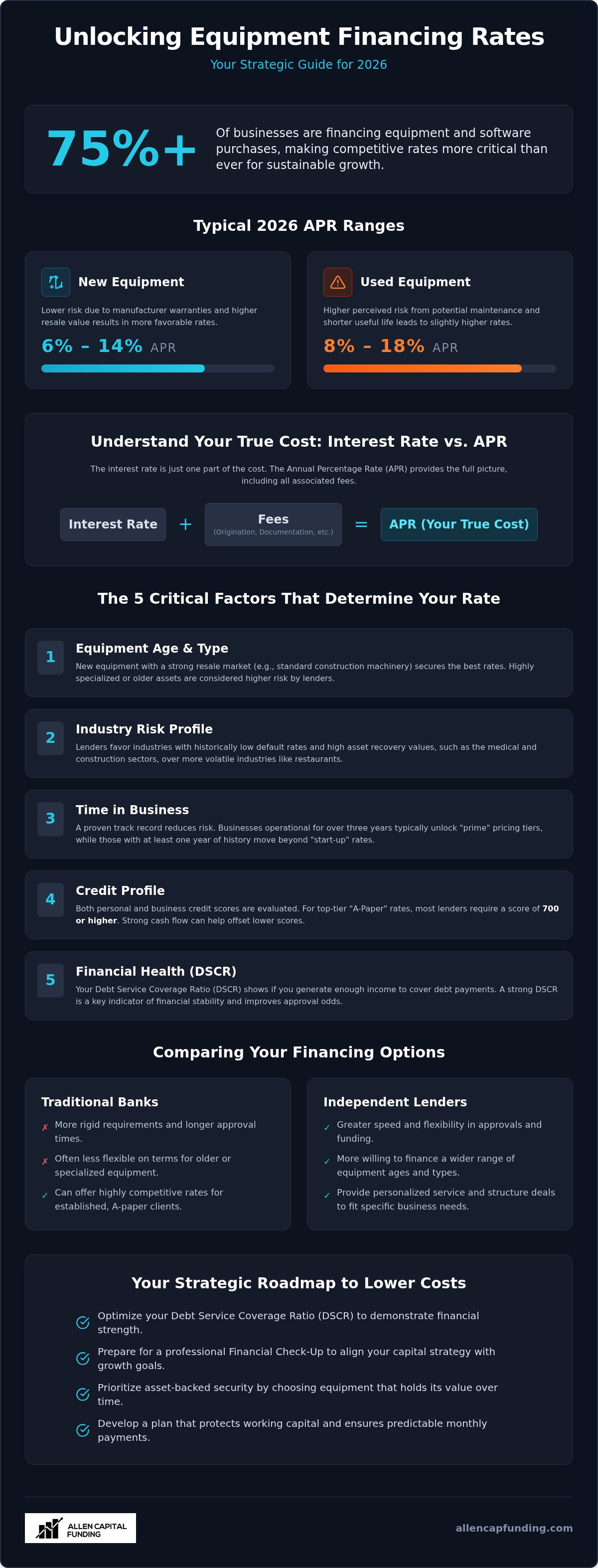
Current market data from September 2026 shows that "prime" equipment financing rates for new machinery typically range from 6% to 14% APR. If you are looking at used equipment, expect those rates to sit between 8% and 18% APR due to the higher perceived risk of maintenance issues and lower resale liquidity. You must also decide between fixed and variable rates. Fixed rates offer the security of a predictable monthly payment, which is vital for long-term budgeting. Variable rates may start lower but carry the risk of increasing if the Federal Reserve adjusts its benchmark targets later in the year.
The Difference Between Interest Rate and APR
A common mistake is focusing solely on the nominal interest rate. This figure is often misleading because it ignores the secondary costs of borrowing. The Annual Percentage Rate (APR) provides a more accurate picture by including origination fees, documentation charges, and mandatory insurance costs. When understanding finance leases, you will see how the transfer of ownership risks and these additional fees influence the total cost of the contract. Always use the APR to compare offers from different lenders; it's the only way to ensure you aren't paying hidden premiums that erode your ROI.
Why 2026 Rates Differ from Previous Years
Several factors make the 2026 environment unique. Federal Reserve policies continue to dictate the baseline cost of commercial lending, but technological shifts are playing a larger role than ever before. Rapid advancements in AI and automation mean that certain types of high-performance hardware become obsolete faster. Lenders account for this "tech-burn" by adjusting rates based on the equipment's expected useful life. Additionally, the liquidity of the asset is a major factor. Standard construction or medical equipment is easy to liquidate and often commands lower rates, while highly specialized, custom-built machinery may trigger a risk premium due to its limited resale market.
The 5 Critical Factors That Determine Your Specific Rate
Commercial underwriters don't assign interest rates at random. They utilize a sophisticated risk-reward matrix to evaluate how likely your business is to fulfill its debt obligations. While the broader economy sets the baseline, your specific equipment financing rates are tailored to your company's unique profile. Understanding these variables allows you to position your business as a lower risk, which directly translates into lower capital costs.
The age of the equipment is a primary driver in this calculation. New machinery typically qualifies for the most competitive terms because it carries a manufacturer's warranty and possesses a predictable resale value. Used equipment often triggers higher rates. Lenders view older assets as higher risk due to potential mechanical failure and a shorter remaining useful life. Additionally, your industry plays a significant role. Lenders often favor medical or construction sectors over the restaurant industry because the former groups historically show lower default rates and higher asset recovery values.
Time in business remains a non-negotiable metric for most 2026 lenders. Most institutions require at least one year of operational history to move beyond "start-up" pricing tiers. If you've been in business for over three years, you'll likely unlock a new level of "prime" pricing. To see exactly where your business stands in this matrix, you can request a financial check-up to identify areas for improvement before you apply.
Credit Score Impact: Beyond the Number
Your credit profile is more than just a FICO score. In 2026, underwriters weigh personal credit and business credit scores differently depending on the deal size. For "A-Paper" rates, most lenders look for a score of 700 or higher. If your score falls into the "B" or "C" categories, you can still secure funding by providing additional financial transparency. This might include showing strong cash flow or consistent monthly revenue of at least $15,000. Some owners also find success by utilizing the SBA 7(a) loan program, which offers government-backed guarantees that can make lenders more comfortable with slightly lower credit scores.
The Asset as Collateral
The Loan-to-Value (LTV) ratio determines how much skin you have in the game. A higher down payment reduces the lender's risk and can drastically lower your interest rate. You should also consider "soft costs" like installation, shipping, and training. Many business owners forget that these costs can represent 10% to 20% of the total project. If a lender has to finance these non-tangible items, they may increase the rate to compensate for the lack of collateral value. Generic assets like delivery trucks usually carry lower rates than highly specialized CNC machinery because they are much easier for a lender to liquidate if necessary.
Comparing Financing Options: Banks vs. Independent Lenders vs. Brokers
Traditional commercial banks often provide the lowest baseline interest rates, yet their rigid underwriting standards exclude many growing firms. They typically require near-perfect credit, several years of tax returns, and a high volume of existing collateral. Independent equipment finance companies offer a middle ground. They provide faster approvals and more flexibility regarding equipment age or industry type, though their rates are generally higher to compensate for the increased risk. By contrast, a brokerage model creates a competitive auction for your loan. Instead of settling for a single offer, you force multiple lenders to compete for your business. This competition often results in more favorable equipment financing rates than you could negotiate on your own.
The total cost of capital varies significantly across these channels. While a bank might offer a lower nominal rate, the time it takes to close can result in lost revenue from delayed equipment deployment. Independent lenders and brokers prioritize speed, allowing you to modernize your fleet in days rather than months. When evaluating these options, consider the "opportunity cost" of waiting versus the immediate ROI generated by the new machinery.
The Strategic Advantage of Equipment Loan Brokers
Brokers act as your dedicated guide by accessing "wholesale" rates that aren't advertised to the general public. A single application can reach 50 or more lending partners simultaneously, saving you dozens of hours of administrative work. This efficiency is particularly valuable for complex acquisitions involving multiple assets or specialized machinery. Rather than managing several different bank relationships, a facilitator streamlines the process. This ensures your capital strategy remains cohesive and your debt structure doesn't become overly fragmented.
Leasing vs. Financing: Which Rate Matters More?
Choosing between a lease and a loan involves more than just comparing a monthly payment. In a Fair Market Value (FMV) lease, the implicit interest rate might be lower, but you don't own the asset at the end of the term. Conversely, full financing allows you to leverage the Section 179 tax deduction. For the 2026 tax year, the maximum deduction is $2,560,000, which can significantly offset the total cost of capital. You should also explore SBA equipment financing programs if you need longer terms or government-backed security. For a deeper dive into these structures, see our comprehensive guide on Strategic Business Equipment Financing. Balancing the tax benefits against the interest expense is the key to maximizing your business's cash flow.
Actionable Steps to Lower Your Equipment Financing Costs
Securing the best equipment financing rates isn't just about shopping around; it's about presenting a financial profile that minimizes lender risk. Start by organizing your financial statements to be "lender-ready." Most institutions require the last two years of tax returns and a current year-to-date profit and loss statement. Ensure these documents are clean, accurate, and professional. This level of preparation builds immediate trust and demonstrates that your business is well-managed.
Focus on your Debt Service Coverage Ratio (DSCR). This metric measures your ability to cover your debt payments with your current net operating income. Lenders typically look for a DSCR of 1.25 or higher to qualify you for premium pricing. You can improve this ratio by paying down small, high-interest liabilities or by increasing your net income before you submit an application. A stronger ratio gives you the leverage to demand more competitive terms.
Strategic timing and bundling can also drive down your costs. While many owners wait until the fiscal year-end to take advantage of tax incentives, lenders often have different internal quotas. Applying during a lender's slower quarter might result in more aggressive offers. Additionally, try to bundle your equipment needs into a single transaction. Financing multiple pieces of machinery at once often moves you into a higher "tier" of funding, which can significantly lower your overall rate compared to multiple smaller loans.
Cleaning Up Your Balance Sheet
Reducing short-term, high-interest debt is one of the fastest ways to lower your long-term equipment financing rates. Lenders scrutinize your "debt-to-income" ratio to ensure you aren't over-leveraged. If your balance sheet is cluttered with high-interest credit card debt or merchant cash advances, it signals potential cash flow instability. For a detailed look at how to leverage your existing assets to improve your liquidity and standing with lenders, read our guide on Asset-Based Lending for Small Business.
Negotiating the Terms Beyond the Interest Rate
Look beyond the nominal interest rate to find the real value in a contract. A slightly higher rate with a "no prepayment penalty" clause might actually be cheaper if you plan to pay the loan off early. You should also request seasonal payment structures if your business revenue fluctuates throughout the year. This ensures your payments align with your actual cash flow. Finally, verify the "soft cost" cap. Some lenders limit installation, training, and freight to 10% of the total loan. Negotiating this cap higher can prevent you from having to pay these expenses out-of-pocket.
Ready to optimize your capital strategy? Apply for equipment financing today to see your custom rate options and start your modernization project.
Securing Your 2026 Growth with Allen Capital Funding
Allen Capital Funding acts as a steady hand for business owners facing the complexities of modern commercial finance. As a national facilitator, we bridge the gap between your immediate operational needs and a vast network of specialized lending partners across the United States. Our primary tool for this is the Financial Check-Up. This comprehensive evaluation goes beyond a simple credit pull. It analyzes your revenue streams, asset value, and growth potential to ensure you qualify for the most competitive equipment financing rates available in the current market. We don't just find you a loan; we build a capital strategy that supports your bottom line.
We understand that in 2026, waiting weeks for a traditional bank approval isn't an option for an agile business. Our origination process is designed for speed, often providing decisions in a fraction of the time required by institutional lenders. This efficiency doesn't come at the expense of strategy. We act as your dedicated guide, ensuring that every piece of machinery you finance contributes directly to your long-term expansion goals. Our partnership-driven approach means we stay invested in your success well after the initial funding is secured. We remove the barriers to progress, allowing you to focus on running your business while we handle the financial architecture.
Our National Network of Equipment Lenders
Our network is built to handle the nuances of diverse sectors, from high-tech medical labs to heavy construction. We match your specific industry risk to the right funding partner, ensuring that specialized assets don't trigger unnecessary premiums. This "accelerated success" philosophy is about more than just securing a loan; it's about optimizing your capital structure for future flexibility. While we specialize in equipment, our expertise extends to larger expansion projects through our SBA loan brokerage guide. This national reach allows us to leverage diverse funding pools to find the best possible equipment financing rates regardless of your specific industry or location.
Start Your Consultation Today
Moving forward with your modernization project is a straightforward process. You can book an online strategy session to discuss your specific goals and timeline. To ensure a rapid rate quote, have your last two years of tax returns and a current year-to-date profit and loss statement ready. Our team will review these documents alongside your equipment quotes to build a tailored funding package. We act as a proactive, solution-focused ally, acting as a bridge between your business's current state and its future goals. When you're ready to take the next step toward a modernized fleet and preserved working capital, Contact Allen Capital Funding to begin your strategic consultation.
Empowering Your Business Strategy for 2026
Success in the coming year depends on your ability to turn capital into a competitive advantage. You now understand that equipment financing rates are not fixed obstacles but strategic variables you can influence through careful profile optimization. By focusing on your Debt Service Coverage Ratio and leveraging the competitive nature of a brokerage model, you position your business to modernize its fleet while protecting essential working capital. It's about moving from a passive borrower to a proactive strategist who commands better terms through transparency and preparation.
Allen Capital Funding provides the national access and expert guidance you need to navigate this landscape. With a network of over 50 lending partners and dedicated funding specialists, we deliver tailored capital solutions designed for accelerated growth. We act as your facilitator, removing the barriers between your current operations and your future goals. Don't let opaque pricing or rigid bank standards stall your progress. Secure your 2026 equipment financing rate today with a free consultation. We look forward to supporting your next stage of success with clarity and speed.
Frequently Asked Questions
What is the average equipment financing rate in 2026?
Average equipment financing rates for 2026 typically range from 6% to 22% APR. If you are purchasing new machinery with a strong resale market, you will likely see offers between 6% and 14%. Used equipment generally carries higher risk, resulting in rates between 8% and 18%. Your specific rate depends on your business's financial health, time in operation, and the liquidity of the asset you are acquiring.
Can I get equipment financing with a credit score below 650?
Yes, you can secure equipment financing with a credit score below 650. While "A-Paper" rates usually require a score of 700 or higher, many lenders work with scores as low as 600. In these cases, underwriters place more weight on your monthly revenue and the value of the equipment itself. Providing strong cash flow documentation or a larger down payment can help offset a lower personal credit score.
Is it better to lease or finance equipment in a high-interest environment?
The choice depends on your cash flow goals and tax strategy. Financing allows you to own the asset and utilize the Section 179 deduction, which is capped at $2,560,000 for 2026. This can significantly lower your effective cost. Leasing may offer lower monthly payments and more flexibility for tech-heavy equipment that becomes obsolete quickly. We recommend a Financial Check-Up to determine which structure aligns with your growth.
How long does it take to get approved for an equipment loan?
Approval times vary by lender, but specialized facilitators can often secure decisions within 24 to 48 hours. Traditional banks may take several weeks due to rigid committee reviews. To accelerate the process, have your last two years of tax returns and current profit and loss statements ready. Rapid origination is essential for businesses that need to replace critical machinery quickly to avoid costly operational downtime.
Do equipment financing rates include installation and shipping costs?
Most equipment financing rates apply to the total amount borrowed, which can include "soft costs" like installation, shipping, and training. However, many lenders cap these additions at 10% to 20% of the total loan value. If your soft costs exceed these limits, you might need to cover the difference out-of-pocket or accept a slightly higher interest rate to account for the lack of tangible collateral value.
What is the difference between a secured equipment loan and an SBA 7(a) loan?
A secured equipment loan uses the machinery itself as the primary collateral, often leading to faster closing times. An SBA 7(a) loan is a government-backed product that offers longer terms and potentially lower down payments. While the SBA route can be more cost-effective for large expansion projects, it involves more extensive documentation and longer approval windows. Both options serve as effective tools for preserving your working capital.
Are equipment financing rates tax-deductible?
The interest portion of your equipment financing payments is typically fully tax-deductible as a business expense. Additionally, the Section 179 deduction allows you to deduct the full purchase price of qualifying equipment in the year it's placed in service. For 2026, this deduction remains a powerful tool for reducing your overall tax liability. Always consult with a tax professional to maximize these benefits based on your specific filing status.
Can a startup qualify for competitive equipment financing rates?
Startups can qualify for equipment financing, but they often face higher rates than established firms. Most lenders prefer to see at least one year of business history and monthly revenue of $15,000. If your business is newer, you can still secure funding by leveraging a strong personal credit score or providing a larger down payment. This reduces the lender's risk and helps you build the credit history needed for future offers.


Comments