


Alternative Business Lenders: A Strategic Guide to Non-Traditional Funding in 2026
Updated: 60 minutes ago
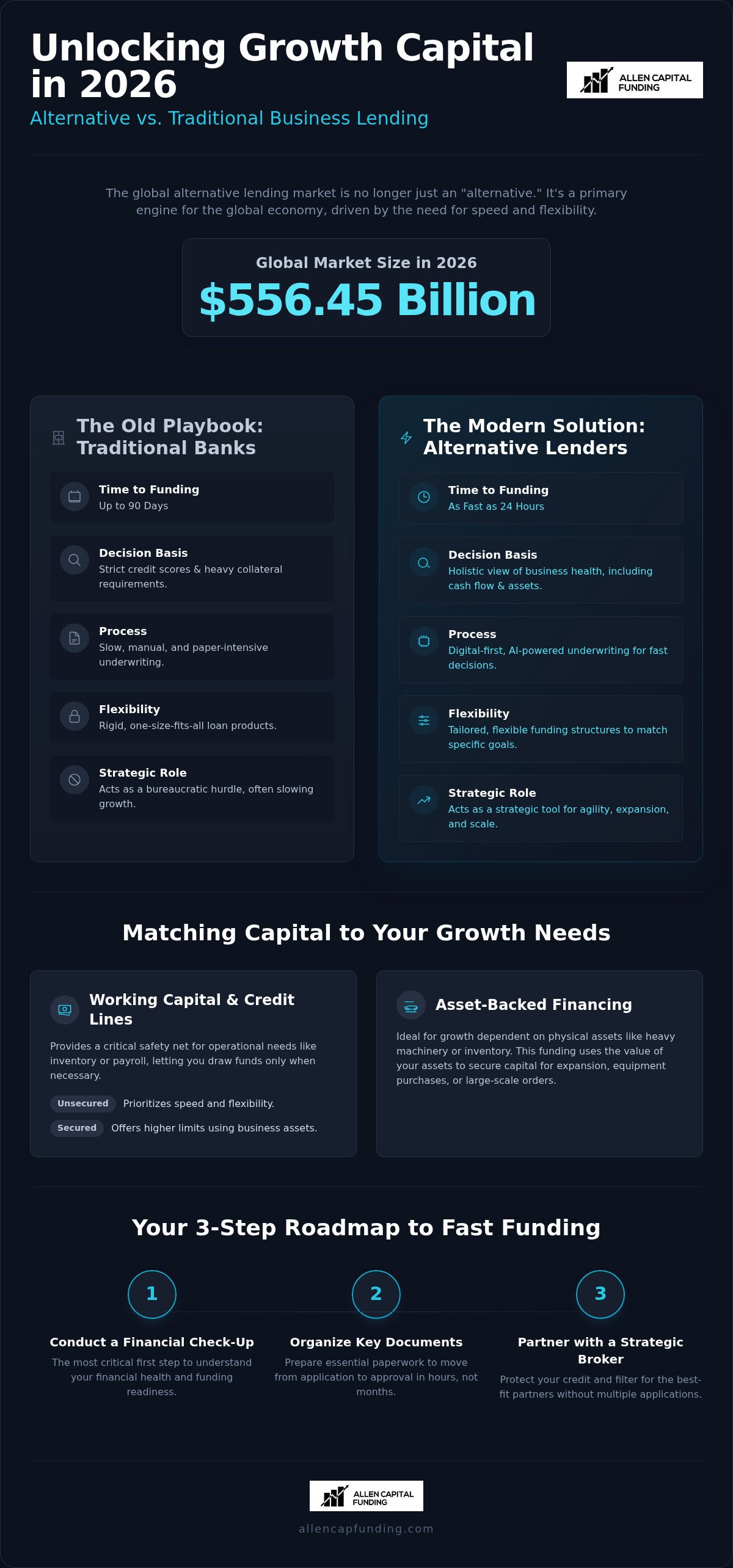
If you think waiting three months for a bank's "maybe" is the only way to fund your expansion, you're operating on an outdated playbook. In 2026, the global alternative lending market has reached $556.45 billion because agile companies realize that speed is a competitive asset. You've likely felt the frustration of rigid collateral requirements and the cold, impersonal nature of traditional big-bank applications. It's exhausting to deal with slow approval times when a market opportunity is right in front of you. You deserve a funding partner that acts as a proactive ally rather than a bureaucratic hurdle.
This guide will show you how to leverage alternative business lenders to secure the flexible, fast, and strategic capital your business needs to scale effectively. We will break down the latest 2026 market trends, compare specialized funding vehicles like revenue-based financing and private credit, and explain how to choose a partner that actually understands your industry. You'll learn how to move past the bottlenecks of traditional finance and unlock the tailored solutions that drive accelerated success. By the end of this article, you'll have a clear roadmap to the funding that fits your specific business goals.
Table of Contents
Navigating the Alternative Business Lending Landscape in 2026
Core Funding Structures: From Credit Lines to Asset-Based Loans
Traditional Banks vs. Alternative Lenders: A Strategic Comparison
Qualifying for Alternative Capital: Preparation and Strategy
Securing Your Growth Partner: The Role of a Strategic Funding Broker
Navigating the Alternative Business Lending Landscape in 2026
Alternative lending is a spectrum of private capital solutions outside traditional depository institutions. In 2026, the market for Alternative finance has matured into a primary engine for the global economy, with the market size reaching $556.45 billion. These alternative business lenders consist of non-bank financial institutions and fintech platforms that utilize sophisticated technology to remove the friction found in legacy banking. The most significant shift this year is the move toward digital-first underwriting. By using AI as a digital co-worker to handle core operations, these lenders analyze thousands of data points in minutes. This evolution has changed the perception of the industry. The "alternative" tag now represents a commitment to financial innovation rather than a compromise on quality or safety.
Why Modern Businesses Are Pivoting to Alternative Capital
Market opportunities move faster than a bank's loan committee. For many business owners, the standard 90-day approval cycle at a traditional bank is no longer just a delay; it's a genuine business risk. If you can't move on a piece of equipment or a bulk inventory purchase within a few days, your competitor will. Alternative business lenders prioritize this speed, often delivering working capital or credit lines in a fraction of the time. They also offer much-needed flexibility in underwriting. Instead of obsessing over a single credit score, they look at current cash flow, purchase orders, and specific business assets. This allows for a tailored approach that fits the specific rhythm of your industry, whether you're in manufacturing, retail, or professional services.
Breaking the 'Last Resort' Stigma
It's a mistake to view non-traditional funding as a "last resort" for struggling companies. Today, high-growth firms use alternative debt as a strategic tool to avoid equity dilution. Founders realize that giving up a percentage of their company to a venture capitalist is often more expensive in the long run than a short-term capital arrangement. This funding acts as a proactive growth tool, particularly when used as bridge capital for acquisitions or rapid geographic expansion. By choosing a partner that understands your specific goals, you simplify the path to progress. Utilizing these private credit markets shows that a business is agile enough to capture market share using modern financial instruments. It acts as a bridge between your current operations and your future scale.
Core Funding Structures: From Credit Lines to Asset-Based Loans
Choosing the right capital structure is just as important as securing the capital itself. Alternative lending isn't a single product; it's a diverse ecosystem of financial tools designed for specific operational needs. When you start comparing alternative business lenders, you'll find that the best partners offer structures that preserve your cash flow rather than straining it. Allen Capital Funding acts as a dedicated guide in this space, helping you filter through these diverse categories to find the one that aligns with your strategic goals. Matching the right "flavor" of capital to your use case ensures that the funding accelerates your success instead of creating a new debt burden.
Flexible Working Capital and Business Credit Lines
Operational fluctuations are a reality for any growing company. A business line of credit provides a critical safety net, allowing you to draw funds only when necessary. This revolving nature makes it ideal for managing seasonal inventory surges or bridging the gap during payroll cycles. You'll generally choose between two primary types of credit lines:
Unsecured lines: These prioritize speed and flexibility, requiring no specific collateral but often relying more on cash flow history.
Secured lines: These offer higher limits and potentially better terms by leveraging business assets like accounts receivable.
Alternative business lenders typically provide these lines with much faster setup times than traditional banks. This efficiency ensures you have access to funds before a liquidity crunch hits, allowing you to remain proactive in your market.
Asset-Backed Solutions: Equipment and Inventory Financing
If your growth depends on physical machinery or a massive fleet, asset-backed solutions are often the most efficient route. By leveraging the value of the asset itself, you can often secure more favorable terms because the lender's risk is mitigated. The strategic use of commercial equipment loans allows you to upgrade your capabilities without depleting your cash reserves. This keeps your capital working elsewhere in the business while the new equipment generates revenue to cover the financing.
For companies experiencing a sudden surge in demand, Purchase Order (PO) financing offers a way to fund growth you've already sold. This tool allows you to fulfill large orders that might otherwise be out of reach due to upfront costs. Instead of turning away a major contract, you use the contract itself as the basis for the funding. If you're ready to explore how these structures can support your specific industry, our team can help you identify tailored funding solutions that fit your trajectory.
Traditional Banks vs. Alternative Lenders: A Strategic Comparison
Traditional institutions often operate on a legacy model that prioritizes historical data and physical collateral. This approach leads to "paperwork mountains" and approval timelines that can stretch into months. In contrast, alternative business lenders utilize fintech models to provide a data-driven decision in as little as 24 to 48 hours. While a big bank might deliver an algorithmic rejection based on a single missing document, a strategic broker acts as a facilitator. We bridge the gap between these two worlds, helping you find the speed you need without sacrificing the security you want. This partnership ensures that you aren't just another number in a queue but a business with a clear path to capital.
Underwriting Philosophy: Cash Flow vs. Collateral
Underwriting in 2026 has moved beyond the static balance sheet. Traditional banks still lean heavily on hard assets, which often excludes service-based businesses or tech firms from high-level funding. Alternative business lenders focus on your future revenue. By using high-frequency data from bank APIs, these lenders see real-time cash flow patterns. Companies like Black Onyx Corporation, LLC use these insights to prioritize your current performance over your past credit history. It's a shift from asking what you own to asking what you can generate. This model opens doors for companies that have strong sales but lack the heavy equipment or real estate required by traditional depository institutions.
Many owners focus solely on the interest rate, but that ignores the true cost of waiting. If you wait 90 days for a lower-rate bank loan, you might miss a time-sensitive acquisition or a bulk inventory discount. A higher-rate alternative loan often carries a "speed premium," but it's frequently the more profitable choice when compared to lost revenue. You have to calculate the profit lost by not having the funds today. If the capital allows you to capture a market share that pays for the financing multiple times over, the speed becomes the true value. In competitive markets, the ability to act fast is often more valuable than a few percentage points on a loan. We help you evaluate these trade-offs to ensure your funding aligns with your strategic growth goals.
Qualifying for Alternative Capital: Preparation and Strategy
Preparation transforms a frantic search for cash into a strategic selection of capital. Unlike traditional banks that often demand three years of tax returns, alternative business lenders prioritize real-time performance and current trajectory. In 2026, the standard benchmarks for many online platforms include at least six months of operation and a consistent monthly revenue stream. Your digital footprint is your most powerful asset in this process. By connecting your online banking and accounting software directly to a lender's underwriting API, you allow for near-instant verification of your cash flow. This transparency speeds up the process significantly. Many owners worry that a less-than-perfect credit score is an automatic disqualifier. In the alternative space, your current revenue often carries more weight than a historical score, provided your cash flow is healthy. If you want to find out more about the specific steps to navigate this process safely, it helps to review industry-standard guides on non-bank capital.
Essential Documentation for Accelerated Funding
Speed requires organization. While alternative models are "lite" on paperwork compared to government-backed options, you still need the "Big Three": three to six months of bank statements, a current Profit & Loss statement, and a Balance Sheet. Organized books are the fastest way to lower your cost of capital. When a lender can clearly see your margins and debt-to-income ratio, they feel more confident offering competitive terms. We recommend a "Strategic Financial Check-Up" before you submit an application. This internal review ensures your data is accurate and ready for a lender's digital underwriting tools, removing barriers before they cause delays.
Improving Your Profile for Better Terms
You can actively influence the quality of the offers you receive. One effective tactic involves cleaning up small, high-frequency debts before you submit an application. This simple move improves your debt coverage ratio and demonstrates financial discipline. Additionally, a clear "Use of Funds" statement builds lender confidence. If you can demonstrate exactly how the capital will generate more revenue, you become a more attractive partner. For businesses with challenged credit, asset-based lending for small business offers a path forward by focusing on your balance sheet liquidity rather than just a FICO score. It's about finding the right facilitator to unlock the potential already present in your business.
If you're ready to see where your business stands, start your Financial Check-Up with our team today to prepare for your next growth phase.
Securing Your Growth Partner: The Role of a Strategic Funding Broker
Many business owners make the mistake of using the "shotgun approach" when they need capital. They apply to every institution they find online, hoping that volume will lead to a "yes." This strategy backfires quickly. Each application often triggers a credit pull, and multiple inquiries in a short period can lower your score and signal desperation to alternative business lenders. Instead of casting a wide and damaging net, you need a strategic filter. A funding broker acts as your dedicated guide, matching your specific profile with the lenders most likely to offer favorable terms. This advocacy ensures your application lands on the right desk the first time, protecting your credit profile while maximizing your chances of success. It's a methodical process that respects your time and your business's reputation.
Why a Broker Beats a Single-Lender Approach
Applying directly to a single lender limits your options to their specific, often rigid, criteria. If you don't fit their exact box, you're out of luck. A broker provides access to proprietary lending networks that aren't always available to the general public. You benefit from an objective comparison of multiple offers, which allows you to see the true variety of terms across the market. This "one application, dozens of solutions" model saves you significant time. Instead of managing twenty different conversations, you have one expert facilitator who handles the heavy lifting. This efficiency is vital when you're trying to scale a national business and can't afford to be bogged down by administrative hurdles. We speak the language of the alternative business lenders, ensuring your story is told in a way that resonates with underwriters.
Allen Capital Funding’s Tailored Approach
We don't believe in one-size-fits-all financing. Our commitment to "Accelerated Success" means we take the time to understand the unique rhythm of your industry before recommending a path. We act as a bridge between your current state and your future goals, removing the barriers that traditional banks often create. Whether you need a credit line for a seasonal surge or equipment financing for a major expansion, our team provides the expert guidance necessary to secure the right fit. We focus on building long-term partnerships rather than just closing a single transaction. You can explore your custom funding options with Allen Capital Funding today to see how a tailored strategy can transform your growth trajectory.
Unlocking Your Business's Full Potential Through Strategic Funding
The finance landscape has shifted significantly. Relying on traditional bank timelines is no longer a necessity for companies that need to move fast. By partnering with alternative business lenders, you gain the agility to capture market opportunities that your competitors might miss. You've learned that the right capital structure should preserve your cash flow while fueling expansion. Success in this space depends on clarity and preparation. Organizing your digital data and understanding your specific funding needs ensures you access the most favorable terms available in 2026.
Don't let bureaucratic hurdles stall your progress. Allen Capital Funding acts as your dedicated facilitator, providing expert guidance through the national lending landscape. We're focused on removing barriers to business growth by connecting you with tailored SBA, equipment, and working capital solutions. Our team is ready to help you navigate these complex options with confidence and speed. It's time to move toward your future goals with a partner that understands your industry.
Book Your Strategic Funding Consultation with Allen Capital Funding today to secure the capital your business deserves. Your next phase of accelerated success is within reach.
Frequently Asked Questions
What exactly is an alternative business lender?
An alternative business lender is a non-bank financial institution or fintech platform that provides capital outside the traditional depository banking system. These entities utilize digital-first underwriting and alternative data sources to evaluate creditworthiness. Instead of relying solely on years of tax returns, they often prioritize current cash flow and specific assets. This sector has grown to a $556.45 billion market in 2026, offering specialized tools like purchase order financing and factoring to support business growth.
How do alternative business loan interest rates compare to traditional banks?
Interest rates from alternative providers are generally higher than those at traditional banks to account for the increased speed and flexibility of the funding. While a bank might offer a lower rate, the application process can take months. Alternative providers focus on the "speed premium," allowing you to secure capital within days. In September 2026, online term loans typically range from 14% to 36% APR, whereas traditional bank loans often stay between 8% and 17.25%.
Can I get an alternative business loan if I have bad credit?
You can often secure funding through alternative business lenders even with a challenged credit history. These lenders prioritize your current revenue and business performance over a single FICO score. Solutions like factoring or equipment financing leverage the value of your invoices or machinery rather than your personal credit profile. This approach makes capital accessible for service-based businesses or companies in rapid growth phases that don't meet the rigid requirements of traditional big banks.
How fast can I realistically get funding from an alternative lender?
Funding speed is one of the primary advantages of the alternative finance market. While traditional bank loans often take 60 to 90 days, many alternative platforms deliver a decision in 24 to 48 hours. Depending on the complexity of the deal, capital can be deposited into your account in as little as three to five business days. This rapid turnaround is essential for businesses needing to act on time-sensitive opportunities or manage unexpected operational fluctuations.
Are alternative business lenders safe and regulated?
Alternative lenders are subject to various federal and state-level regulations designed to ensure transparency and fair practices. The CFPB Section 1071 rule has a uniform compliance date of January 1, 2028, to improve data collection for small business lending. Additionally, several states like California and New York have enacted disclosure laws requiring lenders to provide clear details on rates and fees. Working with an expert broker helps you identify reputable partners in this evolving regulatory environment.
What is the difference between a direct lender and a business loan broker?
A direct lender provides the funds for the loan and manages the underwriting process internally. A business loan broker, like Allen Capital Funding, acts as a facilitator between you and a national network of multiple lending partners. The broker's role is to act as a strategic filter, finding the best-fit solution for your specific industry and needs. Using a broker allows you to submit one application to access dozens of potential funding structures simultaneously.
What documents do I need to apply for alternative business funding?
Most alternative lenders require a "lite" documentation package compared to traditional banks. You'll typically need three to six months of business bank statements, a current Profit & Loss statement, and a Balance Sheet. Some digital-first lenders allow you to connect your accounting software directly via an API, which speeds up the verification process. Having these organized records ready is the fastest way to lower your cost of capital and secure a favorable offer.
Does applying for an alternative loan affect my credit score?
The impact on your credit score depends on the lender's specific process. Many lenders start with a "soft" credit pull for the initial pre-qualification, which does not affect your score. However, a "hard" inquiry usually occurs when you officially accept an offer or move into deep underwriting. To protect your profile, we recommend avoiding the "shotgun approach" of applying to many lenders individually. A strategic broker can help manage this by filtering options first.


Comments