


SBA Loan Down Payment Requirements: 2026 Strategic Guide
Could your dream of business expansion be stalled by a number you don't even have to pay entirely out of pocket? Many entrepreneurs feel a sense of dread when reviewing their balance sheets, fearing that meeting SBA loan down payment requirements will leave their operations drained of liquidity. You've worked hard to build your cash reserves. The idea of risking every cent of your working capital just to secure a 7(a) or 504 loan is enough to make any savvy leader hesitate. It's a common concern that often stops great projects before they ever get off the ground.
You don't have to choose between growth and stability. This guide helps you master the specific equity requirements for both major SBA programs while uncovering strategic ways to source your down payment from allowable alternative pots. We'll provide a clear understanding of the 10-20% equity rule and identify which assets the SBA actually accepts as capital. You'll also discover a strategy to minimize your out-of-pocket costs so you can scale with confidence in 2026. Let's look at how to protect your reserves while securing the capital you need to move forward.
Table of Contents
SBA Loan Down Payment Basics: Why Equity Matters in 2026
In the world of commercial finance, the equity injection serves as the essential foundation of your project. It represents the cash or asset contribution you bring to the closing table to secure your funding. Understanding SBA loan down payment requirements starts with a fundamental truth: the Small Business Administration doesn't actually provide the funds. Instead, they guarantee a portion of the loan provided by a private lender. This guarantee reduces the risk for the bank, but it doesn't eliminate the need for you to have skin in the game. In 2026, lenders are prioritizing strong equity positions more than ever to offset market volatility and ensure long-term stability.
The Purpose of the Equity Injection
Lenders view your down payment as a primary indicator of project viability. It functions as a critical risk mitigation tool, especially for startups or complex business acquisitions. A healthy equity injection demonstrates your personal commitment to the success of the venture. It also ensures the business isn't burdened by excessive debt from day one. By maintaining a solid equity position, you create a financial buffer that helps the company survive the natural fluctuations of the business cycle. This initial investment aligns your interests with the lender's goals, creating a partnership-driven path toward growth.
Minimums vs. Reality: What Lenders Actually Want
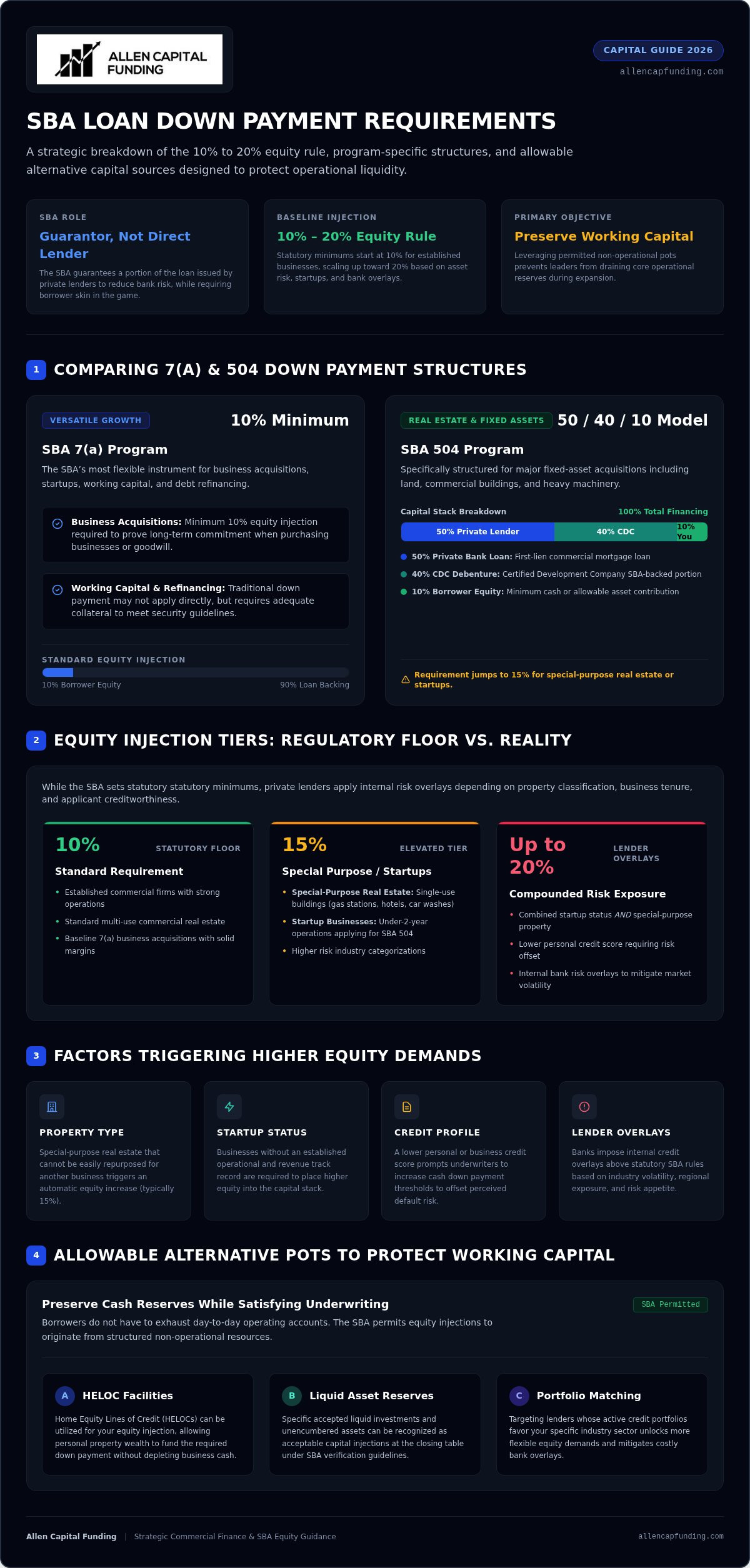
While the SBA sets statutory minimums, these are often just the starting point for negotiations. For example, the standard SBA 504 loan structure typically requires a 10% borrower contribution for established firms. However, many banks apply overlays, which are additional internal requirements that go beyond basic SBA rules. You might find that 10% is the regulatory floor, but 15% is the practical reality for industries considered higher risk. These SBA loan down payment requirements can also fluctuate based on your personal credit history. A lower score often triggers a request for a higher down payment to balance the perceived risk. Preparing your balance sheet through a financial check-up is a proactive way to position yourself for the most favorable terms possible.
Strategic borrowers know that the down payment isn't a fixed fee. It's a variable that changes based on the lender's appetite for your specific industry and the overall strength of your application. In 2026, being prepared with a clear capital strategy is the best way to avoid surprises during the underwriting process. We focus on finding the specific lender whose current portfolio needs match your business profile, which can often lead to more flexible equity demands.
Comparing 7(a) and 504 Down Payment Requirements
Choosing between the two primary SBA programs depends heavily on your specific project goals. While both programs offer government-backed financing, their SBA loan down payment requirements follow different structures based on risk and asset type. It's not just about having the cash; it's about understanding how the SBA categorizes your business and the assets you're acquiring. As we move through 2026, lenders are scrutinizing these equity tiers more closely to ensure projects remain viable despite shifting interest rates.
SBA 7(a): The Flexible Growth Option
The 7(a) program is the SBA's most versatile tool for general business needs. If you're launching a startup or acquiring an existing company, you'll typically need a 10% equity injection. This is particularly important when the deal includes intangible assets like goodwill. According to the SBA 7(a) loan terms and eligibility requirements, lenders must verify that you have sufficient "skin in the game" to manage the debt. For 2026 acquisitions, you're required to provide a minimum 10% equity injection to ensure you're fully committed to the business's long-term success. Keep in mind that for working capital or debt refinancing, you might not face a traditional down payment in the same way, but you'll still need to provide adequate collateral to satisfy lender security requirements.
SBA 504: The Real Estate & Equipment Powerhouse
The 504 loan is specifically designed for fixed assets like land, buildings, or heavy machinery. It uses a structured 50/40/10 funding model: a private lender provides 50%, a Certified Development Company covers 40%, and you provide the final 10%. While this 10% floor is standard for established firms, the requirement climbs quickly under specific conditions. If your business is a startup or if you're purchasing "special-purpose" real estate, the requirement increases to 15%. Special-purpose properties include buildings that are difficult to repurpose for another industry, such as cold storage facilities, bowling alleys, or car washes. If your project hits both categories, a new business buying a special-purpose property, the total equity injection reaches 20%. Understanding these SBA loan down payment requirements is vital for your Commercial Real Estate Strategy and Funding plan. If you're unsure which tier your project falls into, getting a financial check-up can help clarify your standing before you apply.
Acceptable Sources for Your SBA Down Payment
Meeting SBA loan down payment requirements doesn't always mean emptying your primary savings account. While personal cash and liquid assets are the most straightforward sources, the SBA allows for several creative equity injections to help you preserve your operational liquidity. Identifying these alternative pots of capital is a critical step in building a sustainable growth strategy for 2026. Lenders simply want to see that the funds are "sourced and seasoned," typically meaning you've held the assets for at least 60 to 90 days and can provide a clear paper trail of their origin.
Leveraging Retirement and Home Equity
One of the most effective ways to source an equity injection is through a ROBS (Roll Overs as Business Startups) structure. This strategy allows you to use funds from your 401(k) or IRA to finance your business without triggering early withdrawal penalties or tax hits. It's a powerful tool, though it requires strict compliance with IRS guidelines to maintain its tax-advantaged status. Alternatively, you can use a Home Equity Line of Credit (HELOC) on your personal residence. To use HELOC funds, you must demonstrate a reliable secondary source of income, such as a spouse's salary or investment dividends, to cover the line's repayment. To maintain liquidity during this transition, many owners use a business line of credit for operational needs while dedicating their cash reserves to the SBA requirements.
Seller Carrybacks and Investor Capital
When comparing 7(a) and 504 loan programs, you'll find that seller financing can be a game-changer for business acquisitions. A seller-financed note can often count toward your equity injection, potentially reducing your out-of-pocket cash requirement to as little as 5%. However, this comes with specific strings attached. The SBA requires that seller-financed notes used for equity must be on full standby, meaning no principal or interest payments can be made to the seller for the entire duration of the SBA loan term. This ensures the business's cash flow is prioritized for the primary debt and operational stability.
If you still face a gap, bringing on equity partners is another viable path. These partners provide capital in exchange for a percentage of ownership, helping you meet SBA loan down payment requirements without taking on additional personal debt. Gifts from family members are also permitted, provided you include a formal "gift letter" stating that the funds are not a loan and no repayment is expected. By mixing these sources, you can build a robust equity position that satisfies even the most conservative 2026 lenders while keeping your working capital intact.
Factors That Can Increase Your Required Down Payment
While the SBA provides a clear framework for equity injections, individual banks often add their own internal rules. These are known as lender overlays. Even if your project qualifies for 10% down under federal guidelines, a specific bank might decide that SBA loan down payment requirements for your deal should be 15% or 20%. These decisions are rarely arbitrary. They're usually driven by the bank's internal risk assessment of your industry, your business's age, or the type of collateral you're offering. Understanding these variables allows you to prepare your balance sheet before a lender even asks the first question.
Industry risk is one of the most common drivers of higher equity demands. Lenders view sectors like restaurants, retail, and hospitality as inherently more volatile. If your Debt Service Coverage Ratio (DSCR) is tight, a lender will likely ask for a larger down payment. They want to see a DSCR of at least 1.25, meaning your business generates $1.25 in profit for every $1.00 of debt payment. If you're hovering closer to 1.15, increasing your equity injection lowers the total loan amount. This reduces your monthly payment and brings that ratio back into a range the bank finds acceptable.
The 'New Business' Penalty
The SBA defines a startup as any entity with less than two years of operating history. This status carries a specific financial weight. Under the 504 program, being a startup automatically adds a 5% equity requirement to your project. Lenders view the first 24 months as the highest risk period for any venture. To transition from "startup" to "established" in the eyes of a credit officer, you need to highlight your direct management experience in the same industry. Proving you've successfully run a similar operation can sometimes help you negotiate more favorable terms, though the 5% startup addition for 504 loans is often a firm regulatory requirement.
Collateral Shortfalls and Personal Guarantees
A low appraisal can derail your funding plan at the last minute. If the property or equipment you're buying doesn't value out to the purchase price, the lender won't bridge the gap. You'll be expected to cover the difference with a larger down payment. This is a moment where asset-based lending for small business becomes a vital tool. It can help you unlock liquidity from other balance sheet items to meet the new requirement. Keep in mind that while a higher down payment reduces the lender's risk, it doesn't usually remove the need for a personal guarantee. It does, however, give you more leverage to negotiate other loan covenants. Ready to see where your business stands? Schedule a financial check-up to identify potential lender overlays before you start the application process.
Strategic Funding: How a Broker Minimizes Out-of-Pocket Costs
The complexity of SBA loan down payment requirements often leads business owners to believe that the first offer they receive is the only one available. A strategic broker acts as an expert guide, identifying lenders with more aggressive equity terms that align with your specific industry profile. While a generic algorithm might match you with a bank, a specialist understands the nuances of lender appetites. We package your application to highlight operational strengths, such as strong management experience or niche market dominance, which can often offset a lower down payment. This proactive approach ensures you're not just getting a loan, but the most favorable structure for your long-term capital needs.
Navigating the "Credit Elsewhere" test is another area where professional guidance is essential. The SBA requires proof that you can't obtain similar terms without a government guarantee. We help you document this necessity correctly to avoid unnecessary delays. We also look at your project holistically. By integrating your loan into a broader strategic business equipment financing plan, we ensure your capital stack is optimized. This prevents you from over-leveraging one area of the business while leaving another underfunded.
Finding the Right Lender Match
Not all SBA lenders are created equal. Some institutions prefer the flexibility of the 7(a) program, while others specialize in the fixed-asset focus of the 504. Working with a Preferred Lender Program (PLP) partner is often the difference between a 30-day closing and a 90-day struggle. PLP lenders have the authority to make final credit decisions on behalf of the SBA, significantly accelerating your success. Allen Capital Funding identifies the optimal path by matching your industry requirements with the specific portfolio needs of our national lending partners.
Next Steps: Your Financial Check-Up
Securing a 10% down payment requires more than just having the cash; it requires a balance sheet prepared for scrutiny. Your first step should be a comprehensive review of your equity sources to ensure they meet "sourced and seasoned" standards. We invite you to book a consultation to explore how we can minimize your out-of-pocket costs and protect your working capital. Taking this proactive step ensures you're ready for a capital draw when the right opportunity arises. Contact Allen Capital Funding for a tailored SBA strategy today to begin your financial check-up and unlock your business's full potential.
Mastering Your Capital Strategy for 2026
Meeting SBA loan down payment requirements is a strategic milestone rather than a financial hurdle. By understanding the nuances between 7(a) and 504 programs and exploring alternative equity sources like seller carrybacks or retirement rollovers, you can fuel growth without depleting your reserves. Success in the current lending environment requires a proactive stance and a clear understanding of how industry risks impact your capital stack. You now have the tools to identify potential lender overlays and position your business as a strong, viable candidate for funding.
Allen Capital Funding acts as your dedicated guide, providing expert SBA loan origination and brokerage services for even the most complex acquisitions. We offer tailored funding options and supportive guidance from your initial financial check-up through to a successful closing. Our goal is to simplify the path to progress and accelerate your results. Secure your business's future; book a strategic SBA loan consultation with Allen Capital Funding today. Your expansion goals are within reach with the right strategic partner by your side.
Frequently Asked Questions
Can I use a loan for an SBA loan down payment?
You can use borrowed funds for your equity injection only under specific conditions. The SBA requires you to demonstrate a reliable source of repayment outside of the business's cash flow, such as income from a separate job or a spouse's salary. Additionally, the loan for the down payment cannot be secured by the business assets you're acquiring. This ensures your new venture isn't over-leveraged from day one and remains stable.
Does the SBA 7(a) loan always require 10% down in 2026?
While 10% is the standard for business acquisitions and startups, it isn't a universal rule for every 7(a) loan. For working capital or debt refinancing, SBA loan down payment requirements may be lower or even waived if you provide sufficient collateral. However, lenders often apply their own overlays. While the SBA minimum is flexible, individual bank policies may still require a 10% equity injection to mitigate their specific risk profiles.
Can seller financing count toward my SBA equity injection?
Seller financing can contribute toward your down payment, potentially reducing your out-of-pocket cash to as little as 5%. For this to count as equity, the seller note must be on "full standby" for the entire life of the SBA loan. This means you cannot make any principal or interest payments to the seller until the SBA debt is fully satisfied. This structure protects the business's cash flow during its most critical growth years.
Is it possible to get an SBA loan with 0% down?
Obtaining an SBA loan with 0% down is extremely rare and typically reserved for established businesses expanding their current operations. If you're opening a second location of a highly profitable business and have significant existing equity or collateral, some lenders may waive the injection. For startups and acquisitions, however, expect to bring at least 10% to the table. Lenders almost always require some skin in the game to approve a guarantee.
What are the rules for using gifted funds for a down payment?
You can use gifted funds from family or friends, provided you follow strict documentation rules. The lender will require a formal gift letter signed by the donor, explicitly stating that the money is a gift and requires no repayment. These funds should ideally be seasoned, meaning they've been in your account for at least 60 days. This transparency allows the lender to verify the capital isn't actually a hidden loan that adds debt.
How do 504 loan down payment requirements differ for startups?
The SBA 504 program adds a 5% startup tax for businesses with less than two years of operating history. While an established firm might only need a 10% injection for real estate, a startup must provide 15%. If the project also involves a special-purpose property, like a car wash or cold storage facility, the requirement can jump to 20%. These tiered SBA loan down payment requirements ensure that higher-risk projects have a stronger equity foundation.
Can I use my 401(k) for an SBA loan down payment without taxes?
You can use retirement funds through a structure known as Roll Overs as Business Startups (ROBS). This process allows you to invest your 401(k) or IRA into your own company's stock, providing the necessary cash for your down payment without triggering early withdrawal penalties or income taxes. It's a complex maneuver that requires professional setup to remain compliant with IRS regulations, but it's an excellent way to preserve your personal liquidity and cash reserves.
What happens if the property appraisal is lower than the purchase price?
If the appraisal comes in low, the lender will only fund based on the appraised value rather than the purchase price. You'll be responsible for covering the shortfall with a larger equity injection. For example, if a building is priced at $1 million but appraises for $950,000, your loan will be calculated from the lower figure. You'll need to bring additional cash to the closing table to satisfy the original deal terms and the lender's requirements.


Comments