


Strategic Business Equipment Financing: The 2026 Guide to Growth
In 2026, owning your machinery outright is no longer a sign of financial strength; it's often a strategic anchor that slows your ability to pivot. You likely feel the pressure of rapid technological shifts and the looming fear that today's top-tier tech will be obsolete by next season. High upfront costs often force a difficult choice between upgrading your operations or preserving your cash reserves. By leveraging business equipment financing, you can stop choosing between growth and stability. This approach allows you to acquire the latest tools immediately while keeping your working capital available for other strategic investments.
We understand that traditional banks often make this process feel like a hurdle race with their slow approvals and rigid requirements. You deserve a partner that acts as a bridge to your future goals rather than a barrier. This guide provides a clear roadmap to modernizing your business without the typical financial strain. We'll show you how to secure predictable monthly payments and access the most efficient equipment available today. You'll also learn about the current tax advantages and how a tailored funding strategy can help you outpace your competition throughout the coming year.
Table of Contents
The Fundamentals of Business Equipment Financing in 2026
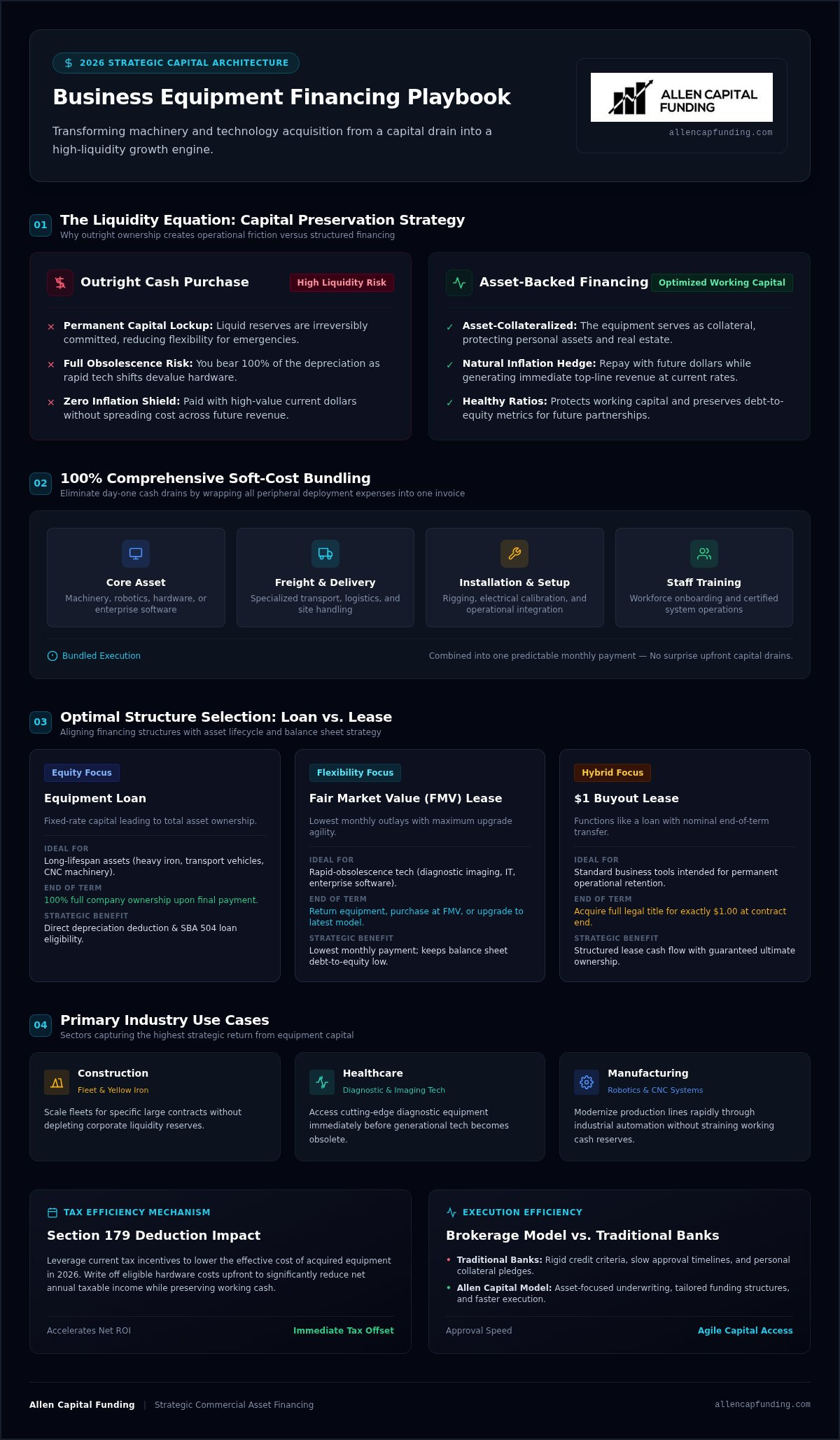
Business equipment financing is a strategic funding solution where the asset you're acquiring serves as the collateral for the debt. It's a targeted way to grow because the lender focuses on the value of the machinery or technology rather than just your credit score. This structure allows you to secure modern tools without pledging your personal home or other business assets. In 2026, the range of eligible assets has expanded significantly. You can finance everything from heavy earth-moving equipment to complex enterprise software systems and industrial robotics.
One major advantage of this model is the ability to include soft costs. Many owners forget that the sticker price of a machine isn't the total cost. You often need to pay for delivery, complex installation, and staff training. Modern financing packages allow you to bundle these expenses into your monthly payment, ensuring you don't face a surprise cash drain on day one. It's a streamlined way to get your new operations running without multiple separate invoices.
Why Use Equipment Financing Instead of Cash?
Choosing to finance instead of buying outright is a tactical decision to maintain liquidity. When you spend a large sum of cash, that capital is gone forever. If a market shift occurs or an emergency repair is needed, you can't easily turn a bulldozer back into liquid funds. Financing acts as a natural hedge against inflation. You're essentially paying for the equipment with future dollars that may have less purchasing power, while the equipment generates revenue at today's rates. This approach keeps your debt-to-equity ratio healthy and ensures your balance sheet remains attractive to future partners. Many businesses utilize finance lease agreements to manage these ratios effectively while keeping their operations current.
Common Industries That Benefit Most
While almost any sector can use these tools, three industries see the most significant impact from business equipment financing:
Construction: Heavy machinery costs are massive. Financing allows firms to scale their fleet for specific contracts without depleting their reserves.
Healthcare: Medical technology moves fast. Financing helps clinics access the latest diagnostic tools and imaging systems before they become obsolete.
Manufacturing: Industrial automation and CNC machines are essential for staying competitive. Financing these assets allows for rapid modernization of production lines.
By using these specialized funding paths, you protect your cash flow and ensure your business remains agile enough to respond to new opportunities as they arise.
Equipment Loans vs. Leasing: Selecting the Optimal Structure
The decision between a loan and a lease often dictates your company's future agility. While both paths facilitate growth, they impact your financial statements and operational roadmap differently. Selecting the right structure for your business equipment financing requires a clear understanding of the asset's expected useful life and your long-term equity goals. You don't want to be tied to a long-term debt obligation for technology that will be obsolete in twenty-four months.
The Equipment Loan: Building Equity
An equipment loan is the preferred choice for assets with a long operational lifespan. If you're acquiring heavy yellow iron, specialized manufacturing tools, or transport vehicles that will serve your company for a decade, building equity makes sense. You own the asset once the final payment is made. This path also allows you to claim depreciation benefits, which can significantly offset your taxable income. For very large projects involving long-term, fixed-rate capital for heavy machinery, many owners explore the SBA 504 loan program. This structure provides stability through fixed monthly payments that eventually lead to total ownership.
Equipment Leasing: Prioritizing Flexibility
Leasing is often the smarter move for high-tech assets that face rapid obsolescence. If you're upgrading medical imaging tech or enterprise software, you don't want to be stuck with outdated hardware five years from now. A Fair Market Value (FMV) lease offers the lowest monthly payments. It gives you the option to return the equipment or upgrade to the latest model at the end of the term. Conversely, a $1 Buyout lease functions more like a loan. You pay slightly more each month but own the equipment for a nominal one-dollar fee at the end of the contract.
Leasing can also be more favorable for your debt-to-equity ratio. Because certain lease payments can be treated differently on your balance sheet, they may help you maintain a cleaner financial profile compared to traditional large-scale debt. This flexibility is vital if you plan to seek additional funding or scale your operations quickly. If you aren't sure which path fits your current trajectory, a financial check-up can help clarify your best move. Match the financing term to the equipment's peak performance years to ensure you're always operating at maximum efficiency.
Maximizing ROI: The Strategic Advantages of Financing Assets
Smart growth requires more than just new gear. It demands a strategy that turns every monthly payment into a profit center. When you view business equipment financing as a wealth-building tool rather than a simple expense, your perspective on expansion shifts. By using equipment financing to scale operations, you can immediately deploy advanced technology that generates more income than the cost of the capital itself. This creates a self-funding growth cycle that keeps your bank balance intact.
Understanding the Tax Impact
Section 179 is a tax provision that allows businesses to deduct the full purchase price of qualifying equipment in the tax year it's placed into service. This incentive drastically reduces the effective cost of your acquisition by lowering your taxable income immediately. If you choose a lease structure, you typically deduct the full monthly payment as an operating expense. With a loan, you focus on interest deductions and depreciation schedules. You should always consult with a qualified tax professional to align these financing choices with your specific fiscal goals for the 2026 filing year.
Calculating Your Break-Even Point
To ensure your investment is sound, you must analyze the 'Revenue-to-Payment' ratio. Start by estimating the specific monthly revenue your new asset will generate through increased output or new service capabilities. Compare this number against your monthly financing payment. If a new piece of technology costs $2,000 per month but produces $8,000 in additional billable work, the ROI is clear. You should also factor in the hidden savings that modern equipment provides. Newer models often feature lower energy consumption, fewer repair requirements, and faster cycle times. These operational savings often cover a significant portion of the payment before you even account for new sales.
Financing allows you to stay ahead of competitors who are struggling with outdated, inefficient technology. While they deal with downtime and high maintenance costs, you're operating with peak efficiency and predictable costs. This strategic edge is what separates market leaders from those who are merely surviving. By leveraging business equipment financing, you transform a necessary upgrade into a competitive weapon that drives long-term success.
The Step-by-Step Path to Securing Equipment Capital
Securing the right funding requires a methodical approach to ensure you don't face unexpected delays. While the strategy behind business equipment financing focuses on ROI and tax benefits, the execution depends on precision and documentation. Following a clear path helps you move from identifying a need to operating your new machinery with minimal friction. This process begins long before you sign a final contract.
First, identify the exact equipment you need and obtain a formal quote from a reputable vendor. This quote must include the full purchase price plus any bundled soft costs like installation or shipping. Next, prepare your financial package. You'll typically need the last two years of business tax returns and your most recent year-to-date financial statements. Having these ready prevents the back-and-forth that often slows down traditional bank approvals. You should also evaluate your credit profile to address any potential red flags, such as unresolved liens or reporting errors, before a lender sees them. Finally, consult with a specialist to determine the most effective commercial equipment loan structure for your specific industry.
Documentation Requirements for 2026
Your documentation needs will vary based on the size of your request. For smaller transactions, many lenders offer 'Application Only' programs that require minimal paperwork and provide rapid decisions. However, large-scale industrial acquisitions usually trigger full disclosure requirements. This means providing deeper insights into your company's cash flow and debt obligations. If you're using the equipment to launch a new line of business, a clear business plan becomes essential. Lenders want to see how the new asset will specifically generate the revenue needed to cover its own costs.
Credit and Qualification Factors
Lenders look at both your business and personal credit scores to gauge reliability. Your time-in-business also plays a significant role. Companies with at least two years of operational history often access better rates and more flexible terms. If your business is younger or you're dealing with challenged credit, asset-based options focus more on the equipment's value than a perfect credit score. This ensures that a temporary dip in credit doesn't stop your long-term growth. If you're ready to see which options fit your profile, apply for equipment financing today to start your modernization journey.
Accelerating Your Success with Allen Capital Funding
A single bank often limits your options to its specific internal policies and risk appetite. If your request falls outside their narrow criteria, you face a rejection that stalls your progress. Allen Capital Funding operates differently. We act as a dedicated brokerage with deep connections across the national lending landscape. We don't just offer a product; we provide a bridge to the capital you need to scale. This model ensures you receive multiple competitive options rather than a single take-it-or-leave-it offer.
Our approach centers on speed and strategic alignment. We understand that in 2026, waiting weeks for an approval means missing out on vital growth opportunities. We streamline the entire process from your initial consultation to the final distribution of funds. By removing traditional bureaucratic barriers, we allow you to focus on running your business while we handle the complexities of the financial markets. You gain a proactive ally who is deeply invested in your long-term success.
Expert Guidance for Strategic Growth
Generic loans rarely account for the unique operational rhythms of your specific industry. We move beyond one-size-fits-all debt to build custom capital solutions that fit your cash flow. Before you commit to any new obligation, we recommend a strategic financial check-up to ensure your funding plan aligns with your broader goals. This step helps identify the most efficient way to deploy capital without overextending your resources. Our team acts as a solution-focused facilitator, helping you manage the nuances of business equipment financing with total confidence.
Your Next Steps Toward Acquisition
Moving forward shouldn't be a complex ordeal. Our "accelerated success" funding model is designed for efficiency and clarity. We respect your time by delivering essential information quickly and moving you through the approval stages with precision. Whether you are modernizing a single production line or overhauling an entire fleet, we provide the expert guidance needed to make it happen. You don't have to face the complexities of commercial finance alone when you have a dedicated partner by your side.
Ready to unlock your business's full potential? Booking a consultation allows you to explore the diverse capital options available to your firm today. Don't let outdated machinery or cash flow fears hold you back from the growth you've earned. Secure your equipment financing with Allen Capital Funding today and take the first step toward a more efficient future.
Securing Your Operational Future in 2026
Modernizing your business doesn't have to be a drain on your liquid capital. By choosing the right structure for your business equipment financing, you transform a necessary expense into a powerful engine for growth. Whether you prioritize the long-term equity of a loan or the rapid upgrade cycle of a lease, your strategy should focus on maximizing ROI and capturing every available tax benefit. We've outlined the path to securing these assets with speed and clarity, moving you from the planning phase to full operational capacity without traditional bank delays.
At Allen Capital Funding, we provide the expert guidance needed to navigate the national lending landscape. You gain access to a wide network of strategic partners and support tailored to your unique business goals. Our team acts as a dedicated ally, removing barriers and helping you outpace the competition with the latest technology. Ready to take the next step toward accelerated success? Book Your Strategic Funding Consultation today and discover how we can facilitate your expansion. Your goals for 2026 are within reach, and we're here to help you achieve them with confidence.
Frequently Asked Questions
What is the typical down payment for business equipment financing?
Down payments for business equipment financing typically range from 0% to 20% of the total purchase price. Many well-qualified businesses can secure zero-down options where the lender finances 100% of the cost. Your specific requirement often depends on your credit profile and the type of asset you are acquiring. Lenders might ask for a higher percentage if the equipment has a high rate of depreciation or if you are a newer business.
Can I finance used equipment or only new models?
You can absolutely finance used equipment as long as it meets the lender's standards for age and condition. Financing pre-owned machinery is a common strategy to lower your monthly payments while still gaining necessary operational capacity. Lenders typically review the asset's remaining useful life to ensure it outlasts the financing term. This flexibility allows you to acquire reliable tools without the premium price tag of brand-new models.
How long does the approval process take for an equipment loan?
The approval process for an equipment loan is generally much faster than traditional bank funding. Many application-only programs can provide a credit decision within 24 to 48 hours. For larger, more complex industrial acquisitions that require full financial disclosure, the process may take a few business days. Once you are approved, funding can often occur shortly after you provide the final vendor invoice and signed contract.
What happens if the equipment becomes obsolete before the term ends?
If your equipment becomes obsolete, your options depend on your original agreement structure. Under a lease, you may have the flexibility to upgrade to newer technology at the end of the term or even mid-term in some cases. If you chose a loan, you own the asset and remain responsible for the debt. This is why we recommend matching your financing term to the expected technological life of the equipment.
Is it possible to finance equipment if I am a startup business?
Startups can secure equipment financing, though requirements are often more stringent than for established firms. Lenders may look for a stronger personal credit score or a larger down payment to offset the lack of business history. Because the equipment itself serves as collateral, it is often easier to qualify for this type of funding than for an unsecured line of credit. Having a solid business plan helps demonstrate how the asset will generate revenue.
Are there restrictions on the type of equipment I can finance?
Most tangible assets used for business purposes are eligible for financing. This includes heavy machinery, medical devices, office furniture, and even specialized software. Restrictions generally apply to items that are consumed quickly or lack a clear resale value. Lenders prefer assets that are essential to your daily operations and have a predictable lifespan. If you aren't sure if your specific equipment qualifies, our team can help you verify eligibility quickly.
Can I bundle installation and shipping costs into the financing?
Yes, you can often bundle soft costs like installation, shipping, and initial training into your financing package. When coordinating the transport of new machinery, securing coverage through Cargo Insure Online ensures your investment is protected during the delivery process. Many lenders allow these additional expenses to represent up to 20% or 25% of the total loan amount. This approach is highly beneficial because it prevents you from having to pay thousands of dollars in upfront cash just to get your new equipment operational while keeping your working capital intact for other growth initiatives.
Business equipment financing can positively impact your business credit score if you make your payments on time. Most commercial lenders report your payment history to business credit bureaus, which helps you build a stronger profile for future funding needs. It also helps your score by diversifying your credit mix. Because this is an asset-backed obligation, it may have a different impact on your debt-to-equity ratio than an unsecured term loan or credit line.


Comments