


Used Equipment Financing Guide: Strategic Asset Acquisition in 2026
- anthonyarallen
- 3 days ago
- 12 min read
Why pay a 30% "newness premium" the moment you drive a machine off the lot? For many business owners, the heavy depreciation of new assets feels like a mandatory tax on growth, but it doesn't have to be. Strategic used equipment financing allows you to bypass that immediate value drop while securing the exact same operational output for your job site or factory floor. It's about working smarter with your capital, not just harder.
We understand the frustration of facing rigid bank criteria or the fear of draining your cash reserves for a massive down payment. You need equipment that performs without a debt structure that stifles your flexibility. This guide shows you how to leverage used assets to maximize your ROI and keep your cash flow liquid. You'll learn how to navigate the 2026 lending landscape, take advantage of the $2,560,000 Section 179 deduction limit, and secure lower monthly payments. We'll explore how non-bank lenders are opening doors that traditional institutions have closed, giving you the speed and agility to scale your operations immediately.
Table of Contents
What is Used Equipment Financing?
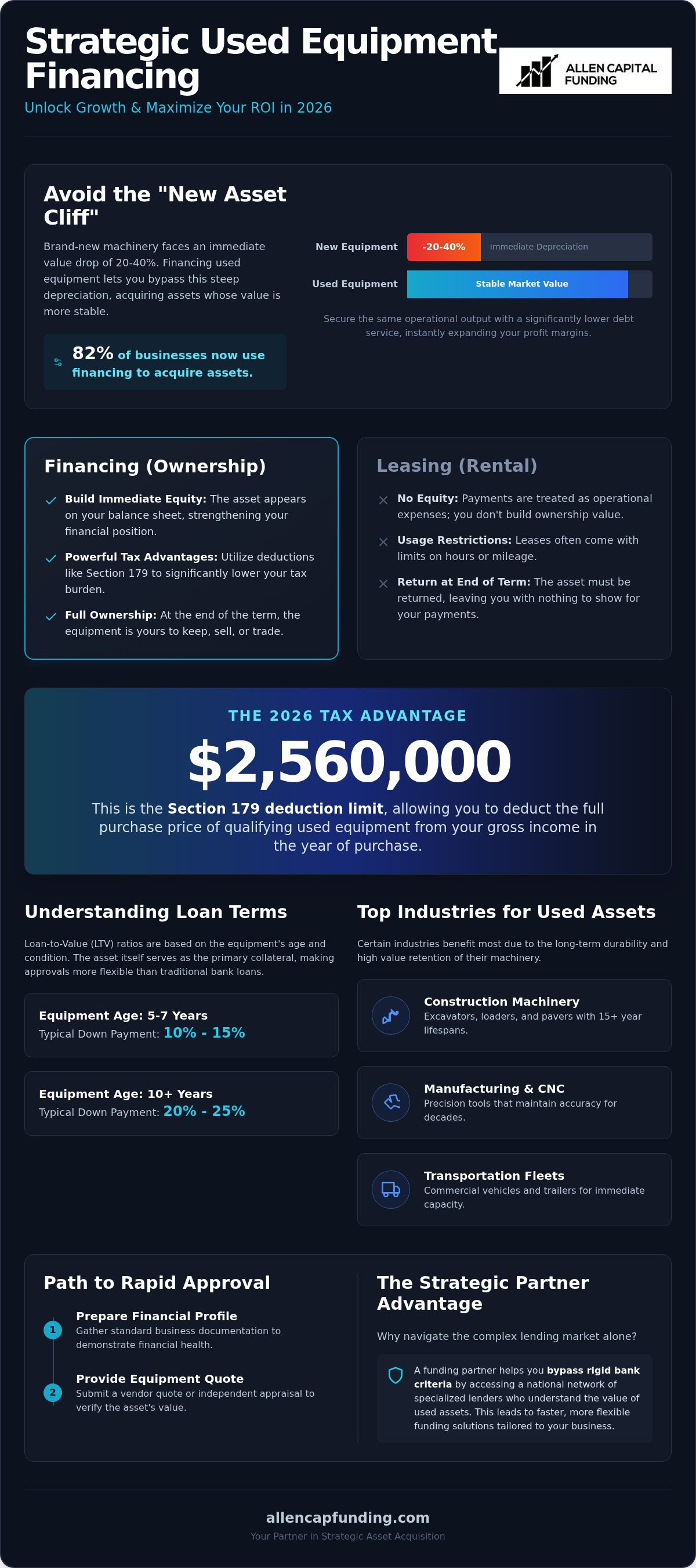
At its core, used equipment financing is a specialized commercial loan where a pre-owned asset serves as the primary collateral for the debt. Unlike unsecured lending, the value of the machinery itself secures the capital, which often leads to more favorable terms for the borrower. While standard business equipment financing often focuses on brand-new acquisitions, used-market lending requires a deeper understanding of an asset's remaining lifecycle. Recent data from the 2026 Industrial Equipment Guide shows that 82% of businesses now use some form of financing to acquire assets, reflecting a massive shift toward capital preservation.
Lenders protect their interest in the machinery through a UCC-1 filing. This public notice establishes a legal lien on the equipment until the loan is fully satisfied. Interestingly, many specialty lenders view used equipment as a lower-risk asset because it has already survived the initial "new asset cliff." Since the steepest part of the depreciation curve is in the past, the equipment's market value remains relatively stable. This stability provides a more predictable collateral base for the lender and a more manageable debt-to-equity ratio for your business.
The Mechanics of Asset-Based Used Loans
Success in this space depends heavily on the Loan-to-Value (LTV) ratio. For equipment that's 5 to 7 years old, lenders typically require a 10% to 15% down payment. If the machinery is over 10 years old, that requirement may increase to 20% or 25% to account for increased maintenance risks. The age of the machinery also dictates the available term length; most lenders won't extend a loan beyond the equipment's useful life. To verify these values, you'll need an independent appraisal or a detailed vendor quote. This process ensures the debt structure aligns with the asset's real-world utility, often mimicking the structure of a Finance lease where ownership is the goal from day one.
Commonly Financed Used Assets in 2026
Certain industries are particularly well-suited for used equipment financing because of the inherent durability of their machinery. We frequently see business owners leverage capital for:
Construction Machinery: Excavators, loaders, and pavers often have 15-year lifespans, making a 5-year-old model a high-value strategic buy.
Manufacturing and CNC: Precision tools and CNC machines maintain high operational accuracy for decades if maintained properly.
Transportation Fleets: Commercial vehicles and logistics trailers are staples of the used market, offering immediate operational capacity for national routes.
The Financial Logic: Why Used Assets Outperform New in 2026
Buying new often feels like a safe bet, but the financial reality tells a different story. The moment a piece of heavy machinery leaves the dealer lot, it faces the "New Asset Cliff," an immediate value drop of 20% to 40%. By choosing used equipment financing, you sidestep this steep depreciation. You're essentially letting a previous owner pay for the most expensive years of the machine's life while you reap the benefits of its continued productivity.
Operational output rarely justifies the premium of a brand-new model. A well-maintained 5-year-old excavator or CNC machine typically produces the same hourly revenue as a model manufactured this year. When your debt service is 30% lower but your billing rate remains identical, your profit margins expand instantly. This arbitrage allows you to reallocate those savings into working capital solutions to fund inventory surges or payroll during expansion. Using fixed-rate financing also acts as a vital hedge against 2026 market volatility, locking in predictable costs regardless of inflation.
ROI and Capital Allocation Strategy
ROI in the context of 2026 used equipment acquisition is the ratio of net profit generated by the asset relative to the significantly lower entry cost of pre-owned machinery. Calculating your Internal Rate of Return (IRR) becomes much more attractive when the initial investment is reduced. Financing used assets preserves your liquid cash, providing a vital buffer for emergency reserves. This strategy ensures your capital isn't trapped in a depreciating metal box but is instead available to fuel growth. If you're looking to optimize your balance sheet, exploring our tailored Equipment Financing options can provide the flexibility you need.
Section 179 and Used Equipment
Tax efficiency is a major driver for the used market. For the 2026 tax year, the Section 179 deduction limit is $2,560,000, and it applies to "new-to-you" used equipment just as it does to new machinery. You can often expense the full purchase price in the first year, combining that deduction with the ability to write off interest payments. Qualification standards often align with EXIM Bank used equipment policies, which emphasize the remaining useful life and condition of the asset. To ensure your debt structure matches your specific tax goals, consider scheduling a strategic financial check-up with a partner who understands your holistic capital stack.
Used Equipment Financing vs. Leasing: Choosing Your Path
Choosing between a loan and a lease is a strategic decision that shapes your company's financial future. While many providers push leasing as a low-friction entry point, used equipment financing through a commercial loan offers a distinct advantage. It provides immediate ownership. When you secure a loan, the title typically transfers to your business at the start. This allows you to build equity with every payment, turning a monthly expense into a growing asset on your balance sheet. Ownership means you aren't just paying for the use of a machine; you're investing in your company's net worth.
Leases often come with restrictive end-of-term buyouts or "fair market value" clauses that can lead to unexpected costs. In contrast, a loan provides a clear, predictable path to full ownership. This structure also offers superior customization. If your business is seasonal, we can often structure payments to match your peak revenue months. Over the total lifecycle of the machine, a loan is generally the more cost-effective choice. It avoids the recurring "rent" of a lease and puts you in full control of the asset's eventual resale value. Typical repayment terms range from 2 to 7 years, allowing you to match the debt to the equipment's remaining useful life.
When a Used Equipment Loan is Optimal
A loan is the best path for assets with significant remaining utility, typically seven to ten years or more. This allows you to maximize the tax benefits discussed earlier, including the $2,560,000 Section 179 deduction limit for 2026. By owning the asset, you can also integrate this debt into broader asset-based lending strategies. This approach uses your equipment equity to unlock further liquidity, creating a self-sustaining cycle of growth. It's a proactive way to ensure your balance sheet remains a tool for expansion rather than a static record of expenses.
When to Consider Leasing Used Assets
Leasing remains a viable tool for specific, short-term needs. If you have a project lasting only 18 to 24 months and don't want the burden of long-term maintenance, a lease might fit. It requires the lowest possible initial cash outlay, which is helpful if your primary goal is preserving day-to-day liquidity. However, for many entrepreneurs, a lease can feel like a perpetual expense. If you only need a temporary cash injection for equipment-related costs, a short-term business line of credit draw may provide more flexibility. This allows you to address immediate gaps without the long-term commitment of a lease or specialized used equipment financing agreement.
How to Qualify for Used Equipment Loans in 2026
Qualifying for used equipment financing in 2026 requires a more detailed approach than securing capital for new machinery. Lenders need to verify the asset's value and your company's ability to service the debt simultaneously. Following a structured preparation process ensures you move through the approval phase quickly and avoid the long delays typical of traditional banks.
Step 1: Secure a detailed quote from the seller. This must include the serial number, model year, and a verified count of hours or mileage.
Step 2: Organize your financial profile. Be ready to provide the last two years of business tax returns and a current year-to-date Profit and Loss (P&L) statement.
Step 3: Review your credit tier. Lenders look at both personal and business credit scores to determine your risk profile and interest rate eligibility.
Step 4: Verify the equipment's condition. Many lenders require a third-party inspection to confirm the machinery is in good working order and matches the seller's description.
Step 5: Work with a strategic funding partner. This allows you to bypass rigid bank boxes and access a national network of lenders who specialize in your specific industry.
The implementation of the CFPB's Section 1071 in 2026 now requires detailed reporting on equipment financing transactions over $50,000. This means lenders are more meticulous with data collection. Having your documentation ready before you apply is the best way to accelerate the process.
Lender Criteria in the 2026 Landscape
Lenders use the Debt Service Coverage Ratio (DSCR) to measure your ability to pay. Most institutions look for a DSCR of 1.25x or higher to ensure your cash flow can comfortably handle the new obligation. Another critical factor is the "age plus term" rule; for example, if the equipment is 8 years old and you want a 5-year term, the total of 13 years must typically fall under a 15-year cap. In 2026, borrowers with FICO scores above 720 typically access prime rates between 6% and 9%, while scores below 650 often see APRs ranging from 15% to 22% due to increased risk profiles.
Navigating Automation and Tech Upgrades
The 2026 market shows a strong preference for automation and "green tech." Financing used robotics or automated manufacturing cells requires a lender who understands the residual value of high-tech components. Specialized lending is also growing for pre-owned equipment with energy-efficient certifications. You can use strategic business equipment financing to modernize older facilities with these advanced assets without the cost of buying new. If you are ready to secure the machinery your business needs, apply for equipment financing today and let our team build a custom solution for your growth.
Navigating the 2026 Market with a Strategic Funding Partner
Many business owners fall into the "Single Bank Trap" during their search for capital. They approach their primary financial institution, receive a rejection based on rigid internal criteria, and assume their search has reached a dead end. In reality, traditional banks often operate within narrow "boxes" that exclude older machinery or specific industries. A rejection from one bank isn't a reflection of your business's health; it's often just a sign that you don't fit that specific lender's current risk appetite. This is why a strategic partner is essential for securing used equipment financing in a complex market.
The broker advantage lies in access and advocacy. Instead of being limited to one set of rules, you gain entry to a national network of specialized lenders who prefer specific asset classes. Some lenders focus exclusively on heavy construction, while others specialize in medical technology or transportation. An expert guide understands these nuances and positions your application to the lenders most likely to approve it. This partnership also allows for high levels of customization. We can often negotiate skip-payment schedules for seasonal businesses or adjust terms to align with your specific cash flow cycles, providing a level of flexibility that traditional institutions rarely offer.
The Allen Capital Funding Advantage
At Allen Capital Funding, we maintain a partnership-driven mindset that looks far beyond a single transaction. We act as a steady, reliable hand, guiding you through the documentation process and pushing for approvals with speed and precision. While a traditional bank might take weeks or months to process an application, our proactive approach focuses on "accelerated success." We function as a bridge between your current operational state and your future growth goals. Our national reach ensures you aren't limited by local economic conditions, giving you access to the most competitive terms available across the entire United States lending landscape.
Integrating Your Capital Stack
Effective used equipment financing should never exist in a vacuum. It works best when it's integrated into a holistic capital stack that might include SBA loans, credit lines, or working capital solutions. By coordinating these different funding sources, we help you reduce administrative friction and preserve your liquid reserves for unexpected opportunities. This strategic alignment ensures that your debt structure supports your long-term stability rather than just solving a short-term equipment need. We focus on removing the barriers to progress so you can stay focused on running your business. Ready to expand your capacity? Book your strategic consultation today.
Take Control of Your Operational Growth
Strategic asset acquisition in 2026 is about building a capital stack that protects your cash flow while driving immediate revenue. By leveraging used equipment financing, you sidestep the massive depreciation of new assets and put your capital to work where it matters most. You now understand how to navigate the current tax limits and why ownership equity consistently outperforms the long-term costs of a lease. Success requires moving beyond the limits of a single bank and working with a partner who understands your industry's specific needs.
Allen Capital Funding acts as your national strategic ally, providing expert guidance on asset-based lending and cash-flow optimization. We provide access to diverse capital networks that bypass rigid institutional boxes to ensure you get the speed and customization your business deserves. Secure the equipment your business needs; book a consultation with Allen Capital Funding today. We're ready to help you remove the barriers to your progress and accelerate your future goals.
Frequently Asked Questions
Can I finance used equipment from a private seller?
Yes, you can finance used equipment from a private seller, though the process requires additional verification compared to a dealership purchase. Lenders typically require a clear title, a detailed bill of sale, and often a third-party inspection to verify the asset's condition and serial number. We help facilitate these transactions by coordinating with the seller to ensure the funding is secure and the ownership transfer is legally documented for your protection.
What is the maximum age for used equipment to be eligible for financing in 2026?
Most lenders follow an "age plus term" rule that generally caps the total at 15 years. For example, a 10-year-old machine could be eligible for a 5-year term. However, specialized used equipment financing providers can sometimes extend this for high-value assets like CNC machines or heavy construction equipment with long operational lifespans. We review each piece of machinery individually to find a lender whose criteria match the specific age and utility of your asset.
Do I need a down payment for used equipment financing?
Down payment requirements typically range from 0% to 25% based on your credit quality and the equipment's age. For machinery that's 5 to 7 years old, a 10% to 15% down payment is standard. Older assets or those with weaker resale markets may require up to 25%. We work to minimize your initial cash outlay by leveraging our national network of lenders to find the most flexible terms for your specific financial profile.
What credit score is required for used equipment loans?
While prime rates between 6% and 9% are generally reserved for borrowers with FICO scores above 720, solutions exist for scores as low as 600. Lenders for used assets often look at the overall health of your business and the value of the collateral rather than just a single number. If your score is lower, you might face interest rates between 15% and 22%, but we focus on structuring the debt to remain manageable.
How long does the approval process take for used machinery?
The approval process can be as fast as 24 to 48 hours when working with specialized non-bank lenders. Traditional institutions often take weeks or months to review used assets due to rigid appraisal requirements. Our proactive approach streamlines the documentation phase, allowing us to move from application to funding in as little as one to five days. This speed ensures you can secure high-demand equipment before a competitor makes a move on the same asset.
Can I finance the shipping and refurbishment costs of used equipment?
Yes, many lenders allow you to bundle "soft costs" like shipping, installation, and initial refurbishment into the total loan amount. Financing these expenses preserves your liquid working capital for daily operations rather than tying it up in logistics. We specialize in tailoring capital stacks that cover the full acquisition cost, ensuring your equipment is job-ready the moment it arrives at your facility without draining your cash reserves for the move or setup.
Does Section 179 apply to used equipment purchases?
Yes, Section 179 applies to used equipment as long as it's "new to you" and used for business purposes. For the 2026 tax year, the maximum deduction is $2,560,000. This allows you to deduct the full purchase price of the equipment in the first year it's placed in service. It's a powerful tool for maximizing ROI and reducing your overall tax liability while simultaneously upgrading your operational capacity with pre-owned machinery.
What happens if the used equipment breaks down before the loan is paid off?
You remain responsible for the loan payments even if the equipment experiences a mechanical failure. This is why we recommend thorough third-party inspections and considering aftermarket warranties or equipment breakdown insurance during the acquisition process. Because used equipment financing uses the asset as collateral, maintaining the machine's condition is vital. If a major breakdown occurs, you can explore working capital solutions to fund repairs while keeping your primary equipment debt current and your operations moving.


Comments