


How to Choose a Small Business Lender: 2026 Guide
- anthonyarallen
- 3 days ago
- 12 min read
The most expensive loan isn't the one with the highest interest rate; it's the one that arrives too late to capture a market opportunity. If you've felt the frustration of waiting on a traditional bank while a competitor gains ground, you know that timing and strategy matter. Speed is everything. Learning how to choose a small business lender is no longer just about finding the lowest APR. It's about identifying a strategic partner who understands your industry's specific rhythm and can move at the pace of your business.
We recognize that complex fee structures and the fear of predatory terms can make the search for capital feel overwhelming. You deserve a clear path to the funds you need without hidden surprises. You need clarity. In this 2026 guide, you'll master a professional evaluation framework designed to help you vet potential partners with confidence. We'll provide a clear comparison framework to help you secure faster access to capital and build a long-term relationship with a lender that fuels your strategic growth.
Table of Contents
Navigating the Business Lending Ecosystem in 2026
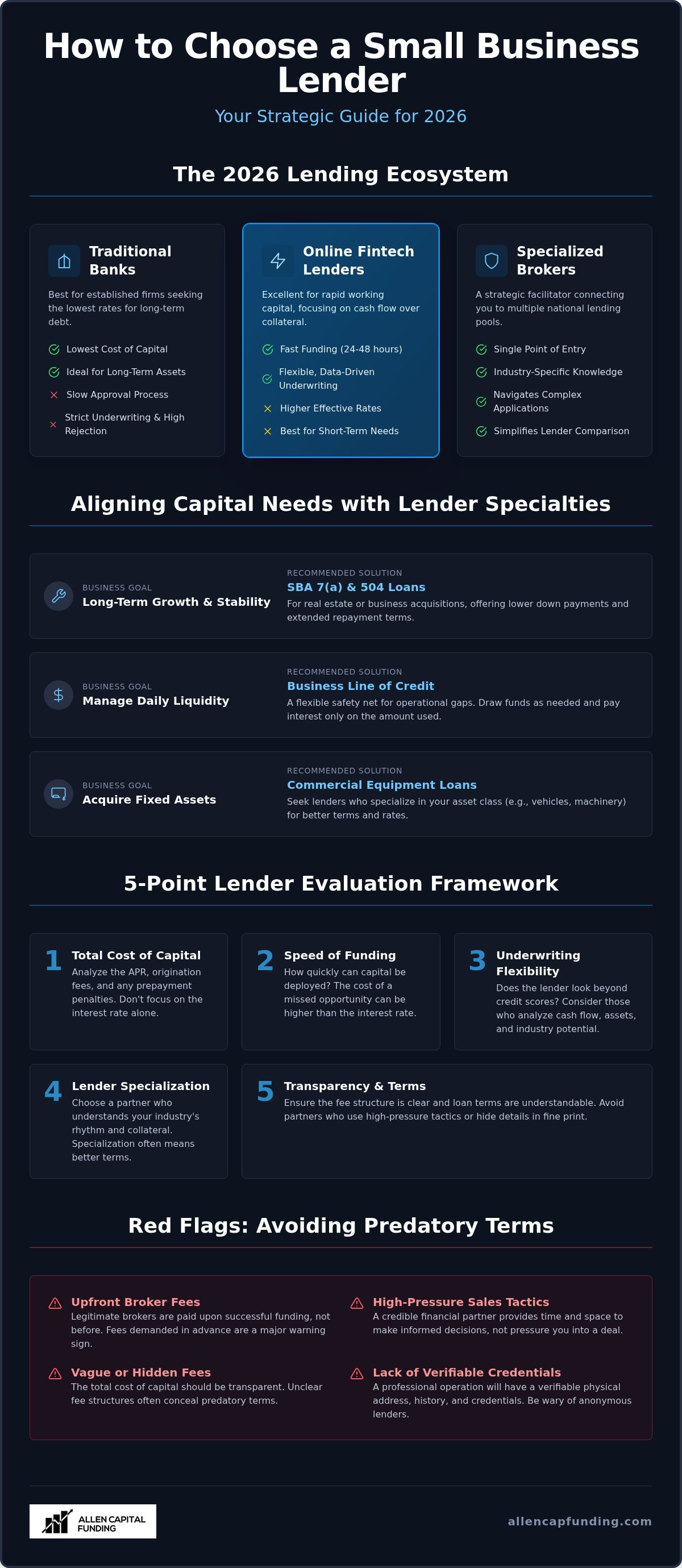
The 2026 lending market has moved away from rigid, one size fits all products toward highly specialized capital solutions. Understanding the players in this ecosystem is the first step in learning how to choose a small business lender who can actually meet your growth targets. The current landscape is defined by three primary categories: traditional banks, online fintech platforms, and specialized brokers. While institutional lending remains a pillar of the economy, alternative sources like factoring and purchase order financing have gained significant ground by offering asset-based flexibility that traditional debt can't match.
The fundamental trade-off in this market is speed versus total cost of capital. Institutional funds are typically the most affordable but require extensive documentation and weeks of underwriting. Conversely, alternative sources prioritize rapid deployment, sometimes funding within 24 to 48 hours, though they carry higher effective rates. Identifying where your business sits on this spectrum determines your ideal path. You must decide if saving on interest is more important than the immediate opportunity cost of waiting for a traditional approval.
Traditional Banks vs. Online Lenders
Traditional banks prioritize stability and long-term operating history. They remain the best choice for established firms seeking the lowest possible rates for long-term debt. However, their risk appetite is often narrow, leading to high rejection rates for newer ventures. Online fintech platforms have filled this gap by using real-time data to assess risk. These platforms excel at providing rapid working capital draws, often focusing on cash flow rather than collateral. National credit unions have also emerged as a vital hybrid option, offering competitive rates similar to banks but with a more community-focused underwriting approach. Exploring different Types of business loans helps clarify which of these institutions aligns with your current balance sheet.
The Strategic Role of a Loan Broker
A specialized broker acts as a dedicated guide through a crowded marketplace. Rather than applying to individual banks one by one, you gain a single point of entry to multiple national lending pools. This is particularly valuable when you are learning how to choose a small business lender and navigating the complex SBA application process, where a single missing document can stall your progress for months. Brokers bring industry-specific knowledge to the table, which is essential for securing technical equipment financing or complex asset-based lines. By acting as a facilitator, a broker simplifies the path to progress, ensuring you don't just find a lender, but the right partner for your specific trajectory.
Aligning Your Capital Needs with Lender Specialities
Successful financing begins with a clear objective. You must decide if you are funding aggressive growth, managing daily liquidity, or acquiring long-term assets. This distinction is the most important factor in how to choose a small business lender. If your goal is long-term stability, SBA 7(a) and 504 programs are excellent for real estate or business acquisitions. They offer lower down payments and longer repayment schedules than most conventional products. Comparing small business lenders often reveals that while SBA terms are attractive, the underwriting is rigorous and specific to the asset being financed.
For operational gaps or seasonal fluctuations, a business line of credit is often the superior tool. It acts as a safety net, allowing you to draw capital only when needed and pay interest only on the utilized amount. This keeps your balance sheet lean while ensuring you never miss a payroll or inventory purchase.
Financing Fixed Assets: Equipment and Real Estate
When you need to upgrade your fleet or facility, look for lenders who specialize in that specific asset class. A commercial equipment loan from a specialist often comes with better terms because the lender understands the equipment's residual value. Generalist lenders may impose stricter terms because they perceive higher risk in assets they don't frequently handle. For real estate, prioritize lenders with national secondary market access. This ensures they can offer competitive pricing and flexible structures that local banks might lack. Selecting a partner based on their appetite for your specific collateral can drastically reduce your cost of capital.
Working Capital and Liquidity Solutions
If your business is growing faster than your cash flow allows, consider partners who offer purchase order and invoice financing. These lenders focus on the creditworthiness of your customers rather than your own financial history. This is where asset-based lending becomes a strategic advantage. These lenders view your balance sheet through the lens of liquidity, unlocking value from your accounts receivable and inventory. Identifying "speed-to-capital" leaders is essential for emergency operational needs where a delay of even a few days could disrupt your supply chain. If you want to see where your business currently stands, starting with a financial check-up is a proactive way to identify your best lending options.
The 5-Point Evaluation Framework for Comparing Lenders
Most advice on how to choose a small business lender focuses on your credit score or collateral. While those factors matter, a professional evaluation requires you to audit the lender's performance as a strategic partner. You aren't just looking for money; you're looking for a reliable financial engine. A high quality partner should be evaluated across five specific pillars: cost, flexibility, velocity, transparency, and support. This shift in perspective ensures you don't just qualify for a loan but secure a partnership that accelerates your success.
Understanding how to compare small business loans involves looking past the headline interest rate. You must weigh the funding velocity, which is the realistic timeline from your first application to the moment capital hits your account. Some lenders promise speed but get bogged down in manual underwriting. Others prioritize underwriting flexibility, placing more weight on your consistent cash flow than a static credit score. Finally, demand transparency regarding prepayment penalties and verify that the lender provides post-funding support, such as revolving draws or strategic financial check-ups.
Calculating the True Cost of Borrowing
Total Cost of Capital is the sum of all interest, origination fees, and closing costs associated with a loan over its entire duration. This figure is the only metric that allows for an honest comparison between different offers. Be vigilant for hidden balloon payments in commercial contracts that can cause a liquidity crisis at the end of the term. In the 2026 economic environment, you must also decide between fixed and variable rates. Fixed rates provide predictable overhead, while variable rates may offer lower initial costs but carry the risk of future market volatility.
Assessing Lender Reliability and Reputation
Professionalism isn't just about a polished website. You must verify national lending licenses and industry affiliations to ensure you're working with a legitimate institution. One of the most significant indicators of a quality lender is whether you have direct access to a dedicated underwriting team. This access allows for nuanced conversations about your business's unique trajectory that automated systems might miss. When reviewing client testimonials, look for stories of strategic growth rather than just "fast cash." A lender that helps a client scale through complex equipment financing or SBA guidance is far more valuable than one that simply provides a one-time draw.
Red Flags: Avoiding Common Selection Pitfalls
Protecting your business from predatory practices is as critical as finding the right rate. When you're learning how to choose a small business lender, you'll encounter various offers that seem too good to be true. Legitimate national lenders and brokers rarely charge upfront fees before providing a formal term sheet. If a firm asks for an "application fee" or "processing fee" just to review your file, walk away. These are often signs of a firm that prioritizes volume over your strategic success.
High-pressure tactics are another major warning sign. Business finance is a strategic decision, not a flash sale. Any lender using "limited time offers" to force a signature is likely hiding unfavorable terms. Similarly, be wary of vague language. If a lender quotes "approximate" daily rates instead of a clear APR or total cost of capital, they are obscuring the true expense of the draw. Stacking loans is perhaps the most dangerous pitfall. This happens when a lender encourages you to take a second or third short-term draw on top of an existing one. This practice can quickly cripple your debt-service coverage ratio, leaving you with no room for operational errors.
The Danger of Unsecured "Easy" Capital
Speed can be a liability if it comes at the cost of your company's health. Merchant cash advances often carry effective APRs that can exceed 50% or even 100% when calculated annually. Aggressive lenders may push for "stacking," which involves taking multiple high-interest draws simultaneously. This rarely solves a cash flow problem; it usually accelerates a liquidity crisis. To protect your business during the shopping phase, ensure lenders only perform soft credit pulls until you're ready to move forward with a specific term sheet.
Questions to Ask Every Potential Lender
Transparency is non-negotiable. Before signing any agreement, request a full amortization schedule that shows exactly how much of each payment goes toward principal versus interest. Ask specifically about early payoff incentives. Some lenders charge the full interest amount even if you pay back the loan early, while others offer discounts for accelerated repayment. Finally, verify the lender's experience with your specific NAICS industry code. A lender who understands your sector's seasonal cycles is a partner; one who doesn't is just a creditor. If you're concerned about predatory terms, you can start a financial check-up to evaluate your current options with a trusted guide.
Allen Capital Funding: Your National Facilitator for Strategic Capital
Mastering how to choose a small business lender is the foundation of your financial strategy, but the search for the right partner doesn't have to be a solo effort. Allen Capital Funding acts as a vital bridge between your business and expansive national SBA and commercial capital pools. We don't just point you toward a list of lenders; we act as a dedicated facilitator. Our team navigates the complexities of the national market to find the specific institution that matches your unique growth trajectory and risk profile. This proactive approach saves you from the frustration of slow bank timelines and the confusion of mismatched terms.
Our methodology centers on the "Financial Check-Up." This diagnostic approach allows us to tailor solutions to your actual operational needs rather than offering generic, high-interest products. We remove the significant processing burden by handling the heavy lifting of documentation and underwriting communication. This specialized support ensures your application is positioned for success before it ever reaches a lender's desk. By simplifying the path to progress, we allow you to stay focused on your daily operations while we accelerate your access to the capital needed for expansion.
A Partnership-Driven Approach to Funding
We believe in moving away from transactional borrowing and toward strategic financial planning. A steady hand is essential in complex markets where underwriting standards can shift overnight. Our dedicated team provides this stability by acting as your strategic consultant. We help you build a customized funding portfolio that might combine an SBA loan for long-term real estate with a flexible credit line for working capital or equipment financing for new technology. This holistic view ensures that every dollar of debt is working toward a specific strategic goal, rather than just filling a temporary gap. When you understand how to choose a small business lender through a partnership lens, you unlock a higher level of financial security.
Next Steps: Securing Your Business’s Future
Securing your future starts with a clear, actionable plan. Preparing your financial profile for a successful national draw requires attention to detail and a deep understanding of what institutional underwriters are looking for in 2026. We act as your proactive ally throughout this entire journey, removing barriers that often stall business growth. When you are ready to move beyond the confusion of the general marketplace, you can Speak with a Strategic Funding Specialist at Allen Capital Funding. Booking an online consultation is the first step toward a tailored capital strategy that respects your time and fuels your long-term vision.
Accelerate Your Business Growth with Strategic Capital
You now have a professional framework for evaluating the lending market with confidence. By focusing on the total cost of capital and aligning your specific needs with lender specialties, you move beyond transactional borrowing. You've mastered how to choose a small business lender by spotting red flags and prioritizing long-term partnership over fast, high-interest cash. This strategic approach ensures your debt fuels expansion rather than creating a liquidity trap.
Allen Capital Funding acts as your dedicated guide in this complex landscape. Our team offers expert guidance on SBA 7(a) and 504 programs, along with access to a wide range of national asset-based lending products. We provide tailored, strategic capital solutions that simplify the path to progress for every client we serve. We don't just find you a loan; we help you build a sustainable financial foundation.
Ready to identify the ideal funding path for your next phase of growth? Book a Strategic Financial Consultation with Allen Capital Funding today. Your business's future depends on the partners you choose; let's build that success together.
Frequently Asked Questions
How do I choose between a bank and an online lender?
Banks remain the gold standard for low interest rates and long-term debt like SBA loans. They require strong credit and extensive history. Online lenders prioritize speed and cash flow metrics over collateral. Choose a bank if you have 30 to 90 days to wait and want the lowest APR. Select an online lender if you need capital within 48 hours to secure inventory or handle an emergency.
Is it better to work with a loan broker or go directly to a lender?
Working with a specialized broker is often the more strategic path for complex capital needs. A broker acts as a facilitator, providing a single point of entry to multiple national lending pools simultaneously. This prevents you from being rejected by one bank and having nowhere else to go. Brokers are particularly valuable for navigating the rigorous SBA 7(a) application process, ensuring your documentation meets specific requirements before submission.
What are the main criteria lenders use to evaluate small businesses in 2026?
Lenders in 2026 prioritize your debt-service coverage ratio and consistent cash flow over static credit scores. They want to see that your business generates enough monthly revenue to comfortably cover new loan payments. Additionally, the quality of your accounts receivable and the residual value of your equipment play a major role in asset-based underwriting. Understanding these metrics is essential when learning how to choose a small business lender that fits your profile.
How much does it cost to use a business loan broker?
Most legitimate national brokers operate on a success-fee basis, meaning they are paid by the lender once your loan is funded. You should not pay upfront application or consultation fees before receiving a term sheet. While the broker's commission is often baked into the loan's origination fee, their ability to negotiate better terms across multiple lenders frequently results in a lower total cost of capital for your business.
Can I get a small business loan with a low credit score?
You can secure capital with a lower credit score by shifting the focus to your business assets. Factoring and purchase order financing rely on the creditworthiness of your customers rather than your personal score. Similarly, equipment financing uses the machinery itself as collateral, reducing the lender's risk. These specialized solutions provide a path to progress for growing companies that don't yet meet the rigid credit requirements of traditional national banks.
What is the fastest way to get a small business loan approved?
The fastest approval path is through online fintech platforms that utilize automated data links to your accounting software. However, the most reliable way to accelerate any draw is to have a complete funding package ready. This includes three years of tax returns, current year-to-date financials, and a clear debt schedule. A dedicated guide can help you organize these documents to ensure your application moves through underwriting without the typical delays.
What documents should I have ready before choosing a lender?
Preparation is key to a smooth funding process. You should have your last three years of federal business tax returns, a current profit and loss statement, and a clean balance sheet ready. If you are seeking asset-based solutions, keep an updated accounts receivable aging report and a list of equipment with serial numbers. Having these documents organized allows you to compare offers quickly when you are deciding how to choose a small business lender.
How do I know if a small business lender is legitimate?
Legitimate lenders maintain clear national licenses and a transparent physical presence. You can verify their reputation through industry affiliations and by checking for secure, encrypted application portals. A major sign of legitimacy is the absence of high-pressure sales tactics or requests for upfront payments before you sign a contract. Reliable partners focus on your long-term success and provide clear, written disclosure of all fees, interest rates, and repayment terms before funding.


Comments