


How to Increase Your Business Line of Credit: A Strategic 2026 Guide
- anthonyarallen
- 2 days ago
- 12 min read
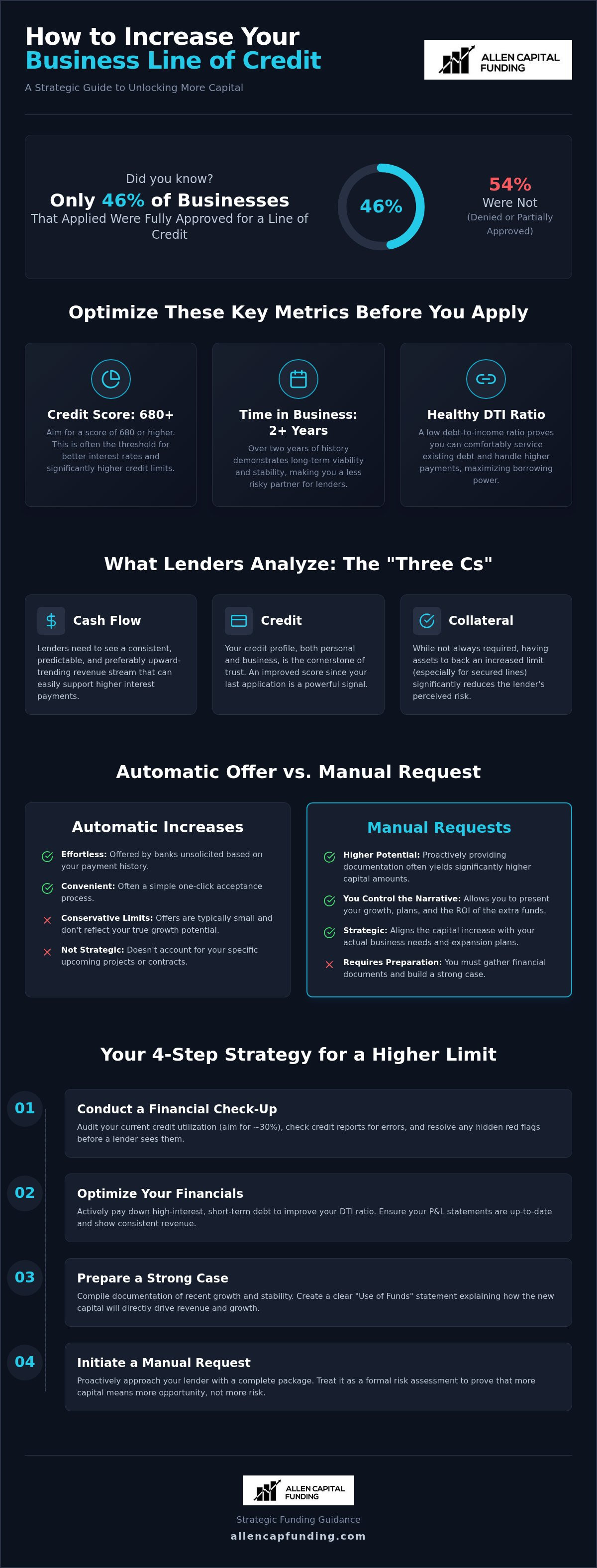
Did you know that only 46% of businesses that applied for a business line of credit recently were fully approved? It's a frustrating reality when your expansion plans are ready to accelerate, but your capital cushion remains stuck. You've likely felt the sting of stagnant growth because of rigid bank limits and a lack of clarity on what metrics lenders actually prioritize. Understanding exactly how to increase business line of credit limits isn't about luck; it's about a 90-day strategic campaign to optimize your financial profile and prove your scalability.
We recognize that capital constraints can feel like a ceiling on your ambition. This guide promises to reveal the specific financial levers and strategic steps required to secure a higher limit and fuel your company's growth. We'll explore how to position your business as a preferred partner by focusing on cash flow consistency and debt management, even with the current WSJ Prime Rate at 6.75%. You'll learn how a proactive financial check-up and a tailored approach to lender relationships can help you maintain low interest rates while establishing the flexible capital you need to move forward with confidence.
Table of Contents
Understanding the Business Line of Credit Increase
A credit line increase is much more than just a higher number on your monthly statement. It represents a strategic expansion of your borrowing capacity, providing you with the agility needed to outpace competitors. Understanding how to increase business line of credit limits is essential for any scaling enterprise. Having a business line of credit acts as a vital growth tool, but securing more capital requires understanding the lender's perspective. When you ask for more, the lender doesn't just see a request; they see a new risk assessment. They'll evaluate your current financial health with the same rigor as a brand-new application.
Why Lenders Approve (or Deny) Higher Limits
Lenders typically base their decisions on the "Three Cs": Cash flow, Credit, and Collateral. They need to see a consistent revenue stream that can comfortably support higher interest payments. Your credit profile remains the cornerstone of trust. If your score has improved since your last application, you're in a much stronger position. Collateral also matters, especially for secured lines where assets back the increased limit.
Your utilization rate is another critical factor. If you're consistently using 90% of your available credit, a lender might view you as over-leveraged. Conversely, using about 30% and paying it down regularly shows you can handle more. In 2026, lenders are also looking at industry-specific economic trends. If your sector is thriving, they're more likely to extend more capital. We often recommend a Financial Check-Up before you make the move to ensure your metrics align with what lenders want to see.
Automatic vs. Manual Increases
Banks sometimes offer unsolicited limit hikes. These automatic increases are usually triggered by consistent, on-time payments and a stable banking relationship. While it's tempting to just click "accept," these offers are often conservative. They don't account for your specific growth plans or upcoming contracts. You might get a small bump, but it rarely matches the full potential of your business's performance.
Manual requests are where the real potential lies. By initiating the request, you control the narrative. You can provide updated financial statements and a clear "Use of Funds" plan. This proactive approach is the best way to master how to increase business line of credit limits to the level your business actually requires. Manual requests often yield significantly higher capital amounts because they allow you to prove the ROI of the additional funds. It's about showing the lender that more capital doesn't mean more risk, but rather more opportunity.
Key Metrics to Optimize Before Requesting More Capital
Lenders don't just look at your current balance; they analyze your financial trajectory. To master how to increase business line of credit limits, you must first master your internal metrics. Aim for a personal credit score of at least 680. While some lenders accept lower scores, 680 is often the threshold for better rates and higher limits. A higher score reduces the lender's perceived risk, which directly translates to a higher ceiling. Time in business also acts as a risk stabilizer. Businesses with over two years of history are significantly more likely to receive favorable bank-tier pricing. Operating for five or more years often unlocks even more aggressive funding options because it demonstrates long-term viability.
Improving Your Debt-to-Income Ratio
Your debt-to-income (DTI) ratio is a direct reflection of your borrowing power. If too much of your monthly revenue goes toward servicing existing debt, lenders will hesitate to add more. Start by paying down short-term, high-interest debt that clutters your balance sheet. This might include credit card balances or high-cost merchant cash advances. Consolidating smaller, fragmented loans into a single monthly payment can also improve your profile by simplifying your cash flow. Before you approach your lender, performing a thorough Financial Check-Up ensures you aren't walking into a negotiation with hidden red flags. It gives you the chance to fix errors on your credit report or adjust your spending before a formal review.
Revenue Documentation and Transparency
Revenue isn't just about the total amount; it's about consistency. Lenders prefer upward-trending monthly revenue over sporadic spikes. Up-to-date profit and loss (P&L) statements are non-negotiable in 2026. Many lenders now utilize bank-linked applications, such as AMEX Blueprint, to verify cash flow in real-time. These tools provide an automated, transparent view of your finances, making the approval process faster and more reliable. You can also leverage your accounts receivable to prove future cash flow. Showing a strong pipeline of incoming payments from reputable clients demonstrates that you have the means to repay a higher limit. This transparency acts as a bridge of trust between your current state and your future goals.
The Request Protocol: A Step-by-Step Increase Strategy
Securing more capital isn't a matter of luck; it's a tactical campaign. To master how to increase business line of credit limits, you need a disciplined approach. Start by auditing your current utilization. If you're consistently maxed out, lenders see desperation rather than growth. Aim to keep your usage below 30% for at least three months before making your move. Next, verify that your payment history is spotless. Even one minor late payment can derail an increase request. Once your internal house is in order, prepare your documentation. This includes updated P&L statements, recent tax returns, and current bank statements. Finally, be ready to negotiate. If a lender offers less than you need, present your growth projections again to justify the higher amount. Don't be afraid to ask for the specific reasons behind a lower offer so you can address them directly.
Timing Your Request for Maximum Success
Timing is everything in finance. Never ask for an increase when you're in the middle of a cash crunch. Lenders smell risk when you're desperate for liquidity to cover basic overhead. Instead, aim for the "Golden Window" right after a profitable quarter or immediately following a major contract win. This proves your business has the momentum to handle more debt safely. If your business is seasonal, request the increase during your peak season when your bank statements look their strongest. This proactive timing shows you're planning for future growth, not just trying to survive a dry spell. It positions you as a steady, reliable hand in your company's financial journey.
The "Use of Funds" Narrative
Lenders want to know your "why." Moving your language from "we need money" to "we are scaling operations" changes the entire risk profile of your request. A clear narrative reduces the lender's perceived risk by showing a specific path to repayment. For example, explain how the additional capital will fund an inventory surge for a confirmed holiday rush or allow you to hire a key sales lead who will drive new revenue. Using funds for new equipment that increases production capacity is another strong argument that lenders appreciate. This growth-oriented focus is the most effective way to show how to increase business line of credit capacity while maintaining the lender's trust. If your current bank has a rigid cap that doesn't match your ambition, it may be time to seek an external partner who can find higher limits elsewhere.
When you formally request the increase, treat it like a brand-new application. Provide current bank statements and proof of any new recurring revenue that wasn't present during your initial filing. If the offer comes back lower than requested, ask if additional collateral or a personal guarantee might bridge the gap. Addressing the difference between an internal increase and seeking a new line is also vital. Sometimes your current lender simply hits a "ceiling" for your industry, and the only path to more capital is through a strategic partner with a higher risk appetite.
Internal Increase vs. Seeking a New Credit Line
Choosing between an internal request and a brand-new application is a pivotal decision. Many business owners assume staying with their current bank is always the easiest path. However, every lender has a "ceiling" based on their specific risk appetite and industry focus. If your current limit is $50,000 but your growth requires $250,000, your bank might simply be unable to meet that need regardless of your performance. Understanding how to increase business line of credit limits often means recognizing when you've outgrown your current provider, especially as your business cycles shift from survival to rapid expansion. While a new application typically involves a hard credit pull, the trade-off is often a significantly higher limit and more flexible terms. Having multiple lines of credit also provides vital redundancy, ensuring you aren't reliant on a single institution's policy shifts.
The Loyalty Trap: When to Switch Lenders
Loyalty to a single bank can sometimes hinder your progress. If your bank is slow to respond or offers rigid, low-tier increases, they've likely outgrown your business model. You can often leverage a higher offer from a competitor to negotiate better terms with your existing lender. However, if the gap between what you need and what they offer is too large, it's time to move. This is where a strategic funding partner becomes essential. We act as a bridge to identify lenders who have a higher appetite for your specific industry, helping you bypass the conservative approach of traditional "Big Banks."
Diversifying Your Capital Stack
A single line of credit shouldn't be your only tool. Diversifying your capital stack allows you to use the right instrument for the right job. For instance, combining a line of credit with equipment financing preserves your LOC for payroll or inventory while long-term assets are covered by a dedicated loan. You might also consider asset-based lending if you have significant accounts receivable or inventory but need to unlock more liquidity than a standard line allows. Strategic use of SBA loans for long-term expansion while reserving your LOC for short-term gaps creates a more resilient financial foundation. Unsecured options offer speed, while secured lines generally provide the highest limits and lowest interest rates.
If your current bank can't keep up with your growth, contact Allen Capital Funding today to explore higher-limit options tailored to your company's specific needs.
How a Strategic Funding Partner Accelerates Your Access to Capital
Traditional "Big Banks" often rely on rigid, automated algorithms that prioritize safety over your specific growth potential. If you don't fit into their narrow box, they'll likely deny an increase or offer a negligible bump. Allen Capital Funding operates differently. We act as a dedicated guide, identifying lending partners with higher risk appetites and more flexible terms than institutional banks. We specialize in tailoring capital solutions that traditional banks often miss, ensuring your business has the resources it needs to scale. Our national reach allows us to find the right fit for your unique industry needs.
Understanding how to increase business line of credit limits in 2026 requires more than just a good reputation. It requires a customized financial profile that meets modern underwriting standards. Our team accelerates this process by streamlining the documentation and matching you with the right lender from the start. This speed advantage is critical when you have a narrow window to capitalize on a market opportunity or inventory surge. We don't just submit an application; we position your business for accelerated success by highlighting the strengths that automated systems overlook.
Beyond the Credit Score: A Holistic Approach
We believe your business is more than just a FICO number. Our approach looks at your total business health, including cash flow stability, contract pipelines, and operational efficiency. By taking this holistic view, we can often secure higher limits or access specialized products that a standard bank wouldn't consider. For example, if a traditional line of credit hits a ceiling, we might integrate factoring or purchase order financing to bridge the gap. This ensures you can handle large capital draws without straining your primary credit line. We help you prepare for these draws through strategic planning, so you're never caught off guard by a sudden need for liquidity.
Your Next Steps to Scaling Capital
Scaling your business requires a proactive stance on your finances. The best way to begin is with a comprehensive review of your current credit limits and overall borrowing power. A proactive Financial Check-Up allows us to identify any friction points before they become obstacles in the application process. This preparation ensures that when you're ready to request more capital, your profile is optimized for maximum approval. Don't let stagnant limits hold back your company's potential. Consult with an Allen Capital Funding expert today. We are here to act as your strategic ally, removing barriers and simplifying your path to growth.
Mastering Your Path to Scalable Capital
Securing the funding you need is a proactive campaign rather than a passive request. By optimizing your credit profile to a 680 score and timing your increase requests after strong quarterly performance, you position your company as a low-risk, high-reward partner. Knowing how to increase business line of credit limits is the first step toward removing the growth ceilings that hold so many entrepreneurs back. Whether you choose to negotiate with your current bank or seek a new, more aggressive lender, your success depends on a clear "Use of Funds" narrative and a clean balance sheet.
Allen Capital Funding acts as your dedicated guide in this complex landscape. We provide expert guidance from SBA loan specialists and offer access to nationwide lending networks that look beyond simple algorithms. Start with one of our fast, professional financial check-ups to identify exactly where your profile can be strengthened. Don't let rigid bank limits dictate your future goals. Secure the capital your business deserves with a tailored funding strategy. Your next phase of expansion is within reach with the right strategic ally by your side.
Frequently Asked Questions
How often can I request an increase on my business line of credit?
Most lenders prefer that you wait at least 6 to 12 months between increase requests. They need this time to observe your repayment behavior and verify that your revenue growth is sustainable. Requesting a bump too frequently can signal financial distress or poor planning. It's more effective to wait for a "Golden Window," such as after a highly profitable quarter, to prove your business can handle a higher debt load without strain.
Will requesting a higher credit limit hurt my credit score?
It depends on whether the lender performs a hard or soft credit pull. A hard inquiry might cause a temporary dip of a few points in your score. However, if the increase is approved, it can actually help your score in the long run by lowering your overall credit utilization ratio. Always ask your lender which type of credit check they intend to perform before you submit your formal request to avoid any surprises.
How much of an increase is realistic to ask for?
A standard request is typically 10% to 25% of your current limit. Asking for a 100% increase is possible but requires substantial documentation, such as a massive new contract or a significant revenue jump. Your request should always be backed by a clear "Use of Funds" statement. This shows the lender that you have a strategic plan for the capital rather than just a general need for more money to cover basic operational expenses.
What is the minimum credit score for a business line of credit increase in 2026?
Most lenders look for a personal FICO score of at least 680 to approve a limit hike in 2026. While some online lenders might consider scores as low as 650, you'll likely face higher interest rates and lower approval amounts. A score of 720 or higher is the gold standard for securing bank-tier pricing. Improving your score before asking how to increase business line of credit limits is a high-impact strategy that yields better long-term terms.
Can I get a credit line increase if my business is currently losing money?
It's very difficult to secure an increase during a period of net losses. Lenders prioritize debt-service coverage ratios, which measure your ability to repay the loan from current earnings. If your P&L shows a loss, you might need to provide additional collateral or show a very strong accounts receivable pipeline. In these cases, exploring asset-based lending or factoring might be a more viable path than a standard line increase to keep your operations moving forward.
What documents will my lender ask for during the increase process?
You should prepare your most recent 3 to 6 months of bank statements, updated profit and loss statements, and your latest balance sheet. Lenders may also request your most recent federal tax returns and a current debt schedule. Having these documents organized shows professional competence and transparency. It also speeds up the underwriting process, helping you move from request to approval much faster while demonstrating that your business is well-managed and ready for more capital.
How long does it typically take to get an answer on an increase request?
Online lenders often provide a decision within 24 to 48 hours. Traditional banks are typically slower, taking anywhere from one to three weeks for a manual review. The speed often depends on the complexity of your request and the quality of your documentation. Working with a dedicated brokerage team can often bypass these delays by matching you with lenders known for their efficiency and fast turnaround times, ensuring you get the capital when you actually need it.
Is it better to have one large line of credit or several smaller ones?
Diversifying your capital across several smaller lines can provide a safer cushion for your operations. If one lender changes their internal policy or freezes a line, you still have access to other sources. However, managing multiple lines requires more administrative effort. One large line often comes with lower overall fees and a simpler management process. We often recommend a balanced approach that includes a primary line and secondary specialized tools like equipment financing for specific needs.


Comments