


Heavy Equipment Financing: The Strategic Guide to Scaling Your Operations in 2026
- anthonyarallen
- 11 minutes ago
- 12 min read
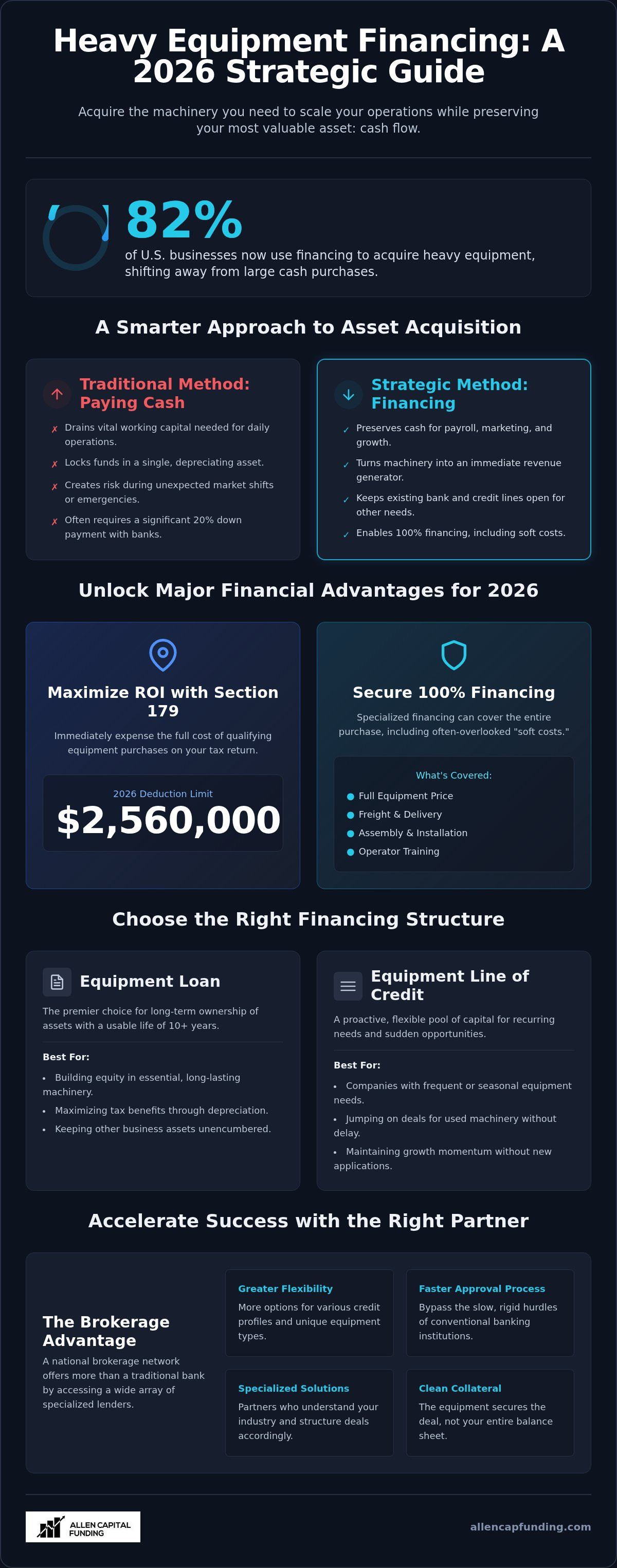
Did you know that 82% of U.S. businesses now use heavy equipment financing to acquire machinery rather than paying cash? In 2026, the traditional model of buying assets outright is being replaced by a more sophisticated approach to liquidity. This shift reflects a growing understanding that capital is often more valuable when it stays in your pocket rather than being locked in a depreciating piece of equipment.
You likely agree that acquiring mission-critical machinery is essential for scaling your operations, yet the high upfront costs feel like a constant drain on your vital working capital. It's a common struggle to balance the need for new gear with the fear of exhausting your existing credit lines or waiting months for a slow bank approval. We understand that you need a partner who values speed and strategic growth as much as you do.
This guide demonstrates how to leverage specialized capital to acquire the assets you need while keeping your cash flow completely intact. We'll explore how to secure 100% financing that includes soft costs, maximize the $2,560,000 Section 179 deduction for 2026, and bypass traditional hurdles to accelerate your success. By the end of this article, you'll have a clear roadmap for turning equipment acquisition into a competitive advantage.
Table of Contents
What is Heavy Equipment Financing and Why Does it Matter?
Heavy equipment financing is a targeted capital solution where the machinery you buy serves as the underlying collateral for the loan. This structure reduces risk for the lender and often results in more accessible terms for the borrower. To understand the broader context of What is Equipment Financing, it's helpful to view it as a specialized branch of asset-based lending designed for growth-oriented firms. Unlike a general-purpose loan, these funds are earmarked specifically for the hardware that drives your production and revenue.
Standard business term loans often require personal guarantees or blanket liens on all company assets. Heavy equipment financing is cleaner. Because the equipment secures the deal, you don't have to tie up your entire balance sheet to get one excavator or a fleet of trucks. It keeps your primary lines of credit open for other needs while allowing for a much lower initial capital outlay than an outright purchase. This distinction is vital for 2026 operations because it separates your long-term debt from the revolving credit you use for seasonal spikes.
The Strategic Role of Machinery in Business Scaling
Many owners view a new crane or bulldozer as a massive cost center. That's a mistake. In 2026, heavy equipment financing is a strategic tool for liquidity preservation that turns depreciating assets into immediate revenue generators. Modern machinery isn't just about doing the work; it's about doing it faster and with less waste. Upgrading to 2026-standard efficiency allows you to bid on larger contracts that require specific safety or environmental certifications. It expands your project capacity and puts you ahead of competitors stuck using aging, high-maintenance fleets that consume more fuel and require more frequent repairs.
Preserving Cash Flow for Daily Operational Excellence
Cash is your company's lifeblood. Sinking $500,000 into a physical asset might seem like a solid investment, but that's $500,000 you can't use for payroll, marketing, or emergency repairs. This "sunk capital" trap can paralyze a business during unexpected market shifts. By financing the purchase, you keep your cash in the bank where it provides agility. For those managing complex day-to-day expenses, combining equipment debt with Working Capital Solutions for Daily Operational Excellence ensures you have the tools to work and the liquidity to grow. It's about maintaining a balance between physical strength and financial flexibility.
Comparing Equipment Loans, Leases, and Credit Lines
Selecting the right financial structure is just as critical as selecting the right machine. You aren't just looking for a way to pay; you're looking for a strategy that aligns with your tax goals and balance sheet requirements. In 2026, heavy equipment financing has evolved to offer more than just simple debt. It provides a variety of pathways to ownership or usage that can be tailored to your specific project timelines.
One of the most significant advantages available now is 100% financing. Unlike traditional bank loans that often require a 20% down payment, specialized equipment funding can cover the entire purchase price. This includes essential soft costs like freight, assembly, and initial operator training. By bundling these expenses into your financing, you avoid the "hidden" cash outlays that often catch business owners off guard during a fleet expansion. It ensures that your first day of operation with new gear doesn't start with a massive hole in your checking account.
For companies with recurring needs, an equipment line of credit offers a proactive solution. It provides a pre-approved pool of capital you can draw from as needed. This allows you to jump on a deal for a used tractor or upgrade a power generator without starting the application process from scratch. It's a tool for agility that keeps your growth momentum steady as market opportunities arise.
When to Choose an Equipment Loan
An equipment loan is the premier choice when you intend to keep the machinery for its entire usable life. If the asset has a projected lifespan of 10 years or more, building equity through ownership makes strategic sense. You'll benefit from interest expense deductions and the ability to claim depreciation on your taxes. Since the machinery serves as the primary collateral, your other business assets remain unencumbered. If you're unsure which path fits your current growth stage, a strategic financial check-up can provide the clarity you need before committing to a long-term note.
The Flexibility of Equipment Leasing
Leasing offers a different set of strategic advantages, particularly for high-tech machinery prone to rapid obsolescence. Capital leases function similarly to loans, often ending with a nominal $1 buyout. Operating leases, however, act more like a long-term rental. They typically offer lower monthly payments and can keep the debt off your balance sheet, which improves your debt-to-equity ratio for future borrowing. This "pay-as-you-go" model is perfect for project-based work where you only need specific gear for a limited duration. You get the latest technology today and the freedom to walk away or upgrade when the term ends.
Maximizing ROI: Section 179 and Financial Benefits
The most powerful financial tool for any business owner in 2026 isn't just the machinery itself; it's how you account for it. For the 2026 tax year, the maximum Section 179 deduction has been set at $2,560,000. This allows you to deduct the full purchase price of qualifying new and used equipment from your gross income in the year you put it into service. This isn't a slow depreciation over a decade. It's an immediate reduction in your tax liability that rewards you for investing in your growth today. If your total equipment spending exceeds $4,090,000, the deduction begins to phase out, but for most scaling operations, this provides a massive shield for your profits.
When you combine Section 179 with heavy equipment financing, you create a unique cash flow advantage. You don't need to pay for the machine in full to claim the full deduction. You can secure 100% financing, make only a few monthly payments during the first year, and still deduct the entire equipment value from your taxes. In many cases, the tax savings you realize in year one are actually greater than the total sum of your loan payments for that same period. This results in a net-positive cash flow that effectively pays you to upgrade your fleet. It's a strategic move that turns a capital acquisition into a liquidity boost.
Calculating the "true cost" of your machinery is essential for determining ROI. If you acquire a $400,000 excavator and your corporate tax rate is 25%, the Section 179 deduction could potentially save you $100,000 in taxes. Your effective cost for that $400,000 machine drops to $300,000. This doesn't even account for the permanent 100% bonus depreciation now available for property that exceeds the standard Section 179 limits. By understanding these numbers, you can bid more aggressively on projects, knowing your overhead is significantly lower than the sticker price suggests.
Leveraging SBA Loans for Heavy Equipment
The SBA 7(a) and 504 programs offer specialized pathways for large-scale machinery purchases that traditional bank products can't match. These programs provide longer repayment terms and lower down payments, which keeps more cash in your operating account. They're particularly effective for multi-million dollar fleet expansions where long-term stability is the priority. You can explore how these government-backed solutions fit your strategy in our guide to SBA Loans: Fueling Long-Term Small Business Growth.
Asset-Based Lending and Liquidity
If you have equity tied up in your current fleet, you can use those assets to fund new acquisitions through a sale-leaseback. This involves selling your existing machinery to a lender and leasing it back, which provides an immediate influx of capital without losing access to your tools. Asset-based lending maximizes balance sheet efficiency by converting dormant equity into active capital. This approach is ideal for businesses that need to scale quickly but want to avoid traditional debt. To see how to unlock the value in your current machinery, read more about Asset-Based Lending for Small Business.
How to Qualify for Heavy Equipment Funding in 2026
Securing capital for major machinery requires more than just a decent credit score. It demands a methodical approach to your business's financial health. The first step is to schedule a strategic financial check-up. This assessment identifies your current borrowing capacity and highlights any areas that might give a lender pause. By addressing these factors early, you position yourself as a low-risk partner ready for growth.
Once you understand your capacity, gather your documentation. You'll need recent financial statements and a clear credit profile for both your personal and business accounts. In 2026, lenders typically look for a FICO score of at least 600 to 650, though stronger scores naturally unlock more favorable terms. After evaluating your profile, you can select the right structure, whether it's a loan, lease, or an SBA product. Partnering with an expert consultant at this stage is vital. They navigate multiple lending partners to find the most competitive heavy equipment financing for your specific niche.
Essential Documentation for Quick Approvals
Speed is often the difference between winning and losing a project. To accelerate your approval, ensure you have a formal quote or invoice from your equipment dealer ready. This is the most critical document because it verifies the asset's value and condition. For mid-year capital draws, prepare interim financial statements to show your current year-to-date performance. If you are seeking a larger equipment loan, include a "use of funds" statement. This brief document explains how the new machinery will increase your revenue, giving the lender confidence in your ability to repay the debt.
Overcoming Common Qualification Hurdles
Many traditional banks require at least two years of operational history and $250,000 in annual revenue. If you don't meet these benchmarks, you still have options. Startups can often qualify for heavy equipment financing by leveraging additional collateral or providing a slightly larger down payment to offset the perceived risk. For smaller needs, typically under $250,000, "Application Only" programs are a powerful tool. These programs focus primarily on credit history rather than extensive financial records, allowing for approvals in as little as 24 to 48 hours. This streamlined path is ideal for replacing a single unit or adding a specialized tool to your fleet without the burden of a full bank audit.
The Allen Capital Advantage: Tailored Equipment Solutions
Traditional banks often have a narrow "box" for approvals. If your business profile doesn't fit their specific criteria, they simply say no. Allen Capital Funding operates differently. As a national specialist, we use a brokerage model to connect you with a vast network of lending partners across the United States. This approach ensures you aren't limited to one set of terms or a single credit policy. Instead, we find the most competitive heavy equipment financing options that align with your unique operational goals.
We act as your dedicated guide through complex capital markets. Whether you're weighing the long-term benefits of an SBA 504 loan or need the speed of an asset-based solution, our team provides the expert clarity required to make an informed choice. We don't just facilitate a transaction; we serve as a strategic ally. Our focus is on removing the financial barriers that slow your progress so you can achieve accelerated success.
Customized Funding for Your Specific Industry
We understand that a construction firm has different cash flow patterns than a medical facility or a large-scale farm. We tailor our funding solutions to match your specific revenue cycles. For example, we can structure repayment terms that account for seasonal dips in the agricultural sector or project-based lulls in heavy excavation. Our expertise spans a wide range of machinery, from precision medical devices to mass earth-moving gear. This industry-specific knowledge allows us to build a bridge between your current state and your future growth. We prioritize speed and efficiency to ensure your fleet is ready when the next big contract arrives.
Ready to Upgrade Your Capacity?
Choosing the wrong loan structure can hinder your agility for years. That's why booking a strategic consultation is the most important step you can take before signing a contract. Our team simplifies the path to funding by handling the heavy lifting of lender negotiations and documentation review. We ensure the process is fast, efficient, and aligned with your broader financial health. Our goal is to make you feel capable and well-supported throughout the entire acquisition process. Explore Heavy Equipment Financing with Allen Capital Funding today and see how we can help you scale your operations with confidence.
Accelerate Your Operational Growth with Confidence
Scaling your business requires a balance between acquiring the right tools and maintaining the liquidity needed for daily excellence. By leveraging heavy equipment financing, you avoid the trap of sinking vital working capital into depreciating assets. You've seen how the $2,560,000 Section 179 deduction can turn a major purchase into a net-positive cash flow event in year one. Whether you choose a flexible lease or a long-term SBA solution, the goal is always to keep your primary bank lines clear and your momentum steady.
Our team at Allen Capital Funding acts as your dedicated guide through this complex landscape. We provide access to a national network of specialized lenders and offer deep expertise in SBA and asset-based solutions. We focus on providing tailored guidance for strategic growth, ensuring every loan structure aligns with your specific industry cycle. You're ready to move from your current state to your future goals.
Book a Strategic Consultation for Heavy Equipment Financing today. Let's simplify your path to progress and accelerate your success together.
Frequently Asked Questions
Can I finance used heavy equipment or only new machinery?
You can finance both new and used machinery. Lenders typically evaluate the age, condition, and remaining useful life of the asset to determine the loan term. While new equipment often secures the most competitive rates, used gear is a popular way to scale without the premium price tag. Expect a down payment between 15% and 25% for used assets, depending on the machine's vintage and your business's financial strength.
How much of a down payment is typically required for heavy equipment loans?
Down payment requirements vary based on your credit profile and the type of equipment. Many qualified borrowers can secure 100% financing with zero down, keeping their cash in the bank for daily operations. If your credit score is in the 600 to 650 range, or if you're buying used machinery, a down payment of 10% to 20% is more typical. This initial equity can also help lower your monthly interest costs.
Does heavy equipment financing cover soft costs like shipping and installation?
Comprehensive heavy equipment financing often includes soft costs such as shipping, delivery, assembly, and operator training. Including these expenses in your loan prevents unexpected cash outlays on day one. By bundling these costs into a single monthly payment, you preserve your working capital for other growth initiatives. This "all-in" approach is a hallmark of strategic capital management for scaling businesses that want to avoid hidden setup fees.
What is the difference between an equipment loan and an equipment lease?
An equipment loan focuses on immediate ownership, where the asset appears on your balance sheet and you build equity with each payment. A lease functions more like a long-term rental or a "pay-as-you-use" model. Loans typically offer better tax benefits through depreciation, while leases often provide lower monthly payments and easier technological upgrades. Your choice depends on whether you value long-term asset ownership or the flexibility to upgrade frequently.
How long does the approval process take for heavy equipment funding?
Approval times depend on the size of the transaction and the depth of documentation required. For "Application Only" programs under $250,000, you can often receive an approval within 24 to 48 hours. Larger, multi-million dollar fleet expansions or specialized SBA solutions may take several weeks due to more intensive financial reviews. Having your dealer quote and updated financial statements ready is the fastest way to accelerate the funding process and secure your gear.
Is Section 179 still available for equipment purchased in 2026?
Section 179 is a vital tool for 2026, offering a maximum deduction of $2,560,000. This allows you to write off the entire cost of qualifying gear in the year it's placed in service. The deduction remains effective until your total equipment spending hits the $4,090,000 phase-out threshold. For larger acquisitions, you can also leverage the permanent 100% bonus depreciation to maximize your tax savings and significantly improve your year-one cash flow.
Can I qualify for equipment financing if I have a low credit score?
You can still qualify for heavy equipment financing with a lower credit score, though the terms may differ from prime offers. Lenders in this space often prioritize the value of the machinery as collateral over your personal credit history. You might need to provide a larger down payment, offer additional collateral, or demonstrate strong recent revenue growth. A strategic financial check-up can help identify the best lending partners for your specific profile.
What happens to the equipment at the end of a lease term?
Your options depend on the specific type of lease you signed. With a $1 Buyout Lease, you own the machine outright for one dollar at the end of the term. In a Fair Market Value lease, you can choose to purchase the gear at its current value, return it to the lender, or upgrade to a newer model. This flexibility is ideal for businesses that need to stay current with the latest technological advancements.


Comments