


Trucking Invoice Factoring: 2026 Strategic Guide
- anthonyarallen
- Aug 5
- 11 min read
Updated: Aug 14
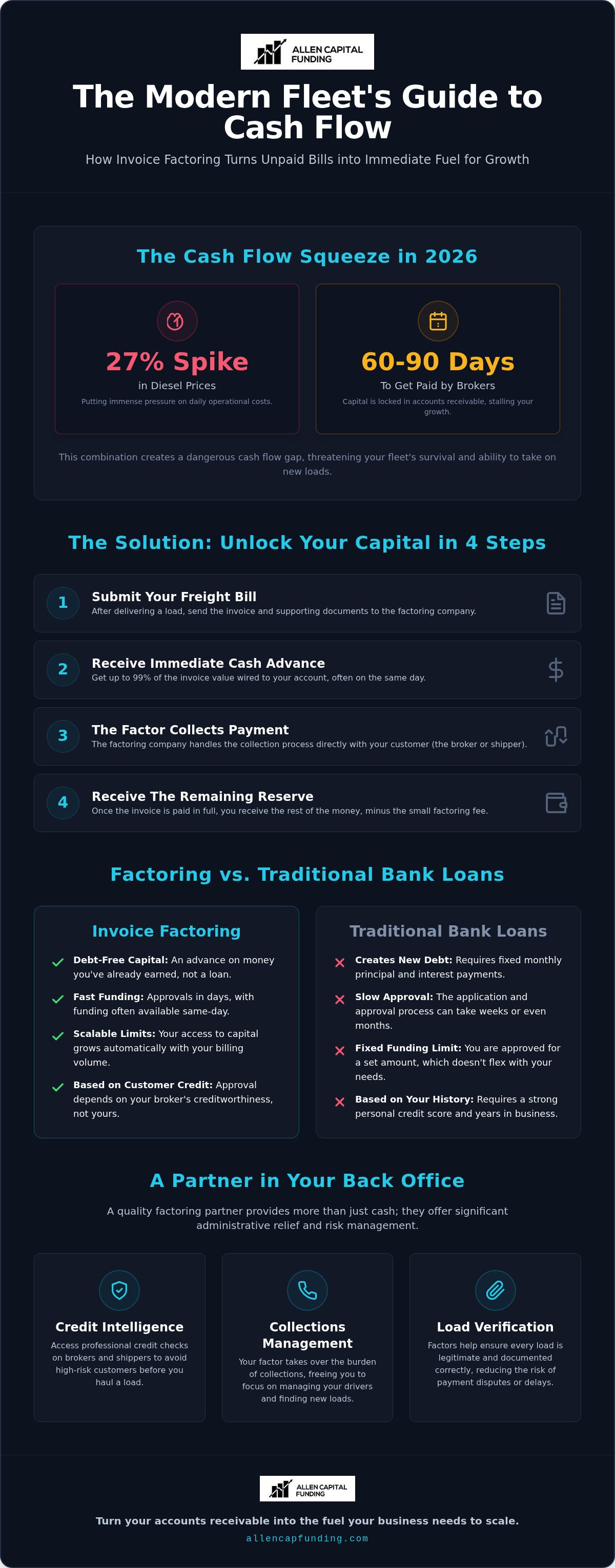
With diesel prices spiking by 27 percent in 2026, waiting sixty or ninety days for a broker to pay isn't just an inconvenience; it's a threat to your fleet's survival. You likely feel the daily pressure of having your capital locked in unpaid freight bills while the fuel pump and maintenance shop demand immediate payment. Traditional bank loans often feel out of reach because of strict credit requirements or your time in business, leaving you stuck in a cash flow gap.
This is where invoice factoring for trucking companies becomes your most powerful strategic tool. You'll learn how to convert those outstanding invoices into same-day liquidity, allowing you to cover operational costs and fuel growth without taking on a single cent of new debt. We'll examine how to leverage factoring to manage credit risks, handle collections, and maintain a steady cash flow in a volatile market. By the end of this guide, you'll have a clear roadmap to turn your accounts receivable into the fuel your business needs to scale.
Table of Contents
What is Invoice Factoring for Trucking Companies?
Trucking is a uniquely high-overhead business where expenses hit your bank account daily, but revenue often arrives monthly. With diesel prices having spiked by approximately 27 percent in 2026, the pressure to maintain liquid cash has never been higher. Factoring solves this by offering a "debt-free" advantage. Unlike a traditional loan or a credit card balance, factoring is an advance on money you've already earned. You aren't borrowing against future earnings; you're selling an asset you already own. To understand the broader financial context of this practice, one might ask, What is invoice factoring? and how has it become such a fundamental part of modern supply chain finance?
How Freight Factoring Differs from Traditional Financing
Traditional bank loans often depend on your personal credit score or your company's years of established history. This can be a major barrier for new owner-operators or fleets experiencing rapid growth. Freight factoring shifts the focus toward the creditworthiness of your customers. Because the factor collects from the broker or shipper, their ability to pay is the primary concern. This structure offers several strategic benefits:
No Monthly Payments: You won't deal with monthly principal or interest checks. The factoring fee is simply deducted from the invoice once it is paid.
Automatic Scalability: Your funding limit isn't fixed. As your billing volume increases, your access to capital grows right along with it.
Asset-Based Speed: Approvals for factoring often happen in days, not the weeks or months required for an SBA loan.
The Role of the Factor in Your Back Office
A factoring partnership provides more than just a wire transfer; it offers significant administrative relief. Your factor acts as a professional extension of your back office, taking over the burden of collections. This allows you to spend less time on the phone chasing payments and more time managing your drivers. Expert factors also provide:
Credit Intelligence: You get access to professional credit checking services. This helps you identify and avoid high-risk brokers before you ever haul a load.
Load Verification: Factors ensure that every load is legitimate and properly documented. This reduces the risk of payment disputes or clerical errors that can delay your funding.
The Mechanics of Freight Factoring: Rates and Advances
Understanding the financial structure of a funding agreement is the first step toward effective cash flow management for trucking companies. When you factor an invoice, the transaction is broken down into three primary components: the advance, the fee, and the reserve. In 2026, the standard advance rate for invoice factoring for trucking companies typically ranges from 90 percent to 99 percent of the total invoice value. This is the capital you receive immediately upon verification of the load. The total cost of factoring is ultimately determined by your monthly billing volume, the credit strength of your customers, and how quickly those customers typically pay their bills.
The factoring fee, often called the discount rate, is the cost you pay for the service. This usually falls between 1 percent and 5 percent. The final piece is the reserve, which is the remaining percentage of the invoice held back by the factor. Once your customer pays the invoice in full, the factor releases this reserve back to you, minus their agreed-upon fee. This three-part system ensures that you get the majority of your cash today while providing a security buffer for the funding partner. If you're looking for a partner to help navigate these structures, a quick financial check-up can clarify which terms best suit your current fleet size.
Recourse vs. Non-Recourse Factoring
Deciding between recourse and non-recourse factoring is a critical risk management choice. In a recourse agreement, your company is responsible for buying back the invoice if the customer fails to pay. This is often the more cost-effective option for fleets with reliable, long-term brokers. Conversely, non-recourse factoring means the factor assumes the credit risk if the customer becomes insolvent or goes bankrupt. While non-recourse plans offer more protection, they generally come with slightly higher fees. For those exploring broader ways to leverage company assets, it may be helpful to read about Asset-Based Lending for Small Business: Unlocking Balance Sheet Liquidity in 2026.
Hidden Fees to Watch For in 2026
While the discount rate is the headline number, extra costs can quickly erode your margins if you aren't careful. Common administrative costs in 2026 include ACH or wire transfer fees, credit check charges, and minimum volume penalties. Some factors might offer a low teaser rate but make up the difference with high monthly maintenance fees. Transparency is the most important quality in a funding partner. Working with a professional guide helps you identify "all-in" rates, ensuring you aren't surprised by fine-print expenses that weren't clearly disclosed upfront.
Factoring vs. Business Lines of Credit: Which is Right for Your Fleet?
Choosing the right financial tool is about matching the solution to your specific operational pressure. While both options provide liquidity, they function differently on your balance sheet and your daily workflow. The choice often depends on whether you need a permanent cash flow bridge to support rapid growth or simply a safety net for occasional emergencies. Invoice factoring for trucking companies is generally the preferred route for fleets that need to scale quickly without the constraints of traditional debt. It's a strategic decision to trade a small percentage of your invoice for immediate access to the funds you've already earned by completing a haul.
In contrast, a traditional credit line is a debt instrument. It offers lower costs but requires higher credit scores and significant collateral, often including personal assets or business equipment. If your fleet has a long history of profitability and you only need capital for seasonal dips, a credit line might be the more efficient choice. To dive deeper into how these revolving facilities work, explore our Business Line of Credit: The Strategic Guide to Flexible Capital in 2026.
When to Choose Freight Factoring
Factoring stands out when speed and flexibility are your top priorities. It's the ideal choice when you need cash within 24 hours to keep your trucks moving, pay drivers, or secure fuel. Because the approval is based on the creditworthiness of your shippers rather than your own business history, it's accessible even for newer owner-operators. You should choose this path if:
You haul for Fortune 500 shippers or high-quality brokers but have limited business credit history.
You want to outsource the administrative burden of collections and credit checking.
You need your funding limit to grow automatically as your billing volume increases.
When a Line of Credit Wins
A line of credit is often the better fit for established carriers with predictable cash flow and strong business credit. It allows you to maintain total control over your billing and collections processes while keeping your cost of capital as low as possible. This option is best suited for long-term strategic projects, such as warehouse expansions or fleet upgrades, rather than daily operational costs. A line of credit is the right move if:
You have a high credit score and can provide the necessary collateral.
You prefer to keep all customer interactions and collections entirely in-house.
You only need to pull funds occasionally and can pay them back quickly to minimize interest.
How to Choose the Best Factoring Company in 2026
Selecting a partner for invoice factoring for trucking companies involves looking far beyond the headline discount rate. A general factoring firm might offer a low fee, but they often lack the specialized knowledge required to handle transportation-specific issues like lumper fees or detention pay. If your funding partner doesn't understand these industry nuances, you'll likely face payment delays and constant clerical friction. You need a partner that acts as a steady, reliable hand in your back office, ensuring that every load is processed with precision.
In 2026, technology integration is no longer optional. The best providers offer robust mobile applications that allow your drivers to upload load documents and proof of delivery immediately after a drop-off. This speed directly impacts your bottom line. Additionally, prioritize contract flexibility. You should avoid "all-in" clauses that legally require you to factor every single load you haul. Instead, look for a partner that respects your autonomy and provides a dedicated account manager who knows your drivers and your routes by name.
Essential Value-Added Services
Top-tier factoring partners provide a suite of tools designed to lower your operating costs and improve safety. These services often provide a competitive advantage that outweighs the factoring fee itself. Look for programs that include:
Fuel Card Programs: Access significant discounts at major truck stops, which is vital given the 27 percent spike in diesel prices seen in 2026.
Broker Credit Search: Utilize real-time databases to check the reliability and payment history of a broker before you ever accept a load.
Maintenance Discounts: Leverage the factor's collective buying power to save on tires and emergency roadside repairs.
The Brokerage Advantage with Allen Capital Funding
A one-size-fits-all approach rarely works for specialized carriers. At Allen Capital Funding, we act as a strategic bridge, analyzing your fleet's specific needs to find the most competitive advance rates and terms. We don't just provide a transaction; we provide a partnership-driven strategy for growth. Our expertise allows us to identify the right funding fit today while preparing you for future transitions into SBA loans or equipment financing as your fleet expands. If you're ready to move beyond generic financing, schedule a financial check-up to see how we can accelerate your success.
Get Started: Accelerating Your Trucking Cash Flow
The path to stable liquidity starts with a streamlined onboarding process. To secure rapid approval for invoice factoring for trucking companies, you must present a professional and organized financial package. Most factors require three core documents to begin: your active MC/DOT authority, a signed W-9, and a current accounts receivable aging report. Because keeping your authority active depends on proper bonding and insurance, many fleets rely on MSB Insurance Group to handle their commercial coverage needs. Once these are submitted, setting up your first funding is a methodical process. It moves from initial document verification to a wire transfer or ACH deposit in as little as 24 hours, giving you the immediate capital needed to dispatch your next load.
Maintaining a healthy relationship with your factoring partner requires ongoing communication. You'll need to submit clean, legible proofs of delivery and rate confirmations for every load you wish to fund. Efficient management of these documents ensures that your cash flow remains uninterrupted. Ready to fuel your growth? Contact Allen Capital Funding for a tailored capital consultation and let us help you simplify your financial operations.
Preparing Your Application for Rapid Approval
Speed is essential in the trucking industry, and your preparation determines how quickly you can access funds. Your DOT and MC authority must be in good standing with the FMCSA, especially with the stricter 2026 enforcement of ELD rules and driver qualification files. Factors will also scrutinize your aging report to assess the credit quality of your shippers. Transparency is your best asset during this phase. If your business has existing liens or UCC filings from previous lenders, disclose them early. A dedicated guide can often work through these hurdles, but hidden filings will almost always cause delays in the funding process.
Your Long-Term Growth Strategy
Smart fleet owners view factoring as a strategic bridge rather than a permanent debt-replacement tool. While it provides the immediate liquidity needed to survive a 27 percent spike in diesel prices, it also helps you build the financial history required for lower-cost capital. Regular financial check-ups allow you to optimize your capital structure as your billing volume grows. As your fleet stabilizes, you can leverage your improved cash position to transition toward more traditional financing. For those looking ahead at fleet expansion or large-scale acquisitions, our SBA Loan Brokers New York: Strategic 2026 Funding Guide provides a roadmap for your next stage of business evolution.
Drive Your Fleet Toward Sustainable Growth
Success in the 2026 freight market requires more than just hauling loads; it demands a sophisticated approach to liquidity. You've seen how invoice factoring for trucking companies transforms stagnant accounts receivable into the working capital needed to stay ahead of rising fuel costs and maintenance demands. By choosing a partner that offers industry-specific expertise and transparent terms, you position your fleet for scalability without the burden of traditional debt. This guide has detailed the mechanics of advances and the critical value-added services that simplify your back-office operations.
At Allen Capital Funding, we act as your dedicated guide, providing expert guidance on national funding products tailored to your unique operational needs. Our partnership-driven approach focuses on your long-term strategic growth rather than just a one-time transaction. If you're ready to stabilize your cash flow and focus on the road ahead, we're here to provide a fast, professional consultation for your immediate needs. Secure Your Fleet’s Future with a Custom Factoring Solution. Your next stage of accelerated success is just one conversation away.
Frequently Asked Questions
How much do factoring companies charge for trucking?
Factoring companies typically charge a fee ranging from 1 percent to 5 percent of the invoice value. The specific rate you pay depends on your fleet's monthly volume, the credit strength of your customers, and the length of their payment cycles. High-volume carriers often secure rates on the lower end of this scale, while smaller operations might pay slightly more for the added administrative support.
Can I get factoring with a low credit score?
Yes, you can qualify for funding even if your business or personal credit score is low. Unlike traditional bank loans, the approval process for invoice factoring for trucking companies focuses primarily on the creditworthiness of your shippers and brokers. This makes it an ideal liquidity tool for new owner-operators or established fleets that are currently navigating financial challenges or rapid growth phases.
What is the difference between recourse and non-recourse factoring?
Recourse factoring requires your company to buy back an invoice if the broker fails to pay, whereas non-recourse factoring protects you if the broker becomes insolvent. Non-recourse plans provide a higher level of security but usually come with increased fees. Most carriers choose recourse factoring to minimize costs when they are confident in the financial stability of their regular customer base.
How fast can I get funded after submitting an invoice?
Funding usually happens within 24 hours of document submission and verification. Many modern factoring partners offer same-day wire transfers if you upload your rate confirmation and proof of delivery through their mobile app early in the day. This rapid turnaround is essential for covering immediate operational costs like diesel, which saw a 27 percent price increase in 2026.
Do I have to factor all of my invoices or just some?
You don't always have to factor every load, but your flexibility depends on the specific terms of your contract. Some providers offer selective factoring, allowing you to choose which invoices to fund based on your current cash needs. However, other companies may require "all-in" agreements for specific brokers to ensure they can offer you the most competitive discount rates across your entire volume.
Will my customers be upset if I use a factoring company?
Most brokers and shippers consider factoring a standard and professional business practice in the transportation industry. They are very familiar with the process of receiving a Notice of Assignment and redirecting payments to a factor. Because factoring is so common, it shouldn't impact your reputation or your ability to secure high-quality loads from the industry's top-tier brokers.
What documents are required to start freight factoring?
To begin the onboarding process, you generally need to provide your MC/DOT authority, a signed W-9, and a current accounts receivable aging report. Once your account is active, you'll simply submit the rate confirmation and a signed proof of delivery for each load you want to fund. Keeping these documents organized and legible is the best way to ensure there are no delays in your payment.
Does factoring count as a loan on my balance sheet?
No, factoring is technically the sale of an asset and is not classified as a loan or a debt instrument. Since you're selling your accounts receivable at a discount rather than borrowing against them, the transaction doesn't add to your company's debt load. This helps you maintain a stronger debt-to-equity ratio, which is beneficial when you eventually apply for equipment financing or other traditional capital products.


Comments