


Strategic Business Equipment Financing: A Complete Guide to Growth in 2026
Did you know that the U.S. equipment finance industry reached a record-setting $11.6 billion in new business volume in January 2026? This surge highlights a growing trend where savvy owners prioritize strategic acquisition over massive cash outlays. Many entrepreneurs searching for equipment financing companies Long Island realize that high upfront costs for modern machinery shouldn't stall their progress. It's common to feel caught between the need for new technology and the fear of equipment obsolescence or drained liquidity.
We believe your capital should be a tool for accelerated success, not a source of stress. This guide shows you how to leverage strategic financing to acquire revenue-producing assets immediately while preserving your cash flow for other vital operations. You'll learn how to maintain a healthy balance sheet and maximize the 2026 Section 179 tax deduction, which offers a maximum write-off of $2,560,000. We'll outline the latest market shifts and provide a clear path to securing the equipment you need to drive long-term business expansion.
Table of Contents
What is Business Equipment Financing and Why Does It Matter?
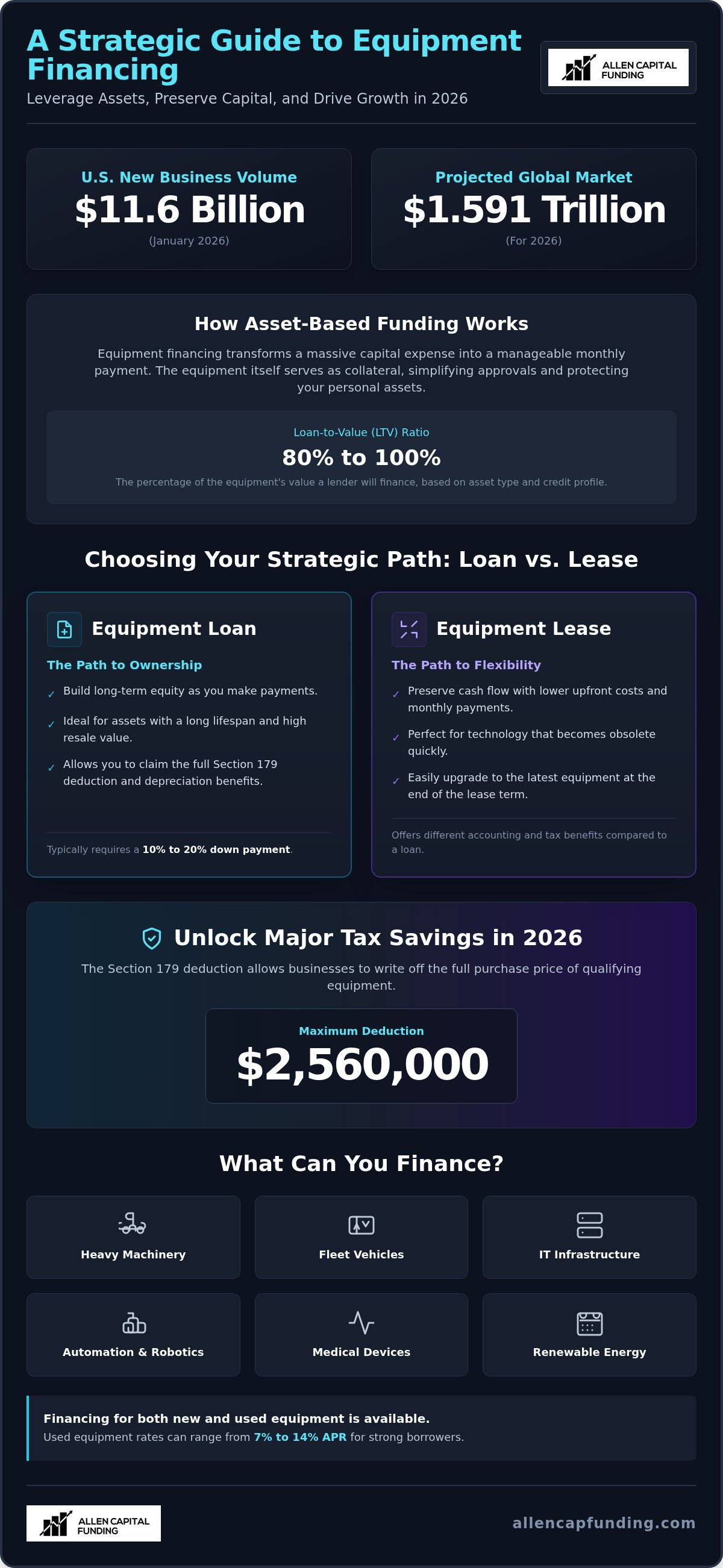
Understanding What is Business Equipment Financing begins with a fundamental mindset shift. It's a specialized funding solution designed for acquiring the physical tools your business needs to thrive. Instead of paying the full price upfront, you use a loan or lease to spread the cost over the equipment's useful life. Many equipment financing companies Long Island focus on this model because it transforms a massive capital expense into a manageable monthly investment. In 2026, the global equipment finance market is projected to reach $1.591 trillion. This growth proves that successful firms view machinery as a revenue generator rather than just a cost center.
This funding model is inherently strategic. Because the machinery itself serves as the collateral, you often face fewer personal liability requirements compared to unsecured lines of credit. If the business can't meet its obligations, the lender's primary recourse is the equipment, not your personal assets. In the fast-paced 2026 environment, where technology cycles are shorter than ever, this protection is vital. It allows you to upgrade to the latest robotics or CNC machinery without risking your daily liquidity or long-term stability.
The Core Mechanism: How Asset-Based Funding Works
The process creates a structured relationship between you, your equipment vendor, and the financial partner. Once you select your assets, the lender pays the vendor directly. You then begin a payment schedule that aligns with your revenue cycles. This self-collateralizing nature typically results in lower interest rates because the lender holds a secured interest in a tangible asset. The loan-to-value (LTV) ratio represents the percentage of the equipment's appraised value that the lender is willing to finance, which often ranges from 80% to 100% depending on the asset type and your credit profile.
Types of Assets You Can Finance in 2026
The scope of what qualifies for funding has expanded significantly to keep pace with innovation. While heavy construction machinery and fleet vehicles remain staples, 2026 has seen a massive rise in financing for automation software and renewable energy hardware. Modern businesses are also prioritizing IT infrastructure and sophisticated medical devices to stay competitive. You don't always need to buy brand new. Many equipment financing companies Long Island offer competitive rates for used equipment, which can range from 7% to 14% APR for strong borrowers. This flexibility allows you to acquire high-quality, pre-owned assets at a lower entry point while still benefiting from the latest efficiency gains.
Equipment Loans vs. Leasing: Choosing Your Strategic Path
Deciding between an equipment loan and a lease isn't just about comparing monthly payments. It's a high-level decision that directly impacts your company’s balance sheet and long-term debt-to-equity ratio. When you consult with equipment financing companies Long Island, you'll find that loans favor those who want to build equity, while leases favor those who prioritize cash flow and technological agility. Both paths offer distinct advantages depending on your specific 2026 growth objectives. You can explore these choices in detail within our 2026 Buying Guide for Commercial Assets to see which structure aligns with your current capital needs.
The choice you make also carries significant tax implications. For the 2026 tax year, the maximum Section 179 deduction has increased to $2,560,000, allowing businesses to write off the full purchase price of qualifying equipment. While loans typically allow you to claim this deduction and benefit from depreciation, certain lease structures might offer different accounting benefits. Understanding How to Qualify and Secure Equipment Funding is essential before committing to either path, as your credit profile and the equipment type will influence the terms available to you.
Equipment Loans: The Path to Ownership
Loans are the traditional route to ownership. You make fixed monthly payments until the asset is fully yours. This structure is ideal for equipment with long lifespans and high resale value, such as heavy machinery or specialized manufacturing tools. One trade-off is the down payment requirement. Depending on your credit profile, you might need to provide 10% to 20% upfront. However, once the loan is paid, the equipment becomes a permanent asset on your balance sheet, providing long-term value long after the financing ends.
Equipment Leasing: Flexibility and Modernization
Leasing offers a different kind of strategic advantage, especially for businesses that need to upgrade equipment frequently. An operating lease functions like a rental, often keeping the debt off your balance sheet and preserving your borrowing capacity for other needs. A "fair market value" (FMV) lease is particularly effective for avoiding technology obsolescence in sectors like IT or medical services. At the end of the term, you can simply return the equipment and upgrade to the latest model. This keeps your operations at the cutting edge without the burden of owning outdated machinery. If you're unsure which path fits your 2026 growth plan, a quick financial check-up can help clarify your best options.
The Strategic Benefits of Financing Business Assets
Strategic financing does more than just secure a tool. It aligns your liability with your income. Top-tier equipment financing companies Long Island help you implement a "matching" strategy. This ensures the revenue produced by the new asset covers its own monthly financing cost. This approach keeps your budget balanced and predictable while allowing the machine to effectively pay for itself as it works for your business. It's a proactive way to scale without the heavy burden of immediate debt repayment from your existing profits.
You can also bundle soft costs into your agreement. Many owners forget that installation, shipping, and specialized training can add 10% to 20% to the total price. Financing these expenses alongside the hardware prevents a sudden hit to your operational funds and simplifies your accounting. Additionally, making consistent, timely payments on your equipment debt helps establish a robust business credit history. This profile is essential for securing future capital at better rates as your company expands. It builds the trust needed for larger institutional partnerships down the road.
Maximizing Liquidity and Working Capital
Cash remains the ultimate safeguard in the 2026 economy. Sinking your liquid reserves into a depreciating asset creates unnecessary risk that can stall your growth. By choosing to finance, you preserve your capital for emergencies or sudden market shifts. This flexibility is often enhanced when you pair equipment funding with a strategic guide to flexible capital in 2026. Using a line of credit for daily operations while financing machinery allows for much larger, more impactful acquisitions than a cash-only strategy would permit. It's about maintaining a healthy balance between asset acquisition and operational liquidity.
Tax Advantages and Section 179 Deductions
The 2026 tax environment offers powerful incentives for proactive growth. Under Section 179, your business can potentially deduct the full purchase price of qualifying equipment, up to $2,560,000, in the very first year it's placed in service. This immediate expensing is a massive advantage over traditional depreciation, which spreads the tax benefit over several years. It provides an immediate cash flow boost that you can reinvest elsewhere. We recommend consulting with a tax professional to ensure you maximize these 2026 incentives while staying within the $4,090,000 total equipment spending limit. Working with experienced equipment financing companies Long Island ensures your documentation is organized and ready for these strategic filings.
How to Qualify and Secure Equipment Funding
Securing capital doesn't have to be a multi-month ordeal. Unlike traditional bank loans that focus heavily on historical cash flow, equipment funding prioritizes the asset itself. This focus allows equipment financing companies Long Island to move much faster, often providing initial decisions within 24 to 48 hours. Because the equipment secures the loan, lenders have a tangible safety net. This reduces their risk and simplifies your path to acquisition, helping you get revenue-producing tools into your shop or office without the typical red tape.
Your credit score remains a key factor in determining your interest rate and down payment requirements. A FICO score of 650 or higher usually unlocks the most favorable terms. However, even borrowers with scores around 600 can often secure funding from specialized equipment financing companies Long Island, though they might face rates between 16% and 25% APR for used machinery. The average credit approval rate in the industry reached 76.8% in early 2026, which is significantly higher than many other forms of commercial lending. Lenders look at both your personal and business credit history to build a complete picture of your financial reliability.
The Approval Checklist: What Lenders Look For
Preparation is the key to a smooth approval. Most lenders require at least six months to two years of time in business and a minimum monthly revenue of $15,000. Use this checklist to organize your application:
Current business and personal credit reports.
Last three to six months of business bank statements.
A detailed equipment invoice or formal quote from your vendor.
A brief business plan if you've been operating for less than two years.
The equipment invoice is the most critical piece of documentation. It defines the collateral's value and specifications, which directly impacts your loan-to-value ratio. Providing a clear, professional quote from a reputable vendor shows the lender that you've done your homework and that the asset is a sound investment for their capital.
Navigating the Application Journey
The path from consultation to funding is designed for speed. In the 2026 market, "accelerated success" means moving from a quote to a funded contract in just a few business days. A broker plays a vital role here by acting as your dedicated guide. Instead of you chasing down multiple banks, a broker compares offers from a national network of specialized lenders to find the one that matches your specific industry needs. This proactive approach removes barriers and ensures you get the best possible terms without the stress of managing the process alone.
Ready to see what you qualify for? Start your equipment financing application today to unlock your growth potential.
Partnering with Allen Capital Funding for Strategic Growth
Choosing the right financial partner is the most critical step in your 2026 growth strategy. While there are many equipment financing companies Long Island, Allen Capital Funding stands out by acting as a proactive ally rather than a simple lender. Our national brokerage model gives you a distinct advantage. We provide access to a wide network of specialized lenders nationwide, ensuring you aren't limited by the rigid criteria of a single local bank. This breadth of options allows us to find the specific capital solutions that match the unique demands of your industry, whether you're investing in robotics, medical tech, or heavy construction machinery.
Our approach is rooted in partnership. We don't just facilitate a transaction; we invest time in understanding your business milestones. By removing the barriers to capital, we help you maintain momentum in a market where the global equipment finance sector is growing at a CAGR of 10.7%. We focus on providing expert guidance that fosters security and confidence. You get a steady, reliable hand to navigate the often-complex world of business finance, allowing you to focus on what you do best: running your company.
The Advantage of a Tailored Funding Strategy
We believe in looking at your entire financial ecosystem. Our consultative process involves a deep dive into your current assets and future goals. This often includes exploring Asset-Based Lending to unlock liquidity hidden on your balance sheet. We match your equipment needs with the right debt structure, ensuring your monthly payments align with your revenue cycles. Strategic capital placement accelerates your future goals by turning your equipment into a powerful engine for growth rather than a drain on your cash reserves.
Getting Started: Your 2026 Financial Roadmap
The most successful businesses plan their acquisitions well in advance. Waiting until a machine fails or a contract is at risk creates unnecessary pressure. We encourage you to take a proactive step by booking an online consultation for a personalized financial check-up. This roadmap will help you identify the best timing for your next acquisition and ensure your credit profile is optimized for the best possible rates. Let's work together to build a foundation for your long-term expansion. Our team is ready to act as the bridge between your current state and your future success.
Explore Strategic Equipment Financing with Allen Capital Funding and take the first step toward your business's accelerated success.
Securing Your Competitive Edge in 2026
Strategic equipment acquisition is the primary fuel for your 2026 expansion. By choosing to finance rather than purchase outright, you protect your liquidity and leverage the asset's own revenue to pay for itself. While many equipment financing companies Long Island offer basic lending, the true advantage lies in a tailored strategy that maximizes current tax incentives and maintains a healthy balance sheet.
Navigating the loan origination process requires a dedicated guide who understands your long-term vision. Our team provides expert guidance and access to a diverse national network of specialized lenders to ensure you receive the best fit for your specific goals. We focus on removing financial barriers so you can focus on building your legacy with confidence.
Don't let high upfront costs or technology shifts slow your momentum. Connect with an Allen Capital Funding specialist to secure your business assets and start your journey toward accelerated success. Your future growth is within reach, and we're here to help you bridge the gap.
Frequently Asked Questions
How does business equipment financing differ from a standard business loan?
The primary difference is that the equipment itself serves as the collateral for the debt. Standard business loans often require you to pledge personal assets or general business equity as security. Because equipment financing is asset-based, the approval process is usually faster and the terms are more closely tied to the value and lifespan of the specific machinery you're acquiring.
Can I finance used equipment or only brand-new assets?
You can absolutely finance both new and used equipment to support your operations. Many equipment financing companies Long Island offer competitive rates for pre-owned machinery, which often range from 7% to 14% APR for strong borrowers. Financing used assets is a smart way to acquire high-quality tools at a lower entry price while still preserving your working capital for other strategic growth initiatives.
What is the typical down payment required for an equipment loan in 2026?
Down payment requirements in 2026 typically range from 0% to 20% of the total purchase price. Your specific requirement depends on your credit profile, time in business, and the type of asset being financed. Stronger borrowers with FICO scores over 700 frequently qualify for zero-down options, allowing them to acquire revenue-producing equipment without any immediate out-of-pocket costs.
Does equipment financing cover soft costs like installation and training?
Yes, most agreements allow you to bundle soft costs like shipping, installation, and employee training into the total financed amount. This prevents these secondary expenses from draining your daily liquidity. By rolling these costs into your monthly payment, you ensure that the entire implementation of the new technology is covered by the revenue the equipment helps generate.
Can a startup with limited credit history qualify for equipment funding?
Startups can qualify for funding because the equipment's value provides a safety net for the lender. While newer businesses may face higher interest rates or require a larger down payment, equipment financing companies Long Island often prioritize the asset's utility over years of historical data. Providing a solid business plan and a detailed equipment quote can significantly improve a startup's chances of securing a quick approval.
How does Section 179 impact my equipment financing decision this year?
Section 179 allows you to deduct the full purchase price of qualifying equipment, up to $2,560,000, in the 2026 tax year. This incentive encourages you to invest in new assets now rather than waiting. By financing the purchase, you can take the full tax deduction immediately while only paying for the equipment in small, manageable increments over several years.
What happens to the equipment at the end of a lease term?
Your options depend on the specific lease structure you chose at the beginning of the agreement. With a Fair Market Value (FMV) lease, you can return the equipment, renew the lease, or buy it at its current market value. If you chose a $1 buyout lease, you'll take full ownership of the asset once the final payment is made.
How quickly can I receive funding once my application is approved?
Funding is often remarkably fast, with many transactions completed within a few business days. Once you've provided the necessary documentation and received an approval, the lender typically pays the equipment vendor directly. This streamlined process reflects the "accelerated success" model of 2026, where digital platforms and efficient brokerage networks remove traditional barriers to progress.


Comments