


Stop Worrying About Late Invoice Payments: Build a More Resilient Cash-Flow Plan in 2026
Payroll is due Friday, a supplier invoice lands tomorrow, and a customer’s payment still hasn’t arrived. If that timing feels familiar, it’s understandable to want to stop worrying about late invoice payments. An overdue receivable can turn routine planning into guesswork, while repeated follow-ups take time and can strain customer relationships.
You can’t control every customer’s payment habits, but you can build a process that helps prevent avoidable delays and makes them easier to manage. Clear terms, prompt invoicing, and consistent reminders reduce friction. A calm, structured follow-up plan also gives you a practical next step when an invoice passes its due date.
This guide covers ways to strengthen your invoicing and follow-up routine, manage a cash-flow gap when payment is late, and assess financing options before making a rushed decision. It also explains how a credit line or invoice factoring may fit different receivables and business needs. Prevention, follow-up, and liquidity planning work best together, giving you a repeatable way to handle late payments in 2026.
Table of Contents
Why Late Invoice Payments Create Cash-Flow Stress, and What You Can Control
A late invoice payment is a customer payment received after the due date agreed by the business and its customer. Even a brief delay can affect more than the invoice itself: payroll, supplier commitments, and operating plans may all depend on cash arriving when expected.
A cash-flow gap is the temporary shortfall between money a business expects from overdue invoices and the cash it needs to cover expenses due before those payments arrive. The unpaid amount remains part of the business’s accounts receivable, but it isn’t cash available to spend. That’s why profitable work can still create short-term pressure.
How overdue invoices affect day-to-day business cash flow
Cash moves through a sequence: a business delivers work, prepares and sends an invoice, waits for the customer to process it, then receives payment. Expenses don’t always follow the same schedule. Payroll or a supplier bill may come due while an invoice is outstanding, forcing the owner to adjust plans or delay other spending.
Hypothetical example: A small design firm completes a project and sends an invoice with an agreed due date. The firm has earned revenue, but the customer pays after that date. Meanwhile, payroll comes due. The work may be profitable on paper, yet the firm faces a temporary cash shortage because the funds haven’t reached its account.
Which parts of late payment risk can a business reduce?
Customer payment decisions aren’t fully within a business’s control. Even a well-run company can face a slow approval process, an internal customer delay, or an unexpected change in the customer’s circumstances. No invoicing routine can guarantee prompt payment.
Still, businesses can reduce preventable friction and improve visibility by focusing on the steps they do control:
Clarify terms: State the due date and agreed payment terms clearly before work begins.
Check invoice details: Include complete, accurate information and any required purchase-order reference.
Follow a routine: Send invoices promptly and track their due dates so follow-up doesn’t depend on memory.
These steps won’t determine when every customer pays. They make it easier to spot a missed payment, understand what’s outstanding, and respond consistently. If you want to stop worrying about late invoice payments, improve the visibility and reliability of your own process, then plan for delays you can’t prevent.
Prevent Late Invoice Payments with Clear Terms and a Reliable Process
A dependable invoicing process starts before work begins. Clear expectations help both sides understand when billing happens, what the customer needs to approve payment, and how to resolve questions. They can’t control every payment decision, but they can prevent avoidable confusion and help you spot delays earlier.
Set payment expectations before work begins
Put the payment terms in writing and make sure both parties understand them. Confirm the due date, accepted payment methods, and any billing milestones. If the customer uses an approval process, identify the steps and the person responsible for accounts payable before sending the first invoice. You’ll have a named contact and a clear route to confirm the invoice reached the right place.
Agree on contract terms before work starts. If you’re considering late fees or changing payment terms, check the applicable legal requirements and ensure any changes are properly agreed to before relying on them.
Make invoice delivery and follow-up repeatable
Issue each invoice promptly after the agreed delivery or billing milestone. Check it for accuracy, including customer details, service or product descriptions, amounts, due date, payment instructions, and any required purchase-order reference. Consistent invoice details help customers match, approve, and route each bill correctly, reducing avoidable processing delays.
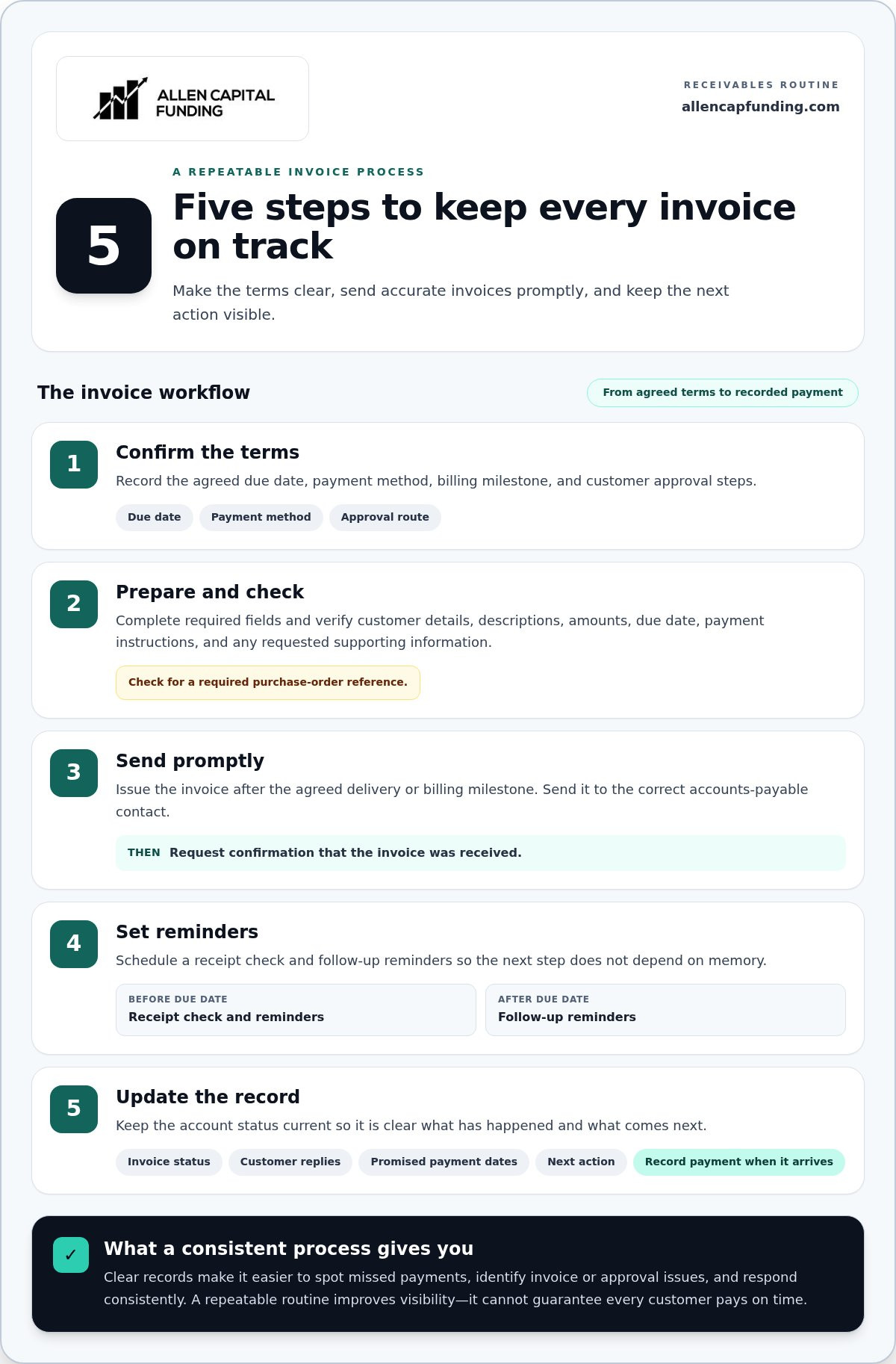
Use a simple checklist for every invoice:
1. Confirm the terms: Record the agreed due date, payment method, billing milestone, and customer approval steps.
2. Prepare and check: Complete all required fields and include requested supporting details, such as a purchase-order reference.
3. Send promptly: Deliver the invoice to the correct accounts-payable contact and request confirmation that it was received.
4. Set reminders: Schedule a receipt check and follow-up reminders before and after the due date.
5. Update the record: Track invoice status, customer replies, promised payment dates, and your next action in one place. Record the payment when it arrives.
Confirming receipt can uncover a missing document, incorrect contact, or approval issue while there’s still time to address it. Keep records factual and current so anyone handling the account can see what’s happened and what comes next. The U.S. Small Business Administration’s Manage your finances resource also covers core financial management practices, including attention to receivables and cash flow.
A repeatable process can help you stop worrying about late invoice payments by making each step visible, not by guaranteeing that every customer pays on time. If a timing gap remains after you’ve strengthened your process, you can explore business funding options as one part of a broader cash-flow plan.
How to Follow Up on Overdue Invoices Without Damaging Customer Relationships
A missed due date calls for a clear next step, not an assumption about the customer’s intent. A courteous, specific message can uncover an administrative oversight, a question about the work, or a cash-flow difficulty. Keep the tone professional and the record factual. That gives you a basis for deciding what to do next while preserving a constructive working relationship.
Verify the status. Check your records for the invoice, agreed due date, payment instructions, and any payment already received. Confirm you sent it to the correct contact and that it reached the customer.
Send a courteous reminder. Identify the invoice and original due date. Ask whether the customer needs a copy or supporting documentation, and request a payment update without implying bad intent.
Clarify any blocker. Listen for an administrative issue, a dispute about the work or amount, or a cash-flow problem. Ask focused questions and document the customer’s response rather than guessing at the cause.
Agree on next steps. Confirm who will take action and when you’ll follow up. If the customer shares a payment date or requests additional information, record it and respond as agreed.
What should a first overdue-invoice reminder say?
Keep the first message brief and neutral. For example: “Hello [Name], our records show invoice [number] for [description] was due on [date]. Could you confirm its status? Please let me know if you need the invoice or any supporting details, or if an approval issue is holding it up. When do you expect payment?” This invites a useful update without assigning blame.
When should a business escalate an unpaid invoice?
Escalation should follow a documented progression, guided by the agreement and the customer’s responses. Review the contract, prior communications, and any dispute history before changing service or delivery plans. If you’re considering late fees, collection steps, or other formal action, verify the contract terms and applicable legal requirements, and seek qualified guidance where needed.
Match your response to what you learn. A missing document may call for a prompt resend; a disputed charge may need clarification; a cash-flow problem may require an agreed, realistic update. Keep records of dates, messages, commitments, and unresolved questions. Avoid threats or unverified legal claims, which can inflame the conversation without resolving the invoice.
A repeatable, respectful approach helps you stop worrying about late invoice payments by replacing uncertain follow-up with clear actions. It won’t guarantee a payment date, but it can make each overdue invoice easier to understand and manage.
Plan for Cash-Flow Gaps While Customer Payments Are Delayed
A forecast turns an overdue invoice from a vague worry into a timing question: what cash is expected, what expenses are committed, and when might a shortfall arise? Build it around conservative assumptions, not the customer’s best-case payment date. Update it as you receive new information, then compare practical adjustments with funding options if a gap remains.
Forecast the timing and size of a potential cash gap
List receivables by expected payment date and confidence level. Separate confirmed invoices from uncertain or disputed ones, and don’t treat a promised payment date as cash already in hand. Then map those receipts against payroll, supplier bills, rent, and other essential expenses. The U.S. Small Business Administration’s Manage your finances resource offers broader guidance on managing business finances and cash flow.
Expected receipts: Record invoice amounts, due dates, status, and how reliable each expected date appears.
Committed expenses: Note payment amounts and due dates for obligations the business needs to meet.
Alternative timing: Model what happens if a key customer pays later than expected, or if a disputed invoice remains unpaid while you resolve it.
For example, a contractor might expect a customer payment before a supplier bill is due. The forecast should also show the effect if that receipt arrives afterward. Revise the assumptions when the customer confirms a date, raises a question, or requests additional documentation. This helps identify the size and duration of a potential gap before you choose a response.
Compare cash-flow responses before borrowing
Start with operational options. Where commercially appropriate, you might adjust the timing of discretionary expenses, agree on customer deposits, or set billing milestones for future work. These steps may ease timing pressure without adding a financing obligation, though they won’t fit every business or situation.
If a gap persists, compare funding by purpose and structure. A business credit line may offer flexible access to capital for changing short-term needs. Review the business line of credit guide to understand this option. Factoring involves receivables, but how it works depends on the transaction structure and customer circumstances. Consider which invoices are involved, when funds are needed, and how the arrangement fits expected collections.
To stop worrying about late invoice payments, use the forecast to decide whether operational adjustments are enough or whether a capital solution deserves consideration. The right path depends on receivables, timing, and business needs. Discuss tailored business funding options as you evaluate ways to bridge a cash-flow gap.
Choose a Sustainable Next Step for Late Invoice Payments
Reliable cash-flow management combines several actions in the right order: improve invoicing, follow up consistently, forecast expected receipts and expenses, then assess whether a funding gap remains. Financing can help bridge a timing gap between work completed and customer payment. It won’t fix a persistent collections problem, unclear billing practices, or recurring disputes, so strengthen the process as well as addressing immediate liquidity needs.
How to decide whether financing merits consideration
Start by defining the gap. How much cash is needed, when is it needed, and how long might the shortfall last? Identify the cause, such as a late receivable, a disputed invoice, or a recurring mismatch between customer payment timing and operating obligations. If the problem keeps returning, review the collections process before treating financing as the primary response.
Then compare potential capital with expected cash inflows and committed expenses. Consider how a credit line’s repayment obligations may fit the forecast, or how factoring may affect the receivables involved. Review proposed terms carefully, including how the arrangement works and what obligations it creates. The right fit depends on the business’s timing, receivables, and broader needs, not simply on how quickly cash is required.
Turn the plan into a clear next action
Assign responsibility for each step so invoices don’t disappear between delivery and collection. One person, or a clearly defined role, should own invoice issuance, reminders, status tracking, and forecast updates. Keep the underlying information accessible, including invoice amounts and due dates, customer responses, expected payment dates, and upcoming expenses.
Bring that information together before discussing funding. A clear view of receivables and cash needs makes it easier to evaluate whether operational adjustments are sufficient or whether a capital option merits consideration. Allen Capital Funding provides guidance on tailored approaches that may include factoring, working capital, and credit lines. A conversation can help you consider potential funding paths before committing to a decision.
To stop worrying about late invoice payments, build a repeatable response rather than relying on a single fix. Keep improving the process, update the forecast as circumstances change, and weigh any funding choice against your business obligations and expected cash inflows. Explore tailored business funding options when you’re ready to discuss a potential next step.
Build a Cash-Flow Plan You Can Rely On
Late payments may be outside your control, but your response doesn’t have to be. Clear terms and accurate invoices can reduce avoidable delays. Calm, consistent follow-up helps uncover what’s holding up payment, while a cash-flow forecast shows how a delay could affect upcoming obligations.
If a gap remains, assess its cause, size, and duration before considering financing. Funding may help bridge a timing shortfall, but it won’t replace a reliable invoicing and collections process. To stop worrying about late invoice payments, make prevention, follow-up, and liquidity planning parts of the same routine.
Allen Capital Funding offers guidance on factoring, working capital, and business credit lines. An online consultation can help you discuss potential capital solutions in light of your receivables and business needs, without rushing into a decision. Explore tailored business funding options and take a considered next step toward steadier cash flow.
Frequently Asked Questions
How can I stop worrying about late invoice payments?
Build a repeatable process for invoicing, follow-up, and cash-flow planning. Put payment terms in writing, send complete invoices promptly, and track due dates, customer updates, and next actions in one place. Follow up calmly when a payment is overdue, then update your forecast with realistic receipt dates. You can’t control every customer’s timing, but better visibility helps you plan and respond without relying on guesswork.
What is the best way to follow up on an overdue invoice?
Start with a brief, courteous reminder that identifies the invoice and its original due date. Ask the customer to confirm its status and whether they need supporting documents or have an approval issue. If payment remains outstanding, clarify the blocker and agree on a specific next step or update date. Keep communication factual and save the responses so you can follow a consistent, documented progression.
Can late invoice payments be prevented completely?
No process can guarantee that every customer will pay on time. Clear written terms, accurate invoices, timely delivery, and consistent reminders can reduce avoidable delays, such as missing purchase-order details or invoices sent to the wrong contact. Confirming receipt may also surface approval issues earlier. Treat these practices as ways to improve visibility and lower preventable risk, while planning for customer behavior that remains outside your control.
Should I charge a late fee for an overdue invoice?
Consider a late fee only after reviewing your agreement and applicable legal requirements. Check whether the fee and payment terms were clearly agreed to, and verify any rules that apply before adding a fee or changing terms. Don’t assume a particular rate or approach is allowed in every situation. If you’re unsure how the rules apply to your circumstances, seek qualified legal guidance before pursuing a charge.
How do I manage cash flow when customers pay late?
Build a forecast that compares expected receipts with committed expenses, using conservative payment dates. Separate confirmed receivables from disputed or uncertain invoices, then model how a later payment would affect obligations such as payroll and supplier bills. Consider appropriate operational adjustments, like reviewing discretionary expense timing or future billing milestones. Update the forecast as customers provide information, and assess financing only if a cash gap remains.
Can invoice factoring help when customers pay late?
Factoring may help address a cash-flow gap by using eligible receivables as part of a financing arrangement. The structure and potential fit depend on the invoices, transaction details, customer circumstances, and the business’s needs. It doesn’t make customers pay sooner or replace a reliable collections process. Review how the arrangement affects the receivables and expected cash inflows before deciding whether it suits your situation.
When should I consider business financing for overdue invoices?
Consider financing after improving invoicing and follow-up and forecasting the size, cause, and expected duration of the gap. Compare potential obligations with expected receipts and upcoming expenses, and review proposed terms carefully before making a decision. Allen Capital Funding provides guidance on options such as factoring, working capital, and business credit lines. An online consultation can help you discuss potential capital approaches based on your receivables and business needs.


Comments