


Small Business Loan Requirements: The 2026 Strategic Guide to Qualification
The most successful entrepreneurs don't view small business loan requirements as hurdles; they treat them as a strategic blueprint for institutional growth. It's completely normal to feel a sense of anxiety when faced with extensive documentation requests or the new 100% U.S. citizenship mandates effective this year. You've worked hard to build your company. The last thing you want is a rejection letter because of a misunderstood financial ratio or a missing tax return from three years ago.
We understand that the gap between needing capital and actually receiving it often feels like a maze of complex jargon. We're here to bridge that gap. This guide will help you master the essential criteria lenders use to evaluate your business and position your company for successful capital acquisition. We'll provide a clear roadmap of required documents, explain the 1.10:1 debt-service coverage ratio benchmarks, and give you the confidence to select the right funding path. You'll move from uncertainty to a position of strength, ready to unlock the capital your business deserves.
Table of Contents
Understanding the Strategic Framework of Small Business Loan Requirements
Think of small business loan requirements as a strategic framework rather than a series of obstacles. These standards act as a lender’s risk-mitigation toolkit, designed to ensure that capital is deployed where it can actually generate growth. Meeting these benchmarks proves your business’s operational maturity. It signals to the financial world that your internal controls, reporting, and strategy are robust enough to handle additional debt. When you align with these requirements, you aren't just "checking boxes"; you're demonstrating that your company is a low-risk, high-potential partner.
The lending landscape in 2026 has moved toward data-driven, real-time financial monitoring. Traditional lenders and fintech platforms now prioritize digital transparency over static, annual reports. They look for integrated accounting systems that provide a live view of your performance. This shift means your preparation must be proactive rather than reactive. By exploring different types of small business financing, you can better understand how these digital requirements vary across credit lines, SBA loans, and equipment financing. Proving your stability through real-time data is now the fastest way to secure competitive terms.
The Lender’s Perspective: Why Requirements Exist
Lenders use these requirements to predict your future repayment behavior. It's a mathematical approach to trust. They analyze industry-specific risk profiles to determine if your sector is currently stable or volatile. If you provide clear, transparent documentation, you often reduce your overall cost of capital. Clarity removes the "uncertainty premium" that lenders often tack onto interest rates when data is murky or incomplete. A well-prepared application shows that you understand your own financial health, which builds immediate confidence with the underwriting team.
The Three C’s of Lending: Credit, Cash Flow, and Collateral
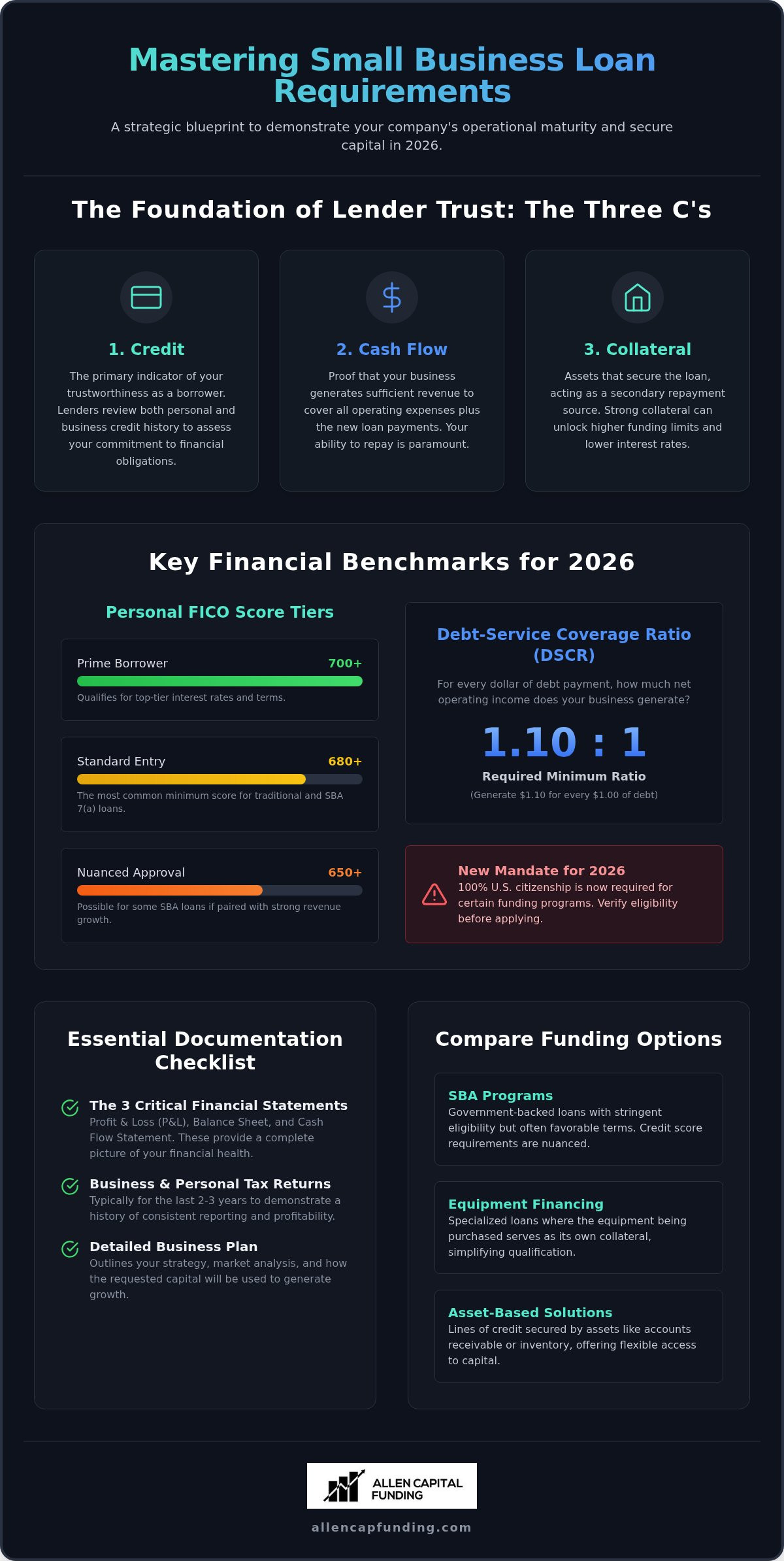
These three pillars form the foundation of almost all small business loan requirements. Mastering them is essential for any successful application.
Credit: Your personal and business credit history remains the primary indicator of trust. It reflects your character as a borrower and your commitment to meeting financial obligations even during lean periods.
Cash Flow: You must demonstrate that your business generates enough revenue to cover all operating expenses plus the new loan payments. In 2026, a standard benchmark is a Debt-Service Coverage Ratio (DSCR) of 1.10:1 or higher for most small loans. Utilizing a Financial Check-Up can help you identify if your current cash flow meets these specific thresholds before you formally apply.
Collateral: This serves as a secondary source of repayment. While cash flow pays the loan, collateral secures it. Assets like inventory, accounts receivable, or machinery provide the lender with a safety net, which often unlocks higher funding limits and lower interest rates.
Financial Profile Standards: Credit Scores and Revenue Benchmarks
Lenders in 2026 categorize risk into specific tiers based on your financial history. They use these benchmarks to determine not only if you qualify, but also the interest rate you'll pay. Prime borrowers typically present a FICO score above 700, while subprime or "mid-tier" lending often covers the 600 to 680 range. Meeting small business loan requirements involves more than just hitting a single number. It's about demonstrating a consistent pattern of financial responsibility across multiple data points.
For most traditional programs, a 680 FICO score is the standard entry point. However, SBA loan eligibility guidelines have become more nuanced. While 680 is preferred for 7(a) loans, some lenders accept scores as low as 650 if your business shows strong revenue growth. Beyond the score, lenders calculate your Debt-Service Coverage Ratio (DSCR). As of March 2026, the SBA requires a minimum DSCR of 1.10:1 for small loans. This means for every dollar of debt payment, your business must generate at least $1.10 in net operating income. If your ratio is lower, you might need to reduce existing debt before applying.
Personal vs. Business Credit Scores
Lenders still rely heavily on personal FICO scores because they serve as a proxy for how you manage obligations. Even if your company is a separate legal entity, your personal history is the primary indicator of trust. You should also monitor business-specific bureaus like Dun & Bradstreet or Experian Business. To separate these profiles, ensure your business has its own Tax ID (EIN), a dedicated business bank account, and trade lines registered in the company name. This separation protects your personal assets and builds a standalone "reputation" for your enterprise.
Revenue Stability and Debt-to-Income (DTI)
Consistency matters more than occasional revenue peaks. Lenders typically require at least two years in business for SBA loans, though equipment financing might only require 12 months. They analyze your average daily bank balances to gauge liquidity. A sudden spike in sales is less impressive to an underwriter than 24 months of steady, predictable cash flow. If your revenue fluctuates seasonally, a Business Line of Credit can help manage those gaps while keeping your bank balances healthy for future loan applications. Most SBA lenders look for at least $150,000 in annual revenue to ensure the business can comfortably sustain debt service.
Understanding where you stand today is the first step toward a successful application. You can use a Financial Check-Up to identify any gaps in your credit or revenue profile before you approach a lender.
Documentation Checklist: Preparing Your Financial Package
Documentation is where your strategic vision meets reality. While your credit score and revenue benchmarks open the door, your financial package provides the proof lenders need to finalize an approval. Organizing these documents early prevents delays and demonstrates the operational maturity we discussed in the opening framework. Most small business loan requirements center on three core financial statements: the Profit & Loss (P&L) statement, the Balance Sheet, and the Cash Flow statement. Together, these documents provide a 360-degree view of your company's health, from current debt levels to daily liquidity.
Beyond internal reports, you'll need to provide three years of both personal and business tax returns. Lenders use these to verify the income reported in your P&L and to ensure you are in good standing with the IRS. You should also prepare a "Use of Proceeds" statement. This is a concise document that explains exactly how you'll spend the capital, whether it's for purchasing new machinery, hiring staff, or refinancing existing debt. A specific, data-backed plan for the funds significantly increases your credibility during the underwriting process.
Tax Returns and Financial Statement Accuracy
Clean books are the fastest way to a loan approval. If your records are disorganized, lenders view it as a sign of high operational risk. While many owners use legal write-offs to reduce their tax burden, you must be careful. Excessive write-offs can artificially lower your reported net income, which may inadvertently reduce your borrowing power when a lender calculates your debt-service coverage. A Profit & Loss statement is the primary narrative of your business performance, showcasing exactly how your revenue translates into net income. Ensuring this narrative is accurate and matches your tax filings is vital for meeting SBA loan requirements and other institutional standards.
Legal Structure and Ownership Requirements
Lenders also require a complete legal profile of your business. This includes your Articles of Incorporation, Operating Agreements, and all current business licenses or permits. Your entity type, such as an LLC or S-Corp, can influence which loan products are available to you and how the debt is structured. It's standard practice for anyone with 20% or more ownership to provide a personal guarantee. This means that if the business cannot repay the debt, the owners become personally responsible for the balance. Having these legal documents ready, along with a clear list of all stakeholders, ensures that the legal review phase of your application moves forward without friction.
Specialized Requirements for SBA, Equipment, and Asset-Based Funding
Not all small business loan requirements are created equal. While SBA programs offer high loan limits up to $10 million as of July 2026, they involve the most stringent eligibility checks. Private lenders often provide more flexibility regarding credit scores or time in business, but they may require higher interest rates or shorter repayment terms. Choosing the right path depends on your specific capital needs and the assets you can leverage to secure the debt.
If you need to upgrade your technology or production capacity, Strategic Business Equipment Financing offers a streamlined solution. In this model, the equipment itself serves as the primary collateral, which often simplifies the approval process compared to unsecured loans. Conversely, Asset-Based Lending for Small Business shifts the focus away from your personal credit score and toward the value of your balance sheet. This is particularly effective for companies with significant accounts receivable or inventory that need immediate liquidity to fuel growth.
SBA-Specific Eligibility: Size Standards and Affiliation
To qualify for SBA support, your company must first meet the agency's size standards. These are defined by your industry’s NAICS code and are usually based on either annual revenue or number of employees. You must also pass the "Credit Elsewhere" test. This requires the lender to document that your business cannot obtain comparable financing from non-government sources on reasonable terms. Startups seeking SBA capital must provide a comprehensive business plan that includes three years of detailed financial projections to prove future viability.
Collateral Valuation for Equipment and Real Estate
Lenders evaluate secured loans using the Loan-to-Value (LTV) ratio. For equipment, the LTV typically ranges from 75% to 100%, depending on the asset's lifespan and resale value. Standard vehicles or common construction machinery are easier to value than highly specialized medical or manufacturing tools. Specialized machinery may require a professional appraisal to determine its secondary market worth. For commercial real estate acquisitions, a formal appraisal is mandatory to confirm the property's market value. This ensures the loan amount aligns with the underlying asset’s worth, protecting both you and the lender.
For B2B enterprises, Purchase Order Financing and Factoring provide additional paths. These options prioritize the creditworthiness of your customers rather than your own operating history. If you're ready to explore these specialized options, you can start your application today to see which strategic solution fits your 2026 growth goals.
Navigating the Application: How a Strategic Partner Simplifies Compliance
Meeting small business loan requirements is rarely a linear path. Many entrepreneurs discover gaps in their profile only after a rejection letter arrives. A strategic partner acts as a filter, matching your specific financial data with the lenders most likely to approve your request. Instead of broadcasting your application to dozens of banks, we target the specific institutions that value your industry and asset mix. This approach protects your credit score and saves weeks of wasted effort.
If your credit score falls below the prime benchmarks discussed earlier, don't assume funding is impossible. Alternative capital paths like asset-based lending or factoring focus on the strength of your collateral rather than your personal history. We help you identify these opportunities and build a bridge toward traditional financing as your profile improves. This proactive guidance ensures that even businesses that are "too new" or have "too little" revenue can find a path to the capital they need to scale.
The Strategic Financial Check-Up
Before you commit to a formal application, a Financial Check-Up provides a risk-free assessment of your standing. This process allows us to review your debt-service coverage and liquidity without a hard credit pull. We use this data to identify qualification gaps, such as high debt-to-income ratios or inconsistent bank balances. By addressing these issues before you face an underwriter, you optimize your balance sheet for the best possible terms. Allen Capital Funding serves as a dedicated guide, ensuring your current state doesn't limit your future growth potential. We remove barriers and simplify the path to progress by providing a clear, data-driven roadmap.
Closing the Funding Gap: Next Steps
The journey from initial consultation to capital acquisition is streamlined when you're prepared. Most successful funding rounds take between two and six weeks, depending on the complexity of the loan type. You should gather the documentation checklist mentioned in section three before your first strategy call. This preparation allows us to move quickly once we identify the right lender for your needs. The process is methodical and logical, designed to respect your time while delivering the capital necessary for accelerated success. We act as a proactive ally, deeply invested in your success from day one.
Master Your Path to Strategic Growth
Securing the capital you need to scale requires more than just a strong business idea. It demands a clear understanding of small business loan requirements and a commitment to financial transparency. You've learned how to treat these standards as a strategic blueprint, from maintaining clean documentation to understanding the specific benchmarks for credit and revenue. By aligning your business with these 2026 standards, you position your company as a resilient, fundable enterprise.
Success in the lending world often comes down to matching your specific profile with the right capital product. Whether you're leveraging equipment as collateral or navigating the complexities of an SBA loan, preparation is your greatest advantage. You don't have to navigate this complex path alone. We're here to act as your dedicated guide, removing barriers and simplifying the path to your future goals.
Book a Strategic Consultation with Allen Capital Funding to access expert guidance on SBA and private lending products. We provide tailored capital solutions for every growth stage and a streamlined process to accelerate your success. Your business is ready for its next chapter; let's unlock the funding to make it happen.
Frequently Asked Questions
What is the minimum credit score required for a small business loan in 2026?
Most traditional lenders in 2026 require a minimum FICO score of 680 to qualify for prime interest rates. While SBA 7(a) lenders generally stick to this benchmark, some programs may consider scores as low as 650 if your business shows strong revenue growth. Equipment financing is often more accessible, with minimum scores starting around 600. If your score is lower, microloans or asset-based solutions may accept scores in the high 500s.
Can I get a business loan if my company has been operating for less than a year?
Yes, you can secure funding, though your options for traditional SBA 7(a) loans are limited since they typically require two years of history. Startups often find success with equipment financing, which usually requires only 12 months of operation. For businesses under a year old, SBA microloans or purchase order financing are viable paths. These programs prioritize your revenue projections or the creditworthiness of your B2B customers over your company's age.
What documents do I need to prepare for an SBA loan application?
You must provide three years of personal and business tax returns along with current year-to-date financial statements. Lenders specifically look for a Profit and Loss statement, a Balance Sheet, and a detailed Use of Proceeds document. You'll also need legal documents like your Articles of Incorporation and any relevant business licenses. Meeting these small business loan requirements ensures the underwriting process moves forward without the delays caused by missing paperwork.
Do all small business loans require a personal guarantee from the owner?
Most lenders require a personal guarantee, especially for government-backed programs. For any SBA loan, every owner with a 20% or greater stake in the company must sign a personal guarantee. This provides the lender with a secondary layer of security if the business cannot meet its obligations. While some specialized unsecured loans exist without this requirement, they often carry significantly higher interest rates to compensate for the increased risk to the lender.
What is the difference between secured and unsecured business loan requirements?
Secured loans require physical assets like real estate or equipment to act as collateral, while unsecured loans rely solely on your creditworthiness and cash flow. Secured small business loan requirements focus heavily on the Loan-to-Value (LTV) ratio of the asset. Unsecured loans are faster to process but typically offer lower borrowing limits and higher interest rates. Choosing between them depends on whether you prefer to leverage your balance sheet or your credit history.
How much annual revenue does my business need to qualify for a line of credit?
Lenders typically look for a minimum of $150,000 in annual revenue to qualify for a traditional business line of credit. For specialized products like equipment financing, a common benchmark is $15,000 in monthly revenue. Consistency is key here; lenders prefer seeing steady monthly deposits rather than erratic spikes. If your revenue is currently below these marks, factoring or purchase order financing may provide a more accessible entry point for your business.
What happens if my business does not have traditional collateral to pledge?
If you don't have real estate or equipment, you can leverage your accounts receivable or inventory through asset-based lending. Factoring allows you to sell your outstanding B2B invoices for immediate cash, while purchase order financing helps you fulfill large orders by paying your suppliers directly. These solutions focus on the value of your specific business transactions rather than traditional hard collateral, making them ideal for rapidly growing service or manufacturing firms.
How does a Debt-Service Coverage Ratio (DSCR) affect my loan eligibility?
Your Debt-Service Coverage Ratio (DSCR) is a critical measure of your ability to repay debt from your operating income. As of March 2026, the SBA requires a minimum DSCR of 1.10:1 for small loans. This means your net operating income must be at least 110% of your total debt payments. A higher ratio demonstrates that your business can comfortably sustain its debt load, which often leads to more favorable interest rates and higher loan approvals.


Comments