


Equipment Financing for Startups: Complete 2026 Guide
Why surrender precious equity or drain your launch runway just to purchase machinery that begins depreciating the moment it arrives? Securing dedicated equipment financing for startups allows early-stage ventures to acquire mission-critical machinery and technology without sacrificing ownership or exhausting liquid capital reserves.
You already know the frustration of dealing with conventional commercial lending. When traditional banks demand two years of filed tax returns before even reviewing an application, founders get trapped in a painful catch-22. You need operational hardware to generate revenue, yet lenders demand established revenue before releasing funds. Depleting your cash reserves to purchase heavy equipment leaves zero liquidity for payroll, marketing, and unexpected hiccups.
Because the acquired machinery serves as its own core collateral, you can bypass rigid operating history requirements and protect your cap table. This comprehensive guide reveals how new ventures qualify for low-down-payment equipment acquisitions, demystifies the structural differences between fair market value leases and term loans, and outlines an actionable roadmap to launch operations while building commercial credit.
Table of Contents
What Is Equipment Financing for Startups and How Does It Operate?
Startup Equipment Financing Requirements: Qualifying Without Historical Revenue
Equipment Loans vs. Leases: Selecting the Right Structure for Runway
The Step-by-Step Acquisition Roadmap: Securing Startup Equipment Debt
Capital Stacking: Integrating Equipment Financing with Growth Capital
What Is Equipment Financing for Startups and How Does It Operate?
Equipment financing is an asset-backed funding vehicle designed specifically to purchase essential operational machinery and commercial gear. Unlike generic unsecured loans that depend almost entirely on years of historical balance sheets, equipment financing for startups relies primarily on the intrinsic value of the hardware itself. The equipment acts as immediate, tangible collateral. That built-in security lowers default risk for commercial lenders, enabling early-stage ventures to obtain mission-critical tools without sacrificing equity to venture capitalists or angel investors.
Every dollar diverted from working capital toward upfront machinery costs tightens your operational runway. By leveraging asset-backed debt, founders retain cash for vital needs like payroll, software development, and market validation. Exploring how strategic business equipment financing protects working capital reserves gives early-stage teams a distinct competitive edge.
The Mechanics of Asset-Backed Financing for New Ventures
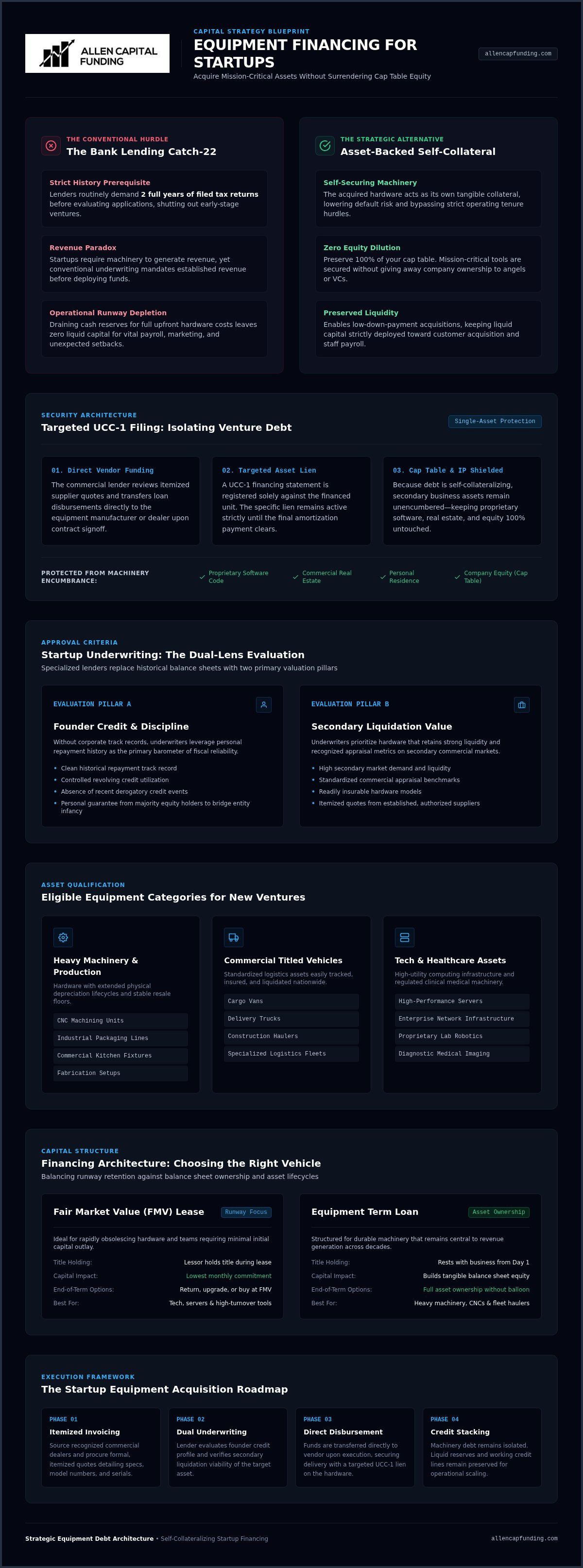
The transaction process remains direct and transparent. Once you identify necessary equipment, your vendor provides a formal commercial invoice. The lender reviews the invoice alongside your startup profile, issuing loan funds directly to the equipment manufacturer or dealer upon approval.
To secure the transaction, the funder registers a UCC-1 financing statement covering that specific asset. This targeted lien remains active until the final payment clears. Because it represents self-collateralizing debt, you avoid encumbering secondary assets like your personal residence, commercial real estate, or proprietary software code. Depending on whether you use direct debt or finance lease structures, legal title either rests with your business from day one or transfers fully once the term concludes.
Eligible Equipment Types: From Machinery to Enterprise Technology
Startups can finance a broad spectrum of commercial hardware essential for revenue generation:
Heavy Machinery and Production Equipment: CNC machining units, industrial packaging lines, commercial kitchen fixtures, and fabrication setups.
Commercial Titled Vehicles: Cargo vans, delivery trucks, construction haulers, and specialized logistics fleets.
Enterprise Technology and Healthcare Assets: High-performance server arrays, network infrastructure, proprietary lab robotics, and diagnostic medical imaging systems.
Lenders favor assets that maintain strong secondary resale value. When equipment can be easily appraised, insured, and liquidated in secondary markets, early-stage operators find securing approval significantly smoother.
Startup Equipment Financing Requirements: Qualifying Without Historical Revenue
Traditional institutions frequently turn away early-stage ventures because automated underwriting algorithms expect years of historical tax returns. In contrast, specialized commercial lenders evaluate transactions through a dual lens: the secondary liquidation value of the machinery and the personal financial discipline of the founding team. When obtaining equipment financing for startups, you don't need decades of corporate history. You need a structured package demonstrating repayment capacity and asset stability.
Founder Credit Thresholds and Personal Financial Strength
Without years of corporate balance sheets, lenders utilize the founder's personal credit score as the primary operational barometer. A clean repayment history, low revolving credit utilization, and an absence of recent derogatory marks reassure underwriters that obligations will be honored. To solidify this commitment, lenders standardly require a personal guarantee from majority equity holders. This legal framework bridges the gap between an unproven entity and institutional capital.
Crucial Documentation: Vendor Invoices and Business Feasibility
Preparation separates approved applications from stalled submissions. Lenders evaluate three core items during startup credit reviews:
Itemized Vendor Invoices: Official commercial quotes from recognized suppliers establish exact hardware specifications, serial identifiers, and true market transaction values.
Operational Business Plans: Realistic financial forecasts demonstrate precisely how the machinery will generate sufficient operating cash flow to service debt comfortably.
Liquidity Verification: Recent bank statements prove your business retains adequate cash reserves to manage everyday payroll and handle unexpected operational friction.
Tactical Steps to Overcome Limited Time in Business
If your startup profile falls slightly below prime underwriting thresholds, practical levers can offset lender hesitation. Committing a larger cash down payment immediately lowers the loan-to-value ratio, reducing lender exposure from day one. Bringing on a creditworthy guarantor can also strengthen debt-service coverage metrics. For substantial long-term machinery projects, government-backed structures like the federal SBA 504 loan program provide dedicated paths for capital asset purchases, while exploring asset-based lending for small business allows you to unlock liquidity against existing unencumbered machinery. Working alongside a consultative advisor like Allen Capital Funding can help package your startup profile effectively, positioning your commercial narrative to secure optimal financing terms.
Equipment Loans vs. Leases: Selecting the Right Structure for Runway
Managing early-stage burn rate requires selecting the right contractual instrument. Both loans and leases deliver access to operational machinery, but their impact on cash flow, balance sheet equity, and capital runway differs markedly. Choosing the optimal vehicle for equipment financing for startups depends on how quickly your assets depreciate, your immediate tax priorities, and whether permanent ownership serves your long-term roadmap.
When long-term utility is the primary objective, founders often turn to commercial equipment loans. A term loan transfers full title to your business immediately, allowing you to build balance sheet equity as each monthly payment reduces principal. This approach suits durable machinery with a long useful lifespan, such as manufacturing systems, yellow iron, or heavy processing tools.
Capital Leases vs. Operating Leases for Emerging Businesses
Lease agreements provide functional flexibility when preserving day-to-day liquidity is your top operational concern:
Capital Leases ($1 Buyout): These agreements function similarly to standard debt. You finance the asset over a set term and assume full ownership at the end for a nominal sum, typically one dollar. This structure requires higher monthly payments than an operating lease, but it secures ultimate ownership without a large terminal cash balloon.
Operating Leases (Fair Market Value): An FMV lease delivers the lowest monthly cash outflow. The funder retains asset ownership, while your startup pays purely for asset utility over the contract duration. When the lease expires, you can return the machinery, renew the agreement, or upgrade to newer technology. This setup shields startups from rapid obsolescence in fast-evolving fields like enterprise computing and laboratory testing.
Tax Strategic Advantages and IRS Section 179 Deductions
Tax code incentives can significantly offset the net cost of acquiring business assets. Under current IRS Section 179 and depreciation guidelines, businesses purchasing qualifying new or used equipment can deduct the full purchase price from taxable income during the tax year the asset enters service, rather than amortizing deductions slowly over multiple years.
Equally critical for growth ventures, permanent 100% bonus depreciation rules allow startups to accelerate expensing. Unlike Section 179 expensing, bonus depreciation can generate a net operating loss that carries forward to offset future profitable quarters. Conversely, if you select an operating lease, your business claims monthly payments directly as deductible operating expenses, creating predictable, ongoing operational write-offs across the agreement term.
The Step-by-Step Acquisition Roadmap: Securing Startup Equipment Debt
Securing debt financing for early-stage machinery requires structured execution. Without a disciplined approach, applications stall over incomplete documentation, missing asset specifications, or misunderstood lender covenants. Navigating equipment financing for startups successfully means treating debt acquisition as an organized three-phase deployment that aligns funding terms with asset utility.
Phase 1: Specifying Equipment Needs and Selecting Verified Vendors
Underwriters favor transactions with recognized, reputable manufacturers or licensed industrial dealerships. Private-party sales often introduce valuation disputes that slow approvals. Work with established suppliers who can issue detailed commercial pro-forma invoices. Ensure quotes itemize hardware serial numbers, standard warranty coverage, transport freight, and bundled software so lenders can verify accurate fair market valuations.
Phase 2: Compiling Your Commercial Startup Credit Dossier
Lenders need a cohesive narrative connecting the machinery to future cash generation. Before submitting an application, assemble a clean credit package containing:
Corporate Entity Documents: Articles of incorporation, state registrations, and operating agreements identifying authorized signatories.
Financial Liquidity Records: Three to six months of recent business and personal bank records establishing unencumbered cash reserves.
Executive Commercial Summary: A concise briefing linking the equipment acquisition directly to booked contracts, expanded production capacity, or immediate revenue pipelines.
Phase 3: Evaluating Term Sheets, Covenants, and Lien Releases
Once term sheets arrive, review structural covenants before executing agreements. Scrutinize amortization schedules, prepayment terms, and administrative documentation fees. Confirm whether the security agreement specifies an asset-specific UCC-1 filing or attempts to place an enterprise-wide blanket lien across all startup property. Retaining unencumbered intellectual property and working assets protects future fundraising options.
Upon final document execution, the lender issues acceptance paperwork. Once delivery and hardware operational tests are verified, loan funds disburse straight to the vendor, bringing the machinery online without delay. If you want to streamline this entire funding cycle across a national network of asset-based lenders, connect with the specialists at Allen Capital Funding to package your transaction for maximum leverage.
Capital Stacking: Integrating Equipment Financing with Growth Capital
Treating machinery acquisition as an isolated funding event often leads to cash crunches later. Smart financial architecture separates long-term asset debt from daily operating funds. When you match long-lived equipment liabilities with the multi-year revenue that machinery produces, your venture protects vital liquidity. Relying on dedicated equipment financing for startups ensures your initial equity and cash reserves remain untouched for marketing, talent acquisition, and market expansion.
Pairing structured equipment debt with a flexible business line of credit establishes operational resilience. This multi-product approach prevents costly cash flow crunches, giving you the runway to fulfill customer purchase orders, manage payroll, and absorb seasonal fluctuations without friction.
Preserving Cash Runway via Strategic Asset Debt Isolation
Every dollar spent outright on physical assets shrinks your defensive cash cushion. Aligning debt structures with asset types creates balance sheet balance:
Asset Matching: Fund durable, revenue-producing hardware over three- to seven-year terms while funding short-term receivables or inventory through revolving facilities.
Runway Extension: Retain venture equity for non-collateralized growth activities, such as software development, client onboarding, and brand awareness campaigns.
Risk Containment: Ring-fence debt against specific machinery rather than encumbering your entire enterprise or surrendering cap table ownership.
The Brokerage Advantage: Accessing National Lending Networks
Applying to isolated commercial banks often ends in rejection due to rigid, automated scoring models. Strategic brokerages change this dynamic by connecting founders to an extensive nationwide network of asset lenders and funding partners. Rather than relying on rigid algorithms, an experienced broker evaluates your business holistically, packaging your startup profile to highlight operational viability and commercial potential. This consultative approach expands your options, matching your venture with lenders that understand your specific sector and asset class.
Executing Your Equipment Strategy with Allen Capital Funding
Accelerating business growth requires capital solutions tailored to your operational realities. Allen Capital Funding acts as a steady consultative partner, guiding founders through lender requirements, vendor coordination, and contract reviews. Our integrated multi-product capabilities allow you to pair tailored machinery debt with working capital lines and SBA financing under one coordinated capital strategy. By packaging your commercial profile effectively, our team helps early-stage businesses secure the tools they need to launch operations, protect cash flow, and build long-term enterprise value.
Accelerate Your Startup Operations with Strategic Equipment Capital
Acquiring commercial machinery shouldn't force founders to dilute valuable equity or drain operational cash reserves. By letting hardware serve as its own collateral, equipment financing for startups bypasses rigid banking history rules. When you pair asset-backed debt with revolving capital, you protect your liquid runway and establish a strong commercial credit profile from day one.
Success comes down to strategic alignment. At Allen Capital Funding, our dedicated advisory team guides you from vendor invoice analysis through closing, ensuring every term sheet matches your operational goals. We connect you to an extensive nationwide network of specialized commercial equipment lenders, delivering tailored financial structuring that integrates asset debt with flexible working capital. Ready to equip your business for long-term growth? Explore custom startup equipment financing with Allen Capital Funding and take the next step toward scaling your operations today.
Frequently Asked Questions
Can a brand-new business qualify for equipment financing with zero revenue history?
Yes, brand-new businesses can qualify because the equipment itself serves as the underlying collateral. Lenders evaluate the secondary liquidation value of the asset alongside the founder's personal credit strength and industry background. Presenting an itemized vendor invoice and a practical business plan showing how the machinery will generate operating cash flow reassures underwriters, making equipment financing for startups viable even before booking initial revenue.
What minimum personal credit score is typically required for startup equipment financing?
Most commercial lenders look for a personal credit score of at least 600 to 650 to approve early-stage applications. Founders with scores above 680 generally unlock more favorable financing structures and lower initial equity requirements. If your score sits on the lower end, you can often offset lender hesitation by providing a larger cash down payment or adding a qualified credit co-signer to the agreement.
How much cash down payment do lenders expect from a startup purchasing equipment?
Lenders generally require startups to provide an initial down payment between 10% and 20% of the total equipment invoice. This equity injection reduces the lender's loan-to-value risk while establishing immediate borrower commitment. Highly specialized, custom-built machinery may require a higher upfront deposit, whereas standard, readily liquidable commercial vehicles or production machinery often qualify at the lower end of the spectrum.
Is it better for an early-stage startup to lease or buy its operating equipment?
The choice depends on asset lifespan and your immediate cash priorities. If technology evolves rapidly and you want minimal monthly cash outflows, a fair market value operating lease is ideal because it transfers obsolescence risk to the funder. If you need long-term machinery and plan to build balance sheet equity, an equipment term loan or dollar-buyout capital lease provides full asset ownership and substantial upfront tax deductions.
How does IRS Section 179 help startups offset the cost of new equipment purchases?
IRS Section 179 allows qualifying businesses to deduct the full acquisition cost of eligible machinery and software in the year it is placed in service, rather than spreading depreciation deductions over multiple years. For early-stage companies purchasing revenue-generating assets, this expensing accelerates tax savings. In addition, 100% bonus depreciation rules can produce net operating losses that roll forward to offset future taxable business income.
Can used equipment or refurbished machinery qualify for commercial startup financing?
Yes, used and refurbished machinery can easily qualify for equipment financing for startups if purchased through an established commercial dealer. Lenders assess the equipment's remaining operational lifespan, serial numbers, and secondary market value rather than requiring brand-new units. Securing used machinery through verified vendors often reduces capital requirements significantly, allowing startups to stretch their debt service capacity while obtaining heavy-duty, field-tested assets.
What happens if the financed equipment malfunctions or requires premature replacement?
Your debt or lease obligation remains binding regardless of machine operational status. Financing agreements cover the capital debt, not the manufacturer's performance guarantee. To protect operations, startups should verify OEM warranties, negotiate vendor service-level agreements, and carry comprehensive commercial equipment insurance. If an asset suffers total loss, insurance proceeds typically satisfy the outstanding lender lien, allowing you to re-finance replacement machinery.


Comments