


Small Business Loan Brokers: The 2026 Strategic Guide to Growth Capital
Updated: Jul 9
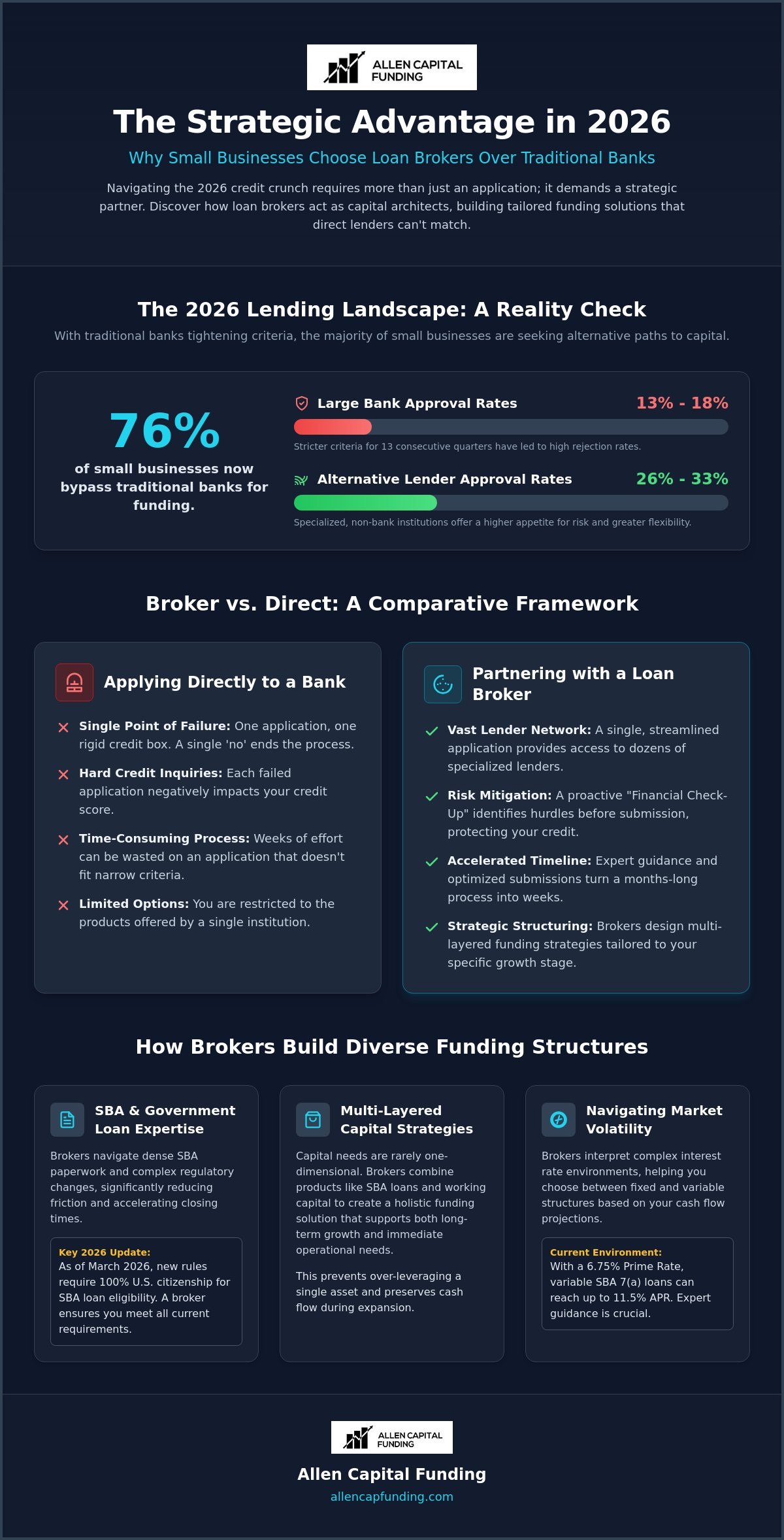
Did you know that 76% of small businesses now bypass traditional banks to secure the capital they need? With large bank approval rates hovering between 13% and 18%, many entrepreneurs find themselves stuck in a cycle of high rejection and time-consuming applications. It's exhausting to manage a growing company while struggling to decode 2026 interest rate environments or new SBA citizenship requirements. This is where small business loan brokers act as your strategic advantage. They don't just find a loan; they serve as capital architects who build multi-layered funding strategies that direct lenders simply cannot offer.
We understand that your time is better spent scaling your operations than chasing paperwork. You deserve a partner who removes barriers and simplifies the path to progress. This guide will show you how small business loan brokers navigate the 2026 lending landscape to secure the most advantageous capital structures for your company. We'll explore the shift toward alternative financing, provide expert guidance on loan structuring, and outline the steps to accelerate your funding timeline so you can focus on your next stage of growth.
Table of Contents
Navigating the Complex Landscape of Small Business Capital in 2026
The 2026 capital market is defined by a paradox: high growth expectations paired with restricted access to traditional funding. A small business loan broker functions as a strategic intermediary, bridging the gap between your company's potential and the capital required to reach it. Unlike a traditional Business broker who focuses on the sale of entities, a loan broker designs the debt structure that keeps your business competitive. As of July 2026, large banks approve only about 13% to 18% of applications. This volatility creates a "credit crunch" where even profitable firms struggle to secure conventional terms without expert guidance.
Traditional banks have reported stricter lending criteria for 13 consecutive quarters. This trend has pushed over 76% of small businesses to look beyond their local branch for growth capital. Small business loan brokers provide the essential link to specialized, non-bank lending institutions. These alternative lenders often have a higher appetite for risk and approve between 26% and 33% of applications. By leveraging these relationships, a broker acts as a facilitator of accelerated success. They remove the bureaucratic barriers that typically stall progress, allowing you to move from application to funding with speed and precision.
Why Direct-to-Bank Applications Often Fall Short
Applying directly to a bank often leads to a single point of failure. Banks use rigid credit boxes that haven't kept pace with the 2026 economy. If you don't fit their narrow criteria, you're left without options and a hard inquiry on your credit report. Small business loan brokers mitigate this risk by providing a comprehensive Financial Check-Up before any application is submitted. This proactive step identifies potential hurdles early. It ensures you only approach lenders who have an active interest in your specific industry and growth stage, saving you weeks of wasted effort.
The Role of the Broker in 2026 Market Volatility
The current interest rate environment is complex and requires constant monitoring. With the Prime Rate at 6.75%, variable SBA 7(a) loans can reach up to 11.5% APR. Brokers interpret these shifts, helping you decide between fixed and variable structures based on your cash flow projections. They act as a bridge between your business’s current liquidity and its future goals. This partnership provides the professional confidence needed to navigate high-stakes capital draws. You gain a steady, reliable hand that ensures your capital structure remains an asset rather than a liability during economic shifts.
How Specialized Brokers Facilitate Diverse Funding Structures
Modern capital requirements are rarely met by a single financial instrument. Small business loan brokers excel at creating multi-layered strategies that address both long-term growth and immediate operational needs. By combining various products, they ensure your business remains liquid while expanding. Understanding the nuances of Working With A Business Loan Broker helps you see why specialized access matters. They look at your entire financial profile to determine how different debt layers interact. This architectural approach prevents the common mistake of over-leveraging one specific asset or exhausting your cash reserves prematurely.
SBA and Government-Backed Specialists
Brokers simplify the complex requirements of SBA loans. As of March 2026, new rules require 100% U.S. citizenship for eligibility, a shift that has caught many entrepreneurs off guard. A broker identifies "SBA-friendly" lenders who understand these specific regulatory changes. They handle the dense documentation for 7(a) and 504 programs, which significantly reduces the friction of government paperwork. This expertise accelerates closing times. It often turns a months-long process into a matter of weeks. For manufacturers, brokers can even identify specific SBA fee waivers available through September 2026. This targeted knowledge ensures you don't leave money on the table during your expansion.
The documentation for SBA programs is notoriously dense. Small business loan brokers act as your dedicated guide through this maze. They ensure every form, from personal financial statements to business debt schedules, is accurate and complete. This precision is vital because incomplete applications are the primary cause of delays. Brokers also understand which lenders are currently active in the 504 program, where the CDC portion currently sits at a fixed rate between 6.5% and 7.5%. They coordinate between the bank, the CDC, and the SBA to ensure a seamless closing.
Asset-Based and Operational Funding
Growth often requires a mix of asset acquisition and daily liquidity. Brokers facilitate Equipment Financing to help you acquire modern machinery without depleting your cash reserves. This is particularly useful when you need to upgrade high-cost technology to stay competitive. By structuring these as separate leases or loans, brokers keep your primary Credit Lines open for other needs. It creates a balanced ecosystem where assets pay for themselves over time while your operations remain agile.
When your sales cycle creates gaps in cash flow, Factoring becomes a powerful tool. It allows you to convert outstanding invoices into immediate cash. Brokers help you integrate this with your Working Capital strategy. This combination ensures you have the funds to cover payroll, rent, and materials even during seasonal dips. It's about building a resilient financial structure that supports every aspect of your operations. If you're ready to explore these options, a Financial Check-Up can clarify which structure fits your current trajectory.
Brokerage vs. Direct Lending: A Comparative Framework
Choosing between a single bank and a brokerage firm is a decision about market access. A direct lender offers exactly one credit box. If your business doesn't fit their specific criteria, the conversation ends. Small business loan brokers open doors to over 50 specialized lending partners through a single point of contact. This breadth ensures you aren't limited by one institution's current liquidity or risk appetite. When you work with a broker, you gain an advocate who understands the nuances of various SBA loan programs and private capital markets. They leverage long-standing institutional relationships to secure "unlisted" terms that aren't available to the general public.
The cost of time is a critical factor for high-growth companies. DIY applications require hours of repetitive data entry and document uploads for every bank you approach. A broker streamlines this into a single, professional package. This modular approach respects your schedule. It allows you to maintain focus on daily operations while your broker manages the negotiation process across multiple competitive term sheets. You get the benefit of a professional hand guiding the process, ensuring that your application highlights your business's strengths to the right audience.
The Economics of Brokerage Fees
Many owners hesitate at the thought of origination or facilitation fees. It's helpful to remember that a "free" direct application often carries hidden costs. These can manifest as higher interest rates, shorter terms, or restrictive covenants that hamper future growth. Brokers focus on the total cost of capital over the life of the loan. By securing a structure with better interest savings and flexible repayment terms, the ROI of a broker becomes clear. You're investing in expertise that prevents expensive structural mistakes and ensures your debt remains manageable as you scale.
Speed and Efficiency in Capital Acquisition
The "black hole" of online application portals is a common pain point for entrepreneurs. These systems are often automated to reject any file that doesn't fit a standard profile immediately. Small business loan brokers bypass these digital barriers by speaking directly to decision-makers and underwriters. They follow a methodical progression from needs assessment to a successful closing. This "accelerated success" model turns capital acquisition into a competitive advantage. You get funded when the market opportunity is live, not months after the window of opportunity has closed.
Identifying Performance and Integrity: Choosing Your Broker
Finding the right small business loan brokers is just as important as the capital itself. A proactive ally doesn't just pass papers; they architect solutions that fit your specific growth stage. You need a partner with a national reach and a diverse product portfolio. This breadth of access is vital because lending trends vary by region and industry. A partnership-driven broker focuses on your long-term trajectory, whereas a transaction-driven shop only cares about the immediate closing. You want a guide who's deeply invested in your success and acts as a steady hand in a volatile market.
High-performance brokers act as facilitators who remove barriers to progress. They simplify the path to funding by acting as a bridge between your company's current state and its future goals. This means they don't just present one offer; they present a strategy. They project professional confidence that builds trust with both you and their institutional partners. This reliability is what helps them secure the unlisted terms and competitive rates that direct lenders often reserve for their most trusted brokerage partners. If you're ready to see how a strategic partner can change your funding outlook, connect with us for a professional consultation.
Red Flags and Industry Ethics
Ethics should be at the forefront of your selection process. Avoid any broker who asks for upfront application fees before they've secured a term sheet. This is a common tactic in "churn-and-burn" shops that prioritize volume over value. A strategic financial consultant will always be transparent about how they're compensated. They provide a clear, written fee disclosure and a formal brokerage agreement. This clarity fosters a sense of security and ensures both parties are aligned on the desired outcomes. You deserve a partner who values transparency as much as you value your business's growth.
Industry-Standard Questions to Ask
Before signing an agreement, you must vet the broker's specific expertise. Ask about their experience with Real Estate or other specialized asset financing. In 2026, the complexity of the market requires a broker with a robust and active network. Inquire about the number of lending partners they actually work with on a weekly basis. A broker with a limited network isn't providing a true market overview. Finally, ask if they can provide a tailored funding roadmap. You need a strategy that covers your current needs and anticipates your next three stages of growth. Small business loan brokers who can't see the big picture will likely leave you under-capitalized when you need it most.
Allen Capital Funding: Tailored Capital Solutions for National Growth
Allen Capital Funding serves as a steady, reliable hand in the complex world of business finance. We act as a proactive, solution-focused ally for entrepreneurs who need more than just a transaction. As experienced small business loan brokers, we provide the expert guidance necessary to secure advantageous capital structures in an unpredictable economy. Our dedicated team approach ensures that you aren't just another file in a database. Instead, you receive tailored support from consultants who are deeply invested in your company's trajectory. We remove the barriers to progress, simplifying the path to success through clarity and strategic execution.
Our national scope of service ensures that businesses across the country have access to top-tier capital, regardless of their local banking environment. We recognize that the 2026 lending market requires a facilitator who can bridge the gap between a business's current state and its future goals. By maintaining a diverse portfolio of lending partners, we offer a level of market access that individual banks cannot match. This reliability allows you to focus on scaling your operations while we manage the intricacies of the debt market.
A Strategic Consultant for Every Growth Stage
Your capital needs evolve as your company matures. We provide a steady hand whether you are a startup seeking equipment financing or an established firm pursuing large-scale commercial property acquisition. Our commitment to professional confidence means we don't just solve today's liquidity issues. We help you plan for the next three stages of your growth. This proactive partnership-driven approach beats the "churn-and-burn" model of traditional brokerage shops. You gain a dedicated guide who understands the synergy between different funding layers and helps you maintain operational excellence during high-stakes expansions.
When these expansions lead to major corporate milestones, such as a business sale or a strategic merger, the expertise of Pinnacle Global Advisory can provide the M&A advisory needed to maximize the value of your transition.
Accelerate Your Funding Journey Today
We respect your time and prioritize efficiency. Our modular approach to capital acquisition ensures you get the essential information you need immediately without unnecessary distractions. We have streamlined the progression from your initial needs assessment to a successful closing. This allows you to seize market opportunities with speed and precision. The process starts with a simple conversation to clarify your objectives and identify the best path forward. Schedule your strategic financial consultation with Allen Capital Funding today to explore your options and secure the growth capital your business deserves.
Secure Your Competitive Advantage in 2026
The current lending market demands a more sophisticated approach than a standard bank application. As we've explored, small business loan brokers act as capital architects who design multi-layered strategies to ensure your company remains liquid during expansion. By choosing a partner with national reach and a solution-focused team, you bypass the bureaucratic barriers of traditional banks. You gain access to a wider network of funding options, from SBA loans and Credit Lines to specialized Asset-Based Funding.
Allen Capital Funding provides the professional confidence and expert guidance you need to navigate this complex environment. We don't use high-pressure tactics; instead, we focus on strategic growth and building a long-term partnership. Our modular approach ensures you get the information you need quickly so you can focus on scaling your operations. Empower your business with strategic capital-contact Allen Capital Funding today. It's time to bridge the gap between your current state and your future goals with a dedicated guide by your side.
Frequently Asked Questions
How do small business loan brokers get paid?
Small business loan brokers typically earn a fee through origination or success fees paid at the time of funding. These fees can be paid by the lender as a referral or by the borrower as a percentage of the total capital secured. Clear disclosure is a hallmark of a professional broker. You should always receive a written agreement that outlines the fee structure before the application process begins.
Is it better to use a broker or go directly to a bank?
It's often better to use a broker if you want to compare multiple offers and save time. A direct application at a bank limits you to one institution's current appetite for risk. Brokers provide an objective overview of the entire market. They act as a dedicated guide, helping you choose the structure that offers the best long-term strategic advantage for your company's expansion.
What is the difference between a loan broker and a loan officer?
The primary difference is their allegiance and product range. A loan officer is an employee of a single bank and can only offer that bank’s specific loan products. Small business loan brokers act as independent consultants with access to a wide network of diverse lending partners. This allows the broker to prioritize your business needs rather than trying to fit you into one bank's rigid credit box.
Can a broker help me if I have challenged credit?
Brokers are often the best resource for businesses with less than perfect credit. They maintain relationships with alternative lenders who look beyond credit scores to evaluate cash flow, business history, and collateral. A broker helps you navigate these options without the high rejection rates of traditional banks. They package your file to emphasize your operational strengths, making a compelling case for your company's growth potential.
Do brokers guarantee loan approval?
No professional broker can guarantee a loan approval because the final decision is always made by the lender’s underwriter. However, a broker significantly increases your success rate by only submitting your application to lenders whose criteria you already meet. They remove the barriers to progress by identifying the right match early, which prevents unnecessary credit pulls and saves you from the frustration of a bank rejection.
What documents do I need to provide to a business loan broker?
You generally need to provide business and personal tax returns for the last three years, along with a current profit and loss statement. A balance sheet, business debt schedule, and recent bank statements are also standard requirements. Brokers streamline this by creating a single document package. This prevents you from having to resubmit information multiple times to different lenders during the negotiation phase.
How long does the funding process take when using a broker?
Are there specific brokers for SBA loans?
Specialized brokers focus specifically on government-backed programs like the SBA 7(a) and 504 loans. These experts stay updated on changing regulations, such as the 2026 citizenship requirements, to ensure your business is eligible before you apply. They know which lenders have the highest approval rates for your specific industry. This expertise reduces the guesswork and shortens the timeline for these often complex financial products.


Comments