


Secured Business Line of Credit: Unlocking Growth with Asset-Backed Capital
- anthonyarallen
- Aug 13
- 12 min read
Updated: Aug 14
What if your company's balance sheet held more borrowing power than your credit score ever could? Many entrepreneurs rely on unsecured debt to bridge cash flow gaps, only to find themselves trapped by high interest rates and restrictive limits that stall real momentum. You likely recognize the frustration of watching a seasonal peak approach while your available capital remains static. It's a common bottleneck that limits your ability to respond to new opportunities or cover essential operational costs during lean months.
By shifting your strategy toward a secured business line of credit, you can leverage your existing assets to gain a competitive edge. This article shows you how to use equipment, inventory, or accounts receivable to secure higher revolving credit limits and significantly lower interest rates. We will examine the mechanics of asset-backed capital, compare it to traditional lending, and provide a roadmap for building a flexible safety net that supports sustainable growth. You'll learn how to stop being a passive borrower and start using your company's internal value to command better financial terms.
Table of Contents
Understanding the Secured Business Line of Credit in 2026
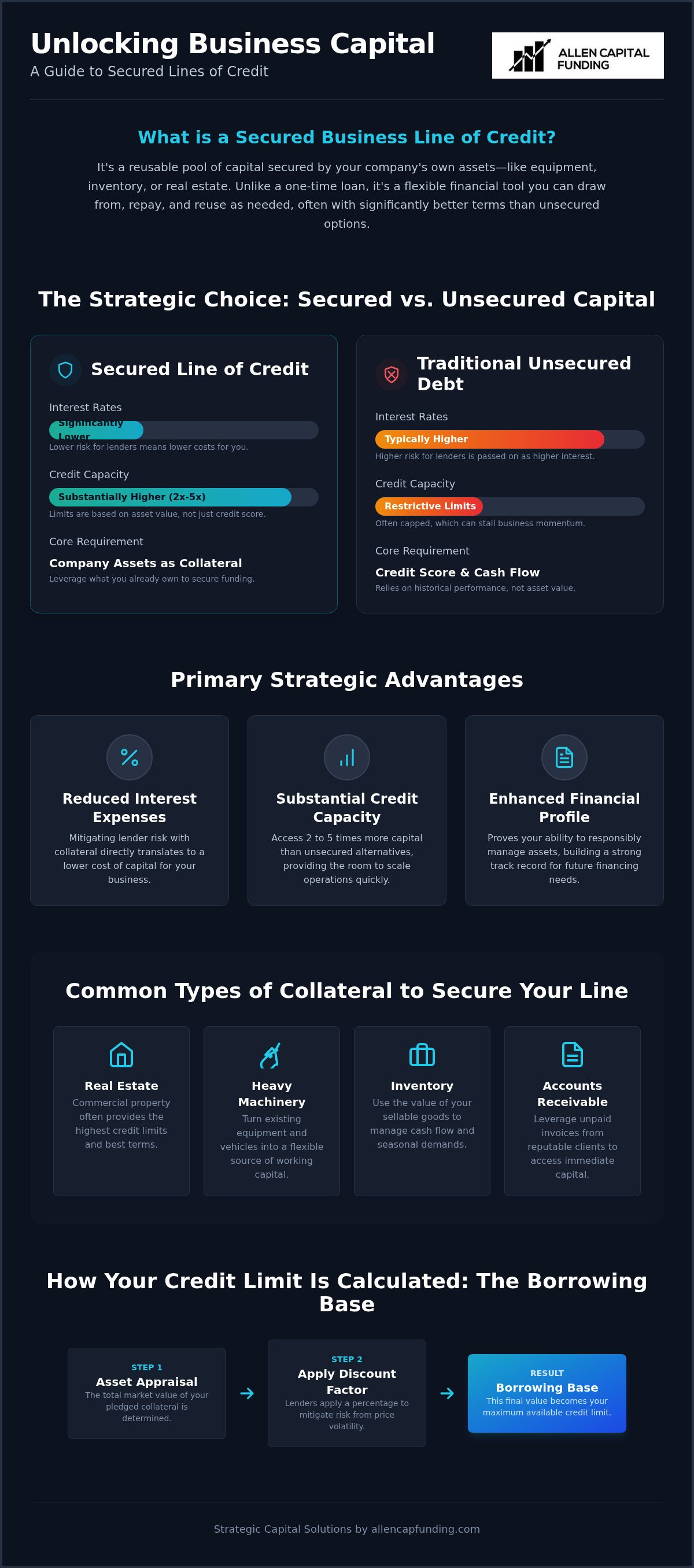
A secured business line of credit is a professional revolving credit facility where your company's assets act as collateral. This structure provides a powerful safety net that grows alongside your business. The fundamental revolving nature means you only pay interest on the capital you actually use, rather than the entire limit. Once you repay the borrowed balance, that capital becomes available for use again immediately. This flexibility marks the primary difference between a line of credit and a one-time loan. While a loan is a rigid, single-use injection of cash, a line of credit functions as an ongoing strategic resource you can tap into whenever operational needs arise.
Current 2026 market trends show a widening gap between secured and unsecured interest rates. As lenders tighten their criteria for signature-based loans, businesses with clear asset value can command significant discounts. This shift makes secured options more than just a backup plan. They're now a primary tool for reducing the total cost of capital. By backing your credit with tangible assets, you offer the lender a level of security that translates directly into lower overhead for your firm.
The Core Mechanism: Collateral and Borrowing Base
Lenders determine your credit limit through a calculation known as the borrowing base. This figure represents the total value of the assets you've pledged, adjusted for risk and marketability. Highly liquid assets, such as high-quality accounts receivable from reputable clients, often allow for a higher percentage of credit extension. Conversely, specialized machinery or older inventory might result in a more conservative limit due to the time and effort required to liquidate those items. A discount factor is the specific percentage a lender subtracts from an asset's appraised market value to protect against potential price volatility or depreciation.
Why Modern Businesses Prioritize Secured Facilities
Shifting to a secured facility offers three primary strategic advantages that help a company scale efficiently:
Reduced Interest Expenses: Because the lender's risk is mitigated by your collateral, you typically secure a much lower interest rate than you'd find with an unsecured product.
Substantial Credit Capacity: A secured business line of credit often provides between two and five times the borrowing capacity of unsecured alternatives, giving you the room to scale quickly without hitting a ceiling.
Enhanced Financial Profile: Successfully managing a large secured line proves your company’s ability to leverage its balance sheet responsibly. This builds a track record of reliability that strengthens your overall creditworthiness for future financing.
A secured line acts as a strategic bridge. It allows you to keep your cash reserves untouched while using the value of your inventory or equipment to fund new projects. This preservation of liquidity is vital for maintaining a healthy debt-to-equity ratio and ensuring you're ready for any market shift.
Types of Collateral: What Can You Use to Secure Your Line?
Many business owners assume only cash or personal savings can secure a line. In reality, your balance sheet is likely full of dormant value. A secured business line of credit can be backed by a variety of tangible and intangible assets, each offering different advantages for your borrowing capacity. Choosing the right collateral depends on your industry and how quickly you need access to funds. By identifying these assets, you move from a position of limited credit to one of strategic strength.
Leveraging Real Estate and Hard Assets
Commercial property is often the most powerful collateral available. By pledging real estate, you can often access the highest possible credit limits and the most favorable repayment terms. It's vital to understand your lien position. A first-lien position means the lender has the primary claim on the asset. This typically maximizes your borrowing power. If you already have a mortgage, a second-lien position might still be viable, but it often results in a more conservative credit limit.
Heavy machinery and vehicles also serve as excellent security. While commercial equipment loans provide a lump sum to purchase specific items, an equipment-backed line of credit allows you to draw against the value of hardware you already own. This strategy turns existing machinery into a flexible source of working capital without requiring a new purchase. It's a proactive way to maintain liquidity while keeping your essential tools in operation.
Liquid Assets: AR and Inventory Financing
For service-oriented or retail firms, liquid assets provide the fastest path to funding. This is the core of asset-based lending for small business. Accounts receivable (AR) are particularly attractive to lenders because they represent near-cash value. Lenders apply an "advance rate" to your AR. They typically provide between 70% and 90% of the invoice value depending on the creditworthiness of your customers. This ensures you have cash on hand even when clients take 30 or 60 days to pay.
Inventory is another flexible option, though it requires more oversight. Lenders will conduct inventory audits to verify the quality and turnover rate of your stock. This is especially useful for businesses preparing for seasonal peaks or bulk purchases. If you have a portfolio of marketable securities, you can also use these business investments as collateral. This allows you to access capital without liquidating your holdings and missing out on potential market gains. Identifying the right mix of assets ensures your business stays agile. You can explore these options further with the team at Allen Capital Funding to find a tailored solution for your needs.
Secured vs. Unsecured Lines: Making the Strategic Choice
Choosing between these two models determines your long-term financial health. While unsecured lines offer speed, they often come with a heavy risk premium in the form of elevated interest rates. A secured business line of credit requires collateral, but this pledge significantly lowers your cost of capital. For an established business, the decision isn't just about getting cash; it's about the return on investment for every dollar borrowed. You're trading a portion of your asset's equity for a drastically reduced interest expense.
Many owners fear pledging assets, yet this risk is often more perceived than actual. Lenders aren't in the business of liquidating equipment or real estate. They prefer the steady income of interest payments. For businesses with significant balance sheet value, the lower rates of a secured facility often far outweigh the theoretical risk of asset seizure. This is especially true when compared to the compounding costs of high-interest unsecured debt that can quickly erode your profit margins.
When to Choose a Secured Line of Credit
This facility is the ideal choice for companies planning substantial capital expenditures or massive inventory acquisitions. If your FICO score is recovering but your business owns valuable property or machinery, a secured line bridges that gap. It's also a tactical tool for managing 90-day invoice cycles. Instead of stressing over delayed payments, you use your asset base to maintain operational momentum without the high costs associated with signature-based loans. This approach allows you to scale based on your actual business value rather than just your personal credit history.
The True Cost of Capital Comparison
To understand the real impact, you must look beyond the base interest rate. Unsecured debt often carries higher maintenance fees and shorter repayment windows. Secured lines typically offer longer terms and lower rates that are often tax-deductible as a business expense. When you factor in these savings, the effective rate of a secured line becomes even more attractive. A business line of credit acts as an insurance policy for cash flow, providing a reliable safety net that protects your operations from market volatility.
Speed is the final variable in this comparison. Unsecured lines can fund in days, making them useful for immediate emergencies. However, for ongoing growth and large-scale scaling, the sustainability of a secured facility is unmatched. It provides the heavy-duty capital needed to transform a business from a local player into a regional leader. By securing your debt, you ensure that your capital remains affordable as your borrowing needs grow.
Qualification Checklist: Preparing for Your Application
Lenders need clarity before they commit capital. While a secured business line of credit shifts the focus toward your assets, your operational health remains a critical factor in the approval process. You'll need to present a cohesive financial story that proves your business can handle the debt service. This preparation starts with a deep dive into your "Big Three" financial statements: the balance sheet, profit and loss (P&L), and cash flow statement. These documents show the lender not just what you own, but how efficiently you turn those assets into revenue.
Repayment ability is often measured through the Debt Service Coverage Ratio (DSCR). This metric compares your annual net operating income to your total annual debt payments. Most lenders look for a ratio of 1.25x or higher, indicating you have a 25% cushion above your debt obligations. Even with collateral, your personal and business credit scores still play a role. They act as a "character" check, showing the lender your historical reliability with credit. A strong score can often lead to higher advance rates on your collateral.
The Appraisal and Valuation Process
The valuation of your collateral is the cornerstone of your credit limit. For equipment or real estate, expect a professional appraiser to visit your site. They'll evaluate the age, condition, and market demand for your hardware. When it comes to inventory, lenders rarely use the retail market value. Instead, they often calculate the Net Orderly Liquidation Value (NOLV). This is the estimated amount the lender would receive if they had to sell the stock in a controlled liquidation.
To maximize your borrowing base, keep your accounts receivable aging reports "clean." Lenders typically exclude any invoices that are more than 90 days past due. By proactively managing your collections, you ensure that a higher percentage of your AR qualifies as collateral. This direct link between your administrative efficiency and your borrowing power is a key advantage of asset-backed facilities.
Essential Documentation for 2026 Lenders
Modern lenders require a streamlined but comprehensive digital file. You should have the last two years of business and personal tax returns ready, along with current interim financials that are no more than 30 days old. You'll also need to provide your Articles of Incorporation and clear proof of ownership for any collateral you intend to pledge. This includes titles for vehicles, deeds for property, or UCC filings for equipment.
If your current financial profile doesn't perfectly align with private lender requirements, you might explore other avenues. A SBA loan specialist can help you determine if a government-guaranteed program provides a better fit for your specific asset type. To ensure your documentation is in top shape before you apply, start with a professional Financial Check-Up to identify any gaps in your balance sheet.
The Allen Capital Advantage: Strategic Sourcing of Secured Capital
Traditional banks often operate within narrow risk corridors that can overlook the true value of your balance sheet. When you apply for a secured business line of credit through a single institution, you're limited by their specific appetite for your asset type. Allen Capital Funding functions as a strategic ally, providing access to a national network of lenders that specialize in various collateral classes. This reach ensures you aren't just getting an offer, but the best possible advance rate for your specific situation. Our team handles the complex coordination between appraisers and underwriters to accelerate your path to liquidity.
Integrating this credit facility into a broader strategic business equipment financing plan allows you to scale without depleting your cash reserves. We focus on the long-term health of your capital structure rather than just a one-time transaction. This perspective ensures that your line of credit works in harmony with your other debt obligations and growth goals. By matching your specific asset type to the right lender, we maximize your borrowing capacity while keeping your interest expenses as low as possible.
Why a Broker Beats a Bank for Secured Lines
Choosing a broker over a traditional bank provides immediate practical benefits for a growing company. You submit one application, which we use to source multiple offers from across the country. This process protects your credit score by avoiding the multiple hard pulls that occur when you shop around yourself. We also bring significant negotiating power to the table. Because we understand the current 2026 lending landscape, we can leverage our relationships to secure better terms and more flexible covenants. We specialize in deals that traditional banks find too complex, such as those involving specialized machinery or multi-state real estate portfolios.
For organizations managing complex or international projects, working with an international property finance partner like The Federal Group can provide the specialized development finance and private equity expertise required to optimize high-value real estate assets.
Starting Your Strategic Financial Check-Up
Our process begins with a comprehensive evaluation of your current financial state. We don't just look at your debt; we look at the untapped potential within your assets. During a Financial Check-Up, we identify the most efficient way to structure your line of credit to support your upcoming growth milestones. Once we've aligned on a strategy, we move quickly through the documentation and appraisal phases to get your line funded. You shouldn't let your company's potential remain locked in its balance sheet. Book your consultation today to unlock your hidden liquidity and secure the capital your business deserves.
Strategic Capital for Your Next Growth Phase
A secured business line of credit is more than just a loan; it's a strategic tool that turns your company's existing value into actionable momentum. By pledging assets like commercial real estate or equipment, you can unlock higher limits and lower interest rates that unsecured debt simply can't match. Each asset on your balance sheet represents a potential bridge to your next expansion, provided you have the right partner to help you value and leverage it correctly.
Allen Capital Funding acts as your dedicated guide, providing expert guidance on tailored funding options through our extensive national network. We specialize in SBA, equipment, and asset-based financing, ensuring you receive localized expertise with a broad reach. Don't let your growth be limited by restrictive credit scores or high-interest premiums. Take the next step toward a more resilient financial future by speaking with a specialist who understands your unique operational needs.
Frequently Asked Questions
What is the typical interest rate for a secured business line of credit in 2026?
Rates for a secured business line of credit in 2026 generally track slightly above the prime rate, offering a significant discount compared to unsecured options. While exact figures depend on your collateral type and credit profile, secured facilities typically provide the lowest cost of revolving capital available. Lenders view the reduced risk of asset-backed debt favorably. This allows them to pass those savings on to you through more competitive interest margins.
Can I get a secured business line of credit with bad credit?
Yes, you can often obtain a secured line even with a lower FICO score because the lender's risk is mitigated by your assets. While traditional banks might require a score of 680 or higher, asset-based lenders prioritize the value and liquidity of your collateral. Strong accounts receivable or high-equity real estate can often offset past credit challenges. This makes secured funding an excellent tool for businesses focused on rebuilding their financial profile.
How much collateral do I need for a $500,000 line of credit?
To secure a $500,000 line, you typically need assets with an appraised value between $625,000 and $1,000,000 depending on the advance rate. Lenders rarely lend 100% of an asset's market value. Instead, they apply a discount factor. For example, if a lender offers an 80% advance rate on commercial real estate, you would need $625,000 in equity. If using inventory with a 50% advance rate, you would need $1,000,000 in stock.
What happens if my business cannot repay the drawn amount?
If your business defaults on a secured line, the lender has the legal right to seize and liquidate the pledged collateral to recover the balance. This process is usually a last resort; most lenders prefer to restructure the debt or negotiate a repayment plan. It's important to maintain open communication with your financial partner if cash flow issues arise. Proactive management can often prevent the loss of essential business equipment or property.
Can I use my accounts receivable as collateral for a credit line?
Absolutely, accounts receivable are among the most common and liquid forms of collateral for a secured business line of credit. Lenders view unpaid invoices from creditworthy customers as near-cash assets. They typically provide an advance rate of 70% to 90% of the total eligible AR balance. This allows you to bridge the gap between completing a project and receiving payment, ensuring your working capital remains fluid during long billing cycles.
How long does it take to get approved for a secured line of credit?
Approval for a secured line typically takes between two and four weeks, depending on the complexity of the asset appraisal. Real estate and specialized equipment require professional valuations, which can add time to the process compared to unsecured loans. However, if you are using liquid assets like accounts receivable, some specialized lenders can move from application to funding in as little as 10 business days. Preparation of all financial documents speeds up this timeline.
Is a secured line of credit better than a traditional term loan?
A secured line is often better for managing fluctuating operational costs, while a term loan is suited for specific, one-time purchases. The revolving nature of a credit line allows you to borrow, repay, and borrow again without reapplying. You only pay interest on the amount you've actually drawn. For businesses facing seasonal peaks or irregular cash flow, the flexibility of a line provides a more efficient safety net than a rigid loan.
Can an LLC use personal real estate to secure a business line of credit?
Yes, an LLC owner can use personal real estate to secure a business line of credit, though this often requires a personal guarantee. This is a common strategy for newer businesses that haven't yet acquired significant commercial property. By pledging a personal asset, the business can access much higher limits and better terms. It's vital to consult with a legal professional to understand how this affects your personal liability and the asset separation.


Comments