


SBA Microloan Program for Startups: 2026 Funding Guide
Updated: 1 day ago
Most traditional banks won't even look at a startup without two years of tax returns and a pristine credit score. It's frustrating to be told your vision isn't "bankable" simply because you're just getting started. You've likely felt the sting of rejection or the weight of high interest credit card debt while trying to bootstrap your operations. The SBA microloan program for startups offers a professional alternative by providing the essential capital that traditional institutions often withhold from new entrepreneurs.
This program offers more than just debt; it provides a strategic "incubator" model that combines up to $50,000 in working capital with dedicated business mentorship. You can use these funds for inventory, equipment, or supplies while gaining the management experience necessary to scale. It's a proven way to build a solid credit foundation for future larger-scale SBA financing as your company matures and your capital needs grow.
This guide explores the updated 2026 eligibility requirements and explains how to navigate the intermediary lender landscape. You'll discover how to secure funding despite a lack of business credit history and how to leverage technical assistance for long-term growth. We'll simplify the path to capital so you can focus on building your business with confidence.
Table of Contents
Understanding the SBA Microloan Program for Startups
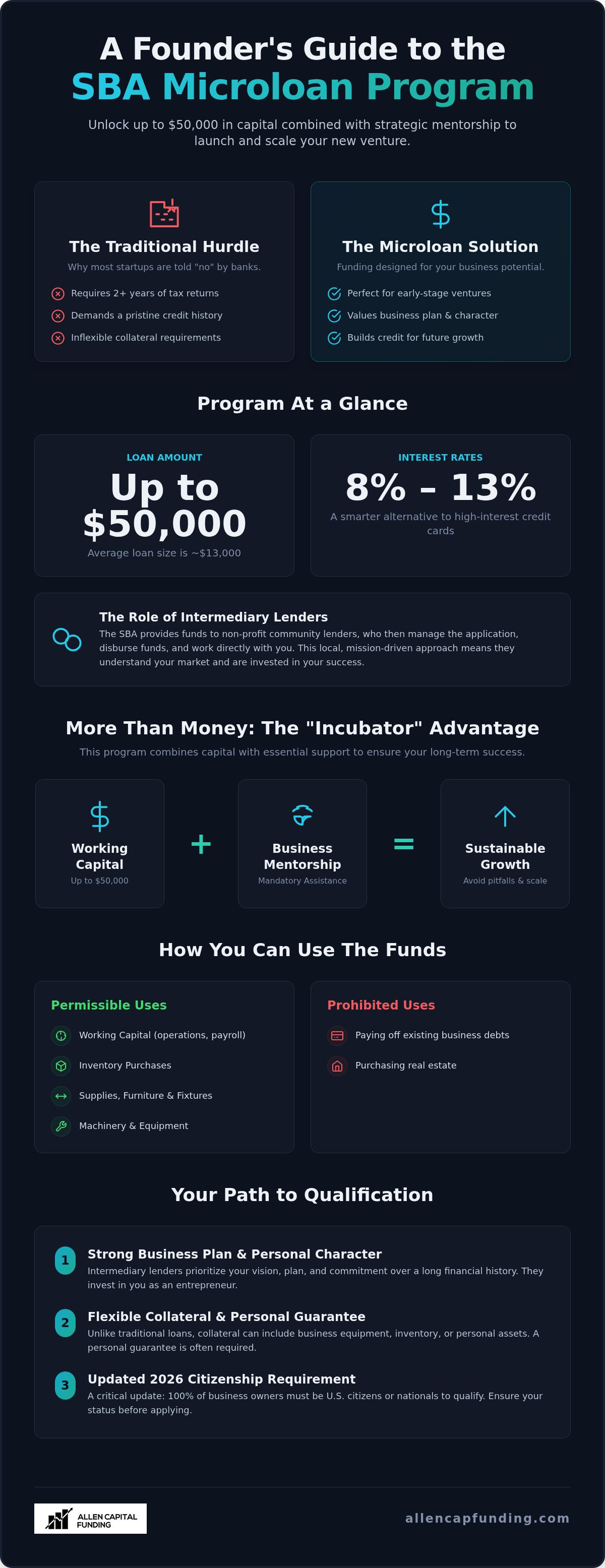
The SBA microloan program for startups serves as a strategic entry point for entrepreneurs who need capital but don't yet qualify for traditional commercial bank loans. This federal initiative provides loans up to $50,000, with an average loan size of approximately $13,000. While the larger SBA 7(a) program focuses on financing that can reach $10 million, the microloan program is specifically designed for the early-stage needs of new businesses. It targets underserved markets, including women, veterans, and minority-owned startups, ensuring that high-potential founders aren't left behind by rigid institutional standards.
By examining the SBA Microloan Program history, you'll see it was built to foster local economic growth through a decentralized lending model. This structure allows the program to be more responsive to the unique challenges faced by small entities that lack a long-standing financial track record. It isn't just about the money; it's about creating a sustainable foundation for businesses that might otherwise struggle to find a foothold.
The Role of Intermediary Lenders
The Small Business Administration doesn't issue these checks directly to your business. Instead, it provides funding to designated non-profit community-based organizations known as intermediary lenders. These organizations manage the application process, disburse the funds, and service the debt. Because these intermediaries are mission-driven, they often offer more flexible credit requirements than a standard bank. They prioritize the strength of your business plan and your personal character. This localized approach means you're working with a partner who understands your specific market and is invested in your community's success.
Why Startups Prioritize Microloans in 2026
Securing traditional bank debt or venture capital in 2026 remains difficult for most new entities. Banks typically require two years of operating history, leaving startups in a difficult position. The SBA microloan program for startups fills this gap by offering a lower barrier to entry. These loans generally require less collateral than commercial options, which is a major advantage if you haven't yet built up significant business assets. Additionally, with interest rates typically ranging from 8% to 13%, they're a much smarter alternative to using high-interest personal credit cards. Founders should be aware that as of 2026, 100% of business owners must be U.S. citizens or nationals to qualify, making it essential to verify your status before starting the application.
Key Features and Terms of the SBA Microloan Program
The SBA microloan program for startups provides a maximum of $50,000 in capital. While that's the ceiling, the average disbursement typically sits around $13,000. This smaller scale makes it an ideal fit for early-stage companies that need a precise injection of cash rather than a massive debt burden. Interest rates for these loans generally range between 8% and 13% as of 2026. These rates are determined by the specific intermediary lender you work with, rather than being set directly by the SBA. This variability means you should compare multiple intermediaries to find the most competitive terms for your specific situation.
Collateral requirements for these loans are often more flexible than traditional commercial products. Intermediaries may accept business equipment, inventory, or even personal assets to secure the draw. In many cases, a personal guarantee from the business owners is also required to finalize the agreement. Because the loan amounts are smaller, the paperwork is often less daunting than what you'd find with a million-dollar 7(a) loan, allowing for a faster path to funding.
Permissible Uses of Microloan Capital
Understanding how you can deploy these funds is critical for a successful application. You can use the capital for:
Working capital to cover daily operational costs and initial payroll.
Initial inventory purchases to stock your shelves or warehouse.
Office supplies, furniture, and essential fixtures for your physical location.
Strategic investment in commercial equipment loans to upgrade your production capacity.
It's vital to remember that these funds have strict prohibitions. You cannot use a microloan to pay off existing business debts or to purchase real estate. If your goal is to acquire property, you'll need to explore other SBA programs or specialized real estate financing. Adhering to these usage rules ensures your business remains in good standing for future financing rounds.
Repayment Flexibility and 2026 Market Conditions
The repayment structure is designed to support a startup's growth trajectory. While the maximum repayment term allowed by law is seven years, many intermediaries structure agreements that extend up to six years. This duration allows you to manage early-stage cash flow without the pressure of aggressive monthly payments. In the 2026 financial environment, fixed-rate microloans have become particularly popular. They provide a predictable expense that helps new businesses maintain tight margins despite broader market fluctuations.
Choosing the right repayment term is a balancing act between minimizing interest costs and maintaining monthly liquidity. If you're unsure which specific asset should serve as collateral or how to structure your request, performing a financial check-up can clarify your path forward. Selecting the right terms early prevents future liquidity issues as you scale your operations.
Strategic Advantages: Capital Plus Technical Assistance
The SBA microloan program for startups stands out because it treats capital and knowledge as inseparable. Unlike a standard bank loan where you receive funds and are left to your own devices, this program mandates a strategic partnership. This "capital plus coaching" model acts as a built-in accelerator for your new entity. It ensures you possess the management competency required to deploy your capital effectively, maximizing the return on every dollar borrowed.
Intermediaries realize that capital alone doesn't guarantee success. By providing professional guidance alongside the loan, they significantly reduce the risk of default while empowering you to build a more resilient company. This approach transforms the lending process from a simple transaction into a comprehensive growth strategy. You aren't just gaining a creditor; you're gaining a dedicated consultant invested in your survival.
The Mandatory Training Requirement
Most founders initially view mandatory training as a hurdle, but it's actually a massive competitive advantage. You should expect intensive workshops covering essential topics like GAAP accounting, digital marketing strategies, and lean business planning. Intermediary lenders use this training to de-risk the loan for your startup. By the time the funds hit your account, you've already stress-tested your business assumptions. Many founders find that the professional financial check-up included in the process is just as valuable as the loan itself. It provides a clear, objective view of your cash flow and operational health before you commit to significant spending.
Building Business Credit for Future Expansion
Successful repayment of a microloan is your first step toward institutional credibility. When you consistently meet your obligations to an intermediary lender, you establish a positive business credit profile that exists independently of your personal finances. This history is vital when you're ready to transition from a microloan to a larger business line of credit. Traditional lenders often view a successfully completed SBA microloan as a "proof of concept." It proves you can manage debt responsibly and execute a complex business plan over a multi-year period.
Beyond the credit benefits, the program creates a bridge to a wider professional network. You'll often find yourself in cohorts with other local entrepreneurs, creating opportunities for local partnerships and peer-to-peer support. This networking component helps you integrate into the local business ecosystem, providing a support structure that lasts long after the loan is repaid. The SBA microloan program for startups isn't just a way to get cash; it's a way to build the skills and reputation needed for long-term success.
Qualification and Application Requirements for Startups
While the Small Business Administration establishes the overarching framework, the SBA microloan program for startups is unique because individual intermediaries define their own specific approval criteria. This means if one lender declines your application, another may approve it based on your industry focus or geographic location. Generally, these mission-driven lenders look for a personal credit score in the mid-600s, though some organizations consider scores as low as 575 if your business plan demonstrates significant potential. These flexible standards are designed to support founders who have been overlooked by traditional banking institutions.
Expect to provide a personal guarantee as part of the approval process. This is a standard requirement for almost all microloans and signifies your personal commitment to the debt. Collateral is typically required as well, but intermediaries are often more creative than banks. They may accept business equipment, inventory, or personal assets to secure the loan. Because the maximum loan amount is $50,000, the collateral requirements are usually proportional to the smaller draw, making it accessible for founders without extensive corporate assets.
Essential Documentation for Startup Founders
Your application package must be comprehensive to win over an intermediary's credit committee. A disorganized file is the fastest way to receive a rejection. Ensure you have the following documents prepared:
A professional business plan featuring detailed 2026 revenue projections and a clear market analysis.
Personal financial statements and the last two years of tax returns for every owner with a 20% or greater stake.
A specific "sources and uses" statement explaining exactly how the capital will grow your operations.
Documentation proving 100% U.S. citizenship or national status for all owners, as required by the April 1, 2026, regulation update.
Navigating the Intermediary Selection Process
Don't apply to the first lender you find. Research intermediaries that align with your specific industry or demographic, as some focus exclusively on veterans, women-owned businesses, or tech startups. Interview the lender about their technical assistance offerings to ensure their coaching style matches your management needs. Because the intermediary landscape is complex, working with an SBA loan specialist can significantly streamline your search and help you avoid lenders whose criteria you don't meet.
If you're ready to move beyond the research phase and start building your application package, it's time to speak with a professional who understands the national intermediary network. You can explore tailored SBA loans today to begin your path toward securing the capital your startup needs to scale.
Optimizing Your Funding Strategy with Allen Capital Funding
The SBA microloan program for startups is an excellent entry point, but it should never be viewed in isolation. True financial success requires a holistic roadmap that anticipates your needs as you move from a seed-stage entity to an established market player. Allen Capital Funding identifies the specific capital tools that match your unique stage of development. We help you look beyond a single $50,000 draw to ensure your capital structure supports sustainable growth without creating future liquidity traps.
Using a professional brokerage allows you to move with the speed and efficiency that 2026 market conditions demand. Instead of spending weeks researching individual intermediary requirements, you gain immediate access to a vetted network of lenders. This strategic approach ensures you don't just get funded; you get funded by the partner most likely to support your long-term vision. We act as the bridge between your current capabilities and your future goals.
Moving Beyond Microloans to Comprehensive Capital
Founders who envision scaling into a diversified enterprise can also look to management examples like rl-private-holding.com to understand how to manage a portfolio of business interests effectively.
A microloan provides the initial spark, but scaling often requires more specialized tools. You might supplement your initial working capital with equipment financing to acquire specialized machinery or use purchase order funding to fulfill large contracts that exceed your current cash reserves. Timing your transition into larger SBA 7(a) or 504 loan products is critical for maintaining momentum. As your balance sheet strengthens, we can help you unlock liquidity through asset-based lending, providing the flexibility needed for rapid expansion. These tailored options empower your business with strategic financial solutions that evolve alongside your revenue.
How a Specialized Broker Accelerates the Process
Government-backed programs are notorious for "paperwork fatigue," which often distracts founders from their core operations. A specialized broker streamlines this process by managing the complex documentation requirements and ensuring your application is "credit-ready" before it reaches a lender. We provide access to a broader network of lending partners than any single bank can offer, increasing your chances of approval on favorable terms. Allen Capital Funding acts as your strategic advocate, ensuring your capital structure aligns perfectly with your immediate operational needs and long-term scaling objectives. This proactive support removes the barriers to progress and simplifies your path to accelerated success.
Securing Your Startup’s Financial Future
The SBA microloan program for startups is more than a simple capital injection; it's a strategic foundation. By combining up to $50,000 in funding with mandatory technical assistance, it equips founders with both the liquidity and the management skills needed to survive the critical early years. This program effectively bridges the gap between initial bootstrapping and future institutional financing by establishing a solid business credit profile from day one.
Allen Capital Funding provides a national network and deep expertise in crafting startup capital roadmaps. We offer tailored financial solutions designed for every growth stage, ensuring you have a steady partner from your first microloan to your eventual expansion. Our team simplifies the complex intermediary landscape so you can focus on building your brand with confidence and clarity.
Consult with our SBA specialists to secure your startup capital today. Your vision deserves the right backing. With professional guidance and a clear funding strategy, you can transform your startup into a resilient and market-leading enterprise.
Frequently Asked Questions
What is the maximum amount I can borrow through the SBA microloan program?
You can borrow a maximum of $50,000 through the SBA microloan program for startups. The average loan size typically settles around $13,000; however, your specific amount depends on your business needs and the requirements of the intermediary lender. These funds are designed for smaller capital injections rather than massive expansions. This makes them ideal for early-stage companies that need to purchase inventory or cover initial working capital costs without taking on excessive debt.
Can I use an SBA microloan to buy a commercial building for my startup?
No, you cannot use an SBA microloan to purchase real estate or commercial buildings. The program specifically prohibits the use of funds for property acquisitions. If your startup requires a physical location, you should explore other SBA options like the 504 loan program. Microloans are strictly reserved for operational needs such as working capital, inventory, furniture, and equipment. Adhering to these usage guidelines is a critical requirement for maintaining program eligibility.
How long does the application process typically take for a microloan?
The application process for a microloan typically takes between 30 and 90 days. This timeline varies based on the specific intermediary lender and how quickly you provide the necessary documentation. Because these lenders are non-profit organizations, they often take the time to review your business plan and complete the mandatory technical assistance phase. Preparing a comprehensive application package in advance can help reduce delays and move your startup toward funding more efficiently.
Do I need a high credit score to qualify for an SBA microloan?
You don't necessarily need a high credit score to qualify, as intermediaries often prioritize your business plan and character over traditional metrics. While most lenders look for scores in the mid-600s, some may approve applications with scores as low as 575. The SBA microloan program for startups was created to help underserved entrepreneurs who may not meet rigid bank standards. Demonstrating a clear path to revenue is often more important than having a pristine personal credit history.
Is the technical assistance and training mandatory for all borrowers?
Yes, technical assistance and training are mandatory requirements for all borrowers participating in this program. Intermediary lenders provide this "coaching" to help you avoid common startup pitfalls and manage your capital effectively. You'll participate in workshops or one-on-one sessions covering topics like accounting, marketing, and business planning. This requirement is designed to de-risk the loan while empowering you with the management skills necessary to scale your business successfully in 2026.
Can I apply for an SBA microloan if I am a sole proprietor?
Yes, sole proprietors are eligible to apply for an SBA microloan. The program supports various business structures, including corporations, partnerships, and limited liability companies. As long as you meet the basic eligibility criteria and the specific requirements of your chosen intermediary, your status as a sole proprietor won't disqualify you. You must still provide personal financial statements and demonstrate that your business is a for-profit entity operating within the United States.
What happens if I cannot provide collateral for the microloan?
If you cannot provide traditional collateral, intermediaries are often willing to be flexible. They may accept business equipment, inventory, or even personal assets to secure the loan. Additionally, a personal guarantee is almost always required from the business owners. Because these lenders focus on economic development, they work with you to find creative ways to satisfy security requirements. This flexibility makes the program accessible for founders who lack significant corporate or personal holdings.
Can a microloan be used to refinance existing high-interest business debt?
No, you cannot use an SBA microloan to refinance or pay off existing business debt. The program is designed to provide new capital for growth and operations rather than restructuring old liabilities. If your startup is struggling with high-interest credit card debt, you'll need to look at other financing products or debt consolidation options. Using microloan funds for prohibited purposes can lead to a default and jeopardize your future access to larger SBA-backed financing products.


Comments