


SBA Loan Brokers: Strategic Funding Excellence for Small Businesses in 2026
- anthonyarallen
- Aug 14
- 11 min read
Updated: 6 days ago
What if the primary obstacle to your business expansion isn't your balance sheet, but the way your story is told to federal lenders? In a year where SBA regulations have undergone significant shifts, including the doubling of combined loan limits to $10 million, many entrepreneurs are turning to specialized SBA loan brokers to manage the complexity. You've likely felt the sting of slow bank response times or the confusion of trying to distinguish between 7(a) and 504 eligibility requirements. It's exhausting to invest months into paperwork only to fear a rejection based on a technicality you didn't see coming.
We understand that securing capital should feel like a breakthrough, not a burden. A professional broker acts as your strategic financial ally, transforming your application into a fundable asset that meets the strict 2026 ownership and residency standards. This guide reveals how a dedicated expert navigates these complex federal waters to secure the most competitive rates and structures for your long-term growth. We'll preview the "Financial Check-Up" process, explain how to leverage the new $10 million lending ceiling, and show you the exact path to faster funding and higher approval probabilities.
Table of Contents
The Role of SBA Loan Brokers in the 2026 Economy
An SBA loan broker is a specialized intermediary who matches small businesses with the right SBA-approved lenders. They act as a bridge between your company's capital needs and the specific underwriting preferences of various financial institutions. In the 2026 economy, where credit conditions fluctuate and federal guidelines have become more stringent, professional navigation isn't a luxury. It's a requirement for speed.
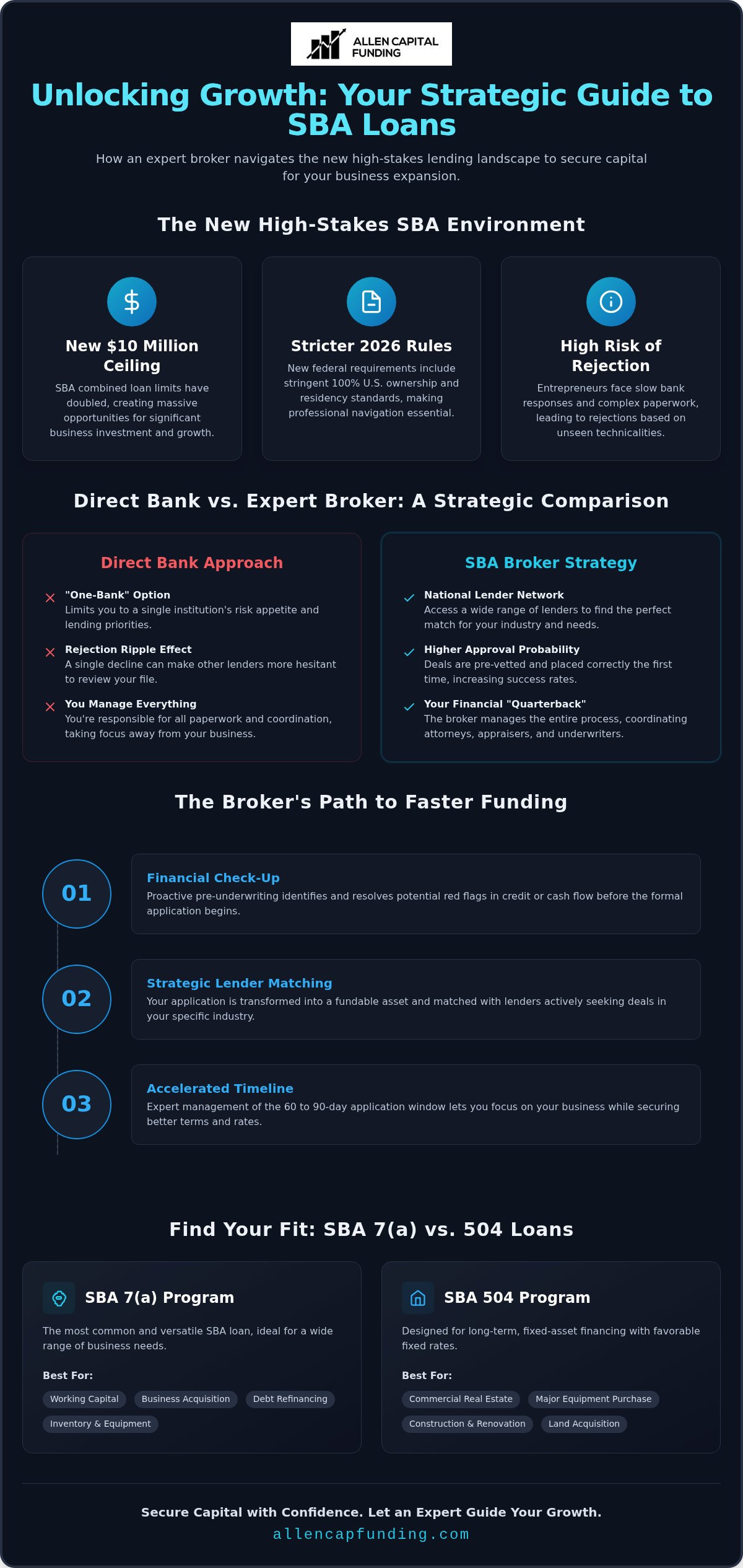
The current landscape features a Small Business Administration (SBA) that has doubled combined loan limits to $10 million while simultaneously tightening ownership verification. These shifts create a high-stakes environment. One misstep in your documentation can lead to "application fatigue," where months of effort result in a rejection. SBA loan brokers mitigate this risk by vetting your file against current standards before it ever hits a lender's desk.
The Value Proposition of Professional Loan Brokerage
A broker acts as your financial advocate, ensuring your application meets the exact risk appetite of the target lender. This advocacy provides access to a national network of banks that specialize in niche industries, from logistics to food production. Instead of you trying to decipher complex SBA Standard Operating Procedures (SOPs), the broker translates these regulations into actionable steps. They ensure your business's story is told in a language that underwriters understand and respect.
Direct Bank vs. SBA Loan Broker: A Strategic Comparison
Walking into your local bank might seem convenient, but it limits you to a "one-bank" option. If that bank's portfolio is currently heavy in your sector, they'll likely decline your request regardless of your creditworthiness. This creates a "rejection ripple effect," where a single decline can make other lenders more hesitant. SBA loan brokers prevent this by placing deals correctly the first time. They're especially essential for non-standard transactions, such as partner buyouts or complex business acquisitions, where generic bank products often fall short of the required flexibility.
For entrepreneurs whose growth strategy involves rental or investment properties, Simplified Commercial Lending offers specialized commercial mortgage products without requiring tax returns, providing a streamlined path for those who need alternatives to standard institutional requirements.
Strategic Advantages of Using an SBA Loan Broker
SBA loan brokers aren't just facilitators. They're strategic architects who transform your financial profile into a fundable asset. By performing rigorous pre-underwriting and financial cleaning before a lender ever sees your file, they significantly increase approval rates. This proactive approach identifies potential red flags in your credit history or cash flow statements, allowing for corrections that prevent an immediate decline. It's about presenting the most polished version of your business to the right audience.
Time is your most valuable resource as an entrepreneur. The official SBA loan programs typically involve a 60 to 90 day timeline from application to funding. While you focus on daily operations, SBA loan brokers manage this entire window. They create a competitive environment among lenders, which often results in better terms and lower fees than you'd receive by walking into a bank alone. This negotiation power ensures you don't just get funded, but you get funded on terms that support long-term stability.
The "Quarterback" Approach to Funding
A broker coordinates the entire financial ecosystem on your behalf. They act as the central point of contact between attorneys, appraisers, and bank underwriters. This eliminates the stress of managing a mountain of paperwork, from personal financial statements to multi-year tax returns. Most importantly, they ensure your Debt Service Coverage Ratio (DSCR) is calculated and presented accurately. If your debt-to-income story isn't framed correctly, even a profitable business can face a rejection based on a technicality.
Maximizing Loan Proceeds and Terms
Strategic brokers identify lenders willing to push boundaries, such as offering 90% Loan-to-Value (LTV) for commercial real estate acquisitions. They also help structure working capital draws to ensure your liquidity remains high after the deal closes. Sometimes, an SBA loan is only one piece of the puzzle. You might benefit from pairing your primary loan with a Business Line of Credit to handle seasonal fluctuations or specific equipment financing for high-tech upgrades. This holistic view of your capital structure prevents you from being over-leveraged in the wrong areas.
To see how your current financials align with the latest lender expectations, you can start with a financial check-up to ensure your business is truly capital-ready.
SBA 7(a) vs. 504: Analyzing the Best Fit for 2026
Choosing between the two flagship SBA loan programs is a pivot point for your 2026 growth strategy. While both offer government-guaranteed backing, their structures serve vastly different operational goals. Specialized SBA loan brokers play a critical role here by analyzing your balance sheet to determine which path offers the lowest cost of capital. They also ensure you meet the strict March 2026 requirement that 100% of business owners must be U.S. citizens or nationals with principal residence in the United States.
The 7(a) program remains the "Swiss Army Knife" of business funding. It's the go-to for working capital, inventory surges, and debt refinancing. In the current market, fixed rates for these loans range from 9.5% to 13.5% APR. Conversely, the 504 program is a precision tool for commercial real estate and long-term machinery. It typically offers a blended effective rate between 7.0% and 8.0%, providing a more stable foundation for heavy asset purchases. With the 2026 policy shift allowing a combined $10 million limit across both programs, you can now strategically pair these options to maximize your expansion potential.
When to Choose the SBA 7(a) Program
The 7(a) is ideal for business acquisitions, partner buyouts, and general operational needs. It provides financing up to $5 million with significant flexibility. If your growth requires immediate liquidity rather than just physical assets, this is likely your best route. SBA loan brokers often recommend the 7(a) for service-based businesses or companies with high inventory turnover that need to maintain a healthy cash reserve during rapid scaling phases.
The Strategic Power of the 504 for Real Estate
For businesses looking to own their facilities, the 504 program offers a low down payment, typically just 10%. This is significantly lower than most conventional commercial loans, which often require 20% to 30% down. The long-term fixed rates protect your business against future market volatility, making your monthly occupancy costs predictable for decades. If you find that your balance sheet is heavy on equipment or real estate needs but light on cash, you might also consider how Asset-Based Lending can complement your SBA strategy to unlock additional liquidity.
Before applying, your broker will verify your eligibility through the "size standards" and "credit elsewhere" tests. These ensure your business qualifies as "small" for your specific industry and that you genuinely benefit from the SBA's enhanced terms. This rigorous pre-check prevents you from wasting time on applications that don't meet federal criteria.
How to Select and Prepare for an SBA Loan Broker
Selecting the right partner is as critical as the loan itself. Not all SBA loan brokers offer the same level of expertise or access. When you evaluate a potential ally, prioritize industry experience and the breadth of their lender network. Transparency is a non-negotiable trait. A reliable broker will explain their fee structure clearly and won't promise "guaranteed" results. Federal lending involves too many variables for anyone to offer a 100% guarantee, and such claims are often a sign of predatory practices.
Avoid brokers who demand significant upfront fees before any analysis is performed. The SBA regulates these fees, and reputable firms typically earn their compensation when your deal successfully funds. Preparation is your best defense against application delays. Before your first meeting, organize three years of business and personal tax returns along with your most recent Profit and Loss (P&L) statement. Having these documents ready shows lenders you're a serious, organized borrower who respects the timeline.
The Financial Check-Up: Your Pre-Application Audit
The most effective way to start is with a comprehensive audit of your "SBA-readiness." This involves a deep dive into your personal and business credit scores to ensure they meet 2026 standards. You must identify "deal killers" like outstanding tax liens or unresolved legal issues before they reach a bank underwriter. If your goal is specifically to acquire heavy machinery or vehicles, understanding how Commercial Equipment Loans fit into your total capital stack is essential. This pre-check ensures that when you finally submit, your application is positioned for success rather than immediate scrutiny.
Questions to Ask Your Potential SBA Broker
Interview your broker as if they were a high-level consultant joining your team. Ask them: "How many lenders do you actively work with in my specific industry?" Industry specialization matters because a bank that loves manufacturing might be hesitant about hospitality. Follow up with: "What is your success rate for files that make it to the underwriting stage?" This reveals how well they vet deals before submission. Finally, ask: "How do you handle communication between the bank and my internal team?" Clear communication prevents the "black hole" effect where you don't hear from your lender for weeks.
To ensure your application is as strong as possible, schedule your financial check-up today and identify any gaps in your funding profile before you apply.
Accelerated Success with Allen Capital Funding
Allen Capital Funding acts as your dedicated guide through the complex SBA maze. We don't just facilitate transactions; we build capital structures that support your long-term vision. Our team shifts your focus from the stress of searching for capital to the momentum of executing your growth strategy. This transition is possible because we handle the technical heavy lifting, allowing you to remain the leader of your business rather than its full-time loan administrator.
As specialized SBA loan brokers, we provide national reach combined with a boutique, partnership-driven service model. You get the benefit of a vast lender network without feeling like a number in a queue. We customize every solution, whether you need working capital for a surge in demand, specialized equipment for a new contract, or a permanent home for your operations. Our goal is to ensure your capital structure is an engine for progress, not a source of friction.
Our Comprehensive Funding Suite
Success in 2026 often requires a multi-layered financial approach. While SBA loans provide a sturdy foundation, your business might need more agile tools to handle daily fluctuations. We integrate Credit Lines, Factoring, and Purchase Order Financing into your broader strategy to ensure you never have to turn down a large contract due to cash flow constraints. For those looking to upgrade their physical capabilities, our Strategic Business Equipment Financing guide explains how to acquire high-value assets while preserving your liquidity.
Your Next Step Toward Strategic Capital
The path to accelerated growth begins with a clear understanding of your current financial standing. Booking an initial consultation with us provides a comprehensive review of your funding potential. In your first 15 minutes with an Allen Capital Funding specialist, we'll identify the most viable loan programs for your specific goals and uncover any immediate hurdles to approval. We value your time and prioritize clarity over complex jargon, ensuring you leave the conversation with a concrete roadmap for success.
Strategic Capital as Your Competitive Advantage
The 2026 financial landscape offers unprecedented opportunity for growth, provided you have the right structural support. We've explored how the doubling of loan limits to $10 million and stricter ownership scrutiny make professional guidance essential. By partnering with specialized SBA loan brokers, you move beyond generic bank applications to a refined, fundable strategy. You've learned that the choice between 7(a) flexibility and 504 stability depends on your specific asset needs. A rigorous pre-application audit remains your best defense against funding delays.
Allen Capital Funding provides the steady hand you need to navigate these complexities. Our national funding network and deep expertise across SBA 7(a), 504, and conventional credit lines ensure your business receives a tailored solution. Every partnership begins with our signature Financial Check-Up. This process is designed to identify and resolve barriers before they impact your timeline. We're committed to your accelerated success through every stage of the lending process.
Your expansion goals are within reach. With a proactive ally by your side, you can focus on building your legacy while we secure the capital that fuels it.
Frequently Asked Questions
What exactly does an SBA loan broker do?
An SBA loan broker acts as a specialized intermediary who matches small businesses with the right SBA-approved lenders based on current underwriting criteria. They manage the entire application lifecycle, from performing a Financial Check-Up to coordinating with bank underwriters and attorneys. Their primary goal is to ensure your business profile aligns with a lender's specific risk appetite before you submit a formal application.
How much do SBA loan brokers typically charge?
Brokerage fees are generally success-based and are collected only when your loan successfully funds. The SBA strictly regulates the fees that can be charged for loan packaging and referral services to protect small business owners. Most reputable brokers provide a clear fee disclosure upfront, ensuring there are no hidden costs or excessive charges for their consulting and application management services.
Can I get an SBA loan without a broker?
You can apply for an SBA loan directly through any participating bank or credit union without using an intermediary. However, going direct limits your options to that single institution's internal policies and current portfolio balance. If your local bank has already met its lending quota for your specific industry, you might face a rejection that has nothing to do with your company's actual creditworthiness.
What is the minimum credit score for an SBA loan in 2026?
Most lenders in 2026 look for a personal credit score of at least 680 for standard 7(a) and 504 loan programs. While the SBA doesn't set a hard minimum score, individual banks use credit history as a primary indicator of reliability. If your score is lower, SBA loan brokers can often help you identify lenders who prioritize strong cash flow or significant collateral over a perfect credit rating.
How long does the SBA loan process take with a broker?
The typical timeline from application to funding ranges between 60 and 90 days. Using a broker can often accelerate the early stages of this process by ensuring your documentation is complete and accurate before it reaches the bank. This "clean" submission prevents the common back and forth requests for additional information that frequently stall direct bank applications for several weeks.
Do SBA brokers help with business acquisition loans?
Brokers are highly effective in securing capital for business acquisitions and partner buyouts. These transactions are often more complex than simple real estate purchases because they require a deep analysis of the target company's historical cash flow and intangible assets. A broker ensures the deal structure meets SBA requirements for equity injections and debt service coverage, which are common sticking points in acquisitions.
What is the difference between an SBA broker and a loan officer at a bank?
A bank loan officer represents a single financial institution and can only offer that bank's specific products and interest rates. An SBA loan broker functions as an independent advocate with access to a national network of multiple lenders. This allows the broker to shop your loan package to several banks simultaneously to find the most competitive terms and the highest probability of approval.
Will using a broker improve my chances of SBA loan approval?
Yes, SBA loan brokers increase your approval probability by identifying and resolving eligibility issues before a lender sees your file. They understand the specific documentation requirements that lead to fast approvals and can frame your business's financial history in the most favorable light. This expert positioning ensures your application meets the exact risk profile of the bank most likely to fund your deal.


Comments