


Purchase Order Financing for Inventory: A 2026 Guide to Fulfilling Large Orders
What if landing the biggest contract in your company's history actually became the moment your business started to fail? It sounds counterintuitive, but for many growing firms, a massive spike in demand is a double-edged sword. You have the opportunity to scale, but your cash is already tied up in daily operations; leaving you unable to pay suppliers for the necessary goods. It's a high-stakes situation where the fear of losing a contract due to lack of capital feels very real.
We understand that feeling of being stuck between a major win and a financial bottleneck. This 2026 guide explains how to leverage purchase order financing for inventory to fulfill those large orders on time without sacrificing your operational liquidity. You'll learn how to bridge the gap between receiving an order and getting paid, all while avoiding the trap of predatory, high-interest debt that can cripple long-term growth.
We'll walk you through the mechanics of this strategic funding tool, compare it to traditional lending options, and show you how to find a reliable partner to facilitate your national expansion. By the end, you'll have a clear roadmap for scaling your business without giving up equity or your peace of mind.
Table of Contents
The Inventory-Cash Gap: How a Small Business Lending Company Solves Growth Stalls
The Mechanics of Purchase Order Financing for Inventory and Supply Chain Scaling
PO Financing vs. Inventory Loans: Evaluating Your Working Capital Options
Strategic Readiness: Qualifying for High-Volume Purchase Order Funding
Unlocking National Growth with Allen Capital Funding’s Strategic Capital Solutions
The Inventory-Cash Gap: How a Small Business Lending Company Solves Growth Stalls
Growth is the ultimate goal for any ambitious business, but it often brings a hidden financial danger. When a massive contract arrives, your bank account might not match your ambition. This is the "big order" dilemma. You have a confirmed buyer, but your cash is already tied up in daily operations. Purchase order financing for inventory is a tactical, short-term funding solution designed to bridge this exact gap. It allows you to pay your suppliers to manufacture and ship goods before you ever receive payment from your customer. In this arrangement, a Purchase order (PO) acts as the primary collateral, proving the validity of the future revenue.
Many entrepreneurs find themselves hitting a wall when their success outpaces their liquid capital. Recognizing the signs you need working capital is the first step toward avoiding a growth stall. If you're turning down contracts or delaying production because your cash flow is locked in existing inventory, you need a specialized lending partner. A dedicated small business lending company doesn't just provide funds; it helps you navigate complex PO terms and ensures your supply chain remains resilient during rapid scaling.
Understanding the Cash Flow Gap in 2026
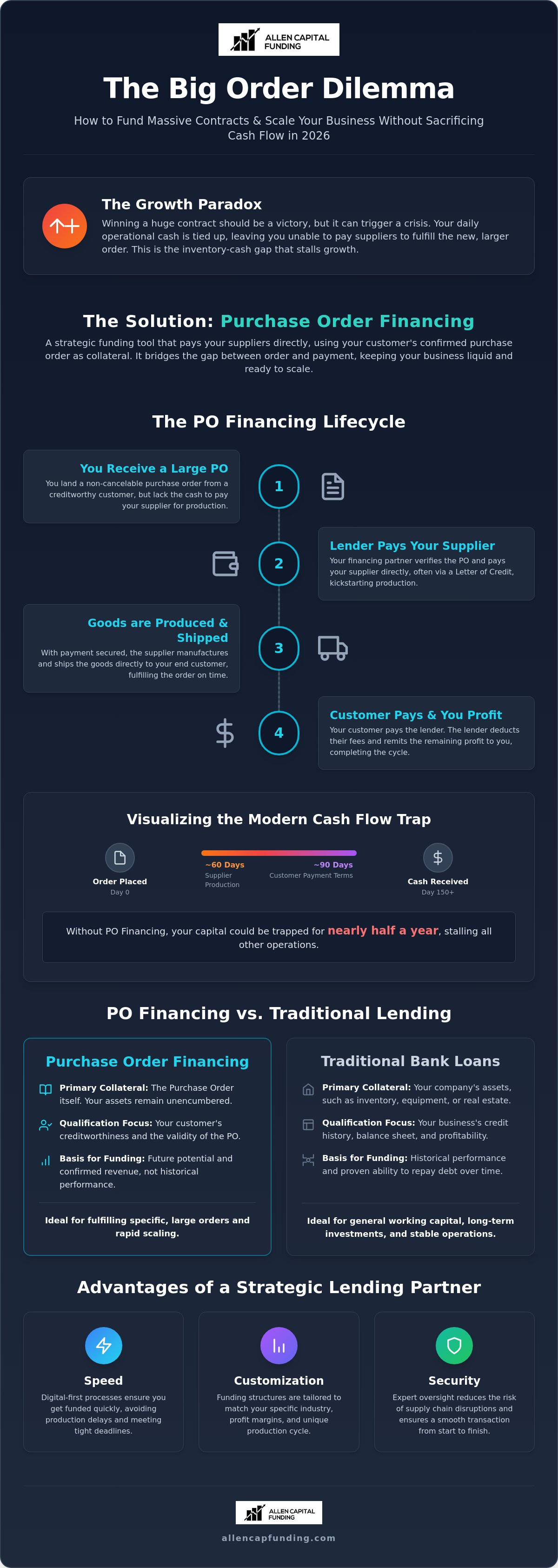
Traditional banks often reject high-growth inventory requests because they focus on historical performance rather than future potential. In 2026, manufacturing lead times remain a significant hurdle for liquidity. If your supplier requires 60 days to produce goods and your customer pays on Net-90 terms, your capital could be trapped for nearly half a year. Using purchase order financing for inventory keeps your operational cash free for essential costs like payroll, marketing, and R&D. It turns a potential crisis into a controlled expansion.
The Role of a Strategic Lending Partner
Finding the right capital solution requires moving beyond single-source lenders. A strategic broker acts as a facilitator, connecting you with multiple lending partners to find the best fit for your specific industry. We bridge the gap between your suppliers and your end customers by managing the flow of funds directly. This brokerage model accelerates the funding process through expert loan origination and specialized guidance. We remove the barriers to large-scale contracts, acting as a dedicated ally in your journey toward national growth. For those also interested in personal or homeowner financial products, you can find out more about how credit brokers simplify the search for the right individual loans.
Speed: Digital-first consulting ensures you don't miss tight production deadlines.
Customization: Tailored funding structures match your unique production cycle.
Security: Expert oversight reduces the risk of supply chain disruptions.
The Mechanics of Purchase Order Financing for Inventory and Supply Chain Scaling
Understanding the mechanics of purchase order financing for inventory is vital for any business looking to scale without friction. This process isn't a traditional loan where cash hits your bank account. Instead, it's a three-way agreement between you, your supplier, and your lending partner. The lifecycle begins when you receive a confirmed, non-cancelable purchase order from a creditworthy customer. Because the lender relies on your customer's ability to pay, this funding method allows you to secure larger contracts than your own balance sheet might typically support.
Once the deal is approved, the lender pays your supplier directly. This direct payment method is the defining feature of Purchase Order Financing. By handling the payment, the lender ensures the production line keeps moving while you focus on sales and logistics. The transaction finally closes when your customer pays the invoice. The lender deducts their fees and remits the remaining profit to you, completing a clean, project-based funding cycle. If you want to see how this fits your current growth stage, you can explore our strategic capital solutions to find the right fit.
Direct Supplier Payments: Securing the Production Line
Lenders often use Letters of Credit or direct cash payments to guarantee supplier priority. This financial security often moves your order to the front of the manufacturing queue, which is critical when meeting tight deadlines. In 2026, the funding release often depends on independent quality inspections. These digital-first audits verify that the goods meet specifications before they leave the factory. This layer of protection reduces the risk of production delays and ensures that your end customer receives exactly what they ordered.
Transitioning from PO Financing to Invoice Factoring
Many high-growth businesses use purchase order financing for inventory as a bridge. Because PO financing carries higher risk before the goods are delivered, it typically costs more than other options. Once the goods are shipped and you issue an invoice, you can transition the debt to invoice factoring. This move lowers your cost of capital for the remainder of the payment cycle. Managing this transition effectively ensures you optimize your margins while maintaining the momentum needed for national growth. We act as your guide during this shift, ensuring the handoff between funding products is seamless and cost-effective.
Step 1: Secure a non-cancelable PO from a creditworthy buyer.
Step 2: Lender verifies the order and supplier capabilities.
Step 3: Lender pays the supplier directly via Letter of Credit or cash.
Step 4: Goods are produced, inspected, and shipped to the customer.
Step 5: Customer pays the lender, and you receive the profit.
PO Financing vs. Inventory Loans: Evaluating Your Working Capital Options
Choosing the right funding vehicle depends on the specific nature of your inventory needs and the structure of your contracts. While both options provide liquidity, they address different financial pressures. Purchase order financing for inventory is a transaction-based tool. It focuses on a specific sales event rather than the overall value of your warehouse. In contrast, traditional inventory loans are asset-based. They rely on the appraisal value of the goods you already own or are currently manufacturing. Understanding how purchase order financing works in relation to these alternatives is essential for maintaining a healthy balance sheet.
The primary difference lies in the collateral. With PO financing, the lender looks at the creditworthiness of your end customer and the validity of the purchase order itself. This is why it's often more accessible for companies that lack a long track record but have secured a contract with a reputable buyer. Inventory loans require you to pledge your physical stock as security. This often involves more rigorous reporting and physical audits. For a deeper look at leveraging your company's existing assets, you can review our guide on asset-based lending for small business.
When to Choose Purchase Order Funding
This method is ideal for wholesalers, distributors, and importers who deal with finished goods. If you've landed a one-off massive contract that exceeds your current credit limit, such as a wholesale agreement to help a new region discover Bambi Nonno Coffee, purchase order financing for inventory provides the necessary surge capacity without a long-term debt commitment. It's especially effective for businesses with high-margin orders where the cost of capital can be easily absorbed by the profit from the specific deal. You aren't paying for a revolving line you don't always need; you're only paying for the capital required to fulfill that specific win. This keeps your debt profile lean and project-focused.
When Asset-Based Inventory Loans Make More Sense
If your business involves complex manufacturing or you need to maintain a steady level of stock for retail sales, an asset-based loan is usually the better fit. These loans provide a revolving structure that allows you to draw funds as you buy raw materials or replenish shelf stock. Unlike PO financing, which requires a pre-sold order, inventory loans allow you to build up stock for anticipated demand. This provides the consistency needed for steady-state growth rather than the rapid, project-based spikes associated with PO funding. It's a reliable hand for businesses with predictable, year-round inventory cycles.
PO Financing: Best for pre-sold, high-margin finished goods and one-off large contracts.
Inventory Loans: Best for raw materials and maintaining consistent, speculative stock levels.
Credit Lines: Best for general operational expenses, payroll gaps, and small equipment needs.
Strategic Readiness: Qualifying for High-Volume Purchase Order Funding
Preparation is the difference between a successful funding round and a missed opportunity. While traditional loans scrutinize your personal debt-to-income ratio, qualifying for purchase order financing for inventory shifts the spotlight. Lenders prioritize the creditworthiness of your end customer over your own financial history. This means your business can secure significant capital even if you lack a decade of track record, provided your buyer is a reliable payer. It's a facilitator for growth that levels the playing field for emerging wholesalers and distributors.
Assessing Your End Customer’s Creditworthiness
Fortune 500 companies and government agencies represent the gold standard for this type of funding. Lenders view these entities as low-risk because their payment history is transparent and consistent. If your customer is a smaller, less established firm, the lender will perform a deep dive into their financial health and payment records. They evaluate the risk of the final payment failing to materialize. If the risk is too high, the deal might stall. We recommend starting with a Financial Check-Up to ensure your business and your contracts are positioned for the best possible terms.
Managing the Cost Structure and Profitability
Profitability is the lifeblood of a PO deal. Most lenders require a minimum gross profit margin of 15% to 20% to approve an application. This buffer ensures that after the financing fees are paid, your business still realizes a meaningful gain. Fees are typically structured in 30-day increments. If your manufacturing and delivery cycle takes 60 days, you should expect to pay two "turns" of the fee. Calculating your net profit requires accounting for every variable: product cost, shipping, inspection fees, and the cost of the capital itself. As your order volume increases, you often gain the leverage needed to negotiate better terms and lower incremental fees.
You'll need a clean paper trail to move through the origination process at speed. Lenders require specific documentation including the final customer PO and detailed supplier quotes. They want to see that the numbers align and that the supplier has the capacity to fulfill the order. Having these documents ready allows for the accelerated success that helps your business scale nationally. If you are ready to bridge the gap between a massive order and its fulfillment, purchase order financing for inventory remains one of the fastest ways to unlock your company's potential.
Unlocking National Growth with Allen Capital Funding’s Strategic Capital Solutions
Allen Capital Funding serves as your dedicated guide in the complex national lending landscape. We don't just offer a single financial product; we act as a strategic broker to connect your business with tailored capital solutions. Scaling a firm requires more than just a large sales team. It requires a financial foundation that can withstand rapid growth. By leveraging purchase order financing for inventory through our expert network, you can fulfill massive contracts without draining your daily operational cash flow. We act as a bridge between your current state and your future goals, removing the barriers that often stall promising companies.
The Advantage of a Brokerage Approach
Choosing a brokerage model over a single-source lender provides a significant strategic advantage. We provide access to a diverse network of lending partners, which allows us to find the most competitive rates and terms for your specific industry. Our team offers specialized guidance through the entire lifecycle of loan origination and closing. Instead of managing multiple bank relationships, you have a single point of contact for all your business financing needs. Whether you require purchase order financing for inventory, SBA loans, or equipment financing to support your expansion, we streamline the process to ensure you move at the speed of business.
Ready to Scale Your Inventory?
Securing the right funding today ensures you can confidently accept the large-scale contracts of tomorrow. The benefits of proactive planning are immediate. You protect your liquidity, fulfill orders on time, and build a reputation for reliability with your suppliers and customers. Our digital-first consulting process is designed for speed and clarity, reflecting the urgency of modern commerce. We invite you to book a consultation to explore your strategic funding options and secure the capital needed for your next big order.
The path to national growth starts with a clear understanding of your financial health. We recommend beginning with a Financial Check-Up to assess your readiness for high-volume contracts. Our team is committed to your accelerated success, acting as a proactive ally in your journey toward scaling. Don't let a lack of upfront capital stop your business from reaching its full potential. Let us help you unlock the working capital you need to dominate your market in 2026 and beyond.
Scale Your Business with Confidence in 2026
You've seen how purchase order financing for inventory acts as a powerful bridge between a massive contract and successful fulfillment. By leveraging the credit of your end customers, you can secure the necessary goods without depleting your operating capital. This strategic tool ensures that your supply chain remains resilient even during rapid surges in demand. Working with a dedicated broker provides you with expert guidance on national business lending and connects you to tailored purchase order and factoring solutions. Instead of navigating complex terms alone, you gain access to multiple capital partners through one firm. This ensures you find the most competitive fit for your specific industry while maintaining full control over your operations.
Ready to remove the barriers to your next big contract? Book a Strategic Consultation with Allen Capital Funding today to explore your options. Your business is ready for national growth, and we're here to provide the steady hand you need to reach that next level.
Frequently Asked Questions
What is the main difference between purchase order financing and a business loan?
Purchase order financing is a transaction-specific funding tool, while a traditional business loan provides a lump sum of capital for general use. In a PO financing arrangement, the lender pays your supplier directly to produce goods for a specific order. You don't receive the cash in your bank account; instead, you receive the profit once your customer pays the lender. This project-based approach doesn't usually require the same long-term debt commitment as a standard term loan.
Can a startup with no credit history qualify for purchase order financing for inventory?
Yes, startups can often qualify because the lender's primary concern is the creditworthiness of your end customer. If you've secured a contract with a reputable, creditworthy buyer, the lender views the transaction as low risk. While your business needs to demonstrate a viable path to fulfillment, your lack of a lengthy credit history is secondary to the strength of the purchase order and the reliability of your supplier.
How much does purchase order financing typically cost in 2026?
Costs are structured as fees based on the value of the purchase order rather than a traditional interest rate. These fees often accrue in 30-day increments, or "turns," for as long as the funding is outstanding. The total cost depends on your production timeline and how quickly your customer pays the final invoice. Because this is a specialized service, we recommend a consultation to evaluate how these fees fit within your specific gross profit margins.
What types of businesses benefit most from PO financing?
Wholesalers, importers, and distributors of finished goods benefit most from this type of funding. It's an ideal solution for companies that experience seasonal demand spikes or those that have landed a contract that exceeds their current liquid capital. If your business model involves buying finished products from a supplier to sell to a large B2B or government client, purchase order financing for inventory is a strategic fit for your growth.
Does the lender pay my supplier directly or do I receive the funds?
The lender pays your supplier directly using cash or a Letter of Credit. This direct payment ensures that the manufacturer has the security they need to begin production immediately. You don't handle the funds used to pay the supplier; this structure protects the lender's investment and ensures the capital is used specifically for the fulfillment of the approved order.
What happens if my customer fails to pay the invoice after the order is fulfilled?
If a customer fails to pay, your business is typically responsible for the repayment of the advanced funds. Most purchase order financing agreements are recourse-based, meaning the risk of customer non-payment stays with you. This is why lenders perform such rigorous credit checks on your buyers before approving a deal. It's essential to work with established, reliable customers to minimize this risk to your operational stability.
Is purchase order financing available for international importers?
Yes, it's a standard tool for businesses that source products from overseas factories. Lenders are well-versed in international trade logistics and often use global banking instruments to guarantee payment to foreign suppliers. This allows you to manage the long lead times associated with international shipping without exhausting your domestic working capital or credit lines. For businesses monitoring their global supply chain, Adimar Shipping, Inc. provides valuable resources for tracking vessel progress through the Panama Canal.
How long does it take to get approved by a small business lending company?
The approval process is much faster than traditional banking, often taking only a few business days to receive a term sheet. Our digital-first consulting process prioritizes speed to ensure you don't miss production deadlines. The total time from application to supplier payment depends on how quickly you can provide the necessary documentation, such as the customer's PO and the supplier's manufacturing quotes.


Comments