


PO Financing for Gov Contracts: 2026 Strategic Guide
You finally secured a major federal contract, but the initial excitement quickly turns to stress when you see the supplier's invoice. Many small businesses find themselves in this exact position, holding a lucrative government agreement while lacking the liquid capital to trigger production. It's a classic cash flow gap where the government's net-30 or net-90 terms don't align with your immediate operational needs.
We understand that turning down a contract because of funding isn't an option if you want to grow. This strategic guide explains how po financing for government contracts acts as a bridge, allowing you to pay suppliers and fulfill orders without depleting your cash reserves. You'll learn how to leverage your contract as a strategic asset to protect your liquidity and build a reliable track record with agencies.
We will cover the latest 2026 procurement trends, the nuances of the Assignment of Claims Act, and how specialized capital solutions help you scale. By the end of this article, you'll have a clear roadmap to navigate federal compliance and secure the funding needed for accelerated success.
Table of Contents
Understanding the Role of PO Financing in Government Contracting
Secure a government contract and you've hit a major milestone, but the financial burden of fulfillment often follows close behind. You can leverage a Purchase Order (PO) financing arrangement to provide the short-term funding necessary for pre-delivery costs like raw materials and manufacturing. This solution empowers businesses that have the expertise to deliver but lack the immediate cash to pay their suppliers. In 2026, we're seeing a surge in government spending on infrastructure and technology, making po financing for government contracts a vital tool for firms looking to scale without exhausting their own reserves.
Shift your perspective from traditional debt to asset-based funding. This isn't a loan based on your business's long-term history or personal credit score. Instead, it's an advance on a specific asset: the contract itself. Government contracts are the gold standard for this type of financing because of the agency's high creditworthiness. Financiers provide capital more readily when they know the end-payer is a federal or state entity with a guaranteed budget. This approach allows you to keep your company's debt profile clean while still accessing significant capital for growth.
The Three-Way Partnership: Contractor, Agency, and Financier
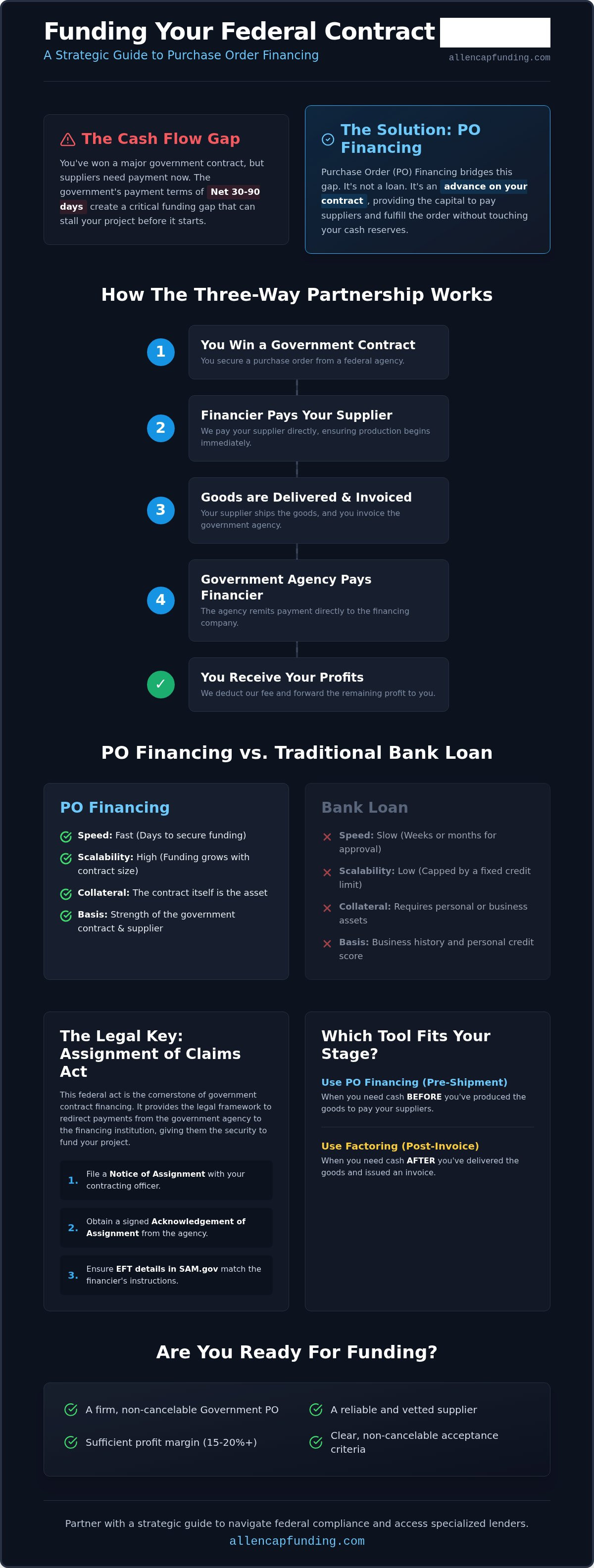
Build a secure triangle of accountability through this financing model. Once the agreement is in place, the financier pays your supplier directly. This ensures production starts immediately and removes the risk of supplier delays due to non-payment. The government agency acts as the reliable end-payer, eventually sending payment for the completed goods. This structure protects you from the weight of traditional debt because the transaction is settled once the agency pays the financier. It leaves your cash flow intact for other operational needs and future bids.
When to Choose PO Financing Over a Bank Loan
Prioritize speed by choosing this path over traditional lending. While a traditional bank might take months to review a loan application, PO funding can often be secured in days. This responsiveness is critical when contract deadlines are tight and production must begin now. Additionally, this solution offers a level of scalability that banks can't match. Your funding capacity grows as your contracts grow. If you win a larger bid, your access to capital increases proportionally, rather than being capped by a fixed credit limit. You also won't need to put up personal collateral, as the financier focuses on the strength of the contract and the reliability of your supplier.
Navigating Compliance: The Federal Assignment of Claims Act
Compliance isn't just a hurdle; it's the framework that makes funding possible. The Federal Assignment of Claims Act of 1940 is the cornerstone of po financing for government contracts. It allows contractors to assign payments from a government contract to a financing institution. This mechanism gives lenders the security they need to advance capital, knowing the government will pay them directly once the work is complete. Far from being a red flag, this is a routine legal procedure utilized by thousands of successful contractors to manage liquidity. The Notice of Assignment serves as the primary legal instrument for government PO funding, formally notifying the agency to direct payments to the financier.
Step-by-Step: Redirecting Government Payments Safely
Start by filing the Notice of Assignment with your contracting officer and the relevant disbursing office. This document must be precise to avoid administrative delays. Once filed, you must obtain an "Acknowledgement of Assignment." This signed receipt from the government confirms they've updated their records. When working with systems like SAM.gov, ensure your banking information and Electronic Funds Transfer (EFT) details align with the financier's instructions. Managing these technicalities correctly ensures that po financing for government contracts remains a smooth, reliable engine for your business. If the paperwork feels overwhelming, a strategic guide can help you navigate these requirements.
UCC Filings and Asset Security
Financiers also use Uniform Commercial Code (UCC) filings to protect their interest in the specific contract's proceeds. A UCC filing acts as a public notice that the financier has a claim on the assets related to that purchase order. This doesn't interfere with your day-to-day operations or your ownership of the company. It simply establishes a clear priority of payment. It's vital to maintain transparency with your existing lenders about these filings. Most traditional banks understand that specialized contract funding is a separate, strategic tool that actually strengthens your overall financial health by ensuring contract fulfillment. This clarity prevents conflicts and builds a solid foundation for winning even larger bids in the future.
PO Financing vs. Factoring: Which Fits Your Contract Stage?
Winning a federal bid creates an immediate need for capital that often exceeds a company's available cash. This creates a "funding gap." It starts the moment you receive a Purchase Order and ends only when you issue an invoice after delivery. Choosing between po financing for government contracts and factoring depends entirely on which side of the delivery line you stand. PO financing addresses the mobilization phase by providing the funds to pay your suppliers for raw materials and labor. Factoring, or Accounts Receivable (AR) financing, takes over once the government accepts your goods or services and you have a valid invoice.
In 2026, the cost of capital remains a critical factor in maintaining healthy margins. Using the wrong tool at the wrong time can erode your profits. If you use a high-interest line of credit for the entire production and waiting cycle, you might lose the competitive edge that won you the contract. Efficiently transitioning between these two tools ensures you aren't overpaying for liquidity. For additional support on navigating these options, the SBA contracting assistance programs provide excellent resources for small businesses entering the federal marketplace.
The Lifecycle of a Government Contract
Every contract moves through three distinct phases that dictate your funding strategy. Phase 1 is mobilization and production. This is the sweet spot for po financing for government contracts, as it covers the costs required to actually create the product. Phase 2 involves delivery and inspection. During this transition, your capital is still tied up in the goods, but you haven't yet reached the invoicing stage. Phase 3 begins with acceptance and invoicing. Once the government signs off, you can switch to factoring to get immediate cash from the invoice rather than waiting 30 to 90 days for the Treasury to cut a check.
Cost Structures and ROI Analysis
Calculate your effective margin carefully before committing to a funding path. PO financing typically operates on a flat fee or a monthly percentage based on the amount advanced to your supplier. Factoring usually involves a discount rate, where the financier takes a small percentage of the total invoice value. To find your true ROI, subtract these financing costs from your gross profit margin. If your contract has a 20% margin and financing costs 3%, your 17% net margin still represents a successful, scalable transaction. You are essentially unlocking balance sheet liquidity with asset-based lending to take on work that would otherwise be impossible. This strategic approach turns capital into a tool for growth rather than a burden on your balance sheet.
Qualification Checklist: Preparing Your Business for Funding
Securing capital for a federal project requires more than just a signed agreement. Lenders evaluate the feasibility of the entire transaction rather than just your company's credit history. To qualify for po financing for government contracts, your first priority must be your supplier's reputation. Financiers look for a proven track record because the supplier's ability to deliver on time is the single most important factor in the deal's success. If the supplier fails, the contract fails, and the financier's investment is at risk.
Profitability and contract structure also play major roles in the approval process. Most lenders require a gross margin of 20% or higher to ensure there's enough room to cover financing costs while still leaving your business with a healthy profit. Additionally, the contract must be "non-cancelable" with clear, objective acceptance criteria. This prevents the government from terminating the deal for convenience without paying for work already performed. Finally, check for any outstanding tax liens or legal encumbrances. These can block the "Notice of Assignment" we discussed earlier, effectively halting the funding process before it begins.
Supplier Due Diligence
Expect your financier to scrutinize your supplier's operational health. They'll request detailed supplier quotes, production timelines, and specific shipping terms. If you're working with international manufacturers, you'll likely need to manage a Letter of Credit (LC) process. This adds a layer of security for the overseas factory while ensuring the financier only releases funds when the goods are shipped. Having these documents organized and ready for review demonstrates that you've mastered the logistics of your bid. It shows you're a proactive partner who understands the high stakes of federal fulfillment.
The Administrative Readiness Test
Your back-office operations must be as strong as your technical expertise. Verify that your SAM.gov registration is active and that all banking information is current. Lenders also look for a detailed Work Breakdown Structure (WBS) to understand how you intend to manage the contract's lifecycle. This level of detail proves you've considered every phase of production and delivery. Before you submit an application, it's wise to conduct a Financial Check-Up with a strategic ally to ensure your business is truly ready for rapid scaling. This proactive step identifies potential roadblocks early and positions you as a low-risk partner for specialized lenders.
Scaling Your Government Portfolio with Allen Capital Funding
Growth in federal contracting requires more than technical expertise; it demands a sophisticated capital strategy. Allen Capital Funding acts as your dedicated guide, helping you navigate the often-dense lending landscape with professional confidence. By leveraging our brokerage model, you gain immediate access to a network of specialized lenders who understand the unique risks and rewards of public sector work. This approach ensures you never have to turn down a large-scale project due to a lack of working capital. Instead, you can position your business for accelerated success by knowing that the funding is already in place.
Total operational excellence often requires more than a single financial solution. You can combine po financing for government contracts with other strategic tools like business lines of credit to handle unexpected overhead or payroll needs during the production phase. This multi-layered approach provides a safety net that protects your existing cash reserves while you focus on delivery. We act as your proactive ally, ensuring that your capital structure is as robust as the services you provide to the government.
The Strategic Advantage of Professional Brokerage
Every agency has different payment cycles and compliance requirements. A specialized broker identifies tailored funding options that match your specific contract terms, whether you're dealing with the Department of Defense or a state-level municipality. Our team understands the nuances of federal and state procurement, removing the friction that often occurs when trying to explain government payment terms to a traditional bank. We manage the lender relationships on your behalf, acting as a facilitator so you can stay focused on fulfilling your mission. This steady hand in the process allows for a smoother transition from contract award to production.
Next Steps: From Bid to Billions
Start viewing financing as a strategic component of your bidding process. When you integrate the cost of capital into your future government bids, you protect your bottom line from the start. Over time, successfully completing these funded projects builds a track record of reliability with both agencies and financiers. This history often leads to lower-cost capital and more favorable terms as lenders gain confidence in your ability to execute large-scale orders. It's time to bridge the gap between your current state and your future goals. Book a consultation with Allen Capital Funding to secure your contract capital and transform your business into a federal powerhouse.
Empower Your Federal Growth Strategy
Winning a government contract is a significant milestone, but your success depends on your ability to deliver. You've learned how po financing for government contracts acts as a critical bridge, allowing you to fulfill large orders without draining your operational cash. By mastering the legal mechanics of the Assignment of Claims Act and choosing the right funding tool for each stage, you protect your margins and build a reputation for reliability with federal agencies.
Strategic capital isn't just about survival; it's about positioning your business to win bigger bids with confidence. Allen Capital Funding provides expert guidance in specialized capital solutions and offers a diverse portfolio of asset-based and SBA funding products. Our national reach ensures you have a dedicated ally regardless of which agency you serve. We simplify the path to progress so you can focus on excellence.
Secure your government contract funding with Allen Capital Funding today
Your next contract is an opportunity for accelerated success. We're here to ensure you have the financial power to meet it with confidence.
Frequently Asked Questions
Is purchase order financing more expensive than a traditional bank loan?
Purchase order financing generally carries a higher cost than a traditional bank loan because it is a short-term, high-speed solution. Banks often require years of tax returns and significant collateral, while PO funding focuses on the immediate contract. Many contractors treat these costs as a line-item expense in their bid. This approach allows you to secure the project without tying up your personal assets or company equity in long-term debt.
Can I get PO financing if my business has challenged credit or is a startup?
Yes, startups and businesses with less-than-perfect credit can qualify for po financing for government contracts. The decision is based on the government's ability to pay and your supplier's ability to manufacture the goods. Since the financier is looking at the strength of the contract rather than your balance sheet, it provides a vital path for new firms to scale quickly. It turns your first big win into a funded reality.
Will the government agency know that I am using PO financing?
Yes, the government agency will know because of the legal requirements under the Federal Assignment of Claims Act. You must submit a Notice of Assignment to the contracting and disbursing officers. This is a routine part of federal business and won't hurt your reputation. In fact, it often demonstrates that you have a professional capital partner, which can increase the agency's confidence in your ability to deliver.
What is the minimum contract size required for government PO financing?
Minimum requirements vary by lender, but most look for contracts valued at $100,000 or more to justify the administrative setup. The transaction must also have a healthy gross margin, typically 20% or higher, to ensure all parties are covered. If you have a smaller contract, it's still worth discussing with a broker. We can often find creative ways to bundle orders or use other working capital products to meet your needs.
How long does the approval process take for federal contract funding?
Initial setup for a funding facility usually takes one to two weeks because of the required legal filings and supplier vetting. Once your account is established, funding for subsequent purchase orders often happens in just a few days. This speed is a major advantage of po financing for government contracts compared to SBA loans. It allows you to move at the pace of government procurement without missing critical production deadlines.
Can PO financing be used for service-based government contracts?
No, PO financing is designed for tangible goods with direct supplier costs. If your contract is service-based, such as providing IT support or consulting, you should explore factoring or credit lines instead. These tools are better suited for covering payroll and administrative overhead. Factoring allows you to receive an advance on your completed work invoices, providing the liquidity needed to keep your team working while waiting for government payment.
What happens if my supplier fails to deliver the goods on time?
If a supplier fails to deliver, it creates a risk for both you and the financier. This is why the vetting process for manufacturers is so rigorous during the application phase. If issues arise, the financier's team often acts as a facilitator to help manage the relationship or find solutions. Ultimately, your business is responsible for the contract's fulfillment, so maintaining clear communication with your supplier and your funding partner is essential.
Is a Notice of Assignment required for every government contract I fund?
Yes, a Notice of Assignment is required for every federal contract that you intend to fund through a third party. This legal document is what permits the government to bypass your standard bank account and pay the financier directly. It's a non-negotiable step for compliance with federal law. While it requires extra paperwork, it provides the legal security that allows financiers to advance the large sums of capital required for major projects.


Comments