


OnDeck Business Loans Review 2026: Is Fast Capital Right for You?
Updated: 16 hours ago
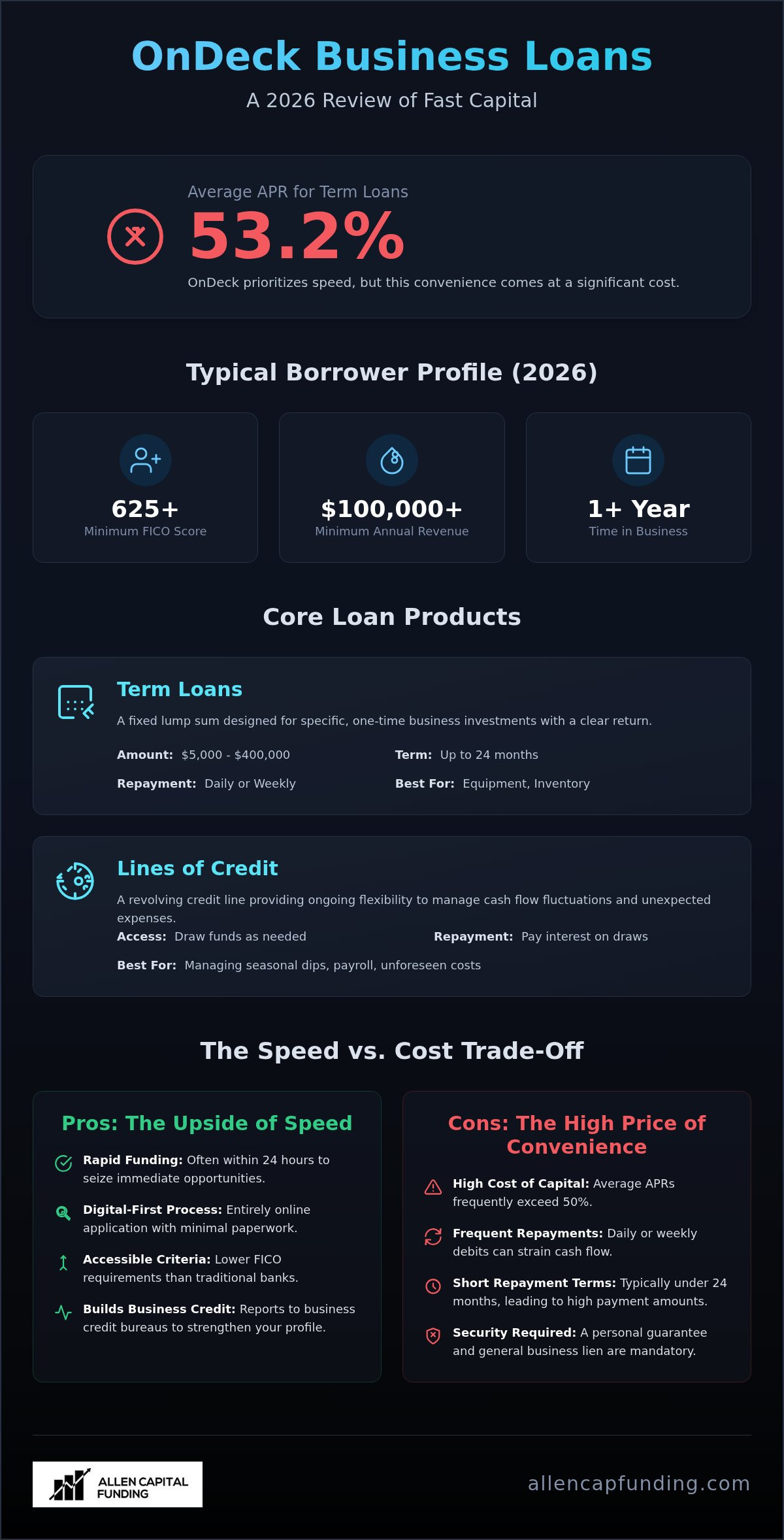
Would you pay a 50% premium for capital if it meant saving your business by tomorrow morning? For many entrepreneurs facing sudden cash flow gaps or rejection from traditional banks, the answer is often a reluctant yes. Speed is a vital asset, but it frequently carries a price tag that can catch even experienced owners off guard. This OnDeck business loans review breaks down the reality of borrowing in 2026, where average APRs for term loans currently sit at 53.2%.
It's natural to feel conflicted when you're balancing the urgency of immediate liquidity against the risk of high interest debt. You need a transparent look at the numbers to ensure you aren't overpaying for convenience. This guide provides a detailed breakdown of total costs, qualification hurdles, and the specific scenarios where fast capital makes strategic sense. We'll also explore how alternatives like SBA loans or revolving credit lines can provide a more affordable foundation for long-term success. You'll gain the confidence to choose a funding path that solves your current gap while protecting your future margins.
Table of Contents
OnDeck Business Loans Review 2026: Fast Capital for Growing Companies
OnDeck operates as a prominent fintech lender that prioritizes speed over the traditional, slower processes of commercial banks. This OnDeck business loans review highlights why the company remains a primary choice for owners who need capital by tomorrow rather than next month. Since its inception, OnDeck Capital has used data-driven algorithms to assess creditworthiness, allowing for funding decisions that often arrive within minutes. They specialize in short-term liquidity, providing the quick injections of cash that keep operations moving during seasonal shifts or unexpected opportunities.
The typical borrower in 2026 has moved beyond the startup phase but might not yet qualify for prime bank rates. These are established companies with at least one year in business and $100,000 in annual revenue. They often turn to OnDeck when a traditional bank says "not yet" or when the paperwork for a standard loan feels too heavy for a simple inventory purchase. Speed is the primary product here; the capital itself is the tool that facilitates that speed.
The Evolution of OnDeck in the Fintech Space
By 2026, the company has fully optimized its digital-first application. They've integrated deeply with business banking software to pull real-time data, which reduces the need for manual document uploads. In a crowded alternative lending market, their reputation for reliability remains strong because they offer a predictable, albeit expensive, path to funding. They've adapted their lending criteria to support businesses that show strong cash flow, even if their personal FICO scores are around the 625 mark. This accessibility has kept them relevant as other lenders have tightened their requirements.
Quick Summary of Pros and Cons
Choosing a lender requires a clear-eyed look at the trade-offs involved. While the convenience is undeniable, the costs are significant. You're trading lower interest rates for immediate access and less friction.
Pros: Funding often arrives within 24 hours; the application is entirely digital; the minimum FICO requirement is lower than traditional banks; they report to business credit bureaus to help you build credit.
Cons: High cost of capital with average APRs exceeding 50%; frequent daily or weekly repayment cycles; short repayment terms that can strain cash flow; personal guarantee and general lien required.
OnDeck is a tactical speed-lender designed to address immediate, short-term cash flow needs rather than long-term strategic expansion.
Analyzing OnDeck’s Loan Products: Term Loans and Lines of Credit
OnDeck provides two main capital structures: term loans and revolving lines of credit. Each serves a distinct financial purpose. This OnDeck business loans review emphasizes that while both products offer rapid access to funds, their repayment schedules and fee structures differ significantly from bank standards. Most borrowers choose between a lump sum for a specific project or a flexible line to manage ongoing cash flow needs.
OnDeck Term Loans: Best for One-Time ROI Projects
The term loan is a fixed lump sum ranging from $5,000 to $400,000. It is designed for specific business investments where you can calculate a clear return on investment. If you need to purchase a bulk shipment of inventory at a discount or fund an urgent equipment repair, this product provides the necessary cash upfront. The speed of the transaction is the primary benefit here, allowing you to act on opportunities that your competitors might miss due to lack of liquidity.
Repayment occurs over a short duration, usually capped at 24 months. Unlike traditional monthly bank payments, OnDeck typically requires daily or weekly automatic draws from your business bank account. This structure ensures the loan is paid down quickly, but it requires consistent daily cash flow to avoid account strain. It's helpful to consult a Forbes Advisor OnDeck Review to see how these frequent draws impact different business models. Additionally, you must account for the origination fee. This fee is deducted from your loan proceeds, meaning the actual cash you receive is slightly less than the gross amount requested. These loans are also secured by a general lien on business assets and require a personal guarantee, which is a standard requirement for this level of speed and accessibility.
OnDeck Lines of Credit: Managing Seasonal Fluctuations
For businesses that need ongoing flexibility, the line of credit offers a revolving limit up to $100,000. You only pay interest on the amount you actually draw. This makes it an effective safety net for managing seasonal dips or minor payroll gaps. Once you repay what you've borrowed, those funds become available to use again, providing a continuous source of working capital.
Every draw you make triggers its own repayment cycle. Each draw also typically incurs a fee, which can add up if you use the line frequently for small amounts. When comparing this to a more traditional business line of credit, the main difference is the speed of access versus the higher cost of these recurring fees. OnDeck's model is built for agility. It's a tactical tool rather than a long-term financing foundation. If you aren't sure which structure fits your current balance sheet, a Financial Check-Up can help clarify your best path forward. Understanding your debt capacity before committing to daily draws is essential for maintaining healthy operations.
The True Cost of Speed: Understanding Rates and Eligibility
Speed is the primary reason business owners choose fintech lenders, but that convenience requires a clear understanding of the price. This OnDeck business loans review focuses on the specific financial mechanics that differ from traditional bank products. In the private capital market, speed always carries a premium. You aren't just paying for the money; you're paying for the technology and risk tolerance that allows for a 24-hour turnaround.
One of the most common points of confusion is the "factor rate" used for term loans. Unlike an Annual Percentage Rate (APR) that amortizes over time, a factor rate is a fixed multiplier applied to your principal at the start. For example, if you borrow $100,000 at a factor rate of 1.15, you owe $115,000. Even if you pay the loan back early, you typically still owe that full $15,000 in "interest" because the cost is fixed upfront. When you add origination fees, which can reach up to 4% of the loan amount, your effective APR can easily exceed 50%.
Qualification Criteria for 2026
OnDeck has maintained consistent eligibility requirements heading into 2026. To qualify, your company must demonstrate a solid track record of revenue rather than just a high credit score. The primary benchmarks include:
Minimum FICO Score: You need a personal score of at least 625.
Annual Revenue: Your business must generate at least $100,000 in gross annual sales.
Time in Business: A minimum of one year of operational history is required.
Your business bank statement is your most important document in this process. While banks focus on tax returns from two years ago, OnDeck looks at your daily ending balances from the last three to six months. They want to see consistent cash flow that can support daily or weekly automatic repayments without triggering overdrafts.
Calculating Total Cost of Capital
To find your true cost, you must look at the net funding versus the total payback. If you are approved for $50,000 with a 4% origination fee, you only receive $48,000 in your bank account. However, your daily payments are calculated based on the full $50,000 plus the factor rate. This "net funding" reality is why transparency matters. As noted in a comprehensive Business.org OnDeck loan review, the company often provides better terms to repeat borrowers who have successfully completed a previous loan cycle.
Owners should also be wary of "double-dipping" during renewals. If you renew your loan when it is 50% paid off, some lenders roll the remaining balance into a new loan, effectively charging you interest twice on the same capital. Always ask if the remaining interest on your current loan is waived before you agree to a refinance. Understanding these nuances ensures you use fast capital as a bridge to growth rather than a weight on your margins.
OnDeck vs. Strategic Alternatives: When Speed Outweighs Cost
Speed is a powerful tool, but it shouldn't be your only strategy. While this OnDeck business loans review highlights the advantage of 24-hour funding, owners must weigh that convenience against the long-term impact on their margins. High-cost capital works well for short-term fires, but it can be a heavy burden for permanent expansion. If your company holds significant inventory or accounts receivable, Asset-Based Lending often provides a more sustainable path by unlocking liquidity from your balance sheet at a lower cost than unsecured fintech loans.
The choice between a direct fintech application and working with SBA Loan Brokers comes down to your timeline. Online lenders prioritize automated approvals. Brokers prioritize strategic fit. A broker acts as a facilitator, vetting multiple lenders to ensure you aren't choosing the most expensive option unnecessarily. In many cases, OnDeck serves best as a bridge. You use the fast capital to seize an immediate opportunity while simultaneously starting the application for more permanent, lower-interest financing.
OnDeck vs. SBA Loans: The Growth Comparison
If you are borrowing specifically to acquire machinery or vehicles, commercial equipment loans are almost always the superior choice. Because the equipment itself serves as collateral, the lender takes on less risk. This results in lower rates and longer repayment terms than OnDeck's 24-month limit. Using a general-purpose term loan for a hard asset often means paying a premium for flexibility you don't actually need. Allen Capital Funding helps you navigate these choices by comparing the total cost of capital across different structures. Before committing to a daily repayment schedule, explore your tailored funding options to ensure your debt supports your growth rather than slowing it down.
Navigating Your Funding Options: Why a Strategic Partner Matters
Applying for capital can quickly become a full-time job that pulls you away from your operations. Many business owners experience "funding fatigue" after submitting multiple applications to different lenders and receiving a flood of conflicting offers. While an OnDeck business loans review often highlights the ease of their digital portal, it rarely mentions the stress of managing these high-frequency repayments alone. Without a clear strategy, you might secure the funds you need today only to find your cash flow severely restricted by next month.
Allen Capital Funding acts as a steady hand in this process. We vet lenders to ensure you aren't choosing the most expensive capital unnecessarily. Our role is to look beyond a single transaction and help you build a sustainable capital stack. This is why we recommend a Financial Check-Up before you commit to any high-interest debt. By analyzing your current debt-to-income ratio and projected growth, we can determine if a short-term loan is a bridge to success or a potential trap for your margins.
This OnDeck business loans review suggests that fast capital is best used as a tactical bridge. You might use a quick draw to secure a time-sensitive inventory discount while we simultaneously prepare your application for a more permanent SBA loan or a revolving credit line. This approach balances the immediate need for speed with the long-term necessity of affordability.
Beyond the Online Application
Automated algorithms are efficient, but they are inherently limited. They see your bank balances and credit score as static data points; they don't see your business potential or the strategic reason behind a temporary dip in revenue. A human consultant provides the nuance that a portal cannot. We help tailor your loan package to reflect your actual capacity for growth. Using short-term debt correctly can also help build your business credit profile, making you more "bankable" for traditional financing in the future.
Your Next Steps to Capital
Success in business lending requires preparation. Before you draw funds, ensure your financial profile is as strong as possible. This means cleaning up any minor credit issues and having your most recent three months of bank statements organized and ready for review. Speed is a vital tool, but it requires a solid foundation to be effective.
If you are ready to explore how fast capital fits into your broader growth plan, contact the team at Allen Capital Funding for a consultation. We provide national coverage and expert guidance on everything from equipment financing to complex SBA structures. Debt is a tool; a broker is the architect. Let us help you design a funding strategy that accelerates your success without compromising your future.
Securing Your Company's Financial Future
Fast capital is a tactical advantage when used for high-ROI opportunities or urgent cash flow gaps. However, as this OnDeck business loans review has clarified, the convenience of 24-hour funding must be balanced against the long-term cost of debt. Choosing the right capital structure requires looking beyond the immediate deposit to understand how daily repayments impact your future flexibility. Your business deserves a funding strategy that supports strategic growth rather than just surviving a temporary hurdle.
Whether you need the speed of a digital lender or the stability of an SBA loan, having a proactive ally makes the difference. Allen Capital Funding acts as your dedicated guide, providing expert guidance from specialists who understand the national lending landscape. We offer access to a diverse range of SBA and asset-based products tailored to your specific goals. Don't navigate the complex world of finance alone. Explore Strategic Funding Options with Allen Capital Funding today to secure the capital your company needs to thrive. Your next stage of success is within reach when you have the right architect for your capital stack.
Frequently Asked Questions
Is OnDeck a legitimate lender for small businesses in 2026?
OnDeck is an established and legitimate fintech lender that has served the small business market for over a decade. They currently maintain an A+ rating with the Better Business Bureau and a 4.6 star rating on Trustpilot. As a major player in the alternative lending space, they're known for transparently reporting payment history to business credit bureaus. This helps owners build their credit profiles while accessing necessary capital for short term operations.
What is the minimum credit score for an OnDeck business loan?
You need a minimum personal FICO score of 625 to qualify for their funding products. While this score is lower than what most traditional banks require, it's only one part of the equation. This OnDeck business loans review emphasizes that your daily bank balances and consistent revenue are equally important. They look for businesses with at least $100,000 in annual gross revenue to ensure you can support their frequent repayment structures.
How much does an OnDeck business loan actually cost?
The cost of capital is significantly higher than traditional bank loans, with average APRs currently sitting at 53.2% for term loans and 59.8% for lines of credit. You must also factor in an origination fee that ranges from 0% to 4% of the total loan amount. These costs reflect the premium paid for speed and accessibility. It's essential to calculate the total payback amount rather than just looking at the daily draw.
Can I get an OnDeck loan if I have been in business for less than a year?
No, you cannot qualify if you've been in operation for less than 12 months. OnDeck requires a minimum of one year in business to verify your cash flow stability. If your company is newer, you might need to explore other avenues like equipment financing or credit lines that focus more on collateral than operational history. A strategic partner can help you identify which specialized products are available for younger companies in your specific industry.
What is the difference between an OnDeck term loan and a line of credit?
A term loan provides a one-time lump sum up to $400,000, while a line of credit is a revolving facility up to $100,000. Term loans are ideal for specific, high-ROI projects like inventory bulk buys. Lines of credit offer more flexibility for managing seasonal dips because you only pay interest on the amount you draw. Both products typically feature daily or weekly automatic repayments, which differs from the monthly cycles found in traditional lending.
Does OnDeck require a personal guarantee for their business loans?
Yes, OnDeck requires a personal guarantee from the business owners as part of the loan agreement. They also secure the debt with a general lien on your business assets. This means that if the business fails to repay the loan, the lender has a legal claim to both business property and your personal assets. This level of security is standard for unsecured fintech loans that provide rapid funding without requiring specific physical collateral.
How fast can I receive funds from OnDeck after approval?
You can often receive funds in your account within 24 hours of approval. In some cases, same-day funding is available for term loans if the application is completed and approved by a specific morning cutoff time. This speed is the primary value proposition discussed in any OnDeck business loans review. It allows owners to handle urgent repairs or capitalize on time-sensitive opportunities that traditional bank processes would likely miss due to their longer underwriting cycles.
Can a loan broker help me find better rates than OnDeck?
A loan broker acts as a strategic architect for your capital stack, often finding more affordable long-term solutions than a single direct lender. While OnDeck is excellent for speed, a broker can vet your profile for SBA loans or asset-based options that offer much lower interest rates. By performing a Financial Check-Up first, a broker ensures you aren't overpaying for capital and helps you avoid the fatigue that comes from applying to multiple lenders alone.


Comments