


Medical Invoice Factoring: A Strategic Guide to Healthcare Liquidity in 2026
- anthonyarallen
- Aug 7
- 12 min read
Updated: 6 days ago
Why is your medical practice acting as a zero-interest lender for multi-billion dollar insurance companies? You provide essential care today, yet the standard 120-day billing cycle often forces you to wait months for capital you've already earned. This lag creates intense payroll anxiety and prevents you from purchasing the new medical equipment your patients deserve. Dealing with the complexities of Medicare and Medicaid shouldn't mean compromising your daily operations. Utilizing strategic medical invoice factoring allows you to reclaim control by converting those outstanding receivables into immediate, debt-free cash flow.
We understand that waiting for insurance companies to pay shouldn't dictate your growth. In this guide, you'll learn how to bridge the payment gap and stabilize your healthcare business with funding that scales as your patient volume grows. We'll show you how to establish a predictable weekly cash flow and move past the hurdles of antiquated billing cycles. It's time to stop acting as a bank and start focusing on providing the best possible care for your community.
Table of Contents
Solving the Healthcare Revenue Cycle Gap in 2026
The healthcare industry in 2026 faces a frustrating paradox. While medical technology has advanced at light speed, the financial systems supporting it remain sluggish. Medical billing cycles are stretching longer than ever before. It isn't uncommon to see insurance carriers take 90 or even 120 days to settle a claim. This "slow pay" environment creates a false sense of financial instability for many providers. You might look at your balance sheet and see millions in assets, yet your bank account remains dangerously low.
It's vital to distinguish between insolvency and a temporary liquidity gap. Your practice isn't failing; your capital is simply trapped in an administrative bottleneck. Traditional bank loans often fail to solve this because they require extensive collateral and months of underwriting. By the time a bank approves a loan, your immediate need for payroll or supplies has already become a crisis. This is where Factoring (finance) becomes a strategic advantage. By using medical invoice factoring, you convert those pending claims into working capital within days rather than months.
The Impact of Delayed Payors on Patient Care
When cash flow is restricted, patient outcomes often suffer. You can't invest in modern medical technology or AI-driven diagnostic tools when your capital is tied up in unpaid invoices. The stress doesn't stop at equipment. Staffing and retention become major hurdles when payroll anxiety sets in. Your medical team needs to feel secure to perform at their best. Delayed payments create a ripple effect that touches every corner of your facility.
The Revenue Cycle Gap is the time between service delivery and cash collection.
Closing this gap ensures you have the resources to maintain a high standard of care without the constant weight of financial uncertainty. It allows you to focus on growth rather than survival.
Medical Vendors vs. Medical Providers: Unique Challenges
The liquidity crunch affects everyone in the healthcare ecosystem, but the pain points vary based on your role. While large hospitals might have deeper reserves, smaller entities and vendors often struggle to keep pace with rising operational costs.
Medical Staffing Agencies: These businesses face massive weekly payroll obligations for nurses and therapists while waiting 90 days or more for hospital payments.
Equipment Manufacturers: High production costs and long payment terms can stall the development of new life-saving tools.
Research and Academic Suppliers: Specialized vendors like Alamo Peptide Labs provide essential materials for laboratory use, yet they often face the same capital bottlenecks when dealing with institutional billing cycles.
Private Practices: Dentists and physicians often have thinner margins and less access to institutional credit than large health systems.
For some, a Business Line of Credit: The Strategic Guide to Flexible Capital might be part of the solution, but medical invoice factoring offers a scalable way to fund growth directly through patient volume. It removes the barriers created by antiquated billing cycles and puts the focus back on the business of healing.
How Medical Accounts Receivable Factoring Operates
Understanding the mechanics of medical invoice factoring is the first step toward stabilizing your cash flow. At its core, this process is the purchase of medical accounts receivable at a discount for immediate cash. It's a financial transaction rather than a debt based loan. This distinction is vital because it means you aren't adding a monthly repayment obligation to your balance sheet. Instead, you're simply accelerating the arrival of funds you've already earned by selling the right to collect on specific invoices.
The process involves a three-party relationship: the healthcare provider, the payor (which includes private insurance companies or government entities), and the factor. Unlike traditional lending where your personal credit is the primary focus, the factor prioritizes the creditworthiness of your payors. This is particularly relevant given the scale of Medical debt and collections in the United States, which complicates the timing of payments. You'll also need to choose between recourse and non-recourse factoring. In a recourse arrangement, your practice is responsible if the payor fails to settle the invoice. Non-recourse options protect you from payor bankruptcy, though they often come with slightly higher discount fees.
The Step-by-Step Factoring Process
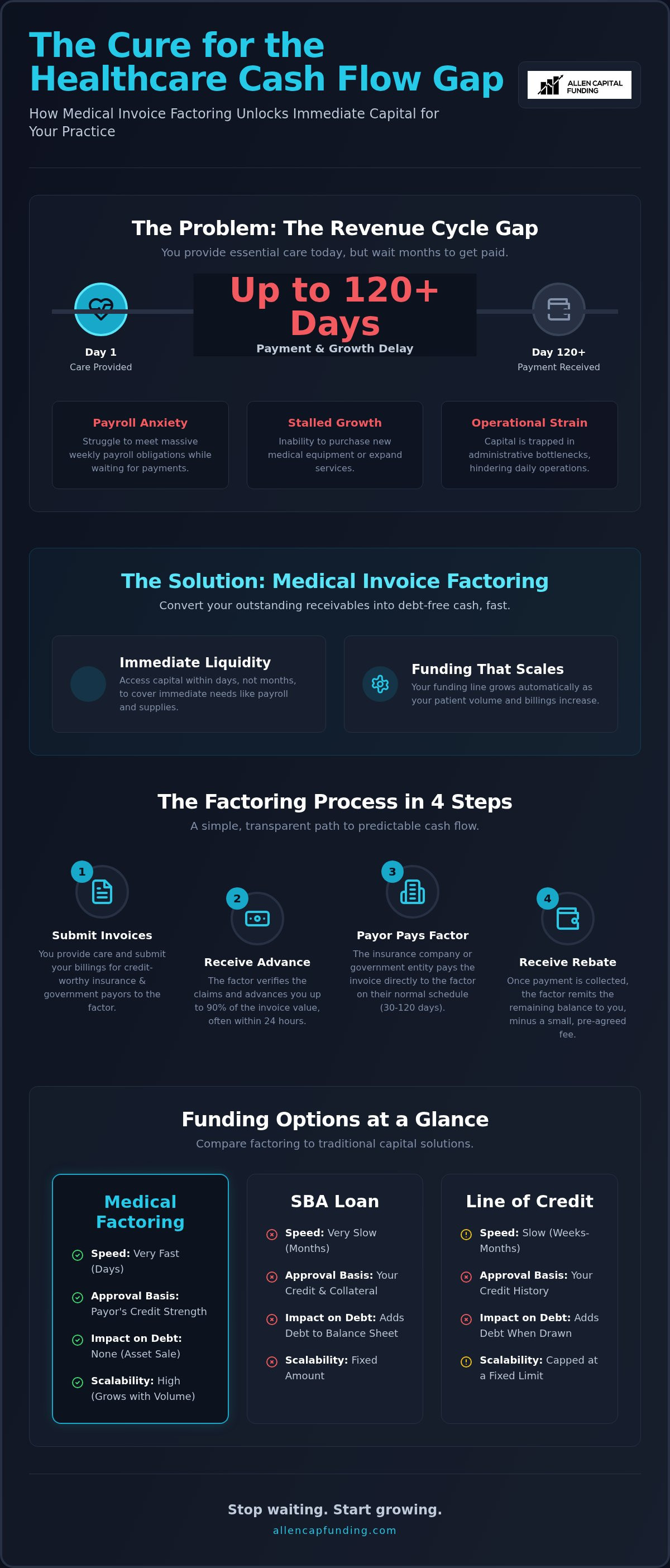
The cycle begins when you submit your billings to the factor after providing services to your patients. The factor then performs a quick verification of these claims with the insurance carriers to confirm the amounts and expected payment dates. Once verified, you receive an initial advance. This advance rate typically ranges from 70% to 90% of the invoice value, and funds are often accessible within 24 to 48 hours. This immediate liquidity allows you to cover payroll or equipment costs without waiting for the carrier's internal processing.
The remaining 10% to 30% of the invoice value is held in a "Reserve" account. After the payor settles the full claim with the factor, the reserve is released to you, minus a small factoring fee. This structured approach ensures that you have a steady stream of capital while the factor manages the collection timeline.
Medicare and Medicaid Factoring Nuances
Factoring government receivables requires a specialized approach due to strict non-assignment rules. Since you cannot legally assign Medicare or Medicaid payments directly to a third party, factors use a "Control Account" or lockbox. This account is established in your practice's name, but the factor has the authority to sweep the funds once they arrive. This setup satisfies government regulations while still providing you with the liquidity you need.
To manage the inherent risks of government billing, factors calculate the Net Realized Value of Medicare claims by deducting historical contractual adjustments, potential recoupments, and average denial rates from the gross billable amount to ensure the advance accurately reflects the final expected payment. If you want to see how these nuances apply to your specific billing mix, a financial check-up can help identify the most efficient funding path for your practice.
Comparing Medical Factoring to Other Capital Solutions
Choosing the right capital structure requires a clear understanding of your immediate needs versus your long-term goals. While SBA loans offer attractive interest rates, the application process is notoriously slow. You might wait 60 to 90 days for approval. This timeline simply doesn't work when you're facing a payroll gap next Friday. In contrast, medical invoice factoring provides access to cash within 24 to 48 hours. It's a speed focused solution designed for the fast-paced healthcare environment.
Business lines of credit are another common alternative. They're useful for small, recurring expenses, but they often come with restrictive covenants and fixed draw limits. If your practice experiences a sudden surge in patient volume, a traditional line of credit might not scale quickly enough to cover your rising costs. Factoring doesn't have these rigid caps. Because it's based on your accounts receivable, your funding capacity increases automatically as you bill more. This makes it an ideal tool for businesses with challenged credit, as the factor prioritizes the payor's ability to pay rather than your personal credit score.
When to Choose Factoring over a Traditional Loan
Immediate liquidity often outweighs the cost of a discount rate during periods of rapid expansion. If you're opening a new clinic or hiring a large block of traveling nurses, you need capital today to fuel that growth. Factoring acts as a bridge, providing the cash necessary to seize opportunities without waiting for the slow turning wheels of bank underwriting. It's also highly effective for managing seasonal surges, such as flu season, where patient volume and operational expenses spike simultaneously. For larger healthcare organizations looking for a middle ground, Asset-Based Lending for Small Business provides a way to unlock liquidity from a broader range of balance sheet assets.
The "Debt-Free" Advantage
One of the most significant benefits of medical invoice factoring is that it keeps your balance sheet clean. Since factoring is the sale of an asset rather than a loan, it doesn't appear as a liability. This is a strategic advantage when you eventually apply for long-term financing for real estate or major medical technology. Lenders see a healthier debt-to-equity ratio, which can lead to better terms on other products. There's also a psychological benefit to selling an asset you've already earned rather than incurring a new liability that requires monthly interest payments. Maintaining this financial flexibility allows you to pursue a Strategic Business Equipment Financing Guide when it's time to upgrade your facility's capabilities.
Qualification Criteria and HIPAA Compliance
One of the most empowering aspects of medical invoice factoring is that approval isn't tied to your personal credit score or years in business. Instead, the primary focus is the creditworthiness of your payors. If you're billing reputable insurance carriers or government entities like Medicare and Medicaid, you've already cleared the biggest hurdle. Factors view these receivables as high quality assets because the likelihood of default is extremely low. This shift in focus allows practices with challenged credit to access the capital they need to thrive.
To qualify, most programs require a minimum monthly billing volume, often starting around $50,000, though this varies by niche. Your billing must also be "clean." This means your accounts receivable shouldn't have existing liens or UCC filings from other lenders. If you have an existing business loan, the factor will often work with your current bank to subordinate the specific receivables being funded. You'll need to provide documentation such as detailed aging reports, current provider agreements, and recent tax returns to establish a baseline for your funding limit.
HIPAA and Data Security in Factoring
Handling patient information requires a high level of security and legal compliance. It's essential to ensure your factoring partner is fully HIPAA-compliant. During the funding process, you'll share billing data that contains Protected Health Information (PHI). A reputable factor will enter into a Business Associate Agreement (BAA) with your practice. This legal contract ensures they're bound by the same privacy and security rules as your medical staff.
Verification of accounts receivable is handled with extreme care to protect patient privacy. Factors typically verify the amount and validity of a claim directly with the insurance carrier's portal or representative. They don't need to discuss specific medical procedures or diagnoses with third parties. All data transfers should occur over encrypted channels to prevent unauthorized access. This professional handling ensures your practice remains compliant while gaining the liquidity needed to operate.
Common Objections: Cost and Control
Some providers worry that factoring means losing control over the patient experience. This is a misconception. You continue to manage your patient relationships and clinical care. The factor simply handles the back-end collection of the business-to-business invoice from the insurance company. Patients rarely even know a factor is involved, as payments are typically sent to a secure lockbox in the practice's name.
Understanding the cost is also vital. While some compare the "factoring fee" to a traditional loan's APR, they're different financial tools. A factoring fee is a discount on the sale of an asset, not an interest rate on a debt. Because medical invoice factoring is scalable, your funding grows automatically as your patient volume increases. This makes it a more flexible tool than a fixed loan with a hard cap. If you're ready to see how these criteria apply to your specific billing mix, get a tailored working capital consultation today.
Accelerating Success with Allen Capital Funding
Choosing the right financial partner is as critical as choosing the right clinical staff. At Allen Capital Funding, we provide the Broker Advantage. Unlike a direct factor that is limited by a single set of internal underwriting rules, we act as your dedicated guide to a broad network of lending partners. This single point of contact gives you access to the most competitive market rates and terms tailored specifically to your healthcare niche. Whether you're managing a medical staffing agency or a specialized private practice, we match your business with the right capital provider to ensure a perfect fit.
Our commitment to your business extends beyond the immediate liquidity provided by medical invoice factoring. We're here to support your long-term growth through every stage of your business cycle. As your patient volume increases and your needs evolve, we provide access to SBA loans for facility expansion and equipment financing for the latest medical technology. This holistic approach ensures you have a steady, reliable hand helping you navigate the often-complex world of business finance. We prioritize professional confidence and supportive empowerment, turning financial hurdles into strategic advantages.
Your Strategic Financial Check-Up
Every successful partnership starts with a clear understanding of your unique business goals. We begin with a Financial Check-Up to evaluate your current capital structure and identify hidden liquidity opportunities. This isn't a high-pressure sales pitch; it's a strategic consultation. We'll look at your accounts receivable and operational overhead to determine if a SBA Loan Brokers New York strategy or a factoring arrangement offers the best path forward. This methodical approach ensures the capital you access today aligns with your vision for 2026 and beyond.
Getting Started: A Streamlined Path to Capital
We understand that healthcare providers and vendors don't have time for long, drawn-out applications. Our process is built for speed and efficiency. You can easily book an online consultation with an Allen Capital specialist to start the conversation. During our initial 15-minute discovery call, we'll discuss your specific cash flow challenges and outline a clear path to funding. Our proactive, solution-focused team handles the heavy lifting, removing financial barriers so you can focus on providing exceptional patient care. It's time to bridge the payment gap and experience the accelerated success your practice deserves.
Reclaiming Your Healthcare Revenue Stream
You've seen how the 120-day payment gap doesn't have to be your practice's reality. By decoupling your growth from antiquated billing cycles, you gain the freedom to invest in technology and staff without the weight of traditional debt. Implementing medical invoice factoring is a strategic move that turns your earned receivables into immediate liquidity. It allows you to move from a state of payroll anxiety to a position of professional confidence and proactive planning.
We've discussed how this process remains fully HIPAA-compliant and scales alongside your patient volume. Whether you are a private practice or a medical staffing agency, the ability to predict your cash flow changes everything. At Allen Capital Funding, we provide specialized healthcare industry knowledge and expert guidance on tailored capital solutions. Our access to nationwide lending partners ensures you receive the best market rates for your specific niche, regardless of your personal credit history.
Take the first step toward a more predictable financial future. Book an Online Consultation with our Funding Experts today to unlock the capital trapped in your billing cycle. Your focus belongs on patient care; let us handle the complexities of your capital structure. Accelerated success is within reach.
Frequently Asked Questions
What is the typical cost of medical invoice factoring in 2026?
The cost of medical invoice factoring is typically calculated as a discount rate applied to the face value of the receivables. This fee varies based on your monthly billing volume and the credit strength of your insurance payors. Unlike a bank loan with monthly interest, this is a one-time fee per invoice. It's a transparent cost that scales directly with the amount of capital you choose to accelerate.
Does medical factoring affect my patients or their billing experience?
Patients generally experience no difference in their billing process because the factoring relationship exists between your practice and the insurance payors. You continue to provide care and manage patient interactions exactly as you do now. The factor works behind the scenes to verify and collect from the insurance carriers. Most patients won't even know a third party is involved in the business side of your revenue cycle.
Can I factor Medicare and Medicaid receivables?
Medicare and Medicaid receivables are eligible for factoring through specific legal structures that respect government non-assignment regulations. We use a control account or lockbox system to ensure compliance while still providing your practice with immediate liquidity. This allows you to bridge the gap on government payments without violating federal rules. It's a specialized process that requires an expert partner who understands healthcare regulatory nuances.
How long does it take to get approved for healthcare factoring?
Approval for a new factoring facility typically happens within three to five business days once all documentation is received. After the initial setup is complete, you can receive funding for new invoices within 24 to 48 hours of submission. This speed is one of the primary advantages for practices facing urgent payroll or equipment needs. It's a much faster alternative to the months-long underwriting process required by traditional banks.
What is the difference between recourse and non-recourse medical factoring?
The main difference lies in who carries the financial risk if an insurance carrier fails to pay an invoice. In recourse factoring, your practice is responsible for replacing or repurchasing any unpaid claims. Non-recourse factoring provides more protection by assuming the credit risk if the payor becomes insolvent. Each option has different fee structures, so we help you evaluate which level of risk management fits your practice's goals.
Do I need a high credit score to qualify for medical factoring?
You don't need a high personal credit score to qualify for medical invoice factoring. The factor prioritizes the creditworthiness of your payors, such as Blue Cross Blue Shield or Medicare, rather than your personal financial history. This makes factoring an ideal solution for newer practices or those that have faced temporary financial challenges. We focus on the value of your work and the reliability of your insurance carriers.
Is medical factoring considered a loan on my balance sheet?
Factoring is not considered a loan; it's a purchase and sale of accounts receivable. Because it's an asset sale, it doesn't add debt to your balance sheet, which keeps your financial ratios healthy for future lending needs. This "off-balance-sheet" treatment is a strategic advantage for practices planning to apply for real estate or equipment financing later. It provides liquidity without the burden of a new liability.
How does HIPAA compliance work with a third-party factoring company?
HIPAA compliance is ensured by executing a Business Associate Agreement (BAA) between your practice and the factoring company. This agreement legally binds the factor to the same privacy and security standards that apply to your medical office. All data exchanged during the verification process is handled through encrypted channels. Professional factors specialize in healthcare and understand the absolute necessity of protecting patient information at every step.


Comments