


Invoice Factoring for Staffing: 2026 Strategic Guide
- anthonyarallen
- Aug 8
- 12 min read
Imagine it is Wednesday afternoon and you have just landed a massive contract with a premier client. Instead of celebrating, you are staring at a spreadsheet wondering how you will cover a $50,000 payroll jump before their first payment arrives in 60 days. It is a stressful reality where rapid growth can actually drain your bank account faster than a slow month. You know that the inherent cash flow gap in recruitment is not just a math problem; it is a barrier that keeps you from competing for the largest contracts.
We believe that your agency's potential should not be limited by your clients' payment terms. This guide will show you how to leverage invoice factoring for staffing agencies to eliminate payroll anxiety and turn your unpaid invoices into immediate working capital. You will learn how to secure predictable weekly cash flow and reduce your back-office burden while scaling your recruitment efforts. We'll preview the current 2026 landscape for advance rates, explain how to manage credit risk, and show you how to get funded within 24 hours of submitting your invoices.
Table of Contents
Solving the Staffing Cash Flow Gap: Why Payroll Funding is Essential
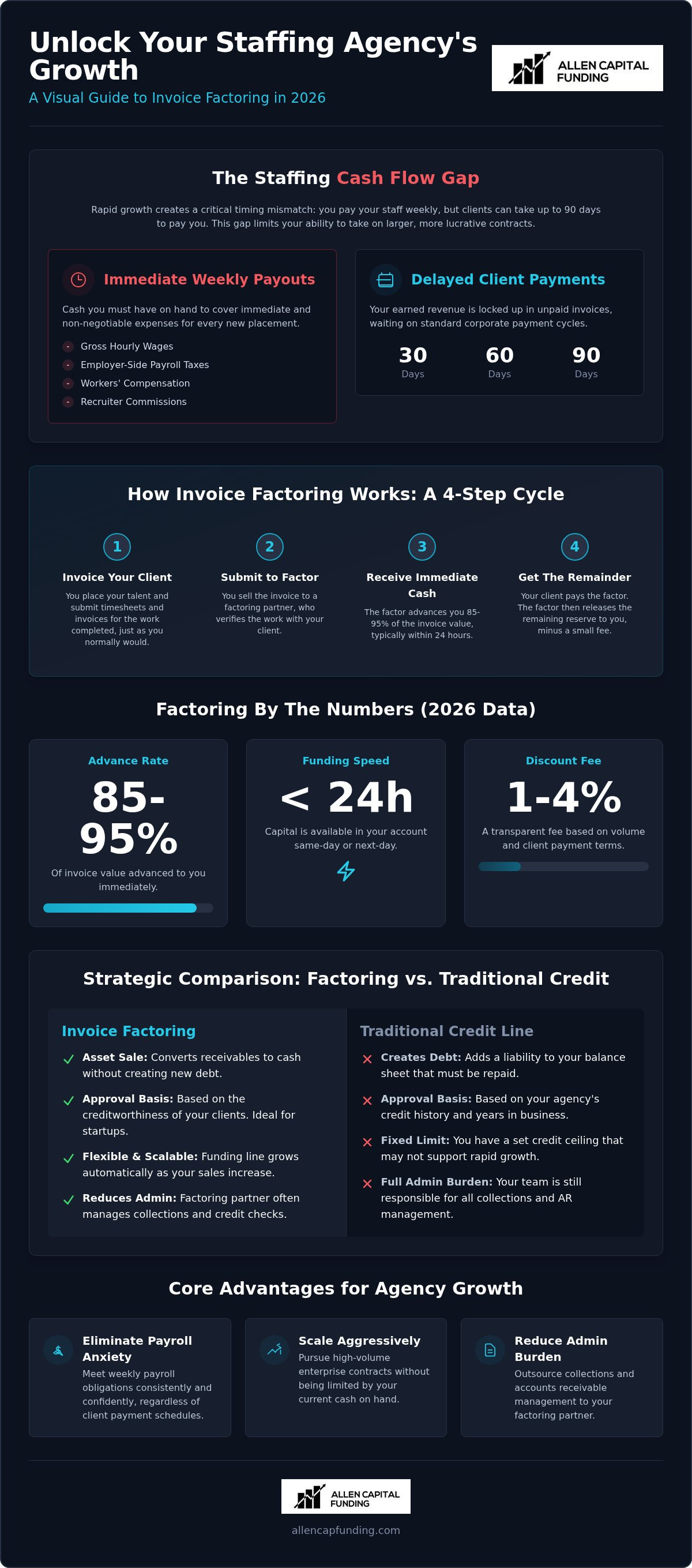
Staffing is a volume-based business. Your success depends on your ability to place talent quickly and at scale. However, the industry faces a unique financial hurdle known as the "Staffing Gap." This gap exists because of a fundamental timing mismatch. You must pay your temporary employees and contractors weekly or bi-weekly, but your clients often wait 30, 45, or even 90 days to settle their invoices. This delay creates a massive cash drain that traditional working capital often fails to cover.
Strategic invoice factoring for staffing agencies provides a reliable bridge over this gap. Unlike a bank loan, Factoring (finance) is an asset-based tool where you sell your accounts receivable to a partner at a small discount. You aren't taking on debt; you are simply accelerating the payment of money you've already earned. This shift in perspective transforms your outstanding invoices from stagnant paper into active growth capital.
The Structural Mismatch: Weekly Payroll vs. Net-60 Invoices
The mathematical reality of a net-60 contract is daunting. If you win a large contract, you must fund approximately eight weeks of payroll before receiving your first payment. These immediate costs include:
Gross hourly wages for all temporary staff
Employer-side payroll taxes like FICA, FUTA, and SUTA
Workers' compensation insurance premiums
Internal recruiter commissions and bonuses
These obligations are fixed and cannot be delayed. Many agencies find themselves forced to turn down lucrative enterprise contracts because they lack the upfront cash to support a large team of new hires. This mismatch acts as a glass ceiling, preventing smaller agencies from competing with national firms that have deeper pockets.
How Capital Constraints Stifle Agency Recruitment Efforts
When cash is tight, every department feels the pressure. Recruiters may hesitate to push for high-volume placements if they know the agency is struggling to meet payroll. This uncertainty can damage morale and lead to talent turnover within your own office. Many agencies also fall into the "growth trap," where every new successful placement actually deepens their cash deficit.
By utilizing asset-based lending for small business, you decouple your growth from your bank balance. You gain the confidence to scale your recruitment efforts aggressively, knowing that your funding scales automatically as your billings increase. Integrating invoice factoring for staffing agencies ensures your team stays focused on finding talent rather than worrying about the next Thursday payroll cycle.
How Invoice Factoring for Staffing Agencies Works in 2026
Understanding the mechanics of invoice factoring for staffing agencies is essential for maintaining a healthy balance sheet. The process involves three primary parties: your agency, your factoring partner, and your end-client. Unlike traditional loans that focus on your agency's credit history, factoring focuses on the creditworthiness of your clients. This shift allows even startup agencies to access significant capital based on the strength of their contracts rather than their years in business.
When you submit an invoice, the factor provides an advance rate typically between 85% and 95%. The remaining 5% to 15% is held in a "reserve" account. Once your client pays the invoice in full, the factor releases this reserve to you, minus a small discount fee. According to July 2026 market data, these fees generally range from 1% to 4% depending on your monthly volume and the payment terms of your clients. It's a transparent system that turns your accounts receivable into a liquid asset.
The Factoring Lifecycle: From Placement to Funding
The process begins with a verification step where the factoring partner confirms the hours worked on the submitted timesheet with your end-client. Most modern platforms allow for the electronic submission of timesheets and invoices, enabling you to access capital on the same day you bill. Once the submission is processed, funds are typically available in your account within 24 hours. The cycle ends when the end-client pays the factor directly, usually within 30 to 90 days, at which point the final settlement occurs and your reserve is released. If you are uncertain which path is best for your current roster, a financial check-up can help you weigh the costs against your specific risk exposure.
Non-Recourse vs. Recourse Factoring for Staffing Risk Management
Deciding between recourse and non-recourse options is a key part of your risk management strategy. Non-recourse factoring acts as a shield against client bankruptcy; if your client becomes insolvent, the factor absorbs the loss. Because of this added protection, fees are slightly higher, generally ranging from 1.5% to 4%. Recourse factoring is the more common choice, offering lower rates between 1% and 3% because your agency retains the risk if an invoice remains unpaid. If you work with high-credit, blue-chip clients, recourse factoring is often the more cost-effective choice. However, if you have a high concentration of risk with one or two large clients, the non-recourse option provides a vital layer of security for your agency's future.
Strategic Comparison: Factoring vs. Traditional Lines of Credit
Choosing the right capital structure is a pivotal decision for any recruitment firm. While a traditional bank loan represents a debt obligation on your balance sheet, invoice factoring for staffing agencies is technically the sale of an asset. This distinction is critical for your long-term financial health. A bank loan or a business line of credit often comes with a fixed limit that requires lengthy renegotiation as you expand. In contrast, factoring is inherently scalable. As your billings increase, your available capital increases automatically because it is tied directly to the value of your outstanding accounts receivable.
Many owners assume that a bank line is the only "professional" way to fund a business, but this ignores the specialized needs of the staffing sector. Factoring allows you to decouple your growth from your personal collateral. Since the funding is based on the quality of your invoices, you don't have to worry about hitting an arbitrary credit ceiling just as your agency starts to gain real momentum in the market.
Why Banks Often Fail Rapidly Growing Staffing Firms
Traditional lenders typically rely on rigid covenants or financial ratios that can be difficult for high-growth agencies to maintain. Their underwriting process is often slow, sometimes taking weeks or even months to approve a limit increase. This timeline is incompatible with the immediate pressure of weekly payroll cycles. Factoring sidesteps these hurdles by prioritizing the creditworthiness of your clients. If you land a massive contract with a Fortune 500 company, a factoring partner looks at that client's history of payment, rather than penalizing your agency for having a thin balance sheet or a short operating history.
Cost of Capital vs. Speed: Evaluating the ROI of Factoring
There is a common misconception that factoring is always more expensive than bank debt. However, when you calculate the true Return on Investment (ROI), the narrative changes. The real cost to consider is the "lost growth" incurred by turning down a major contract because you couldn't fund the upfront payroll. Additionally, having immediate cash allows you to negotiate early-payment discounts with your own vendors or insurance providers, which can effectively offset the factoring fees. When you view capital as a tool to unlock revenue rather than just an expense, the strategic value of invoice factoring for staffing agencies becomes clear. It provides the speed and agility that traditional banking simply cannot match in a fast-paced recruitment market.
Maximizing Liquidity: Integrating Factoring into Your Back-Office
Integrating a funding solution should simplify your life, not add to your workload. Modern invoice factoring for staffing agencies utilizes advanced platforms that sync directly with common accounting software like QuickBooks or Sage. This automation eliminates manual data entry and reduces the risk of human errors that often delay funding cycles. Beyond the immediate capital, a factoring partner provides professional collections support. They act as a steady, reliable extension of your back-office. They follow up on outstanding payments with a level of professional tact that preserves your client relationships while ensuring your cash flow remains predictable and healthy.
This partnership allows you to focus on high-level strategy rather than chasing down checks. By outsourcing the administrative burden of collections, your team can dedicate more time to sourcing top-tier talent and closing new deals. It's a shift from being a bill collector to being a growth-focused executive. Having a partner handle the "soft" collections means you don't have to have awkward conversations with the same clients you are trying to upsell.
Setting Up Seamless Invoicing for Faster Advances
A clean staffing invoice requires specific data points to ensure rapid verification, including the client’s legal name, the employee’s name, total hours worked, the agreed-upon bill rate, and a signed timesheet backup. Digital timesheet approvals are the most efficient way to speed up the funding clock. Once these documents are submitted through a secure portal, the factor processes the advance. During the initial onboarding phase, your clients will receive a "Notice of Assignment." This is a standard, professional document that instructs your client’s accounts payable department to send payments to the factor’s lockbox. It is a routine part of business finance that signals your agency is backed by a sophisticated funding partner.
Managing Client Credit Limits to Prevent Bad Debt
Your factoring partner acts as an external credit department, providing a level of scrutiny that most small agencies cannot manage alone. They help you monitor concentration limits. These limits are important because they prevent you from becoming too dependent on a single client for your agency's survival. Diversifying your portfolio reduces the risk that one late payment or a single bankruptcy will cripple your operations. You can also use factor-provided credit data to vet new contract opportunities before you commit your recruitment resources. This proactive approach helps you identify which prospects are worth the risk and which might lead to payment delays. If you are ready to professionalize your back-office operations and secure your growth, reach out for a financial check-up to see how invoice factoring for staffing agencies fits your specific business model.
Securing Tailored Funding with Allen Capital Funding
Allen Capital Funding acts as your strategic partner in a crowded financial market. Navigating the complexities of commercial lending alone can be overwhelming for a busy agency owner. We simplify this process by acting as a dedicated guide. Our focus is on identifying the most competitive invoice factoring for staffing agencies by leveraging our broad national network of lending partners. We don't just find a product; we find the right fit for your specific growth trajectory and client mix.
We recommend starting with a Financial Check-Up. This strategic review allows us to assess your current cash flow, analyze your client portfolio, and understand your long-term goals. It ensures you aren't just getting capital, but that you're using the most efficient product for your current stage of development. Our consultation process is straightforward and designed to respect your time. We focus on removing barriers so you can focus on what you do best: placing top-tier talent.
The Broker Advantage: Finding the Best Rates Nationally
A local bank relationship often limits your agency's potential. Most community banks don't understand the nuances of the staffing industry, such as the weekly payroll pressure or the specific risks associated with net-60 terms. We provide a national perspective that local lenders simply cannot match. We "shop" your agency's profile to multiple specialized staffing factors who understand your industry and compete for your business. This competition ensures you secure the best possible advance rates and the lowest discount fees available in 2026. Our partnership-driven approach means we stay invested in your success long after the initial funding is secured.
Beyond Factoring: Building a Multi-Stage Capital Strategy
As your agency matures, your capital needs will inevitably evolve. While factoring is a powerful engine for early-stage growth and rapid scaling, it can also serve as a bridge to other financial products. For instance, as you scale your internal team and physical footprint, you might require commercial equipment loans to fund office expansion or high-end technology upgrades.
Eventually, many successful agencies transition to a hybrid model. This might involve combining invoice factoring for staffing agencies with a traditional line of credit to maximize flexibility and lower the overall cost of capital. We help you map out this transition so your funding always aligns with your operational reality. When you're ready to take the next step, contact our team today to secure your agency’s growth capital.
Take Control of Your Agency's Growth
Scaling a recruitment firm requires more than just talent; it requires a financial engine that keeps pace with your ambition. We've explored how invoice factoring for staffing agencies transforms stagnant accounts receivable into immediate liquidity, allowing you to bridge the gap between weekly payroll and net-60 payments. By viewing your invoices as assets rather than just pending checks, you gain the agility to bid on large contracts and expand your internal team without the constraints of traditional bank debt.
Your journey toward predictable cash flow doesn't have to be navigated alone. Allen Capital Funding provides dedicated expert guidance for staffing firms and access to multiple national factoring partners to ensure you receive the most competitive terms available. We specialize in tailored working capital solutions that evolve with your business. It's time to eliminate payroll anxiety and focus on the high-level strategy that drives your success. Book a Strategic Funding Consultation with Allen Capital Funding today. Your agency's future is within reach, and we're here to help you secure it.
Frequently Asked Questions
How much does invoice factoring for staffing agencies typically cost?
Factoring fees generally range between 1% and 4% per invoice as of July 2026. The exact rate depends on your monthly volume, the credit quality of your clients, and the length of their payment terms. Agencies factoring over $500,000 monthly typically secure more competitive rates in the 1.5% to 3% range. It's a transparent cost that scales directly with your revenue and helps you maintain predictable margins.
Will my clients know that I am using an invoice factoring service?
Your clients will know because they receive a standard Notice of Assignment. This document instructs their accounts payable department to redirect payments to the factor’s lockbox. Most large companies and government entities are very familiar with this process. It's viewed as a professional financial strategy rather than a sign of instability. Your factor will handle collections with the same level of tact you use with your clients.
Is invoice factoring considered a business loan or debt?
Invoice factoring is technically the sale of an asset, so it isn't considered a business loan or debt. Because you are selling your accounts receivable, you aren't adding a liability to your balance sheet. This distinction is vital for agencies that want to keep their credit profiles clean for future real estate or equipment financing. It's a strategic way to unlock cash without increasing your debt-to-income ratio.
Can a new staffing agency startup qualify for invoice factoring?
Yes, a new startup can qualify because invoice factoring for staffing agencies prioritizes your clients' credit over your agency's history. Banks often require three years of profitable tax returns, which is impossible for a new firm. Factoring companies focus on the Fortune 500 or established businesses you are staffing. As long as you have a signed contract and a creditworthy client, you can typically secure funding within days.
What is the difference between payroll funding and invoice factoring?
Payroll funding is essentially factoring that is bundled with administrative back-office support. While standard factoring only provides the cash advance, payroll funding might include tax reporting, workers' compensation management, and payroll processing. These extra services often add a fee of 2% to 4% on top of the standard factoring rate. It's a great option for owners who want to outsource their entire administrative burden to focus on recruitment.
How fast can I receive funds after submitting a staffing invoice?
You can typically receive funds within 24 hours once your account is fully established. Modern digital platforms allow you to submit timesheets and invoices on a Friday and see the cash in your account by Monday morning. The initial setup process for a new agency takes between 1 and 10 business days. After that, the funding cycle is fast and mirrors your weekly or bi-weekly payroll needs.
Do I have to factor all of my invoices or can I choose specific clients?
Many providers allow you to choose specific clients to factor rather than requiring your entire portfolio. This flexibility is often called spot factoring or selective factoring. It's useful if you have one client who pays in 15 days and another who takes 60 days. You can factor only the slow-paying client to save on fees while still ensuring you have enough capital to meet your weekly payroll obligations.
What happens if my staffing client fails to pay the factored invoice?
What happens depends on whether you chose recourse or non-recourse factoring. In a recourse agreement, your agency is responsible for buying back the invoice if the client fails to pay within a set period. In a non-recourse agreement, the factoring company assumes the loss if the client becomes insolvent or files for bankruptcy. Most staffing agencies use recourse factoring because it offers lower fees and they trust their clients' credit.


Comments