


How to Improve Working Capital: Practical Guide for 2026
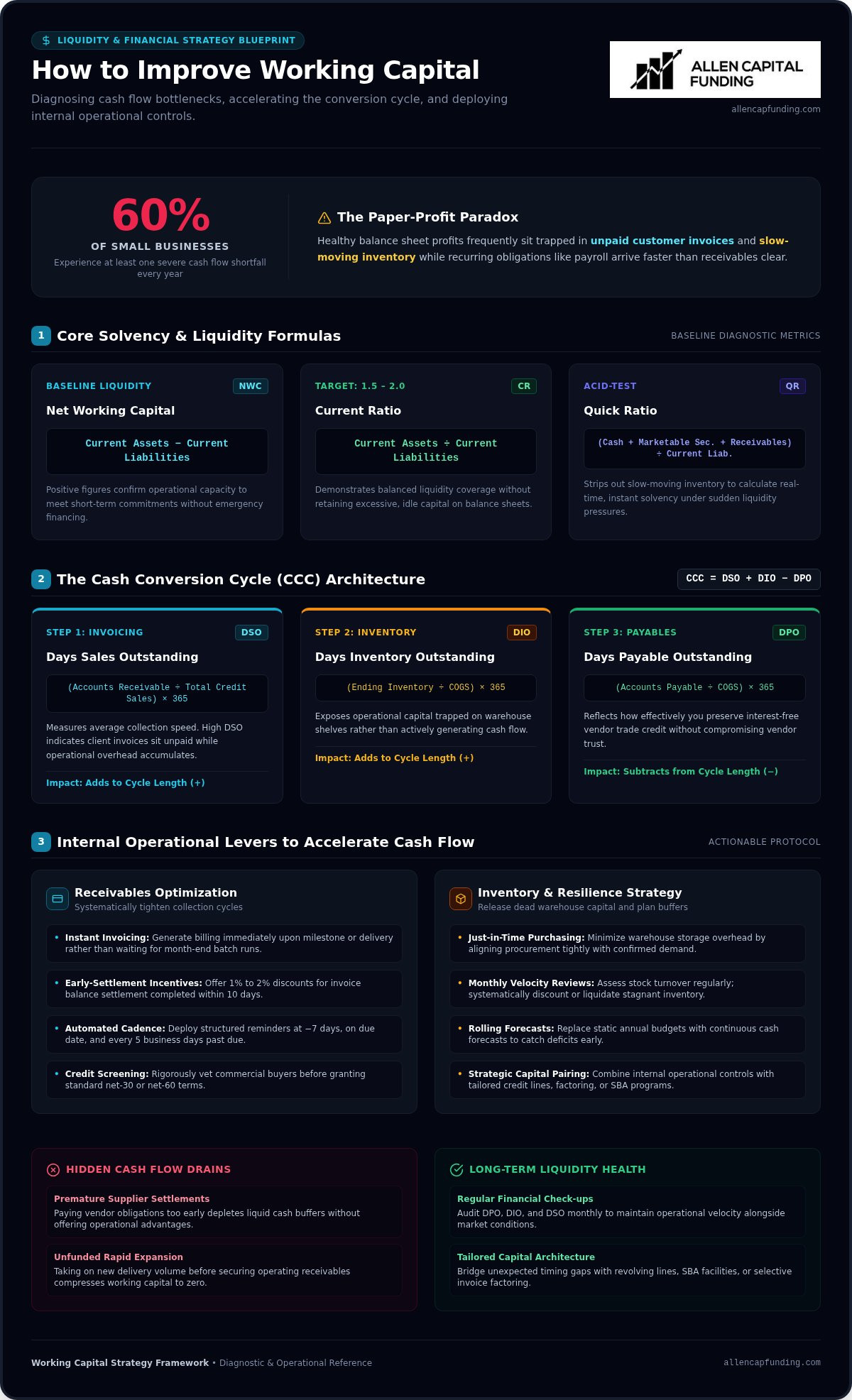
Sixty percent of small businesses experience at least one cash flow shortfall every year, often watching healthy paper profits sit trapped in unpaid customer invoices and slow-moving inventory. It's deeply frustrating when monthly payroll and supplier obligations arrive faster than your receivables clear, especially when traditional bank underwriting moves too slowly to resolve urgent gaps. If you're searching for how to improve working capital to avoid cash crunches while funding growth, you aren't alone. Sustainable financial health isn't merely about cutting expenses; it requires a deliberate balance between internal operational discipline and the right external funding tools.
In this guide, you'll discover actionable operational steps and strategic financing tools to optimize your cash flow and strengthen working capital. We examine proven methods to shorten your cash conversion cycle without damaging key relationships, establish reliable liquidity buffers for unexpected market shifts, and identify tailored capital structures built for sustained operational expansion.
Table of Contents
Diagnosing Liquidity: Metrics and the Cash Conversion Cycle
Liquid reserves fund daily commercial operations, payroll, and sudden expansion opportunities. Net working capital measures the operating liquidity available to an enterprise, calculated directly as current assets minus current liabilities. Understanding this baseline equation is essential, but static balance sheet figures don't tell the entire story. If you want to master how to improve working capital, you must evaluate how rapidly those assets convert into usable cash.
A business can appear solvent on paper while experiencing severe liquidity strains. As detailed by Working capital reference frameworks, effective working capital management requires aligning operational velocity with short-term obligations to preserve commercial stability.
Calculating Core Working Capital and Solvency Ratios
Ratios provide an immediate snapshot of baseline solvency. Monitoring them helps leadership spot cash compression before operational disruptions occur.
Net Working Capital (NWC): Current Assets - Current Liabilities. Positive figures indicate immediate capacity to meet near-term obligations.
Current Ratio: Current Assets / Current Liabilities. A target between 1.5 and 2.0 generally demonstrates balanced liquidity without keeping excessive capital idle.
Quick Ratio (Acid-Test): (Cash + Marketable Securities + Receivables) / Current Liabilities. This metric strips out slow-moving inventory to test instant solvency.
Negative Working Capital: Occurs when short-term liabilities exceed current assets, signaling immediate refinancing needs or severe cash depletion.
Mapping the Three Stages of the Cash Conversion Cycle
The Cash Conversion Cycle (CCC) measures the total days required to convert operational investments into cash receipts. Analyzing each phase clarifies exactly where money gets trapped, showing you how to improve working capital through targeted process refinements.
First, calculate Days Sales Outstanding (DSO) to evaluate your collection speed: (Accounts Receivable / Total Credit Sales) x 365. High DSO figures mean client invoices sit unpaid while your own operational bills come due.
Second, assess Days Inventory Outstanding (DIO): (Ending Inventory / Cost of Goods Sold) x 365. This metric exposes capital locked on warehouse shelves rather than generating active cash flow.
Third, measure Days Payable Outstanding (DPO): (Accounts Payable / Cost of Goods Sold) x 365. Maintaining healthy DPO allows you to preserve interest-free trade credit without straining relationships with key vendors.
Your full cycle calculation is straightforward: CCC = DSO + DIO - DPO. Tracking this composite number helps you pinpoint internal bottlenecks and compress cycle duration across every operational tier.
Five Operational Steps to Optimize Internal Working Capital
Before pursuing external credit, business owners should extract idle liquidity from their existing operational footprint. Large enterprises often rely on heavy bureaucratic procedures, but small and mid-sized enterprises can execute faster, leaner operational adjustments. Learning how to improve working capital begins by systematically tightening receivables, moving warehouse assets, restructuring vendor obligations, and pruning unnecessary operational overhead.
Accelerating Accounts Receivable and Invoicing Workflows
Late collections deplete cash reserves faster than poor sales margins. Accelerate your receivables through these decisive adjustments:
Automate instant invoicing: Generate accurate invoices immediately upon milestone completion or physical delivery rather than waiting for month-end billing batches.
Offer early-settlement terms: Introduce a 1% or 2% discount for accounts settled within 10 days to encourage prompt remittance.
Establish rigid collection cadences: Set automated reminders at 7 days prior to due dates, on the due date, and every 5 business days past due.
Screen client credit profiles: Vet new commercial buyers before granting net-30 or net-60 terms to prevent avoidable bad debt write-offs.
Streamlining Inventory Turnover to Release Tied-Up Cash
Every unsold item on your warehouse floor represents dead cash that could otherwise cover payroll or fuel expansion. Adopt just-in-time purchasing practices to minimize warehouse storage overhead. Evaluate your inventory velocity monthly, identifying non-performing stock and liquidating it through targeted promotional pricing or distributor buybacks. Using historical demand trends rather than guesswork ensures you order sufficient stock without tying up vital operational funds.
Managing Vendor Payables Without Compromising Partnerships
Preserving your own cash doesn't mean damaging key vendor relationships. Renegotiate standard trade terms from net-30 to net-45 or net-60 days with primary suppliers, leveraging your reliable payment track record as commercial proof of stability. Synchronize outgoing supplier payments with incoming client collection cycles so cash leaves your accounts only after new revenue arrives.
Finally, conduct a thorough audit of your monthly operating expenses. Cancel unused recurring software subscriptions, renegotiate utility or merchant processing agreements, and streamline logistical bottlenecks. If you want a complete diagnosis of your current operational efficiency and available balance sheet capacity, schedule a comprehensive Financial Check-Up to uncover hidden capital reserves across your organization.
Overcoming Common Obstacles That Drain Operational Reserves
Revenue expansion can create unexpected balance sheet stress. Operational friction often drains cash faster than collections can replenish it, leaving leadership struggling to meet basic overhead. Mastering how to improve working capital requires identifying these internal cash leaks early, especially when customer volume surges faster than cash collections.
Managing the Risks of Overtrading During Rapid Expansion
Overtrading occurs when an enterprise accepts substantial customer orders without having sufficient cash reserves to fund the upfront production, payroll, and material costs. Uncontrolled growth outpaces cash collection, rapidly draining available liquidity long before high-value client invoices are paid.
Mitigate this structural risk by taking specific defensive steps:
Calculate operating runway: Measure total cash requirements across the entire production cycle before finalizing large commercial contracts.
Stagger delivery milestones: Split massive projects into phases with progress billings to fund raw materials continuously.
Control headcount growth: Delay permanent hires until consistent monthly cash receipts justify added fixed overhead costs.
Pacing expansion protects operating stability. Every dollar committed to raw materials and production labor remains locked until your buyer settles their invoice.
Handling Seasonal Liquidity Dips and Customer Default Hazards
Seasonal demand swings routinely create sharp liquidity drops. A manufacturer producing heavily in spring for autumn sales faces months of heavy cash outflows before generating meaningful revenue. Deploying a twelve-month rolling cash forecast provides dynamic visibility, allowing you to prepare for annual revenue valleys instead of scrambling when reserves run thin.
Customer defaults present another major operational hazard. Relying heavily on one or two dominant clients creates serious financial vulnerability; an unexpected insolvency or delayed settlement by a key account can immediately cripple your own payroll. Establish hard credit exposure caps so no individual customer represents more than 15% to 20% of your total receivables balance. In addition, demand staged upfront deposits for high-volume orders to offset material procurement costs directly. Understanding how to improve working capital means safeguarding against these operational shocks before they threaten daily business continuity.
Comparing Strategic Financing Options for Working Capital Gaps
Operational discipline compresses cycle times, but internal efficiency alone cannot always bridge major cash timing mismatches. Rapidly fulfilling new purchase orders or handling extended customer credit terms demands flexible external funding. Evaluating external facilities based on draw speed, accessibility, and structural alignment is central to understanding how to improve working capital sustainably.
Revolving Business Lines of Credit for Flexible Liquidity
A revolving line of credit serves as a vital operational safety net. You draw capital on demand to cover payroll, purchase seasonal inventory, or settle emergency expenses, paying interest only on the funds actively deployed. As balances are repaid, credit limits reload automatically, preserving ongoing liquidity without requiring repeated loan applications. Examine tactical structures in our guide to securing a business line of credit.
Invoice Factoring and Purchase Order Financing for Immediate Cash
When customer accounts receivable lock up liquidity, asset-backed mechanisms accelerate cash realization:
Invoice Factoring: Monetize outstanding commercial invoices immediately upon billing instead of waiting 30 to 90 days for client payment.
Purchase Order Financing: Pay third-party suppliers directly to produce and deliver goods for confirmed, creditworthy customer orders.
Asset-Based Lending: Unlock working capital tied up in inventory, machinery, and open receivables by leveraging asset-based lending for small business.
Working Capital Loans and SBA Options for Extended Growth
Longer-term liquidity demands require structured debt instruments. Dedicated working capital loans deliver lump-sum cash injections to fund aggressive market entries or substantial raw material acquisitions. For lower borrowing costs and longer amortization profiles, government-backed SBA programs provide durable balance sheet reinforcement. Additionally, purchasing heavy machinery or fleet vehicles outright drains liquid cash quickly; leveraging specialized commercial equipment loans protects your reserves while keeping operations modern.
Selecting the ideal facility depends entirely on your cash conversion velocity. If you need a tailored liquidity facility structured around your exact operating cycle, explore customized working capital options with our advisory team today.
Building a Resilient Working Capital Strategy for 2026
Operational discipline and external funding should not exist in separate silos. High-performing leadership teams integrate daily process efficiency directly with standby capital structures, ensuring unexpected market shifts never interrupt daily operations. Discovering how to improve working capital on a permanent basis requires moving away from reactive borrowing toward consistent liquidity modeling.
Conducting a Regular Financial Check-Up and Cash Audit
Proactive monitoring reveals balance sheet vulnerabilities before cash reserves dwindle. Establishing a routine cash diagnostic ensures your liquidity supports ongoing growth initiatives:
Deploy rolling 13-week cash forecasts: Map weekly disbursements directly against anticipated receipts to spot impending cash crunches a quarter in advance.
Stress test customer defaults: Model your cash position assuming your top two accounts delay payment by an additional 30 days.
Differentiate waste from growth strain: Determine whether cash deficits stem from redundant operating expenses or the upfront costs of fulfilling larger purchase orders.
Track product-level velocity: Review trailing cash cycle metrics across each product line to identify which offerings consume excessive capital relative to their margins.
Routine assessments eliminate surprises. They provide the clear financial baseline needed to secure external capital on advantageous terms before an urgent need arises.
Securing Tailored Capital Solutions with Allen Capital Funding
Executing an effective strategy requires the right capital partner. Allen Capital Funding acts as a consultative advisor evaluating your complete balance sheet health across diverse commercial sectors nationwide. Rather than trying to squeeze your business into rigid underwriting boxes, we tailor financing products around your distinct cash conversion timeline.
Our comprehensive portfolio provides the precise liquidity mechanism your balance sheet requires:
Flexible Revolving Lines: Establish immediate liquidity reserves to smooth seasonal fluctuations or fund payroll without tapping operational cash.
Asset-Backed Facilities: Leverage existing accounts receivable and confirmed purchase orders via factoring to unlock instant capital.
Structured Term Solutions: Reinforce your working capital reserves through competitive SBA loans and equipment facilities designed for sustained operational scale.
Do not wait for a cash shortfall to restrict your commercial momentum. Take control of your balance sheet, master how to improve working capital, and position your company for durable growth. Schedule a consultation with Allen Capital Funding to structure your customized liquidity facility today.
Strengthen Your Balance Sheet for Sustainable Growth
Achieving lasting operational resilience requires continuous coordination between internal workflows and external capital access. By actively shortening your cash conversion cycle, eliminating stagnant inventory, and deploying 13-week rolling cash forecasts, you insulate your enterprise against sudden liquidity crunches. True mastery of how to improve working capital lies in pairing disciplined internal management with scalable funding tools before cash timing mismatches disrupt daily operations.
Allen Capital Funding supports commercial enterprises across the United States with specialized financing built around real operating cycles. Our dedicated financial specialists provide consultative, partnership-driven guidance backed by an extensive portfolio that includes revolving credit lines, invoice factoring, and structured SBA programs. You don't have to let trapped receivables or rapid fulfillment demands slow down your commercial ambitions. Explore tailored working capital solutions with Allen Capital Funding to unlock trapped balance sheet reserves and fund your next phase of expansion with confidence.
Frequently Asked Questions
What is the fastest way to improve working capital in a small business?
The fastest way to improve working capital is accelerating customer collections and monetizing unpaid invoices. Invoicing immediately upon delivery and implementing early payment discounts can pull receivables forward by several weeks. Alternatively, using invoice factoring or drawing on an existing business line of credit provides same-week liquidity. These immediate levers inject cash into payroll and operating expenses without waiting for standard net-30 or net-60 commercial payment terms to elapse.
What is a healthy working capital ratio for a growing commercial business?
A healthy working capital ratio generally falls between 1.5 and 2.0. This benchmark demonstrates that an enterprise maintains sufficient liquid assets to comfortably cover short-term liabilities without leaving excessive capital idle. A ratio below 1.0 indicates severe liquidity distress and potential insolvency risks. Conversely, a ratio consistently above 2.0 often signals that management is hoarding cash rather than reinvesting capital into inventory, technology, or market expansion.
How does the cash conversion cycle directly affect working capital availability?
The cash conversion cycle directly dictates how long cash remains trapped in operations before returning to your bank account. A shorter cycle means your business recovers invested funds rapidly from inventory sales and customer receivables. When cycle days expand, operational cash becomes locked on warehouse shelves and open invoices. Understanding this dynamic is crucial when evaluating how to improve working capital, because every day trimmed from the cycle immediately frees up usable liquid reserves.
Can a business improve working capital without taking on new commercial debt?
Yes, companies can significantly strengthen liquidity through internal operational adjustments without incurring debt. Leadership can audit recurring operational expenses, eliminate obsolete inventory through promotional discounting, and renegotiate supplier terms from net-30 to net-60. Tightening credit standards prevents costly customer defaults before they occur. These operational improvements recover internal cash, demonstrating how to improve working capital organically before seeking external debt or asset-backed funding.
What is the difference between a working capital loan and a line of credit?
A working capital loan provides a lump-sum cash disbursement upfront, whereas a line of credit offers a revolving pool of funds. Term loans require scheduled principal and interest payments across a fixed duration, making them ideal for large planned investments like seasonal bulk purchases. A business line of credit allows flexible, on-demand draws, where interest accrues exclusively on the capital actively deployed. Once repaid, the credit line limit reloads automatically for future operational needs.
How does invoice factoring help optimize accounts receivable liquidity?
Invoice factoring optimizes liquidity by advancing immediate cash against your verified, outstanding customer invoices. Instead of waiting 30, 60, or 90 days for commercial buyers to remit payment, a business sells its accounts receivable to a specialized funding partner. The factoring provider advances a substantial percentage of the invoice value immediately. This structure eliminates collection delays, bypasses rigid bank underwriting, and provides immediate cash flow to meet ongoing payroll and operational vendor commitments.
Why do rapidly expanding businesses often face unexpected working capital shortages?
Rapid expansion causes working capital shortages because upfront fulfillment costs surge long before customer revenue arrives. Winning larger contracts forces an enterprise to purchase additional raw materials, scale warehouse inventory, and add operational labor immediately. If clients operate on standard commercial credit terms, substantial cash outflows occur weeks ahead of customer invoice settlements. This timing mismatch creates severe cash compression, often leaving fast-growing firms short on liquid reserves despite strong top-line sales growth.


Comments