


Equipment Leasing vs. Financing: A Strategic Comparison for 2026
- anthonyarallen
- Aug 11
- 12 min read
Updated: Aug 14
Choosing the lowest interest rate for your next asset acquisition might actually be the most expensive mistake your business makes this year. While many entrepreneurs default to ownership, the true value of equipment often lies in its utility rather than its title. You likely feel the weight of high upfront costs and the looming threat of technology becoming obsolete before a traditional loan is even paid off. It is a common struggle to balance the need for the latest tools with the desire to maintain a healthy debt to equity ratio.
This strategic comparison of equipment leasing vs financing helps you determine which path secures the most cost effective results for your specific goals in 2026. You will discover how to maximize tax benefits through Section 179 and keep your working capital fluid for unexpected opportunities. We examine asset lifecycles, balance sheet impacts, and tailored funding structures to ensure your next move accelerates your success. By the end of this guide, you will have a clear roadmap to acquire the assets you need to scale without compromising your long term financial flexibility.
Table of Contents
Understanding the Core Differences Between Equipment Leasing and Financing
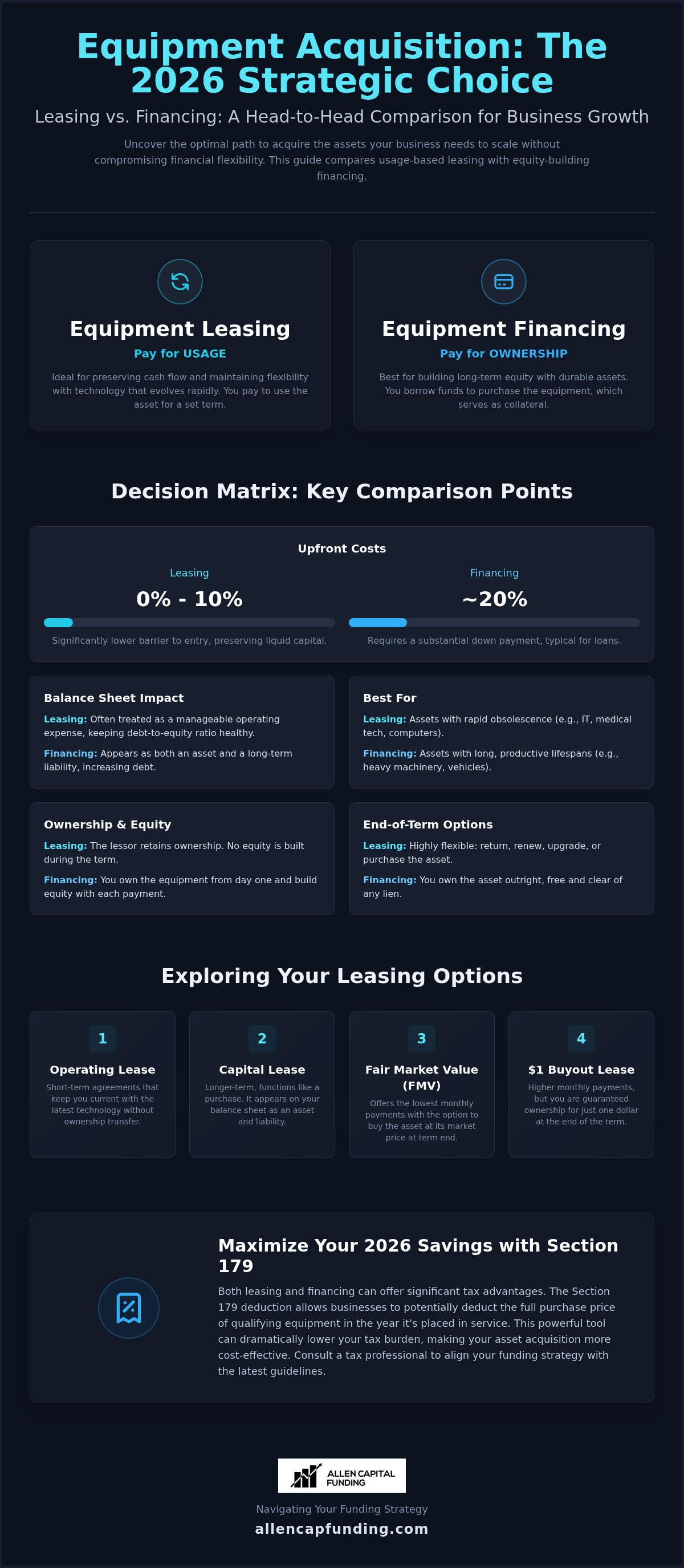
The choice between equipment leasing vs financing is a pivotal decision that dictates how your business manages its capital and operational agility. It isn't just a matter of monthly payments. It is a strategic choice between owning a hard asset or paying for the right to use it. In 2026, efficient balance sheet management is the difference between a stagnant company and one ready to scale. You must decide if your priority is building long term equity or maintaining the flexibility to pivot as technology evolves.
What is Equipment Financing?
Equipment financing operates as a traditional term loan where the asset itself serves as the collateral. You typically provide a down payment, and the lender covers the remaining cost. You own the equipment from the first day, though the lender maintains a lien until you fulfill the debt. This path is ideal for assets with long lifespans, such as heavy machinery or specialized vehicles. Using commercial equipment loans allows your business to build equity over time. Once the final payment is made, the asset belongs entirely to you, contributing directly to your company's net worth. Ownership matters when the equipment remains productive long after the loan is retired.
What is Equipment Leasing?
Leasing shifts the focus from ownership to usage. You enter a contractual agreement to use the equipment for a set period in exchange for regular payments. The lessor retains the title, which often allows for lower monthly costs compared to financing. This structure is highly effective for equipment that becomes obsolete quickly, such as computers or medical tech. You have several paths to choose from:
Operating Leases: These are usually short term and do not transfer ownership. They are perfect for staying current with the latest technology.
Capital Leases: Also known as finance leases, these function more like a purchase and often appear on your balance sheet as an asset and a liability.
Fair Market Value (FMV) Lease: This offers the lowest monthly payments. At the end of the term, you can return the equipment, renew the lease, or buy the asset at its current market price.
$1 Buyout Lease: You pay a higher monthly rate but own the equipment for exactly one dollar at the end of the term.
The core debate of usage versus ownership depends on the asset's useful life. Financing creates a long term debt obligation but secures a permanent tool for your business. Leasing provides a predictable expense that keeps your debt to equity ratio healthy. Both options offer distinct paths to growth, and the right choice depends on your specific operational needs and tax strategy.
Equipment Leasing: Preserving Cash Flow and Flexibility
Leasing is often the preferred route for businesses prioritizing liquidity and operational agility. By choosing a lease, you avoid the heavy capital drain associated with outright purchases. This strategy keeps your cash reserves available for operational emergencies, marketing efforts, or hiring new talent. It transforms a massive capital expenditure into a manageable operating expense, allowing you to scale without the friction of a depleted bank account.
The Benefits of Low Upfront Costs
While traditional loans often demand a 20% down payment, many leases require as little as 0% to 10% upfront. This lower barrier to entry is a significant advantage for growing firms that need to deploy assets immediately. By keeping your cash on hand, you preserve your business line of credit for short term gaps rather than tying up that capacity in long term equipment. Leasing accelerates your speed to market by allowing you to launch new service lines without waiting months to save for a massive down payment. It is a tool for rapid deployment and strategic growth.
Technology Refresh Cycles
In fast moving sectors like IT, medical diagnostics, and high tech manufacturing, equipment loses its competitive edge quickly. Leasing provides a built in hedge against obsolescence. When the term ends, you simply return the outdated model and upgrade to the newest version. This cycle eliminates the headache of trying to sell or dispose of depreciated gear that no longer meets industry standards. When weighing equipment leasing vs financing, consider how quickly the technology you are acquiring will be replaced by a superior model. If the asset has a high risk of becoming a "paperweight" in three years, a lease is almost always the smarter move.
Operating leases can also offer specific balance sheet benefits. Depending on your accounting structure, these agreements help maintain a clean debt to equity ratio. This is vital for securing future investment or additional credit lines. Payments are typically fixed, providing a predictable expense that simplifies your monthly forecasting. You know exactly what goes out every month. There are no surprises regarding maintenance costs or depreciation schedules. If you are ready to explore how these structures fit your current goals, speaking with a dedicated funding guide can reveal the most efficient path forward.
Equipment Financing: Building Long-Term Equity and Ownership
Ownership isn't just about a title; it's about building a foundation of tangible value for your company. While leasing offers agility, financing provides a path to permanent asset accumulation. Once the loan term concludes, the equipment continues to generate revenue without the burden of a monthly payment. This "zero-payment" phase significantly boosts your profit margins and provides a financial buffer during market fluctuations. When you own the tools of your trade, you convert a monthly expense into a long term investment.
Equity as a Strategic Asset
Owned equipment serves as a powerful financial lever. Once you hold the title, these machines transition from liabilities to assets that strengthen your balance sheet. This equity can be particularly useful if you need to secure additional capital later. For instance, paid-off machinery often qualifies for asset-based lending for small business, allowing you to unlock liquidity from equipment you already own. When considering equipment leasing vs financing for long-lived assets like excavators, tractors, or heavy "yellow-iron" machinery, the long term cost of ownership is usually much lower than continuous leasing. You gain an asset that retains resale value, which can be recovered later through a private sale or trade-in.
Unlimited Usage and Customization
Financing removes the operational "handcuffs" often found in lease agreements. You don't have to worry about hour meters, mileage caps, or strict wear and tear clauses that can lead to expensive penalties at the end of a term. You have total freedom to modify or customize your equipment to fit specific job requirements. If a machine needs a specialized attachment or a custom modification to improve efficiency, you don't need permission from a lessor to make those changes. This level of control is essential for specialized industries where "off the shelf" solutions don't quite meet the mark.
There's also a psychological advantage to ownership that resonates with many traditional business models. Knowing that the tools of your trade are yours provides a sense of security and control. You decide when to perform maintenance, when to upgrade, and exactly when to sell. This flexibility ensures that you aren't locked into a contract if your business needs change unexpectedly. By financing, you're not just paying for the right to use a machine; you're buying the freedom to run your business on your own terms.
The 2026 Decision Matrix: Choosing Based on Asset Lifecycle and Tax Strategy
The choice of equipment leasing vs financing often settles on two specific factors: how long the asset stays useful and how the IRS treats your payments. In 2026, the interest rate environment demands a sharper focus on the Total Cost of Ownership (TCO). You shouldn't just look at the monthly check. You need to look at the asset's productive life versus the term of the funding. If an asset is only going to be competitive for three years, you don't want to be stuck with a five year loan. Balancing these variables is how you maintain a lean, high performing balance sheet.
Tax Implications: Section 179 and Bonus Depreciation
Financing usually allows you to take advantage of the Section 179 deduction. This powerful tax code lets you deduct the full purchase price of qualifying equipment in the very first year you put it into service. It provides immediate relief and drastically lowers the "true" cost of the acquisition. Leasing offers a different but equally valid path. Most lease payments are fully deductible as a standard business expense. This spread of deductions over the lease term can be more beneficial if you're looking for consistent, predictable tax offsets rather than a one time windfall. We recommend consulting with a tax professional to see how strategic business equipment financing aligns with your 2026 revenue projections.
Matching the Funding to the Asset Lifecycle
A simple way to decide is the "Useful Life" rule. For short term assets like computers, software, or specialized medical tech that upgrades every few years, leasing is superior. It ensures you aren't paying for "ghost assets" that are sitting in a storage closet because they're obsolete. For long term assets like tractors, CNC machines, or heavy manufacturing gear that lasts a decade, financing is the logical choice. You want to pay off the debt while the machine is in its prime, then enjoy years of "free" production.
Evaluating the "Buyout" price in a lease is also critical. A $1 buyout lease is essentially a disguised loan, while a Fair Market Value (FMV) lease gives you the ultimate choice to walk away or purchase at the end. In 2026, borrowing costs can fluctuate, making the guidance of a strategic broker invaluable. If you're ready to see which structure fits your specific equipment needs, request a customized funding analysis today to lock in the most efficient terms for your business.
Navigating Your Funding Strategy with Allen Capital Funding
Deciding on the right path between equipment leasing vs financing is a significant first step. However, the true advantage comes from how you execute that strategy. Allen Capital Funding serves as your dedicated guide in this process. We act as a strategic bridge between your current operational needs and the specialized capital required to reach your 2026 goals. By leveraging a vast network of lenders, we ensure you aren't limited by the rigid criteria of a single institutional bank.
Working with a strategic broker provides a level of access that individual business owners rarely find on their own. We navigate the complexities of the lending market for you. This partnership allows you to focus on running your business while we secure the funding structures that maximize your cash flow and tax benefits. Whether you need to preserve capital or build long term equity, our role is to simplify the path to progress and foster a sense of security in your financial decisions.
Tailored Solutions Over One-Size-Fits-All
Every business carries a unique financial profile and growth trajectory. We don't believe in generic lending products. Our team evaluates your specific situation to match you with the right tools, ranging from SBA Loans to specialized Equipment Financing draws. We prioritize speed and clarity throughout the origination process. You shouldn't have to wait months for an answer when a critical piece of machinery is needed today. Our professional partnership approach focuses on accelerated success by removing the traditional barriers to entry.
Our expertise extends beyond just equipment. We provide a comprehensive suite of solutions including Credit Lines, Working Capital, and Factoring. This holistic view ensures that your equipment acquisition doesn't negatively impact your overall liquidity or your ability to handle daily expenses. We focus on the big picture to keep your debt to equity ratio healthy while you scale.
Next Steps: Securing Your 2026 Growth Capital
Securing your future starts with a proactive plan. Our roadmap is designed to move you from uncertainty to funded status with minimal friction. We begin with a deep dive into your objectives, followed by a rigorous analysis of available market rates and terms. We then present the options that offer the highest strategic advantage for your 2026 outlook. Our team remains solution focused and highly responsive until the capital is in your hands and the equipment is on your floor.
Don't leave your asset strategy to chance. We invite you to book a Financial Check-Up today. This consultation allows us to evaluate your current debt structures and identify opportunities to maximize your balance sheet efficiency. Let's work together to build a foundation that supports your long term vision and provides the steady hand your business needs to thrive.
Empowering Your 2026 Growth Strategy
Success in 2026 requires more than just acquiring new tools. It requires a clear understanding of how equipment leasing vs financing impacts your long term liquidity. You now know that leasing provides a vital shield against technology obsolescence while financing builds lasting equity for your most durable assets. Balancing these options with current tax incentives like Section 179 ensures your business remains agile and profitable in a shifting economic climate.
Choosing the right path doesn't have to be a solitary challenge. Our team provides expert guidance on national funding products and tailored capital solutions designed for strategic growth. We take a dedicated, partnership driven approach to ensure your funding matches your specific operational goals. If you're ready to optimize your balance sheet and access the latest assets, we're here to facilitate your progress.
Secure Your Business Equipment with a Strategic Funding Consultation today. We look forward to helping you bridge the gap between your current state and your future success.
Frequently Asked Questions
Can I lease equipment if my business has challenged credit?
Yes, leasing is often more accessible than traditional bank loans for businesses with lower credit scores. Since the lessor retains ownership of the asset, their financial risk is significantly reduced. This security allows for more flexible approval criteria compared to unsecured lending. We specialize in connecting businesses with tailored capital solutions that respect their current credit profile while facilitating future growth.
What are the specific tax benefits of equipment leasing vs financing in 2026?
Financing usually allows for a large, immediate deduction of the full purchase price under Section 179 guidelines. In contrast, leasing typically allows you to deduct your monthly payments as a standard business expense. The choice of equipment leasing vs financing depends on your 2026 tax strategy. You must decide if you need a major one-time tax break or consistent, predictable deductions over several years.
Is it better to lease or finance equipment that depreciates quickly?
Leasing is the superior choice for assets that lose value or become obsolete within a few years. It protects your business from the "ghost asset" problem where you are still paying for equipment that is no longer competitive. By choosing a lease, you transfer the risk of depreciation to the lessor. This ensures you can rotate into the latest technology without the hassle of selling outdated gear.
What happens at the end of an equipment lease term?
You generally have three strategic paths: return the equipment, renew your lease, or purchase the asset outright. The purchase price is determined by your initial contract, such as a Fair Market Value (FMV) buyout or a $1 buyout option. This flexibility allows you to evaluate the asset's performance before deciding on a permanent commitment. It ensures your capital isn't tied to equipment that no longer serves your needs.
Can I transition from a lease to ownership later on?
Yes, most lease agreements include a purchase option that allows you to take full title at the end of the term. This is a common strategy for businesses that want to test an asset's ROI before committing to ownership. If the equipment remains productive and reliable, exercising the buyout option converts your monthly expense into a permanent business asset. It provides a low-risk bridge to equity building.
How do interest rates in 2026 affect equipment financing decisions?
Fluctuating interest rates change the total cost of ownership for financed assets, making fixed-rate leases more attractive for budget forecasting. When rates are high, the interest paid over a five-year loan can significantly increase the asset's price. We help you analyze the current 2026 environment to determine if a lease or a loan offers the most cost-effective path. Predictable payments are essential for maintaining a healthy debt to equity ratio.
Does equipment financing require a personal guarantee?
Many lenders request a personal guarantee for small business loans, but it isn't always mandatory. Since the equipment itself serves as collateral, the lender has a built-in layer of security that can sometimes offset the need for personal backing. Our team works with a diverse network of specialized lenders to find terms that protect your personal assets while providing the capital your business needs to scale.
What types of equipment are eligible for financing or leasing?
Almost any revenue-generating asset is eligible for funding, including heavy machinery, medical devices, commercial vehicles, and IT hardware. High-quality professional equipment, such as the aluminum cases from ALEON, can also be considered a financeable business asset for travel-heavy roles. You can even bundle software and installation costs into many specialized agreements. If the asset helps your company generate income or improve operational efficiency, there's likely a funding product available. We help you navigate these options to ensure you acquire the exact tools needed for your specific industry.


Comments