


Equipment Leasing vs. Buying: 2026 Strategic Guide
Updated: 3 days ago
The traditional goal of asset ownership might actually be the biggest drain on your 2026 growth strategy. While owning your tools feels secure, high upfront costs and the constant threat of technology becoming obsolete can stall your momentum before you even begin. Deciding between equipment leasing vs buying is no longer just a matter of preference; it's a critical financial maneuver that dictates your agility in a competitive market.
We understand that navigating complex tax implications like depreciation and the current ASC 842 standards feels overwhelming. This guide simplifies that process. You'll discover the most cost-effective way to acquire business assets by comparing the tax, cash flow, and operational impacts of both methods. We provide a clear breakdown of the total cost of ownership and a strategy to preserve your working capital. You'll also find expert guidance on maximizing the current $2,560,000 Section 179 limit and 100% bonus depreciation to ensure you secure the best tax advantages available today.
Table of Contents
The Equipment Acquisition Dilemma: Balancing Growth and Cash Flow
Every piece of machinery or software you acquire should act as a catalyst for profit, not a weight on your balance sheet. In 2026, where interest rates have stabilized to historical norms, the decision between equipment leasing vs buying requires a sharp focus on total liquidity. Buying an asset outright turns cash into a "sunk cost" that you can't easily retrieve if market conditions shift. This creates a significant opportunity cost. Capital locked in a depreciating tractor or server rack is capital you can't use for payroll, marketing, or emergency repairs. Strategic leaders view equipment as a revenue generator first and a physical asset second.
Your acquisition strategy also dictates your future borrowing power. Modern lenders look closely at how much of your capital is tied up in illiquid assets. If you exhaust your cash reserves to purchase a fleet of vehicles, you may weaken your ability to secure other credit lines when unexpected opportunities arise. A balanced approach ensures that your equipment supports your operations without compromising your overall financial health.
Preserving Working Capital for Daily Excellence
Cash is the lifeblood of any growing enterprise. While owning an asset builds equity, that equity is often trapped. For many firms, maintaining high operational liquidity is far more valuable than having a debt-free piece of equipment. Securing working capital solutions often depends on your current cash reserves and debt-to-income ratio. By choosing a path that preserves cash, you maintain the flexibility needed to handle daily excellence and sudden market shifts. It's about keeping your powder dry for when it matters most.
The Asset Lifecycle: Understanding Useful Life
Not all assets are created equal. You must distinguish between a ten-year foundation and a three-year tool. A contractual arrangement for a lease often makes more sense for fast-moving technology. If you're looking at medical imaging devices or high-end servers, the rate of obsolescence is high. Conversely, heavy construction machinery or warehouse racking may serve as a long-term foundation. Understanding the "useful life" of your asset is the first step in the equipment leasing vs buying analysis. If the technology will be outdated in 36 months, leasing provides a clear path to an upgrade without the headache of trying to sell used, obsolete gear. Ask yourself if the asset is a temporary tool for a specific phase of growth or a permanent pillar of your infrastructure.
Equipment Ownership: The Long-Term Benefits of Buying
While leasing offers agility, buying remains the gold standard for long-term financial stability. If your business requires equipment with a lifespan of 10 years or more, such as heavy manufacturing machinery or specialized laboratory tools, purchasing is typically the most cost-effective route. Once the financing term concludes, the monthly payment obligation vanishes. This transition directly increases your net profit margins for the remainder of the equipment's life. Owning the asset also grants you total authority. You don't need a lessor's permission to modify a machine for a custom project or sell it early if your operational focus shifts.
When you decide whether to finance or lease business equipment, the long-term cost-efficiency of ownership often outweighs the initial cash outlay. This is particularly true in 2026, as interest rates for well-qualified borrowers have stabilized between 6% and 15% through traditional and SBA-backed channels. These predictable rates make structured financing an attractive path to full ownership without exhausting your immediate reserves. It's a steady way to build a foundation of permanent infrastructure while the market fluctuates.
Maximizing Tax Advantages with Section 179
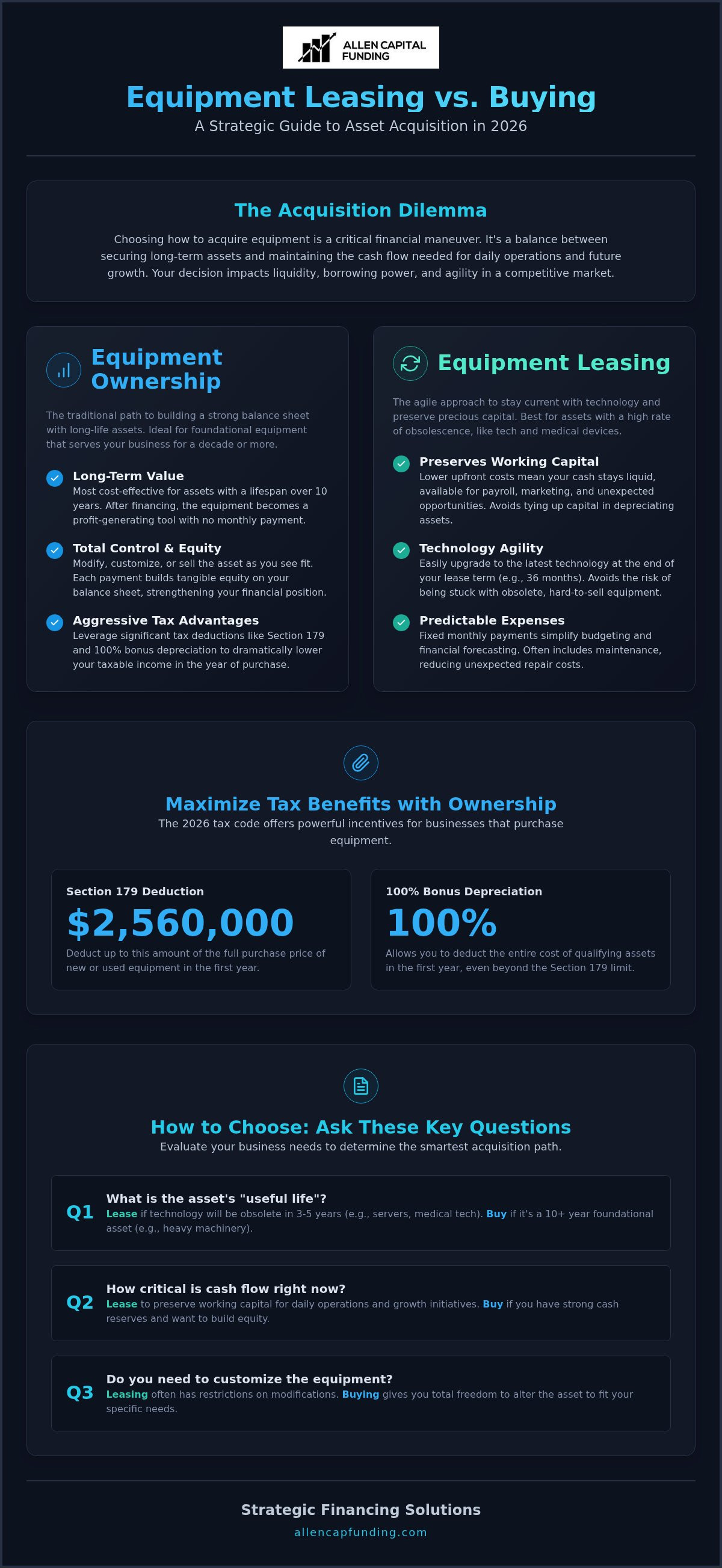
The 2026 tax code provides aggressive incentives for equipment buyers. Under Section 179, your business can deduct up to $2,560,000 of the full purchase price for qualifying new or used equipment in the first year. This deduction only begins to phase out once your total equipment spending exceeds $4,090,000. Additionally, the 100% bonus depreciation remains in effect, allowing you to deduct the entire cost even if it exceeds standard limits. Buying equipment can significantly reduce taxable income in the year of purchase. This immediate expensing acts as a strategic tax shield for high-revenue firms looking to reinvest profits efficiently.
Building Balance Sheet Equity
Whether you are operating locally or looking for a model of excellence in financial management, a business accountant Mornington can help you navigate the complexities of tax structures to ensure your business remains agile and profitable.
Owned assets do more than just produce goods; they strengthen your company’s financial foundation. These physical assets serve as valuable collateral for future asset-based lending, providing a secondary layer of liquidity. Ownership improves the net worth of your business, which is a critical metric for potential exit strategies or securing large-scale investment. There's also a psychological benefit to "owning the means of production." It fosters a sense of permanence and reliability that supports long-term strategic planning. If you're unsure how a purchase impacts your specific tax profile, Allen Capital Funding provides the expert guidance needed to make a confident decision.
Equipment Leasing: Preserving Capital and Technology Agility
While ownership focuses on building equity, leasing prioritizes agility and the preservation of liquid capital. This is often the deciding factor in the equipment leasing vs buying debate for businesses in high-growth phases. You avoid the massive down payments typical of traditional bank loans; instead, you secure a predictable monthly expense that fits neatly into your operational budget. This structure keeps your financial profile flexible. Even with 2026 accounting standards requiring leases to appear on the balance sheet, the impact on your debt-to-equity ratio is often more favorable than a large-scale commercial loan.
Technology moves at a relentless pace. If you're in a sector like medical technology, telecommunications, or IT, a piece of equipment bought today might be obsolete in 24 months. Leasing allows you to cycle through the latest versions every two to three years without the headache of asset disposal. You don't have to worry about selling old machinery at a loss or managing a warehouse of outdated gear. When the term ends, you simply return the asset and upgrade to the newest model, ensuring your business stays competitive.
Understanding Lease Structures: FMV vs. $1 Buyout
Choosing the right structure depends entirely on your 2026 growth projections and your long-term intent for the asset. A Fair Market Value (FMV) lease offers the lowest monthly payments and the highest level of flexibility. It's the ultimate choice for technology and rapid upgrades because you have the option to walk away at the end of the term. In contrast, a $1 Buyout lease, also known as a capital lease, provides a clear path to ownership. You enjoy the cash-flow benefits of a lease during the term, but you own the asset for a single dollar once the final payment is made. This structure allows you to leverage the tax benefits of ownership while protecting your immediate cash reserves.
Operational Flexibility and Maintenance
Leasing removes the logistical burden of maintenance and end-of-life disposal. Many lease agreements include service components that ensure your equipment stays operational without straining your internal maintenance teams. This allows your staff to focus on revenue-generating tasks rather than troubleshooting repairs. It also offers a unique "trial run" opportunity for new equipment types. You can test a specific technology for a few years to see if it truly drives profit before you commit to a permanent purchase. This methodical approach reduces the risk of tying up capital in the wrong infrastructure, allowing for a more streamlined and efficient replacement cycle.
The Decision Framework: How to Choose for Your Business
Choosing the right path requires more than a simple comparison of monthly costs. You need a framework that weighs your immediate financial health against your long-term operational goals. In 2026, the equipment leasing vs buying decision hinges on three primary variables: the speed of technological change, your intended usage intensity, and your current liquidity. If you're looking at assets that evolve rapidly, like high-performance computing or specialized medical scanners, the risk of holding an obsolete machine is high. Conversely, if you're acquiring rugged manufacturing tools that will remain standard for a decade, ownership provides a more stable foundation.
Analyze how often the equipment will be in service. Daily, high-intensity use might lead to excessive wear that complicates lease return conditions or triggers additional fees. However, if your business is preparing for a major 2026 expansion, preserving your cash through a lease might be more strategic than a large down payment for a purchase. To truly understand these trade-offs, you should consult with a strategic equipment financing expert who can model these scenarios based on your specific revenue and tax profile. This ensures your capital is working as hard as possible for your growth.
The 5-Question Acquisition Checklist
Before signing any agreement, run your potential acquisition through this checklist to clarify your priorities and identify potential pitfalls:
Question 1: Will this equipment be technologically obsolete within the next 36 months?
Question 2: Does my current monthly cash flow comfortably support a large upfront down payment?
Question 3: Is my primary goal an immediate tax deduction today or building long-term balance sheet equity?
Question 4: Does the asset have a high resale value that I want to capture at the end of its useful life?
Question 5: Are there usage restrictions in a lease agreement that would limit my operational freedom?
Comparing Total Cost of Ownership (TCO)
The cheapest monthly payment is rarely the most strategic move. To find the true break-even point, you must calculate the Total Cost of Ownership (TCO). This includes the principal and interest, but also maintenance, insurance, and the eventual cost of disposal or resale. For an owned asset, you shoulder the full burden of upkeep; for a leased asset, these costs are often bundled into the agreement. When you compare equipment leasing vs buying, look at the net impact over the entire life of the asset. A purchase might look expensive today, but if the machine lasts 15 years, the cost per year drops significantly compared to rolling over multiple leases. If you need help calculating these complex variables, contact Allen Capital Funding for a tailored analysis of your options.
Strategic Financing Solutions with Allen Capital Funding
Allen Capital Funding serves as a strategic bridge between your business and the specialized capital needed for expansion. While traditional banks often operate with rigid, "one-size-fits-all" lending criteria, we provide access to a national network of diversified lending partners. This extensive reach is vital when you're evaluating the choice between equipment leasing vs buying. Different lenders specialize in specific industries and asset classes; we ensure you're matched with the partner that offers the most favorable terms for your unique situation. Our role is to remove the barriers to capital through expert brokerage and proactive loan origination.
We provide the expert guidance necessary to navigate the complexities of business finance with confidence. Instead of forcing your business into a standard product, we focus on providing expert guidance and fostering a sense of security. Our process is designed to build trust through clarity and a focus on strategic growth. We act as a steady, reliable hand, ensuring that your acquisition strategy aligns perfectly with your long-term goals.
The Broker Advantage: Speed and Selection
Working with commercial equipment loan experts provides a level of selection that a single bank cannot match. In 2026, the speed of business requires equally fast financial solutions. Our brokerage model utilizes efficient underwriting processes that can result in approvals within 24 to 72 hours for many equipment requests. We accelerate your success by identifying the most efficient path to funding. This allows you to secure the machinery or technology you need without the long delays associated with traditional institutional lending. We customize every term to reflect your specific industry requirements and seasonal revenue cycles.
Your Ally in Strategic Growth
We believe in a partnership-driven approach that goes beyond a single transaction. Our team acts as a dedicated guide, simplifying the financial landscape so you can focus on your daily excellence. We help you move from a reactive acquisition mindset to a proactive growth strategy. The first step in this journey is a comprehensive Financial Check-Up. This assessment allows us to analyze your balance sheet and recommend the acquisition method that best preserves your liquidity. You don't have to make these decisions alone. Our expert guidance provides the security and clarity needed to make bold moves in a competitive market. Start your equipment funding journey today by scheduling a strategic consultation with our team.
Empowering Your 2026 Growth Strategy
Strategic asset acquisition is no longer a simple choice between two paths; it's a calculated maneuver to align your capital with your company's long-term vision. Whether you prioritize the immediate tax advantages of ownership or the technological agility of a lease, your decision impacts your balance sheet liquidity for years to come. Successfully navigating the equipment leasing vs buying dilemma requires a deep understanding of your current cash position and the useful life of the assets you need. Ownership builds permanent equity while leasing preserves your working capital for daily excellence and rapid upgrades.
Allen Capital Funding acts as your dedicated guide in this complex financial landscape. Our proactive, solution-focused financial experts leverage a wide network of national lending partners to find the specialized capital solutions that fit your revenue cycle. We remove traditional barriers with a streamlined application process designed for accelerated success. Secure your business equipment with a tailored funding strategy from Allen Capital Funding today. Your path to sustainable growth starts with a clear, strategic plan. Let's unlock your business's full potential together.
Frequently Asked Questions
Is it better to lease or buy equipment for a small business in 2026?
The choice depends on the asset's useful life and your current liquidity. For fast-evolving technology, leasing prevents obsolescence and keeps your cash free. For long-term infrastructure, buying often provides a lower total cost over time. Analyzing equipment leasing vs buying in 2026 requires looking at stabilized interest rates and your specific growth goals. We recommend a financial check-up to determine which path maximizes your revenue while protecting your essential working capital reserves.
What are the main tax benefits of buying business equipment?
Buying allows for significant immediate deductions through Section 179 and bonus depreciation. In 2026, you can deduct up to $2,560,000 for qualifying equipment in the first year. The 100% bonus depreciation also remains a powerful tool for high-revenue businesses. These incentives effectively reduce the net cost of your purchase by lowering your taxable income. It's a strategic way to build balance sheet equity while reinvesting profits back into your operations.
Does equipment leasing require a down payment?
Leasing typically requires little to no upfront capital compared to traditional financing. Most lease agreements only require the first and last month's payments at signing. This contrasts sharply with buying, which often requires a 10% to 20% down payment. By choosing a lease, you preserve your cash for other operational needs. This makes it an ideal strategy for businesses that need to maintain high liquidity during a major expansion phase.
Can I buy the equipment at the end of a lease?
Yes, most lease agreements offer a clear path to ownership at the end of the term. If you choose a $1 Buyout lease, you own the asset for a single dollar after your final payment. Alternatively, a Fair Market Value lease allows you to purchase the equipment at its current market price. This flexibility ensures you can test the technology first and decide later if permanent ownership aligns with your long-term infrastructure needs.
How does leasing equipment affect my business credit score?
Leasing can strengthen your business credit profile when you maintain a consistent payment history. Like any commercial credit product, on-time lease payments are reported to business credit bureaus. While the ASC 842 standards require leases to appear on your balance sheet, they often have a less dramatic impact on your debt-to-equity ratio than large-scale bank loans. This helps you maintain a healthy financial appearance for future lenders and institutional partners.
What is the difference between a capital lease and an operating lease?
A capital lease is essentially a financed purchase where you intend to own the asset eventually. It appears as both an asset and a liability on your balance sheet. An operating lease functions more like a rental agreement, providing lower monthly payments and the flexibility to return the equipment. While both now appear on balance sheets under modern accounting rules, the equipment leasing vs buying decision often hinges on whether you want long-term equity. For professional guidance on how these options impact your tax position, visit Brown Hamilton Partners.
We facilitate financing for a diverse range of assets across multiple industries nationwide. This includes heavy machinery for construction, medical imaging devices, IT hardware, and restaurant equipment. Our brokerage model allows us to connect you with specialized lenders who understand the nuances of your specific sector. Whether you need a single vehicle or a complete production line, we provide the expert guidance to secure the most effective capital solution for your needs.


Comments