


Equipment Financing New York: 2026 Strategic Guide
- anthonyarallen
- 4 days ago
- 11 min read
What if the most expensive way to grow your business is actually by paying for your equipment in cash? While owning assets outright feels secure, tying up your liquid capital often prevents you from responding to new market opportunities or unexpected challenges. Securing equipment financing New York allows you to keep your cash where it belongs: in your daily operations. It's a strategic move that transforms a massive upfront burden into a manageable, predictable monthly expense.
You likely already know that staying competitive requires the latest technology, yet strict bank requirements and the fear of equipment becoming obsolete often stand in the way. This guide will show you how to navigate the 2026 lending landscape to preserve your cash flow and secure modern tools. We'll explore the $2,560,000 Section 179 deduction limit for this year and explain how expert brokerage guidance simplifies the complex licensing and disclosure rules now in effect. From understanding new interest rate trends to leveraging state-specific programs, you'll discover a clear path to scaling your operations with confidence. We're here to act as your dedicated guide, bridging the gap between your current capacity and your future goals.
Table of Contents
Understanding Equipment Financing as a Capital Preservation Strategy
Equipment financing is a specialized form of asset-based lending where the machinery or technology you acquire serves as the primary collateral. This structure reduces the lender's risk. It often leads to more favorable terms than unsecured credit lines. For many businesses, equipment financing New York has become the preferred method for scaling. It keeps cash reserves available for payroll, marketing, and emergency needs.
Choosing to finance protects your debt-to-equity ratio. This financial health indicator is crucial when you need to secure additional capital for real estate or other large-scale expansions. Instead of a massive cash outflow appearing on your balance sheet, you maintain a predictable payment schedule. This aligns costs with the revenue the equipment generates.
The 2026 Economic Outlook for Asset Acquisition
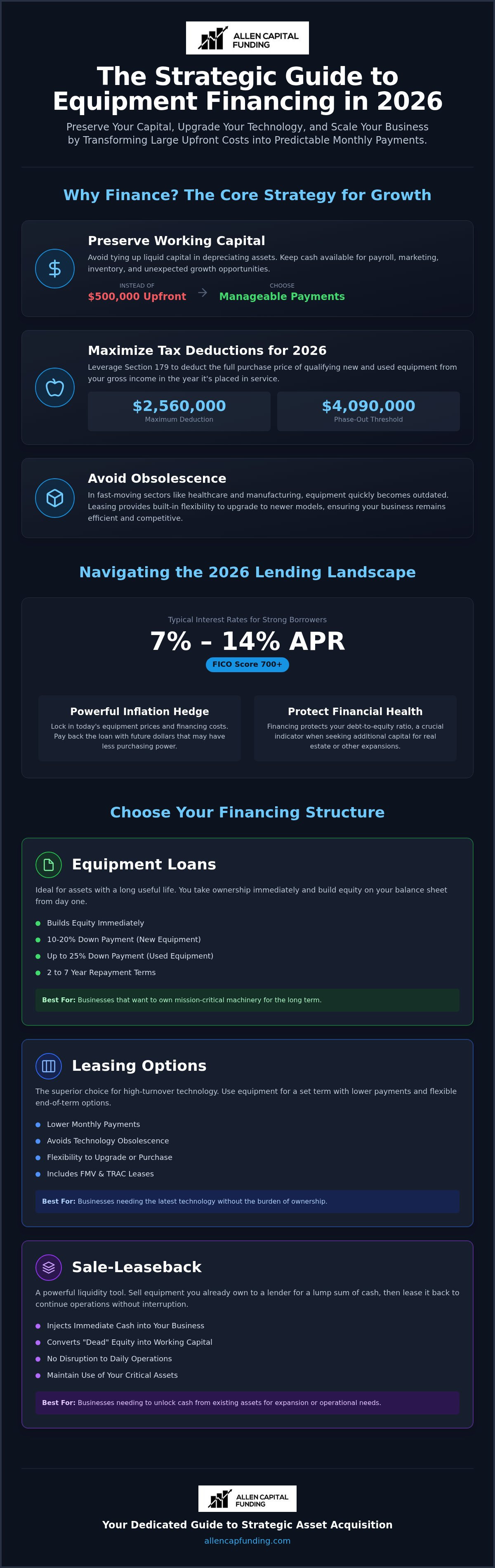
Current trends in commercial lending show that interest rates for strong borrowers with a FICO score of 700 or higher typically range between 7% and 14% APR. While rates remain a factor, equipment financing acts as a powerful hedge against inflation. You lock in today's equipment prices and financing costs. You then pay back the loan with future dollars that may have less purchasing power. Rapid technological turnover also dictates 2026 strategy. In sectors like healthcare or manufacturing, equipment can become outdated in just a few years. Financing allows you to stay current without the heavy burden of owning obsolete machinery.
Core Benefits: Cash Flow, Tax, and Technology
Preserving working capital is the most immediate advantage. Rather than spending $500,000 upfront, you might pay a few thousand dollars a month. This keeps your capital ready for operational growth. The tax advantages for this year are significant. For the 2026 tax year, the maximum Section 179 deduction is $2,560,000. This allows you to deduct the full purchase price of qualifying equipment from your gross income. This is possible as long as the total amount of equipment placed in service doesn't exceed the $4,090,000 phase-out threshold.
Depending on your goals, you might choose a finance lease or a standard loan. A lease structure is particularly effective for avoiding technology obsolescence. It provides built-in flexibility to upgrade to newer models at the end of the term. This ensures your business remains competitive in a fast-moving market. We act as your dedicated guide to help you identify which structure best serves your long-term growth.
Comparing Equipment Loans, Leases, and Sale-Leaseback Structures
Selecting the right path for equipment financing New York requires a clear understanding of your long-term operational goals. Every business has different needs regarding ownership and cash flow. Some prefer to build equity in machinery that will last a decade. Others need the flexibility to swap out technology every three years. By comparing loans, leases, and sale-leaseback options, you can align your capital strategy with your growth trajectory.
Equipment Loans: Building Equity from Day One
Standard commercial equipment loans are ideal for assets with a long useful life. You take ownership immediately, and the equipment itself secures the debt. Most lenders require a down payment of 10% to 20% for new machinery, while used equipment may require up to 25%. Repayment terms typically range from two to seven years. For businesses seeking government-backed support, SBA 7(a) loans provide a reliable framework for acquiring mission-critical assets while building long-term equity on the balance sheet.
Leasing Options: Flexibility and Lower Monthly Costs
Leasing is often the superior choice for high-turnover technology. Operating leases, such as Fair Market Value (FMV) leases, allow you to use the equipment for a set term with lower monthly payments. At the end of the lease, you can return the equipment, purchase it at its current value, or upgrade to a newer model. For logistics and transportation, Terminal Rental Adjustment Clause (TRAC) leases offer specialized structures for commercial vehicle fleets. While the total cost of ownership (TCO) might be higher over time, the ability to avoid obsolescence and preserve cash is a significant advantage.
Unlocking Liquidity via Sale-Leaseback
A sale-leaseback is a powerful liquidity tool that many business owners overlook. In this arrangement, you sell equipment you already own to a lender for a lump sum of cash. You then immediately lease that same equipment back to continue using it in your daily operations. This process converts "dead" equity into immediate working capital. It's a strategic move for businesses that need to fund a sudden expansion or bridge a seasonal gap without taking on traditional debt. A financial check-up can help you determine if your existing assets hold enough value to fuel your next stage of growth.
Strategic Asset Acquisition Across Key Industry Sectors
Success in business often depends on the tools you use every day. However, the ideal capital structure for a medical clinic looks very different from that of a machine shop. Identifying your mission-critical assets is the first step in a successful equipment financing New York strategy. These are the pieces of equipment that directly generate revenue or are essential for core operations. By focusing on these high-impact assets, you ensure your capital is working as hard as possible.
Industry-specific cycles also play a major role in how you should structure your debt. Some sectors experience seasonal peaks, while others face rapid technological shifts. A tailored approach allows you to scale from financing a single unit to coordinating full plant upgrades. This flexibility ensures your growth remains sustainable regardless of market volatility.
Healthcare and Medical Equipment Financing
Medical technology is both expensive and essential. Funding diagnostic imaging, surgical tools, and radiation therapy equipment requires a deep understanding of the healthcare landscape. Providers must navigate high upgrade costs while maintaining strict regulatory compliance. Financing these tools allows you to offer the latest care without the massive upfront price tag. It also simplifies the process of rotating out older tech as new advancements emerge.
Manufacturing and Industrial Machinery
Modernizing a production line is a complex CapEx project. Whether you're installing CNC machines or automated packaging lines, phased funding can protect your cash flow. This approach allows you to implement new technology in stages. You can verify the ROI of one machine before committing to the next. Equipment financing is a primary driver for modernizing American manufacturing. It allows smaller shops to compete with global entities by using the same advanced tools.
Transportation and Logistics Fleet Management
For logistics firms, the fleet is the lifeblood of the business. Strategic funding for heavy-duty trucking ensures you aren't sidelined by aging, unreliable vehicles. We help you incorporate maintenance and operational costs into your financing packages to keep your overhead predictable. If your growth plans involve larger facility acquisitions alongside your vehicles, consulting with SBA Loan Brokers New York: Strategic 2026 Funding Guide can provide the comprehensive support you need to scale your entire operation.
Navigating the Equipment Financing Application Process
The path to securing equipment financing New York is more methodical than most business owners realize. While the speed of funding has accelerated in 2026, the requirements for documentation remain precise. Success begins with a clear roadmap. Following a structured application process ensures you present your business as a low-risk, high-reward partner for lenders.
Step 1: Equipment Identification. Select your machinery and obtain detailed vendor quotes. These quotes must be formal and inclusive of all costs.
Step 2: Documentation Preparation. Gather your most recent two years of federal tax returns and year-to-date financial statements.
Step 3: Credit and Asset Review. Lenders will evaluate your FICO score and the specific resale value of the equipment you're purchasing.
Step 4: Offer Comparison. Review multiple funding structures to find the best balance between monthly cash flow and total interest costs.
Step 5: Closing and Funding. Sign the final lease or loan documents to trigger the wire transfer to your equipment vendor.
What Lenders Look for in a 2026 Application
Lenders prioritize stability and clarity. Most institutional partners look for at least one year in business and consistent monthly revenue of $15,000 or more. They also pay close attention to your "use of funds" description. Because the equipment serves as collateral, they need to know exactly how it will generate revenue or increase efficiency for your company. Your debt-service coverage ratio (DSCR) is the most critical metric here. A strong debt-service coverage ratio proves to the lender that your business generates enough net operating income to comfortably cover the new equipment payments.
Common Pitfalls and How to Avoid Them
One frequent mistake is requesting generic working capital when your actual goal is asset acquisition. Lenders view equipment-specific requests more favorably because the asset itself provides security. Another pitfall is submitting incomplete vendor quotes. Ensure your quotes include shipping, taxes, and installation costs to avoid funding gaps later. Before you begin the process, it's wise to assess your current standing. Schedule a financial check-up to ensure your documents are lender-ready and your strategy for equipment financing New York is sound. This proactive step removes barriers and accelerates your time to funding.
Leveraging Expert Brokerage for Optimized Capital Solutions
Securing the right capital requires more than just a good credit score; it requires access. While a single bank is limited to its own internal lending criteria, a comprehensive finance broker opens doors to a vast network of national lenders. This is the core advantage when seeking equipment financing New York. A broker doesn't just find a loan; they find the specific lender whose appetite matches your industry, equipment type, and current cash flow. This tailored approach ensures you aren't forced into a rigid structure that doesn't fit your operational reality. We act as a steady hand, helping you filter through dozens of options to identify the one that preserves your liquidity while supporting your growth.
Tailored Funding vs. One-Size-Fits-All Banking
Traditional banks often struggle with specialized equipment requests. They prefer high-volume, standardized deals and may decline applications for used machinery or niche technology. Working with a dedicated funding partner provides a significant speed advantage, as we know which lenders prioritize your specific asset class. For a deeper look at how these structures work, see our Commercial Equipment Loans: A Strategic Guide to Financing Business Assets in 2026. By bypassing the layers of bureaucracy found in one-size-fits-all banking, you can move from application to funding in a fraction of the time.
Partnering with Allen Capital Funding
Partnering with Allen Capital Funding means gaining a team invested in your strategic growth. We don't view ourselves as a distant financial entity. Instead, we act as a proactive, solution-focused ally, removing the barriers that slow down your progress. Our process is designed for maximum efficiency, starting with a streamlined online consultation that respects your time. We analyze your unique business needs and then act as the bridge to the capital you require to realize your vision. Whether you are upgrading a single machine or overhauling an entire production line, we provide the expert guidance needed for accelerated success. Your future goals shouldn't wait for slow-moving, institutional bureaucracy. Take the next step by connecting with a team that understands the urgency of business finance and the specific demands of your industry.
Accelerate Your Business Growth with Strategic Capital
Building a resilient business in 2026 requires more than just hard work; it demands a sophisticated approach to capital management. By prioritizing liquidity and leveraging the right equipment financing New York structures, you ensure your company remains agile and competitive. We've explored how choosing the right lease or loan preserves your working capital while allowing for rapid technological upgrades. These strategic decisions form the foundation of a scalable operation that isn't held back by high upfront costs or rigid banking requirements.
You don't have to navigate these complex financial decisions alone. Partnering with a proactive, solution-focused ally provides you with national access to diverse lending partners and expert guidance on tailored funding options. We act as your dedicated bridge to accelerated success, removing barriers and simplifying the path to progress. Your vision for growth deserves a partner that moves as fast as you do. Ready to secure the tools your vision demands? Book a Strategic Consultation with Allen Capital Funding today and let's build your future together. Your next stage of growth is within reach.
Frequently Asked Questions
What is the difference between equipment leasing and an equipment loan?
An equipment loan focuses on immediate ownership and building equity, while leasing provides the right to use the asset for a specific term. With a loan, the equipment appears on your balance sheet from day one. Leasing often offers lower monthly payments and more flexibility to upgrade technology that becomes obsolete quickly. Choosing between them depends on whether you value long-term ownership or the ability to preserve cash flow and rotate assets.
Can I get equipment financing with a lower credit score?
You can often secure equipment financing New York even with a lower credit score because the equipment itself serves as collateral. Lenders generally look for a minimum FICO score between 600 and 650. While higher scores typically earn better interest rates, the asset-based nature of these deals makes them more accessible than unsecured lines of credit. We specialize in identifying lenders who prioritize the value of the equipment over a perfect credit history.
How long does the equipment financing approval process typically take?
The timeline for approval depends on the total amount you need to finance. For requests under $250,000, you can often receive a decision within 24 to 72 hours. Mid-range requests between $250,000 and $1 million typically take three to seven business days. Larger transactions exceeding $1 million require a more detailed review and generally take between seven and 21 business days. Our streamlined intake process ensures your application moves forward with maximum efficiency.
What types of equipment can be financed through Allen Capital Funding?
We facilitate financing for a wide range of mission-critical assets across various industries. This includes medical diagnostic tools, CNC manufacturing machinery, and commercial transportation fleets. We also handle specialized construction equipment, IT infrastructure, and industrial food processing lines. If an asset is essential to your business operations and has a verifiable resale value, it is likely a candidate for our tailored capital solutions. We focus on securing the right funding for your specific operational needs.
Is a down payment required for business equipment financing?
Most lenders require a down payment, though 0% down options are sometimes available for very strong borrowers. Typically, you should expect to provide 10% to 20% of the equipment's cost upfront. Used machinery often requires a higher down payment, ranging from 10% to 25%. Providing a larger down payment can help you secure more favorable interest rates and lower monthly payments. We work with you to find a structure that balances your available cash with your financing goals.
How do the tax benefits of equipment financing work in 2026?
In 2026, the primary tax benefit is the Section 179 deduction, which allows you to deduct the full purchase price of qualifying equipment. The maximum deduction for the 2026 tax year is $2,560,000. This benefit begins to phase out once your total equipment purchases for the year exceed $4,090,000. These incentives are designed to encourage business investment and can significantly reduce the true cost of your equipment financing New York. You should always consult with a tax professional.
Can I finance used equipment or only new machinery?
Yes, you can finance both new and used machinery. Financing used equipment is a common strategy for businesses looking to save on the initial purchase price. Keep in mind that used equipment financing typically comes with interest rates that are one to three percentage points higher than new equipment. Lenders may also require a larger down payment, often between 15% and 25%. We help you compare the total cost of new versus used assets to find the best value.


Comments