


Equipment Financing for Bad Credit: 2026 Funding Guide
- anthonyarallen
- 1 day ago
- 11 min read
Did you know that 79% of U.S. businesses rely on financing or leasing to acquire their essential machinery? Most entrepreneurs assume that a low credit score automatically disqualifies them from securing equipment financing for bad credit to grow their operations. It's frustrating to face repeated bank rejections while your current equipment breaks down or falls behind the competition. You're likely worried about predatory interest rates or being forced to drain your cash reserves just to keep the doors open.
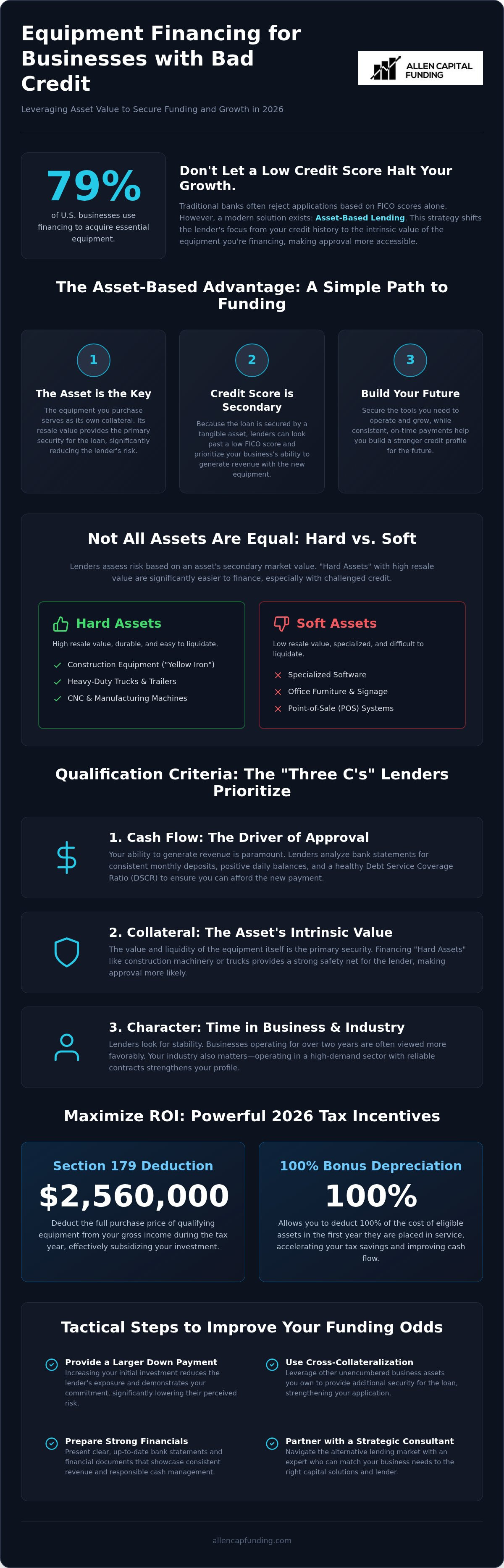
This guide shows you how to leverage asset-based lending to secure the tools you need without the massive upfront costs typical of traditional loans. We'll explain how the intrinsic value of the machinery acts as your primary security, making your credit score a secondary factor. You'll discover how to utilize the 2026 tax benefits, including the $2,560,000 Section 179 deduction and 100% bonus depreciation, to maximize your ROI. We'll outline the specific down payment requirements and terms for your FICO range so you can move forward with confidence and clarity.
Table of Contents
Why Equipment Financing for Bad Credit is a Strategic Asset Play
Securing equipment financing for bad credit is a strategic move that shifts the focus from your past financial challenges to your business's future potential. This type of funding is a self-collateralized loan. The equipment you purchase serves as the security for the debt, which significantly reduces the lender's risk. Because the asset has intrinsic value, lenders are often willing to look past a low FICO score to see the operational value of the machinery.
The success of this strategy depends heavily on the type of equipment you need. Lenders generally distinguish between "hard" and "soft" assets based on their secondary market value:
Hard Assets: These include "yellow iron" (construction equipment), CNC machines, and heavy-duty trucks. They are durable, have long lifespans, and are easy to sell if the lender needs to recover funds.
Soft Assets: Items like specialized software, business signage, or office furniture fall into this category. These have lower resale value, making them harder to finance when credit is a concern.
By focusing on hard assets, you turn your equipment into a bridge. It provides the tools to generate revenue today while helping you build a stronger credit profile through consistent, timely repayments.
The Role of Collateral in Alternative Lending
Asset-backed security is a financial arrangement where the physical equipment acts as the primary guarantee for the loan's repayment. The liquidity of the equipment, or how quickly it can be converted to cash, is the most critical factor in a lender's risk assessment. If you are buying a popular model of excavator, the lender knows they can liquidate it quickly at a predictable price. This security allows alternative lenders to offer approvals that traditional banks, which rely heavily on unsecured personal credit scores, would typically reject.
How 2026 Economic Trends Impact Asset-Based Funding
Current economic shifts in 2026 have made equipment more valuable than ever. Inflation has driven up the cost of new machinery, which in turn has bolstered the resale prices of used equipment. This environment makes Asset-based lending a resilient choice for growth. While traditional institutions are tightening their belts, alternative lenders are stepping in to fill the gap. Utilizing asset-based lending for small business helps you bypass rigid bank requirements and secure the machinery necessary to keep your operations moving forward.
Qualification Criteria: What Lenders Prioritize Over Your Credit Score
Lenders specializing in equipment financing for bad credit don't just look at a single number. They evaluate your business through the "Three C’s": Cash flow, Collateral, and Character. While traditional banks might stop at your credit score, alternative lenders prioritize your ability to generate revenue. They want to see that the equipment will pay for itself. This shift in focus allows many entrepreneurs with past credit challenges to secure the machinery they need to scale.
To verify your repayment capacity, lenders analyze your bank statements to calculate your Debt Service Coverage Ratio (DSCR). This metric compares your net operating income to your total debt obligations. A healthy DSCR suggests you can comfortably handle a new monthly payment. Depending on the loan size, you'll encounter two types of underwriting. "Application Only" programs typically cover smaller amounts and require minimal paperwork. "Full Disclosure" lending involves a deeper dive into tax returns and profit and loss statements, which often leads to more favorable terms for substantial investments.
Cash Flow: The Driver of Approval
Consistent monthly deposits often carry more weight than a 580 credit score. Lenders look for steady revenue patterns rather than sporadic spikes. They specifically monitor your "Ending Daily Balance" to ensure you aren't constantly dipping into the red. Maintaining a positive balance shows you have the liquidity to handle unexpected expenses. Lenders also consider industry risk. If your business operates in a high-demand sector with reliable contracts, your cash flow is viewed as more secure. If you're unsure how your financials look to a lender, a Financial Check-Up can help you prepare your profile before you apply.
The "Time in Business" Factor
Reaching the two-year mark in business is a significant threshold. Once you've operated for 24 months, lenders view you as a lower risk. This stability often translates to lower interest rates and better terms, even if your personal credit isn't perfect. Startups can still qualify for funding, but they face stricter requirements. Research shows that startups should expect to provide a down payment between 10% and 35%. They also typically need a minimum FICO score of 640 or higher to offset the lack of business history. Beyond equipment-specific loans, you might also explore SBA-guaranteed loan programs, which offer various paths for growth. Developing a Strategic Business Equipment Financing plan is the best way to prove to lenders that you have a clear vision for using the new asset to drive future profits.
Maximizing ROI: Section 179 and Operational Gains in 2026
Smart business owners view equipment financing for bad credit as a math problem rather than a credit hurdle. While interest rates for challenged credit can range from 12% to 30% or higher, the financial impact is often neutralized by aggressive tax incentives and increased productivity. In 2026, the tax code is exceptionally favorable for those acquiring machinery. By deducting the full cost of equipment in the first year, you effectively use tax savings to pay for your down payment or several months of installments.
The "Cost of Inaction" is a critical metric often overlooked. If your current machinery is broken or outdated, the revenue you're losing every day usually far exceeds the cost of a loan. You must calculate the total cost of ownership against the projected revenue the new asset will generate. If a new CNC machine generates $10,000 in monthly profit but costs $3,000 in financing, the net gain is $7,000. Waiting to "fix your credit" while losing that $7,000 monthly profit is a strategic error that stalls your growth.
Leveraging Tax Incentives for Cash Flow
Under Section 179, you can deduct the full purchase price of qualifying equipment from your gross income, up to a 2026 limit of $2,560,000. This deduction applies even if you haven't paid off the loan yet, providing a massive cash flow injection during your first year of ownership. Additionally, 100% bonus depreciation has been made permanent for 2026, allowing for even greater flexibility in how you write off large investments. According to the Equipment Leasing and Finance Association, these incentives are designed to encourage immediate investment in American business infrastructure. It's vital to consult with a tax professional to ensure you time your purchase to maximize these benefits before the fiscal year ends.
Calculating the "Break-Even" Point
Determining if a loan is a "good deal" requires looking past the interest rate to the asset's productivity. A high-interest loan is a tool, not a trap, if it enables you to take on larger contracts or reduce labor costs. Utilizing commercial equipment loans allows you to preserve your working capital for daily operations while the asset pays for itself through increased output. For example, many businesses find that a new piece of specialized equipment reaches its break-even point within the first 12 months. Once the equipment is paid off, that increased revenue becomes pure profit, and your successful repayment history will have significantly improved your profile for equipment financing for bad credit in the future.
Improving Your Funding Odds: Tactical Steps for Challenged Credit
Securing equipment financing for bad credit requires more than just submitting a standard application. It involves presenting a strategic case that proves your reliability despite what a credit report might suggest. One of the most effective tools in your arsenal is a "Letter of Explanation." This document allows you to provide context for past credit blemishes, such as a one-time medical emergency or a dissolved partnership. Lenders value transparency. When you explain the "why" behind the numbers, you humanize your business and build trust with the underwriter.
Before you apply, take a moment to clean up "low-hanging fruit" on your credit report. Disputing inaccuracies or paying down small collections can sometimes result in a quick score bump. If your personal profile remains a significant hurdle, consider utilizing a strong co-signer. A business partner or a family member with a score above 700 can provide the personal guarantee necessary to push a difficult deal across the finish line. This addition significantly reduces the lender's perceived risk and shows you have a support system invested in your success.
The Impact of Down Payments
Alternative lenders operate on a "skin in the game" mentality. They are much more comfortable approving equipment financing for bad credit when the borrower takes on a larger share of the initial cost. Increasing your down payment from 10% to 20% does more than just lower your monthly payment. It often moves your application into a completely different interest rate tier. If you lack the immediate cash, you might consider a short-term Working Capital loan to bridge the gap and secure a better long-term rate on your machinery.
Cross-Collateralization Strategies
If you own other business assets outright, you can use them as leverage. This process, known as cross-collateralization, involves pledging existing, paid-off machinery as additional security for your new loan. It is a powerful strategy for high-ticket specialized equipment where the lender's risk is naturally higher. While this approach puts more of your assets on the line, the reward is often a faster approval and significantly more flexible terms. It turns your current equity into a strategic tool for accelerated growth. Using your balance sheet creatively allows you to bypass credit score limitations and focus on operational expansion.
The Allen Capital Funding Advantage: Tailored Capital Solutions
Allen Capital Funding acts as a steady, reliable hand in the complex alternative finance market. When you're seeking equipment financing for bad credit, the process often feels overwhelming and exclusionary. We remove these barriers by acting as your proactive ally. Unlike direct lenders who only offer their own limited products, our broker-led model allows us to scan a diverse network of partners to find the right fit for your specific machinery and financial situation.
We start every relationship with a "Financial Check-Up" to prepare your business profile for the underwriting process. This isn't a simple review; it's a strategic deep dive to highlight your strengths, such as strong monthly revenue or high-value collateral. By positioning your application correctly from the start, we build trust with lenders and increase your chances of a fast approval. We focus on a partnership-driven model. We want to see your business succeed long after the equipment is delivered and the initial transaction is complete.
Navigating the Alternative Lending Market
The alternative lending space contains many non-bank capital pools that aren't available to the general public. Accessing these niche lenders requires a guide who understands their specific appetites for risk and asset types. We prevent "application spam," which happens when business owners apply to multiple lenders and rack up credit-damaging inquiries. Instead, we target the lenders most likely to approve your request. We translate complex financial jargon into clear, actionable strategy so you can make decisions with professional confidence.
Beyond Equipment: A Holistic Funding Strategy
Our team looks at your entire balance sheet to create a comprehensive growth plan. This might involve integrating your equipment loan with other solutions like purchase order financing to ensure you have the cash to keep your new machinery running. Successfully managing a bad credit equipment loan is a proven way to improve your business credit profile. This path eventually leads to future SBA eligibility and more traditional, lower-cost funding options. Schedule a consultation with Allen Capital Funding today to explore your options and unlock your business's full potential.
Take Decisive Action Toward Your 2026 Growth Goals
Navigating the path to equipment financing for bad credit is a strategic journey that requires the right perspective and a focus on long-term value. By prioritizing the intrinsic utility of your machinery and the strength of your business's cash flow, you can bypass the rigid barriers of traditional banking. Remember that the aggressive tax incentives available in 2026, such as the Section 179 deduction, are designed to fuel your immediate operational expansion. These benefits often provide the necessary capital to offset the costs of alternative funding, turning a potential obstacle into a powerful growth engine.
Success in this market depends on precision and expert guidance. You don't have to manage this process alone or risk your credit profile with blind applications. We provide the steady hand and customized funding options you need to align your capital with your specific business ROI. Secure your business equipment today with a custom funding strategy from Allen Capital Funding. Our national commercial lending specialists are ready to help you move from operational bottlenecks to accelerated success. Your business has the potential to thrive; it's time to equip it for the future.
Frequently Asked Questions
Can I get equipment financing with a 500 credit score?
Yes, you can often secure funding with a 500 credit score through alternative lenders who prioritize collateral over FICO scores. These lenders focus on the resale value of the machinery and your business's consistent cash flow. While an approval is possible, you should expect to provide a larger down payment, often between 35% and 40%, to offset the lender's risk. This asset-based approach allows you to acquire essential tools even with a challenged history.
What is the typical down payment for equipment financing with bad credit?
Down payments for borrowers with bad credit typically range from 20% to 40% of the equipment's purchase price. For those with a FICO score below 580, a 35% to 40% down payment is standard. If your score is between 580 and 619, you might see requirements in the 25% to 35% range. This initial investment serves as "skin in the game," which helps lenders feel more secure in providing the remaining capital.
How long does it take to get approved for an equipment loan?
Alternative lenders generally provide approval decisions within 24 to 72 hours of receiving a complete application. This speed is a significant advantage over traditional banks, which often take several weeks to process similar requests. To ensure a fast turnaround, have your last three months of bank statements and a formal equipment quote ready. A broker-led approach can further accelerate this by matching you with the right niche lender immediately.
Does equipment financing help build my business credit?
Yes, successful repayment of equipment financing for bad credit is a proven way to strengthen your business credit profile. Most alternative lenders report your payment history to major business credit bureaus. By making consistent, on-time payments, you demonstrate financial reliability to future creditors. This positive history can eventually help you qualify for lower interest rates and more traditional funding options, such as SBA loans, as your business matures.
What types of equipment can be financed with bad credit?
Lenders prefer to finance "hard assets" that retain significant resale value in the secondary market. This includes construction machinery, heavy-duty trucks, CNC machines, and medical equipment. These items are easier to finance because they serve as strong collateral. Conversely, "soft assets" like specialized software or office furniture are more difficult to secure with bad credit. Lenders view these as higher risk because they are harder to liquidate if a default occurs.
Is leasing better than financing if I have bad credit?
Leasing is often more accessible for businesses with bad credit because the leasing company retains ownership of the asset. This structure reduces the lender's risk, which can lead to easier approval terms. However, financing allows you to build equity and take advantage of the 2026 Section 179 tax deductions. The best choice depends on whether your priority is lower upfront costs or the long-term financial benefits of owning the equipment outright.
What documents do I need for a bad credit equipment loan application?
You will primarily need your last three to six months of business bank statements to prove consistent revenue. Lenders also require a formal quote for the equipment from a reputable vendor and a copy of your driver's license. For larger or more complex deals, be prepared to provide a profit and loss statement or recent tax returns. These documents help the underwriter verify your Debt Service Coverage Ratio and overall repayment capacity.
Are interest rates for bad credit equipment financing fixed or variable?
Most equipment financing for bad credit products feature fixed interest rates to provide borrowers with payment stability. Fixed rates allow you to accurately forecast your monthly expenses and calculate the equipment's ROI without worrying about market fluctuations. Loan terms for challenged credit typically range from 24 to 36 months, though longer terms are sometimes available for high-value assets. This predictability is essential for maintaining steady cash flow while you rebuild your credit profile.


Comments