


Construction Equipment Financing: The Strategic 2026 Growth Guide
- anthonyarallen
- 10 minutes ago
- 12 min read
What if your most expensive asset wasn't the excavator on the job site, but the cash sitting in your bank account? It's a common trap in this industry. You need the latest machinery to stay competitive, yet high upfront costs often force you to choose between modernizing your fleet and maintaining a healthy payroll. We understand that seasonal cash flow fluctuations and the sheer complexity of traditional bank applications make securing capital feel like an uphill battle.
This guide helps you master construction equipment financing so you can scale your operations with confidence in 2026. You'll discover how to acquire efficient equipment while preserving your working capital for day-to-day needs. We'll also show you how to maximize tax-efficient growth by leveraging the $2,560,000 Section 179 deduction limit available this year. By the end of this article, you'll have a clear roadmap for managing current interest rates, understanding new Section 1071 reporting requirements, and selecting the strategic funding solutions that align with your long-term business goals.
Table of Contents
The Strategic Impact of Equipment Financing on Construction Scalability
Construction equipment financing is a specialized asset-based capital solution that utilizes the machinery itself as collateral. This structure allows firms to scale without depleting the cash reserves necessary for daily operations. By choosing this path, you transform a massive liability into a manageable monthly expense that aligns with your project revenue. In 2026, the ability to pivot quickly is a competitive necessity. Preserving cash flow is more critical than outright ownership because it provides the agility to handle project surges or unexpected delays.
Strategic capital prevents operational bottlenecks, ensuring that your crew never stands idle because a machine is missing or broken. This foresight allows you to accept larger contracts without the fear of outgrowing your current fleet's capabilities. By choosing to finance rather than purchase outright, you maintain the capacity to bid on multiple projects simultaneously, knowing your liquidity is protected.
Preserving Working Capital for Operations
Contractors often face a "cash-poor" trap during the mobilization phase of a new project. You might have the contract, but if your liquidity is tied up in a massive down payment, you'll struggle with payroll and material costs. Using a finance lease keeps your bank balance healthy and your credit lines open for emergencies. This strategy ensures that your working capital remains available for the high-priority expenses that machinery can't cover.
Fixed-rate equipment financing acts as a strategic hedge against inflation by locking in machinery costs today and paying them off with tomorrow's potentially devalued currency. This approach provides a level of cost certainty that is impossible to achieve with outright purchases in a volatile market. It keeps your business lean and ready for growth.
Technological Advantage and Fleet Modernization
The hidden cost of downtime is a profit killer. An aging excavator might be paid off, but if it sits in the shop for a week, it's costing you more than a new monthly payment would. Modern construction equipment financing allows you to integrate GPS-guided machinery and eco-friendly engines into your fleet without a massive capital outlay. These modern assets help you win complex bids that require high-precision technology or strict environmental compliance.
Reliable machinery also reduces your liability and can help lower insurance premiums, giving you a dual advantage in a tight market. Newer machines come with advanced safety features and automated shut-offs that protect your workers and your bottom line. Modernizing your fleet isn't just about new paint; it's about maximizing every billable hour on the job site.
Evaluating Your Options: Equipment Loans vs. Leasing vs. Credit Lines
Choosing the right structure for construction equipment financing requires more than just looking at the monthly payment. You need to align your funding choice with the asset's expected useful life and your company's tax strategy. For long-term core fleet items that you plan to keep for a decade, ownership is often the priority. For specialized tech that might be obsolete in three years, usage flexibility is the smarter move. Matching the financing term to the machinery's utility ensures you aren't paying for an asset that has already stopped generating revenue.
Equipment Loans for Long-Term Assets
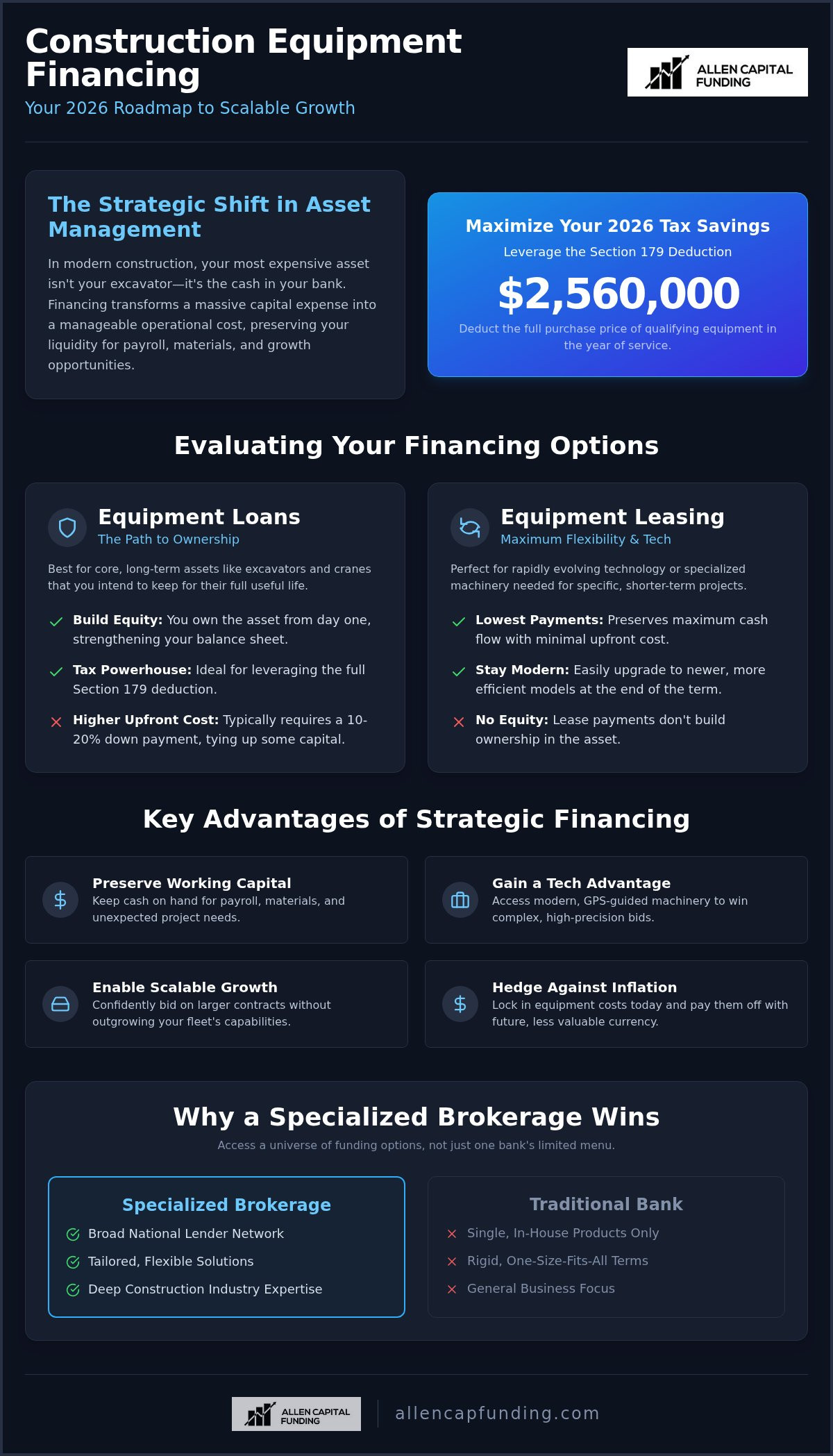
Loans are the traditional path for acquiring heavy machinery like excavators or cranes. With an equipment loan, you own the asset from day one, allowing you to build equity on your balance sheet. This is particularly effective for major fixed assets that qualify for the SBA 504 loan program, which offers competitive rates for long-term growth. Most lenders require a down payment between 10% and 20%, depending on whether the equipment is new or used. The primary advantage here is tax efficiency. For the 2026 tax year, the Section 179 deduction limit is $2,560,000, allowing you to deduct the full purchase price of qualifying equipment in the year you put it into service.
Equipment Leasing for Rapidly Evolving Tech
Leasing is often the preferred choice for high-tech tools or specialized machinery needed for short-term projects. A Fair Market Value (FMV) lease provides the lowest monthly payment and the most flexibility at the end of the term. You can choose to buy the machine, return it, or upgrade to a newer model. This prevents your fleet from becoming technologically stagnant. While you don't build equity, you do preserve cash flow and can often deduct lease payments as an operating expense. It's a strategic way to manage the "end-of-lease" transition without a massive cash outlay.
Hybrid Strategies with Asset-Based Lending
Sophisticated firms often combine multiple funding types to maximize their capital. You might use a dedicated loan for the machinery itself while utilizing a business line of credit to cover soft costs like delivery, installation, and operator training. If you already have significant equity in your existing fleet, you can explore asset-based lending for small business to unlock liquidity for expansion. This hybrid approach ensures you aren't just buying a machine; you're building a sustainable financial foundation. If you're unsure which path fits your current project load, our team can provide a financial check-up to help you weigh the pros and cons of each option.
Why a Specialized Brokerage Beats Traditional Bank Financing
Traditional banks often operate with a "one bank, one product" mindset. This rigidity creates significant barriers for construction firms that don't fit into a standard credit box. When you work with a direct lender, you're limited to their specific risk appetite and internal policies. If they don't like used equipment or your specific debt-to-income ratio, the conversation ends. A specialized brokerage acts as a dedicated guide, providing access to a broad network of national lending partners. This ensures your construction equipment financing isn't just a transaction, but a strategic fit for your balance sheet.
The value of a brokerage lies in its ability to act as a strategic facilitator. Instead of a cold, automated rejection, you get expert guidance that looks at the big picture of your business. We understand that your credit score is only one part of the story. By leveraging a diverse network, we remove the barriers that typically slow down the growth of ambitious firms. This partnership-driven approach turns a complex financial hurdle into a streamlined path toward accelerated success.
Accessing Tailored Funding Options
Lenders have specific preferences. Some want earthmoving equipment with high resale value, while others specialize in paving or specialized machinery. A brokerage identifies these nuances to find the best match for your fleet needs. We also excel at navigating credit challenges. While a traditional bank might require a FICO score of 680 or higher, we connect clients with lenders who accept scores as low as 580 for certain asset types. This flexibility is vital for firms recovering from a slow season or those just starting to scale.
Customizing repayment schedules is another area where brokers outshine banks. Construction is inherently seasonal. You shouldn't be locked into high payments during a winter freeze or a project lull. We help you find lenders who offer skip-payment options or seasonal adjustments. This ensures your capital remains fluid when you need it most, preventing the cash-flow bottlenecks discussed earlier in this guide.
Simplifying the Origination Process
The administrative burden of hunting for capital can pull you away from the job site. A brokerage offers a "single application" advantage. We take your profile and shop it to multiple national sources simultaneously. This creates competition among lenders, which often leads to more favorable terms for your business. Our team handles the expert document preparation to ensure a high probability of approval on the first attempt.
Speed and efficiency are the hallmarks of a dedicated guide. We accelerate the funding timeline by knowing exactly which lenders are currently active and which ones are most likely to approve your specific request. Instead of waiting weeks for a bank committee to meet, you get the machinery you need to start your next project. This efficiency allows you to focus on winning bids while we handle the complexities of the capital search.
The 2026 Roadmap to Securing Construction Equipment Capital
Securing construction equipment financing requires a methodical approach to ensure you don't overextend your debt capacity. The first step is a comprehensive financial check-up. You need to assess your current liquidity and ensure your cash flow can support new monthly obligations without straining your operations. Once your capacity is clear, identify your specific machinery needs and obtain detailed quotes from reputable dealers. These quotes must include all soft costs, such as delivery and warranties, to prevent surprises during the underwriting phase.
Preparation is the difference between a fast approval and a long delay. Gather your essential documentation, including the last two years of tax returns, current year-to-date P&L statements, and detailed equipment specifications. When you receive offers, evaluate them based on the total cost of capital rather than just the base interest rate. Look for hidden fees or restrictive covenants that could limit your future flexibility. Finally, work with your guide to finalize the commercial equipment loan and coordinate delivery directly with the dealer. Before you sign with the first lender that calls, schedule a financial check-up with our team to ensure your capital strategy is sound.
Qualification Criteria for Construction Firms
Lending standards in 2026 place a heavy emphasis on your debt-to-income (DTI) ratio and time in business. Established firms with at least two years of history generally access the most competitive rates, which can be as low as 6% for new machinery. If you're a startup, you can still qualify, but expect lenders to look closely at your personal credit and the resale value of the asset. One way to strengthen a weaker application is to present a robust backlog of signed contracts. Lenders view these project pipelines as guaranteed future income, which significantly reduces their perceived risk.
Maximizing Tax Savings via Section 179
For the 2026 tax year, Section 179 allows your business to deduct the entire purchase price of qualifying equipment up to $2,560,000 directly from your gross income. This immediate expensing is a powerful tool for accelerating your growth. It's distinct from bonus depreciation, which remains at 100% for 2026 for qualified property placed in service this year. While the Section 179 deduction begins to phase out once your total equipment purchases exceed $4,090,000, it remains the primary driver for tax-efficient fleet expansion. You should consult with a tax professional to integrate these deductions into your year-end strategy, ensuring you capture every available benefit before the tax window closes.
Tailored Equipment Solutions with Allen Capital Funding
At Allen Capital Funding, we believe that construction equipment financing should be a catalyst for your company's expansion, not just a line item on a ledger. Our dedicated team provides expert guidance to national construction firms, ensuring that every piece of machinery you acquire serves a specific strategic purpose. We move beyond the limitations of transactional loans by focusing on long-term scalability. This means we look at how a new fleet addition impacts your total debt capacity and your ability to win future contracts.
A unique advantage of our approach is the integration of a comprehensive financial check-up into your funding search. We don't just ask for your credit score; we analyze your balance sheet to identify untapped liquidity. This allows us to recommend the most efficient path forward, whether that involves a standard loan or a more flexible lease structure. By aligning your capital strategy with your operational goals, we help you build a resilient business that can withstand market fluctuations.
A Partnership-Driven Approach to Capital
We act as your strategic consultant throughout the entire lifecycle of your business. Our relationship doesn't end when the funds are disbursed. We maintain proactive communication and highly responsive service standards to ensure your financing continues to meet your needs as you grow. This partnership-driven model allows us to adjust your capital strategy as your project load evolves, providing a sense of security and expert support at every turn.
Building a long-term capital strategy requires a deep understanding of the construction industry's unique rhythms. We help you plan for future equipment needs well before they become urgent. This proactive stance prevents the desperate, high-cost borrowing that often occurs when a machine fails in the middle of a major project. We're here to ensure your growth remains steady and well-funded.
Unlocking Potential with Expert Guidance
Our national reach ensures that we can secure competitive terms for a diverse range of equipment types across the United States. We remove the barriers to progress by simplifying the path to capital, allowing you to focus on managing your job sites rather than drowning in paperwork. Our streamlined solutions are designed for speed, ensuring that you can mobilize quickly when a new opportunity arises.
Empowering business owners is at the core of what we do. We provide the financial tools and expert insights you need to make informed decisions with confidence. If you're ready to modernize your fleet and protect your cash flow, the next step is booking a consultation to discuss your equipment financing strategy. Let us act as the bridge between your current operations and your 2026 growth goals.
Accelerating Your Construction Growth in 2026
Strategic capital is the engine that drives a successful construction firm. You've seen how preserving liquidity allows you to bid on larger projects without the risk of becoming cash-poor during mobilization. By choosing the right structure, whether it's a loan for long-term equity or a lease for technological flexibility, you align your debt with your actual project revenue. Leveraging a national lending network through a specialized brokerage ensures you aren't limited by the rigid credit boxes of a single bank.
Expert brokerage guidance removes the administrative hurdles that often stall progress. It's about more than just getting a machine; it's about building a resilient financial foundation for the future. Our tailored asset-based solutions are designed to simplify the complex world of construction equipment financing so you can focus on the job site. The path to a modernized fleet and tax-efficient growth starts with a proactive plan.
Ready to unlock your company's full potential? Book Your Strategic Funding Consultation with Allen Capital Funding today. We're here to act as your dedicated guide, helping you bridge the gap between your current fleet and your 2026 goals. Your next big project is waiting, and we have the tools to help you reach it.
Frequently Asked Questions
What are the typical interest rates for construction equipment financing in 2026?
Interest rates for construction equipment financing currently range from 6% to 22% APR. For new machinery, strong borrowers with FICO scores above 700 can expect rates between 6% and 14%. Used equipment rates generally sit between 8% and 18% depending on the asset's age. Industry-specialist lenders often provide middle-ground pricing of 8% to 12% for specific machinery types like excavators or pavers.
Can I get equipment financing with a low credit score?
Yes, you can secure funding with a FICO score as low as 580 through specialized asset-based lenders. While traditional banks often require a 680 score, many online lenders and brokerages prioritize the machinery's value over your personal credit history. You might face a higher down payment requirement, often between 15% and 25%, to offset the lender's risk. This allows growing firms to acquire essential tools while rebuilding their credit.
Is it better to lease or buy heavy construction equipment?
The choice depends on the asset's useful life and your current tax strategy. Buying is generally better for long-life machinery where you want to build equity and utilize the full $2,560,000 Section 179 deduction. Leasing is the strategic choice for high-tech tools that become obsolete quickly. It preserves your cash flow with lower monthly payments and offers the flexibility to upgrade your fleet at the end of the term.
How does Section 179 work for construction equipment in 2026?
For the 2026 tax year, Section 179 allows you to deduct up to $2,560,000 of the purchase price for qualifying equipment placed in service. This deduction begins to phase out once your total equipment acquisitions exceed $4,090,000. Additionally, 100% bonus depreciation remains available for qualified property. This combination provides a powerful incentive to modernize your fleet while significantly reducing your overall tax liability for the year.
What documents are required for an equipment loan application?
Most lenders require two years of business tax returns, current year-to-date profit and loss statements, and three months of bank statements. You'll also need a detailed dealer quote or invoice that includes equipment specifications and serial numbers. Providing a robust project backlog or signed contracts can also strengthen your application. Having these documents ready accelerates the underwriting process and improves your chances of a fast approval.
Can I finance used construction equipment through a broker?
You can absolutely finance used machinery through a specialized brokerage. Brokers have access to lenders who focus on appraisal-based valuations for older equipment. Since major brands like Caterpillar or John Deere can retain 40% to 60% of their value after five years, lenders view them as reliable collateral. This is a cost-effective way to expand your fleet without the premium price tag associated with brand-new models.
How long does the equipment funding process take?
The funding process through a brokerage typically takes between 24 hours and five business days. This is significantly faster than traditional banks, which often take several weeks to move through committee reviews. Once you submit a complete application with all required documentation, an initial approval can often be secured within hours. This speed is essential for contractors who need to mobilize quickly for a new project.
What is the difference between a secured and unsecured equipment loan?
A secured loan uses the equipment itself as collateral, which often results in lower interest rates and longer repayment terms. If you default, the lender can repossess the machinery to recover their investment. An unsecured loan doesn't require specific collateral but typically carries higher interest rates and stricter credit requirements. Most construction equipment financing is structured as a secured agreement because the asset's resale value provides security for the lender.


Comments