


Construction Invoice Factoring: A Strategic Guide to Scaling Your Firm in 2026
- anthonyarallen
- Aug 6
- 12 min read
Updated: 7 days ago
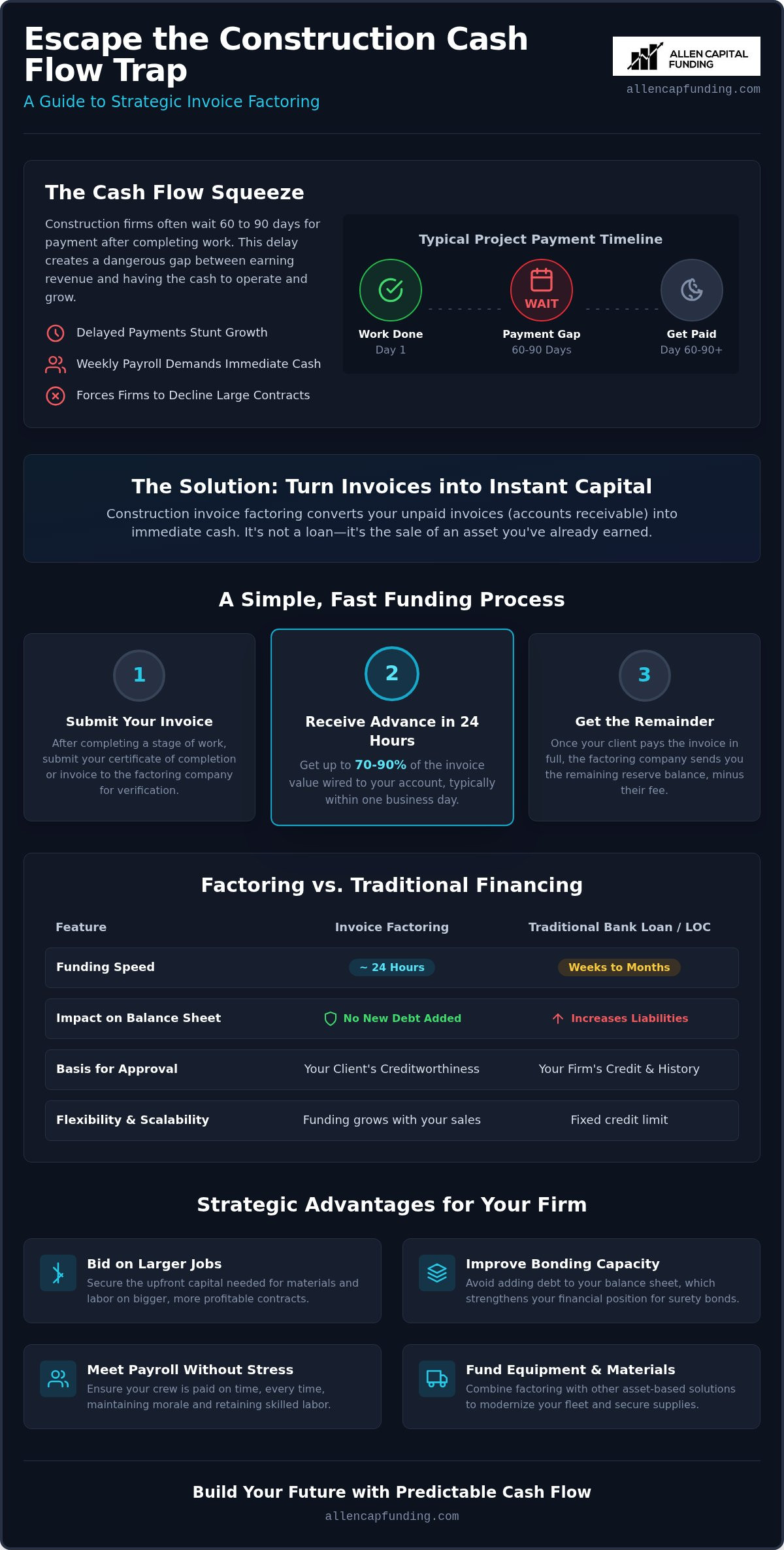
Why are you waiting 60 days to get paid for work you've already finished while your crew expects a paycheck every Friday? This cash flow trap forces many talented firms to turn down large contracts because they simply can't afford the upfront material costs. Strategic construction invoice factoring offers a way out by turning your accounts receivable into immediate working capital. It's not a loan, and it doesn't add debt to your balance sheet. Instead, it's a professional tool that unlocks the value of your earned revenue to keep your projects moving forward.
We understand the pressure of managing high weekly payroll and the demands of 2026's infrastructure projects. You deserve a financial partner that provides predictable cash flow so you can focus on bidding on larger jobs. This guide will show you exactly how to secure the funding needed for materials and labor without the typical wait times. We'll explore the strategic advantages of factoring and provide a clear roadmap for scaling your firm with confidence.
Table of Contents
The Construction Cash Flow Trap: Why Traditional Loans Often Fall Short
How Construction Invoice Factoring Works: A 2026 Strategic Overview
Factoring vs. Line of Credit: Choosing the Right Capital Stack
Qualifying for Construction Factoring: What Lenders Look For
Maximizing Growth with Allen Capital Funding’s Tailored Solutions
The Construction Cash Flow Trap: Why Traditional Loans Often Fall Short
Construction is a high-stakes industry where timing is everything. You've likely felt the squeeze of the 60-to-90-day pay cycle. While your subcontractors and material suppliers might wait, your crew needs their checks every Friday. This gap creates a unique vulnerability. If you don't have enough liquid cash, you can't take on the next big project even if your balance sheet looks healthy on paper. Steady growth depends on having cash ready when the job starts, not months after it's finished.
Many firms fall into a "Debt Trap" by taking out high-interest short-term loans to cover these gaps. This is a dangerous path. These loans increase your liabilities and can significantly damage your bonding capacity. When a surety company sees too much debt, they're less likely to back you for the larger, more lucrative contracts. If you are currently struggling to secure bonding due to credit challenges, click here to explore specialized surety solutions. Choosing construction invoice factoring allows you to access capital without adding new debt to your balance sheet, protecting your ability to bid on future work.
The Mismatch Between Payroll and Paychecks
Managing a workforce requires immediate cash. Skilled crews are in high demand; they won't stick around if payments are inconsistent. If you're eyeing federal or state infrastructure projects, the stakes are even higher. These contracts often require massive upfront investments in iron, steel, and labor before the first milestone payment arrives. Without reliable working capital, you're sidelined from the very growth opportunities that could transform your business. Inconsistent cash flow doesn't just stop you from bidding; it risks the stability of the team you've worked hard to build.
Why Traditional Banks Struggle with Construction
Traditional lenders aren't built for the construction world. They're often spooked by "pay-when-paid" clauses, which mean your payment depends on the general contractor getting paid first. Banks see this as an uncontrollable risk. Additionally, construction liens and retainage, where a portion of your payment is held back until the end of the project, complicate their credit assessments. Most banks want collateral they can easily touch, and they don't always see an unpaid invoice as a secure asset.
This is where asset-based lending for small business provides a more flexible alternative. Instead of focusing solely on your debt-to-equity ratio, these structures look at the value of your work. Understanding How Construction Invoice Factoring Works is the first step in realizing that your unpaid invoices are assets, not just numbers on a report. By using construction invoice factoring, you bypass the rigid requirements of traditional banks and turn your receivables into immediate capital. This approach treats your earned revenue as a tool for expansion rather than a waiting game.
How Construction Invoice Factoring Works: A 2026 Strategic Overview
Construction invoice factoring is the sale of an asset, your earned receivables, rather than a traditional loan that increases your company's liabilities. This distinction is critical for your balance sheet. When you factor an invoice, you aren't borrowing money; you're simply accelerating the payment of money you've already earned. In the fast-paced 2026 market, this liquidity allows you to move from one project milestone to the next without waiting on a general contractor's slow accounting department.
The speed of this process is its greatest advantage. Most specialized factors operate on a 24-hour funding cycle. Once your invoice is approved and verified, the funds are typically wired to your account within one business day. You also have a choice between recourse and non-recourse factoring. Recourse factoring requires your firm to buy back the invoice if your client fails to pay. Non-recourse factoring offers more protection, as the factoring company assumes the credit risk of your client's non-payment due to insolvency.
The Factoring Process for Contractors
The journey from invoice to cash is straightforward and designed for speed. It begins with the verification of the work performed. The factor reviews your client's creditworthiness rather than just your own financial history. After verification, you receive an initial advance, which typically ranges from 70% to 90% of the invoice's face value. The factoring company then manages the collection process from your client. Once the client pays the full amount, the factor releases the remaining "reserve" to you, minus a small service fee for the convenience of immediate capital. If you're ready to see how this fits your specific project needs, consider exploring tailored funding options with a strategic partner.
Handling Progress Billing and Retainage
Construction is unique because projects are rarely paid in one lump sum. Most firms use progress billing, where you invoice for portions of work as they are completed. Specialized construction invoice factoring providers understand this. They focus on "certificates of completion" and the "Schedule of Values" to verify that the work invoiced matches the progress on the ground. This level of detail ensures that you get paid for every stage of the build.
Retainage presents another layer of complexity. General contractors often hold back 5% to 10% of every payment until the entire project is finished. While most factoring companies exclude retainage from the initial advance, they track it as part of your overall receivable. Accurate documentation is vital here. By providing clear proof of completion and maintaining an updated Schedule of Values, you ensure that the construction invoice factoring process remains smooth and that your cash flow stays predictable even when retainage is involved.
Factoring vs. Line of Credit: Choosing the Right Capital Stack
Choosing between a bank line and factoring isn't always an "either-or" decision. For many growing firms, the most effective strategy involves using both in a complementary capital stack. A business line of credit is often ideal for managing predictable, recurring overhead like office rent, insurance premiums, or software subscriptions. However, relying solely on a bank line to fund project-specific costs can be risky. Bank lines come with fixed limits that don't care how many new contracts you've just signed. If your growth outpaces your credit limit, you're stuck.
Construction invoice factoring solves this by scaling automatically. Because it's an asset sale rather than a loan, your funding limit is tied directly to your accounts receivable. As you win larger projects and issue more invoices, your available capital increases. This allows you to bypass the weeks or months of underwriting required for a bank limit increase. While a bank focuses on your balance sheet's debt-to-equity ratio, a factor focuses on the creditworthiness of your clients. This shift in perspective provides immediate liquidity that keeps your projects moving forward without adding traditional debt.
The Flexibility Advantage
Traditional loans often come with restrictive covenants that can limit your operational freedom. These might include requirements to maintain certain financial ratios or restrictions on taking on other forms of financing. Factoring preserves your independence. Since you're selling an asset, you aren't burdened by these long-term commitments. This is particularly valuable for firms with "challenged" credit profiles or those that have experienced rapid growth that hasn't yet been reflected in their tax returns. Your ability to secure capital is based on the work you've already performed, not just your past financial statements.
Cost vs. Value Analysis
Analyzing the cost of capital requires looking beyond the discount rate. Industry standards for factoring fees typically range from 1.5% to 3.5% per 30 days. While this may seem higher than a bank's interest rate, the ROI often justifies the expense. Consider the value of taking on a new $1M project today rather than waiting three months for cash to clear. Additionally, having immediate cash allows you to negotiate early-payment discounts with material suppliers, which can often offset the factoring fee entirely. Over time, the consistent cash flow provided by construction invoice factoring helps you pay your own bills on time, which naturally strengthens your firm's credit score and bonding capacity for future infrastructure projects.
Qualifying for Construction Factoring: What Lenders Look For
The underwriting process for construction invoice factoring is refreshingly different from a bank's rigid scrutiny. Instead of obsessing over your debt-to-equity ratio or years in business, the factor evaluates the credit strength of your customers. This shift in perspective makes it an ideal solution for firms working with government entities or large general contractors. Even startups can qualify if they have creditworthy commercial or government clients. By focusing on the quality of your receivables, you can secure the capital needed to maintain momentum on high-value projects without waiting for your own balance sheet to catch up.
Lenders require specific documentation to verify the legitimacy of your invoices. You'll need to provide an updated accounts receivable aging report, the original contract, and signed proof of completion. These elements confirm that the work has been performed according to the agreed-upon standards. Working with a small business loan broker ensures you match with a lender who understands the nuances of construction milestones and retainage. This preparation reduces the time spent in underwriting and gets you funded faster.
Preparing Your Accounts Receivable
Before applying, clean up your AR aging report. Lenders prefer "clean" invoices that aren't disputed or significantly past due. It's also vital to distinguish between factorable invoices, typically those from commercial or government clients, and residential invoices. Residential work is often excluded from construction invoice factoring due to different legal protections and payment risks. You should also be prepared for the "Notice of Assignment." This is a standard professional notification sent to your client, informing them that payments should be directed to the factoring company. Most large contractors view this as a sign of a well-managed, liquid firm rather than a sign of financial distress.
The Broker Advantage
Using a broker provides access to a national network of specialized construction factors rather than just a single direct lender. This is a critical advantage because different lenders have different appetites for specific trades. Whether you specialize in electrical, HVAC, or site prep, Allen Capital Funding identifies the partner best suited for your niche. We negotiate lower discount rates on your behalf by leveraging our relationships and volume. This tailored approach ensures you aren't forced into a one-size-fits-all contract that doesn't account for your specific project timelines. If you're ready to see which options fit your firm, speak with an expert today to begin the process.
Maximizing Growth with Allen Capital Funding’s Tailored Solutions
Allen Capital Funding doesn't just provide immediate cash; we provide a strategic path to expansion. While construction invoice factoring is a powerful tool for stabilizing your daily operations, scaling a firm in 2026 requires a more comprehensive approach. You need a modern fleet and the right technology to stay competitive on large-scale infrastructure projects. By integrating commercial equipment loans, you can upgrade your heavy machinery and modernize your fleet while preserving your liquid capital for payroll and materials.
Our brokerage model provides a distinct advantage over single-source lenders. We don't rely on rigid, automated algorithms that often miss the nuances of complex construction contracts. Instead, our expert team acts as a dedicated guide, connecting you with specialized lenders across all 50 states. This national reach ensures that whether you're managing a data center build or a federal highway project, you have access to tailored funding structures that fit your specific trade and project timeline.
A Holistic Financial Check-Up
We begin every partnership with a comprehensive review of your firm’s financial health. This financial check-up looks at your total capital needs, from weekly labor costs to long-term asset acquisition. We identify the specific liquidity gaps that hinder your ability to bid on larger contracts. By analyzing your 2026 project pipeline, we develop a roadmap for accelerated success. This strategic planning ensures you have the right mix of working capital and equipment financing to handle growth without taking on unnecessary debt.
Strategic Partnership for 2026
Choosing Allen Capital Funding means gaining a proactive, solution-focused ally. We use industry-standard terminology and institutional credibility to simplify the complex world of business finance. Our goal is to remove the administrative barriers that slow your firm's progress. We act as a bridge between your current state and your future goals, providing the expert guidance needed to navigate the 2026 lending landscape with confidence. We handle the lender negotiations so you can focus on delivering high-quality projects on time and under budget.
Don't let a slow payment cycle dictate the speed of your growth. Secure your firm's future by booking a strategic consultation for your 2026 project pipeline. We'll help you evaluate your current receivables and prepare your firm for the demands of the modern construction market. Together, we can unlock the potential of your earned revenue and move your business forward.
Take Command of Your Cash Flow for 2026
Scaling a construction firm requires more than just winning bids; it requires the liquidity to execute them without compromise. By utilizing construction invoice factoring, you move away from the restrictive debt trap of traditional loans and embrace a scalable funding model that grows alongside your contract volume. You've seen how this strategic tool eliminates the 60-day pay cycle while protecting your bonding capacity for the most lucrative infrastructure projects on the horizon.
Allen Capital Funding provides the expert guidance you need to navigate the complex lending landscape. Our national brokerage network ensures you receive competitive rates and tailored funding options that match your specific trade. We're committed to your accelerated success through streamlined capital solutions that remove the barriers to your progress. It's time to stop waiting for payments and start building your future.
Ready to unlock the value of your receivables? Book Your Strategic Funding Consultation with Allen Capital Funding Today. We're here to act as your dedicated guide and ensure your firm is positioned for sustainable growth in the years ahead.
Frequently Asked Questions
Does my client need to know I am using construction invoice factoring?
Yes, your client will be notified through a standard professional document known as a Notice of Assignment. This notification informs the general contractor or government agency to direct payments to the factoring company’s lockbox. Most large-scale entities and government departments view this as a routine business practice. It signals that your firm is well-managed and has the liquid capital necessary to fulfill contract obligations without delays or material shortages.
Can I factor invoices for government construction projects?
You can absolutely factor invoices for government projects at the local, state, and federal levels. Many specialized lenders prefer these receivables because the credit risk associated with government entities is exceptionally low. Since these projects often involve strict timelines and high upfront costs for materials, construction invoice factoring provides the immediate cash flow needed to keep your crew working while you wait for the public sector's longer payment cycles.
What is the typical cost or "discount rate" for construction factoring?
The cost is structured as a discount rate that depends on your client's creditworthiness, your monthly volume, and the length of the payment cycle. While every agreement is tailored to the specific firm, the expense is often offset by the strategic advantages of having cash on hand. Immediate liquidity allows you to negotiate early-payment discounts with suppliers and avoid the high costs of taking on new debt to cover payroll.
Will factoring my invoices hurt my ability to get a bank loan later?
Factoring typically strengthens your financial position rather than hurting your future borrowing potential. Because it's an asset sale and not a loan, it doesn't add debt to your balance sheet or negatively impact your debt-to-equity ratio. By using the capital to pay your own suppliers and taxes on time, you build a stronger credit profile. This makes your firm more attractive to traditional banks and bonding companies when you're ready for expansion.
Is there a minimum monthly volume required for construction factoring?
Minimum volume requirements vary significantly depending on the specific lender's criteria. Some factors focus on smaller subcontractors with modest needs, while others specialize in high-volume firms managing multi-million dollar infrastructure projects. As a national broker, we identify the partner that matches your current scale and growth trajectory. This ensures you don't pay for capacity you don't need or get turned away because your firm is in an early stage.
How does factoring handle retainage and pay-when-paid clauses?
Factors generally advance funds based on the net invoice amount, which excludes the 5% or 10% retainage held by the general contractor. The retainage is released to you once the factor receives the final payment from your client. Regarding pay-when-paid clauses, specialized construction factors mitigate this risk by focusing on the credit strength of the ultimate payor. They understand these industry-specific billing nuances and build funding structures that account for them.
Can I factor invoices if my construction company is a startup?
Startups are eligible for construction invoice factoring because the approval process focuses on your client’s credit rather than your business history. If you've secured a contract with a reputable general contractor or a government entity, you can access working capital immediately. This is a vital tool for new firms that don't yet have the three years of tax returns often required by banks. It allows you to bid on larger projects from day one.
What happens if my client fails to pay the factored invoice?
The outcome depends on whether your agreement is recourse or non-recourse. In a recourse agreement, your firm is responsible for buying back the invoice if the client fails to pay within a set timeframe. With non-recourse factoring, the factoring company assumes the credit risk if the client becomes insolvent. We help you evaluate which structure provides the right level of protection for your specific project pipeline and client portfolio.


Comments