


Commercial Real Estate Loans NY: The 2026 Strategic Checklist for Business Growth
- anthonyarallen
- Jul 31
- 12 min read
Updated: Aug 15
Why is it that some New York entrepreneurs scale their portfolios effortlessly while others get stuck in a loop of endless paperwork and bank rejections? You've likely felt the sting of high entry costs and the confusion of meeting strict requirements for commercial real estate loans NY. It's exhausting to watch a prime property slip away because a traditional lender took months to review a standard file. You know that timing is everything in this city, yet the barrier to entry often feels higher than ever.
You deserve a clear path to growth that doesn't involve guesswork. This guide provides a strategic checklist designed to accelerate your funding success in a market where the Prime Rate sits at 6.75%. We'll show you how to master the complexities of the current property landscape, including the 2026 LLC Transparency Act. You'll learn to choose between high-leverage SBA 504 options and conventional mortgages. By using a Financial Check-Up, you can remove barriers and build a bridge between your current operations and your future expansion goals.
Table of Contents
Commercial Real Estate Loans NY: Understanding the 2026 Market Dynamics
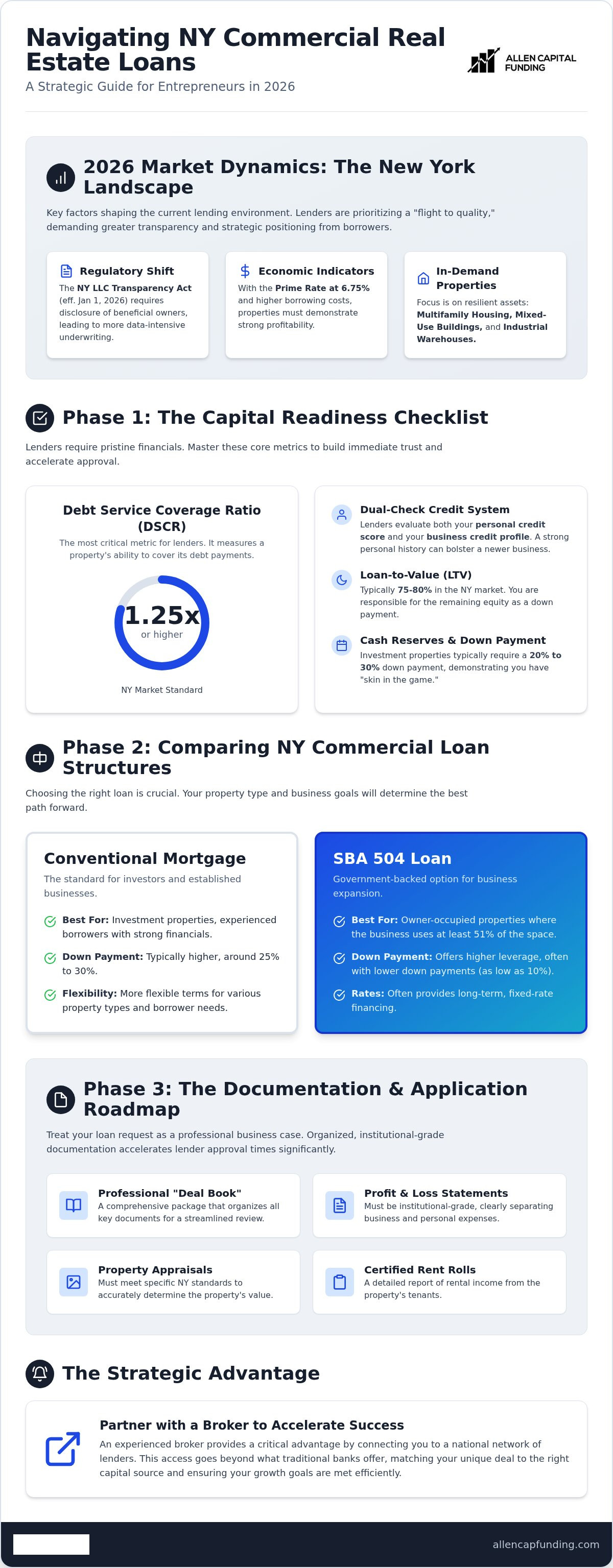
Defining commercial real estate loans NY requires looking beyond simple interest rates. These are asset-backed financing solutions specifically for properties located within the five boroughs and the surrounding regions. In 2026, the market isn't just about property valuations; it's about transparency and precision. The NY LLC Transparency Act, effective January 1, 2026, now requires most LLCs to disclose beneficial owners. This regulatory shift makes the underwriting process more data-intensive than in previous years. Lenders are no longer just looking at the building; they're looking at the people and the strategy behind the entity.
Liquidity has shifted significantly. While capital remains available, lenders are prioritizing a "flight to quality." This means a more rigorous approach is required to secure funding. Most activity in the current market centers on three pillars: multifamily housing, mixed-use buildings, and industrial warehouses. Mixed-use properties are particularly resilient in 2026. They allow owners to spread risk across residential and commercial income streams. There's also a vital distinction between owner-occupied and investment property strategies. If your business occupies at least 51% of the space, you can often access higher leverage. Investors, by contrast, typically face stricter down payment requirements of 25% to 30%.
The Shift Toward Strategic Capital Readiness
Traditional banks have tightened their criteria, often leaving a gap for small to mid-sized firms. They're looking for pristine records and exceptional cash flow. This is why a Business Financial Check-Up is the essential foundation for any move. It helps you identify weaknesses before a lender does. With the Prime Rate at 6.75% and the 10-year Treasury yield near 4.38%, your debt service coverage must be bulletproof. Higher borrowing costs mean your property must work harder to prove its profitability during the application phase.
NY Market Specifics: What Makes This Region Unique?
NY is a distinct ecosystem. Urban corridors in Brooklyn and Queens are seeing a surge in the "multifamily with commercial space" trend. Lenders favor these because the residential units provide a safety net if a retail tenant vacates. Gaining a deep level of understanding commercial mortgages helps you navigate these local nuances. You'll need to account for specific NY environmental reports and appraisal standards that don't apply elsewhere. The NY commercial landscape is a high-barrier, high-reward environment for prepared investors who treat their loan request as a professional business case.
Phase 1: The Essential Capital Readiness Checklist
Securing commercial real estate loans NY in 2026 requires more than just a good property. It starts with a dual-check credit system. Lenders evaluate your personal credit score alongside your business's credit profile. If you're a small business owner, your personal financial health acts as a guarantee for the entity. A strong score suggests you're a reliable partner, while a thin business credit file can be bolstered by a history of on-time payments to vendors. You can't afford to have surprises on your report when you're competing for prime NY acreage.
The Debt Service Coverage Ratio (DSCR) is the most critical metric in any lender's toolkit. It measures your property's ability to cover its debt obligations with its net operating income. In the competitive NY market, aiming for a DSCR of 1.25x or higher is the standard. This means for every dollar of debt, the property generates $1.25 in income. If your ratio is lower, lenders might perceive the deal as too risky given current interest rate volatility. They want to see that the property can stand on its own financial feet.
You'll also need significant cash reserves to move forward. NY deals typically require a 20% to 30% down payment for investment properties. However, owner-occupied buildings might qualify for higher leverage through programs like the SBA 504 loan program. Lenders want to see that you have enough "skin in the game" to weather potential vacancies or unexpected repairs without defaulting. Your Profit and Loss (P&L) statements must be institutional-grade. This isn't the time for messy bookkeeping. Your financials should clearly separate personal expenses from business operations to build immediate trust with underwriters.
Financial Metrics You Must Master
Loan-to-Value (LTV) ratios in New York generally hover between 75% and 80%. This means you're responsible for the remaining equity upfront. Small business owners should also monitor their Debt-to-Income (DTI) ratio. While DSCR focuses on the property, DTI looks at your total monthly debt payments against your gross monthly income. Keeping this ratio low ensures you have the personal bandwidth to support the business if market conditions shift. If you're unsure where you stand, a Strategic 2026 Funding Guide can help you align your documentation with lender expectations.
The Pre-Application Financial Audit
Three Years of Records: Gather the last three years of federal tax returns and current year-to-date (YTD) financial statements.
Expense Analysis: Identify and explain any non-recurring expenses. If you had a one-time legal fee or a major equipment repair, document it clearly so lenders don't mistake it for an ongoing operational cost.
Preparation is the bridge to your next acquisition. If you're ready to see how these metrics apply to your specific goals, you can speak with a specialist to ensure your deal is bank-ready before you submit your first application.
Phase 2: Comparing NY Commercial Loan Structures
Selecting the right capital structure is as important as finding the right property. In the current market, commercial real estate loans NY are typically divided into four primary categories, each serving a different stage of business growth. Conventional commercial mortgages remain the preferred choice for established firms with high equity. These loans offer rates between 5.60% and 8.92% as of July 2026. While they require a larger down payment, usually 20% to 35%, they provide the stability of long-term financing without the specific usage restrictions found in government-backed programs.
For owner-occupants, the SBA 504 loan remains the gold standard. It allows you to acquire property with as little as 10% down, preserving your working capital for operations. The fixed-rate portion of these loans currently sits between 5.50% and 6.50%, making it a highly attractive hedge against inflation. If you need a more versatile solution that combines real estate with working capital or equipment, the SBA 7(a) program is a strong alternative. While rates are higher, ranging from 9.50% to 11.75%, the flexibility it offers can be vital for rapidly scaling businesses. For those pursuing "fix-and-flip" or value-add opportunities, bridge loans provide short-term liquidity with rates between 9.00% and 14.00%, acting as a temporary solution until the property is stabilized and ready for permanent financing.
SBA vs. Conventional: The Tactical Comparison
Choosing between these paths depends on your liquidity and the property's intended use. SBA loans offer lower down payments but come with strict owner-occupancy requirements. Conventional loans provide more freedom for investment-only plays but demand more "skin in the game" upfront. Research from a New York Fed staff report on the CRE market indicates that bank lending behavior is increasingly sensitive to property type and borrower track record. You can ensure your commercial real estate financing is optimized by matching the loan's term to your specific asset-based structure and projected cash flow.
Specialized NY Property Solutions
Lending requirements shift when dealing with specialized NY assets. For multifamily properties with five or more units, lenders prioritize the Debt Service Coverage Ratio and the building's historical occupancy. Mixed-use financing is more nuanced. Lenders carefully evaluate the ratio of residential to retail income. They often prefer properties where the residential component covers at least 50% of the debt service. The best loan for your project is the one that aligns perfectly with your five-year exit or hold strategy. Whether you're looking for a permanent home for your business or a high-yield investment, the structure must support your long-term vision rather than just your immediate need for capital.
Phase 3: The Documentation & Application Roadmap
Presentation matters as much as the numbers when applying for commercial real estate loans NY. Think of your application as a professional "Deal Book." This organized collection of data serves as your business case to an underwriter. In a market where traditional banks are increasingly selective; a clear, transparent package builds immediate trust. You aren't just asking for capital; you're inviting a lender to partner in your growth. This requires a level of transparency that moves beyond basic bank statements and reaches into the strategic core of your business.
The Executive Summary is the heart of your Deal Book. It should outline the property's value, your management experience, and how the acquisition fits into your 2026 growth strategy. If you're acquiring a mixed-use building in Brooklyn or Queens, explain the upside clearly. Are you planning to increase residential rents? Will you occupy the commercial space for your own expanding operations? Selling the "why" helps the underwriter see the vision behind the numbers. When you provide a Personal Financial Statement (PFS) alongside these plans, you demonstrate that you have the personal stability to back the business's goals.
The Property Due Diligence Checklist
Due diligence in New York is notoriously complex. Your rent roll analysis must account for local rent regulations and historical occupancy rates. For industrial or manufacturing sites, a Phase I Environmental Site Assessment is a non-negotiable requirement. Lenders also scrutinize lease agreements to judge tenant quality and the remaining terms. If your primary commercial tenant has a lease expiring in six months, you'll need a plan to address that vacancy risk before the lender flags it as a deal-breaker.
The Borrower Information Package
Step 1: Gather your Articles of Incorporation and Operating Agreements to prove the legal standing of your entity.
Step 2: Compile at least three years of personal and business tax returns to demonstrate long-term financial stability.
Step 3: For owner-occupied deals, draft a professional Business Plan that highlights your revenue projections and market positioning.
Step 4: Prepare Business Equipment Finance records if the property includes specialized operational assets like industrial machinery or medical equipment.
Detailed records show you're a proactive operator who respects the lender's time and understands the stakes. Ready to move your application to the front of the line? Connect with our team to start building your professional Deal Book today.
Partnering for Accelerated Success: The Allen Capital Advantage
Customization is the antidote to the "one-size-fits-all" products that often fail NY small businesses. Traditional institutions might offer a standard mortgage, but they rarely account for the rapid growth cycles of local entrepreneurs. We focus on strategic facilitation, removing the bottlenecks that typically slow down traditional banking approvals. Our goal is to accelerate your success by identifying the specific loan product that aligns with your 2026 objectives. This partnership-driven approach moves beyond a simple transaction; we act as a bridge between your current state and your long-term expansion goals.
Expert Guidance in a Complex Market
Our team acts as your dedicated guide and advocate throughout the complex underwriting process. We don't just submit your "Deal Book"; we manage the conversation with lenders to ensure they see the full value of your business case. By leveraging multiple funding types, including Asset-Based Lending, we can often unlock liquidity that traditional mortgages overlook. This flexibility is essential for navigating the high-barrier environment of NY real estate, especially as transparency regulations like the LLC Transparency Act become more demanding.
Your Next Steps to Funding
Securing capital quickly requires a proactive strategy rather than a reactive one. Your first step should be a thorough assessment of your current position. We recommend performing a Financial Check-Up to identify any potential hurdles before you begin the application process. This ensures that when we approach our lender network, your file is bulletproof and ready for immediate review. When you're ready to scale, we're here to provide the expert guidance you need to navigate market shifts and liquidity changes.
Don't let market complexities slow your momentum. Take the next step toward your property goals by scheduling a session with our specialists. Book Your Strategic NY Real Estate Consultation today and start your journey toward accelerated success.
Accelerating Your 2026 Property Goals
Mastering the New York property market requires more than just capital; it demands a "Readiness First" strategy. By prioritizing institutional-grade documentation and mastering your property's Debt Service Coverage Ratio, you position your business as a preferred borrower. Whether you're targeting a mixed-use building in a suburban corridor or a multifamily asset in the city, the right structure is the one that protects your cash flow while fueling expansion. You've seen how the 2026 regulatory shifts and liquidity changes have raised the bar for everyone in the region.
You don't have to face these complexities alone. Allen Capital Funding provides expert guidance from SBA loan specialists who combine a national lending network with deep local insight. We specialize in tailored solutions for diverse assets, ensuring you aren't limited by the narrow criteria of a single bank. Our team is ready to act as your dedicated guide for commercial real estate loans NY, removing barriers so you can focus on your next phase of growth. Your future property is within reach when you have a steady hand to help you navigate the path forward.
Secure Your Strategic NY Funding Solution Today
Frequently Asked Questions
What is the typical down payment for a commercial real estate loan in NY?
Lenders typically require a 25% to 30% down payment for most property types in the New York market. However, if you're pursuing owner-occupied real estate through an SBA program, you may qualify for financing with as little as 10% down. Multifamily investor properties often fall in the middle, generally requiring 20% to 25% equity upfront to secure competitive terms and interest rates.
Can I get a commercial real estate loan in NY with bad credit?
Securing commercial real estate loans NY with sub-prime credit is challenging but possible through non-traditional lenders. While major banks prioritize scores above 700, private lenders and bridge loan providers focus more on the property's value and cash flow potential. Working with a broker allows you to access specialized funding sources that look beyond a single credit score to the overall strength of your business case.
How long does the approval process take for NY commercial property?
The approval timeline for New York commercial property generally ranges from 45 to 90 days. Traditional bank processes often lean toward the longer end due to rigorous underwriting and appraisal requirements. You can accelerate this timeline by having a completed "Deal Book" ready at the start. Strategic facilitation through a broker often trims weeks off the process by matching your file with lenders known for speed.
What is the difference between SBA 7(a) and SBA 504 for real estate?
The SBA 504 program is designed specifically for major fixed assets like real estate, offering long-term fixed rates and 10% down payments. By contrast, the SBA 7(a) loan is more versatile, allowing you to combine property acquisition with working capital or equipment needs. While the 7(a) offers more flexibility, it often carries variable interest rates that are higher than the fixed-rate portion of a 504 structure.
Do NY lenders require a personal guarantee on commercial loans?
Yes, most lenders in the NY region require a personal guarantee from any individual owning 20% or more of the business. This remains a standard practice even when the loan is held by an LLC. The guarantee provides the lender with additional security, ensuring that the principals are fully committed to the property's success. Some non-recourse options exist for institutional deals, but they're rare for small business loans.
What is a Debt Service Coverage Ratio (DSCR) and why does it matter in NY?
The Debt Service Coverage Ratio (DSCR) measures a property's ability to pay its monthly debt using its own income. In New York, lenders typically look for a ratio of 1.25x or higher to account for the high cost of operations and taxes. This metric is vital because it proves the property can remain profitable even if interest rates shift or a tenant vacancy occurs during the loan term.
Are there prepayment penalties on NY commercial real estate loans?
Prepayment penalties are common in the New York commercial market, particularly with conventional mortgages and CMBS loans. These are often structured as yield maintenance or step-down penalties that decrease over time. SBA 504 loans, for example, have a specific 10-year declining prepayment schedule. It's essential to review these terms early if you plan to refinance or sell the property within the first few years of the term.
How do interest rates for commercial properties in NY compare to residential rates?
Commercial interest rates are typically higher than residential rates because the risk profile of a business asset is considered greater than a primary home. While residential loans track the 30-year bond market, commercial real estate loans NY are usually pegged to shorter-term Treasury yields or the Prime Rate. As of July 2026, conventional commercial mortgage rates range from 5.60% to 8.92%, depending on the property type and credit.


Comments