


Bad Credit Working Capital Loans: A Strategic Guide to Funding Your Business in 2026
- anthonyarallen
- 4 hours ago
- 12 min read
A low credit score isn't a permanent barrier to your company's success; it's a strategic opportunity to rebuild your business on a more resilient foundation. You've likely experienced the frustration of traditional lender rejections or the constant anxiety of managing cash flow gaps while your margins feel squeezed. It's exhausting to feel like your growth is stalled just because of a number on a report. We understand that your business is more than a credit score, and finding the right bad credit working capital loans can be the catalyst for a total recovery.
In this guide, you'll discover how to secure the liquidity you need to keep operations running smoothly without falling into a debt trap. We'll show you how to use these funds as a bridge to stabilize your finances and eventually qualify for more traditional rates. You will learn the specifics of different funding structures, from factoring to SBA microloans, and gain a clear path toward long-term bankability. This article provides the roadmap you need to turn immediate capital into a tool for accelerated success.
Table of Contents
Understanding Bad Credit Working Capital Loans in 2026
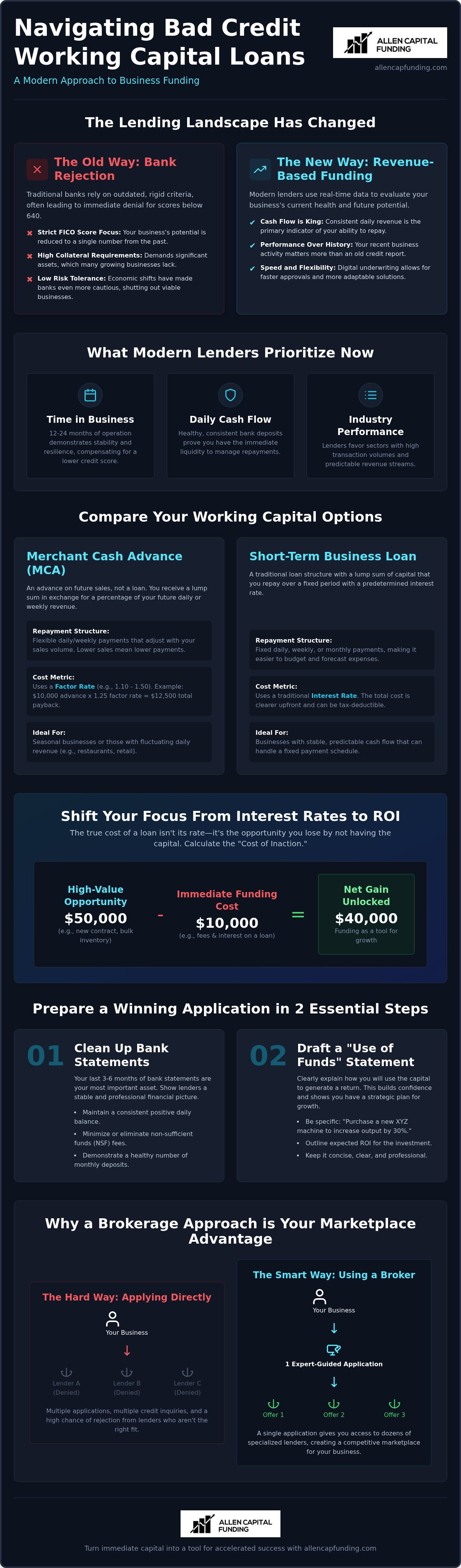
Bad credit working capital loans are specialized financing solutions designed for businesses with personal or business credit scores below traditional bank thresholds, typically falling under 620. In 2026, these are no longer viewed as simple emergency funds. Instead, they act as a strategic tool to manage working capital, which is the functional difference between your company's current assets and its current liabilities. This capital ensures you can bridge the gap between accounts payable and accounts receivable while maintaining smooth operations.
The lending environment has evolved significantly over the last few years. Advanced digital underwriting now allows alternative lenders to analyze real-time data rather than relying solely on historical credit reports. This shift means that businesses with challenged credit can access immediate liquidity based on their current performance and future potential rather than past setbacks.
Why Traditional Banks Say No
Traditional banks often operate with a "one size fits all" approach that prioritizes rigid FICO scores and collateral over the actual health of your business. Recent economic shifts have led many institutional lenders to tighten their risk tolerance. This makes it difficult for anyone with a credit score below 640 to qualify for a standard commercial loan. However, a rejection from a big bank isn't the end of your funding journey. It's simply a sign that you need a more flexible, performance-based solution that recognizes your business's true value.
The Shift to Revenue-Based Underwriting
Modern alternative lenders prioritize consistent bank deposits and annual revenue as the primary indicators of your ability to repay. If your business shows steady cash flow, your credit score becomes a secondary concern. This performance-based approach recognize that a business's health is better measured by its current activity than by a single score.
Several factors now carry more weight during the underwriting process:
Time in Business: Demonstrating stability over 12 to 24 months acts as a powerful compensating factor for a low score.
Industry Performance: Lenders often favor specific sectors with high transaction volumes, regardless of the owner's credit history.
Daily Cash Flow: Maintaining a healthy volume of daily or weekly deposits proves you have the immediate liquidity to manage repayment.
By focusing on these metrics, bad credit working capital loans provide a path to progress. They allow you to maintain operations and invest in growth opportunities that would otherwise be lost. This model creates a bridge, enabling you to secure funding now and eventually move toward the higher credit tiers required for traditional financing.
Types of Working Capital Solutions for Challenged Credit
Navigating the market for bad credit working capital loans requires a clear understanding of the instruments available. You aren't limited to a single product; instead, you can choose from several structures based on your cash flow and collateral. Each option serves a specific purpose, whether you need to bridge a seasonal gap or purchase inventory for a large contract.
Merchant Cash Advances (MCA) allow you to access capital by selling a portion of your future sales. This isn't technically a loan but a purchase of future revenue. Short-term business loans, conversely, provide a lump sum with a fixed repayment schedule. For businesses with significant accounts receivable, invoice factoring turns outstanding bills into immediate cash. Finally, asset-based lending uses your balance sheet strength, such as inventory or equipment, to secure the funds you need.
Merchant Cash Advances vs. Term Loans
Choosing between an MCA and a term loan often depends on your revenue consistency. MCAs typically use daily or weekly draws from your sales. This structure is ideal for seasonal businesses because the repayment amount fluctuates with your volume. If sales slow down, your payment decreases accordingly. This flexibility helps maintain your operational margins during leaner months.
Term loans generally offer monthly installments. While these provide more predictability for your budget, they require a fixed amount regardless of your monthly performance. You should also note the difference in cost. MCAs use factor rates, often ranging from 1.10 to 1.50, while term loans use interest rates. If you have slightly better credit, you might even explore the SBA 7(a) loan program for longer-term working capital needs.
Leveraging Assets to Bypass Credit Issues
When your personal credit score is low, your business assets can serve as a powerful safety net for lenders. Utilizing asset-based lending for small business allows you to unlock liquidity tied up in inventory or heavy machinery. This shifts the lender's focus from your credit history to the tangible value of your collateral. It's a pragmatic way to secure larger sums that might otherwise be unavailable.
For B2B companies, factoring is a game-changer. Instead of waiting 30 or 60 days for a client to pay, you sell the invoice to a factor for a small fee and receive most of the cash immediately. This effectively removes the credit risk from the equation because the factor relies on your customer's credit rather than yours. If you're looking for a partner to help you identify the right path, you can explore customized funding options tailored to your business health.
Evaluating the Real Cost: ROI vs. Interest Rates
Focusing exclusively on interest rates is a common mistake when evaluating bad credit working capital loans. While the cost of borrowing is higher for challenged credit, the true metric of success is the Return on Investment (ROI) the capital generates. You must look at the Total Cost of Capital rather than just the APR. This perspective allows you to see financing as a strategic bridge to your next stage of growth. While the average U.S. FICO score reached 715 in 2025 according to Lendio, many successful entrepreneurs operate below this threshold by focusing on cash flow efficiency.
The Cost of Inaction framework is the most effective way to make a decision about bad credit working capital loans. Ask yourself: what is the price of missing this opportunity? If a supplier offers a 15% discount on bulk inventory that you can't afford today, that missed discount is a real expense. If you can't fulfill a large contract because you lack the materials, the lost profit is the cost of not having capital. When the profit generated by the loan exceeds the cost of the loan, the financing pays for itself.
When Bad Credit Loans Make Strategic Sense
There are specific scenarios where high-cost capital becomes a high-value asset. Fulfilling large purchase orders that would otherwise be lost is a prime example. It protects your reputation and secures revenue that would have gone to a competitor. Strategic borrowing also makes sense when you need to bridge seasonal lulls to keep key staff employed or invest in marketing that has a proven, high conversion rate. Learning how to get a business loan with bad credit requires you to present these strategic use cases clearly to potential lenders. Performing a Financial Check-Up can help you identify exactly where these capital injections will have the most impact.
The Mathematical Reality of Short-Term Funding
You don't need an accounting degree to verify if a loan makes sense. Calculate your net gain by subtracting the total loan fees from the projected profit of the funded project; if the remaining margin is positive, the capital is working for you. Shorter repayment terms, while requiring higher daily or weekly payments, are often safer for businesses with challenged credit. They prevent you from being tied to long-term debt as your business health improves. A factor rate is a multiplier of the total loan amount used to determine the total repayment figure. To avoid a debt spiral, never borrow more than your current cash flow can comfortably support and prioritize loans with a clear path to repayment.
How to Qualify: Preparing a Winning Application
Qualifying for bad credit working capital loans requires more than just meeting a minimum score. It's about demonstrating your business's ability to manage debt through clear data and professional presentation. While traditional banks often stop at your FICO score, alternative lenders look for stability and growth potential. To secure the best terms, you should follow a methodical approach to your application that highlights your current operational health.
Alternative lenders in 2026 typically accept FICO scores starting in the 500s. However, your probability of approval increases significantly when you present a clean financial history. Follow these five steps to strengthen your case:
Step 1: Clean up your business bank statements by eliminating non-sufficient funds (NSF) fees for at least 90 days.
Step 2: Prepare a clear "Use of Funds" statement that explains exactly how the capital will generate revenue.
Step 3: Highlight consistent revenue growth or stability over the last six months to prove your repayment capacity.
Step 4: Resolve any outstanding tax liens or legal judgements, as these are major red flags for even the most flexible lenders.
Step 5: Partner with a consultant to match your specific profile with the right lender in a national network.
The Importance of Bank Statement Hygiene
Lenders prioritize your average daily balance over your total monthly revenue. They want to see that you maintain enough liquidity to handle daily or weekly repayments without straining your operations. Frequent NSF fees or ending the day with a negative balance will lead to instant rejection. To present your cash flow in the best light, try to consolidate small deposits and keep a buffer in your account. This discipline signals that you are a responsible borrower who can handle the structure of alternative financing.
Building a Path to Better Credit
Successful business owners use alternative funding as a bridge rather than a destination. Timely payments on your working capital loan can help improve your business credit profile over time. As your score increases and your cash flow stabilizes, you can begin the transition from short-term loans to a more flexible business line of credit. Set a 12-month goal to reach "bankable" status. This involves maintaining clean books and steadily improving your debt-to-income ratio. If you're ready to start this transition, you can apply for a financial check-up to evaluate your current funding readiness.
Why a Brokerage Approach is the Best Solution for Bad Credit
Searching for bad credit working capital loans on your own can feel like an uphill battle. You might face repeated rejections from traditional banks that don't look past your credit score. This is where the "Marketplace Advantage" changes the game. By working with a broker, you gain access to dozens of specialized lenders through a single application. This process protects your credit from excessive hard inquiries while significantly increasing your chances of finding a partner who values your business's current performance over its past challenges.
Expert guidance is essential when navigating the complexities of alternative finance. Many lenders use different structures, such as factor rates or daily draws, which can be difficult to compare without professional help. A broker helps you navigate the fine print so you don't get trapped by terms that could damage your cash flow. We provide customized solutions by matching your specific industry needs with niche lenders who understand your unique revenue cycles. This tailored approach ensures the funding you receive acts as a catalyst for growth rather than a financial burden.
Allen Capital Funding: Your Strategic Capital Partner
We leverage our extensive national lender network to find the most competitive terms available in 2026. Our approach isn't transactional; it's partnership-driven. For owners with challenged credit, our Financial Check-Up serves as a critical first step. This evaluation helps us understand your business health and identify the right products, whether you need equipment financing or purchase order funding. Our team acts as an advocate for the business owner, not the lender. This means we're committed to finding the solution that best fits your strategic goals and operational capacity.
Securing Your Business Future Today
The speed of alternative funding is vital for seizing immediate opportunities, but it works best when combined with professional brokerage oversight. We don't just help you secure capital today; we help you plan for tomorrow. As you utilize your working capital and stabilize your operations, you'll be in a better position to graduate to more traditional products. This might include preparing for larger milestones like SBA loans as your credit profile strengthens and your bankability improves. Book a consultation with Allen Capital Funding to explore your options and take the first step toward a more secure financial future.
Position Your Business for Future Success
A low credit score doesn't have to define your company's future. Modern lending in 2026 focuses on your actual performance and cash flow rather than just a historical number. By prioritizing ROI over the headline interest rate and preparing a professional application, you can turn bad credit working capital loans into a powerful bridge for growth. Whether you choose invoice factoring or a short-term loan, the goal is to stabilize your operations today while building a path toward long-term bankability tomorrow.
Allen Capital Funding acts as your dedicated guide through this complex landscape. We provide expert guidance through our extensive national lender network and offer tailored solutions for every credit profile. Our comprehensive financial check-ups ensure you understand your current standing and your best path forward. Don't let a temporary setback stall your progress any longer. Secure your strategic working capital with Allen Capital Funding today. We're ready to help you unlock your business's full potential and achieve accelerated success.
Frequently Asked Questions
Can I get a business loan with a 500 credit score?
Yes, you can secure funding with a 500 credit score by looking toward alternative lenders who prioritize revenue over FICO scores. These lenders focus on your recent bank statements and daily sales volume rather than historical credit events. You'll likely qualify for revenue-based financing or asset-based options where the strength of your collateral or cash flow offsets the risk of a lower personal credit score. This allows you to access capital while working on credit improvement.
What is the difference between a working capital loan and a merchant cash advance?
The primary difference lies in the repayment structure and legal classification. A working capital loan provides a lump sum with fixed monthly or weekly installments over a set term. A merchant cash advance is a purchase of your future credit card or bank sales. In an advance, the repayment amount fluctuates based on your daily revenue volume. This makes advances a more flexible option for seasonal businesses that experience significant shifts in monthly income.
How fast can I get funding for a bad credit working capital loan?
You can typically receive funding within 24 to 72 hours of approval. Modern digital underwriting in 2026 has streamlined the process, allowing lenders to verify your bank data almost instantly. While traditional bank loans can take weeks or months, bad credit working capital loans are designed for speed. Once you submit your recent bank statements and complete the verification steps, the capital is often wired to your business account by the next business day.
Do bad credit business loans require collateral?
Collateral requirements depend entirely on the specific product you choose. Many revenue-based options, like merchant cash advances, are unsecured and don't require physical assets. However, asset-based lending and equipment financing use the items you're purchasing or owning as security for the loan. Using collateral can often help you secure better terms or higher funding amounts when your credit score is challenged. It provides the lender with an additional layer of security for the capital provided.
Will applying for a bad credit loan hurt my credit score further?
Most alternative lenders use a soft pull for the initial pre-qualification phase, which doesn't affect your score. A hard pull usually occurs only when you move to the final contract stage. By working with a broker, you avoid the damage of multiple hard inquiries from applying to several lenders individually. This strategic approach protects your credit profile while you explore the various options available for bad credit working capital loans and other specialized funding products.
What are the typical repayment terms for businesses with low credit?
Repayment terms for businesses with lower credit are generally shorter than traditional bank loans. You can expect terms ranging from 3 to 18 months, depending on the lender's risk assessment and your specific industry. Payments are often structured on a daily or weekly basis to align with your business's cash flow. While these shorter cycles require more frequent attention, they help you pay down the debt quickly and move toward qualifying for more traditional, long-term financing products.
How much revenue does my business need to qualify for working capital?
Most alternative lenders require a minimum monthly revenue of $10,000 to $15,000 to qualify for funding. They look for consistency in your bank deposits over the last three to six months rather than just a high annual total. If your business shows steady transaction volume, you're more likely to be approved regardless of your credit score. Lenders use this data to calculate a safe repayment amount that won't compromise your daily operational needs or growth plans.
Can I use a working capital loan to pay off existing high-interest debt?
Yes, using a working capital loan for debt consolidation is a common strategy to improve monthly margins. By paying off several high-interest daily-payment positions with a single, more manageable loan, you can significantly reduce your daily cash outflow. This maneuver stabilizes your cash flow and provides the breathing room necessary to reinvest in growth. Always ensure the new loan's total cost of capital is lower than the aggregate cost of the debts you're replacing to ensure a positive ROI.


Comments