


2026 Commercial Real Estate Loan Requirements Guide
- anthonyarallen
- 11 minutes ago
- 12 min read
A perfect credit score won't save a commercial real estate deal if the property's narrative fails to match the lender's specific risk appetite. You likely already know that securing capital for a major acquisition feels less like a simple transaction and more like a high-stakes interrogation. It's frustrating to face opaque approval criteria or the constant fear that a single missing document could kill your closing. Understanding the specific commercial real estate loan requirements for 2026 is the difference between a stalled project and a successful funding. At Allen Capital Funding, we believe transparency is the key to strategic growth.
This guide empowers you to master the complexities of commercial lending with a comprehensive breakdown of current standards. You'll learn exactly what lenders require to approve your property financing, from debt service coverage ratios to liquidity benchmarks. We'll provide a clear checklist of required documents and explain how modern lenders calculate property value in a shifting market. Whether you're weighing SBA options or conventional bank structures, this breakdown ensures you have the tools to secure the right capital. A thorough financial check-up is your first step toward total confidence at the closing table.
Table of Contents
The 5 C’s of Commercial Lending: Understanding Lenders’ Core Requirements
Financial and Personal Documentation: Building a Winning Borrower Profile
Evaluating the Asset: Property-Specific Requirements and DSCR
Comparing Loan Programs: SBA 504 vs. Conventional Financing Requirements
Navigating the Process: How to Choose the Right Lending Partner for Your Strategy
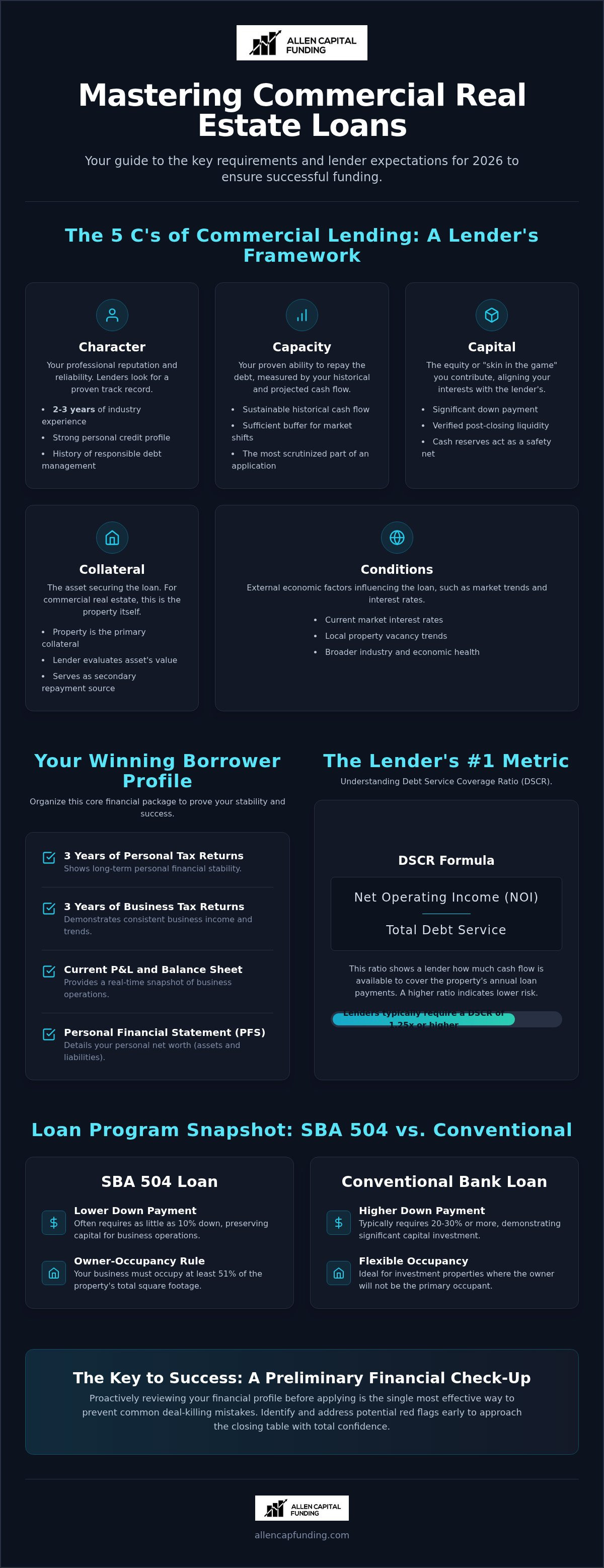
The 5 C’s of Commercial Lending: Understanding Lenders’ Core Requirements
Securing a loan is about more than just filling out forms. It's about presenting a narrative of stability and growth. Lenders use a specific framework called the 5 C's to evaluate every application. Understanding these commercial real estate loan requirements helps you position your business as a low-risk, high-reward partner. By mastering these pillars, you move from guessing at approval to commanding the terms of your financing.
Character and Capacity: The Human Element of Risk
Character represents your professional reputation and reliability. Lenders generally require a minimum of 2-3 years of industry experience to prove you can handle the operational demands of the property. Your personal credit profile also impacts the final terms. A history of timely payments and responsible debt management builds the trust necessary for large-scale funding. We recommend a Financial Check-Up as your first step. This proactive review identifies potential red flags in your history before they become deal-breakers.
Capacity measures your ability to repay the debt. Lenders look at your historical cash flow and project how your business will perform under financial stress. They want to see that you have enough breathing room to cover loan payments even during seasonal downturns or unexpected market shifts. This is often the most scrutinized part of the application because it proves the loan is sustainable for the long term.
Capital and Conditions: External Factors of Approval
Capital is the amount of equity you contribute to the deal. Lenders want to see significant "skin in the game" to ensure your interests align with theirs. Beyond the down payment, you'll need verified liquidity. This means having a specific cash reserve available after the closing costs are paid. These reserves act as a safety net for the property's initial operating period. Collateral serves as the secondary repayment source. In a Commercial mortgage, the property itself is the primary collateral. The lender evaluates the asset's value and condition to ensure it can cover the loan balance if the business defaults.
Economic environment plays a decisive role in your approval. Conditions are the external economic factors that influence lender appetite in 2026. Market interest rates, local vacancy trends, and broader industry health dictate the "Conditions" of your loan offer. When interest rates are high, lenders may tighten their commercial real estate loan requirements to compensate for the increased risk of default. Staying informed about these external shifts allows you to time your application for the best possible results.
Financial and Personal Documentation: Building a Winning Borrower Profile
Lenders view your documentation as the physical proof of the narrative you've built. To meet 2026 commercial real estate loan requirements, you must present a cohesive and transparent financial history. This process is about more than just handing over a stack of papers. It's about organizing your data to show a clear trajectory of success and stability.
Lenders typically require three years of both personal and business tax returns. This duration allows them to spot long-term trends and ensure your income is consistent. They also need current-year interim financials, specifically a Profit and Loss (P&L) statement and a Balance Sheet. These documents bridge the gap between your last tax filing and today's operational reality. Your Personal Financial Statement (PFS) documents every asset and liability you own personally, providing a snapshot of your net worth. Complementing this is the business debt schedule, which details current business liabilities, including original loan amounts and maturity dates.
The Core Financial Package
Organizing your P&L properly can significantly impact your approval odds. Focus on identifying "add-backs" like depreciation, interest, or one-time expenses that don't reflect ongoing operations. Highlighting these can increase your qualifying income and help you meet strict commercial real estate loan requirements. Working with a professional SBA loan specialist ensures these nuances are captured correctly. This is especially critical when applying for SBA 504 loans, where specific eligibility rules apply to business debt and income structures.
Legal and Organizational Documents
You'll need to provide your Articles of Incorporation, Operating Agreements, and EIN confirmation. These prove your business is a legal entity in good standing. Additionally, a "Use of Proceeds" letter is essential. This letter justifies your capital request by detailing exactly how the funds will be spent. If you have "Challenged Credit," don't hide it. Provide a letter of explanation and supporting documentation to offer context for past issues. This transparency builds the character-based trust discussed in the previous section. Taking the time to audit your files now prevents delays during the underwriting process. If you're unsure where to start, a quick financial check-up can clarify your next steps.
Evaluating the Asset: Property-Specific Requirements and DSCR
While your borrower profile is the foundation, the property serves as the ultimate security for the lender. In 2026, lenders have increased their scrutiny of the physical asset to mitigate risks in a fluctuating market. Meeting commercial real estate loan requirements now requires a deep dive into the property's income-generating potential and physical viability. This ensures that the asset can support the debt even if your business faces temporary headwinds.
Mastering the DSCR Calculation
The Debt Service Coverage Ratio (DSCR) is the most critical metric in any commercial deal. DSCR is the ratio of available cash flow to debt obligations. In the current economic climate, the 2026 standard for most lenders has shifted to a requirement of 1.25x to 1.35x DSCR. This means the property must generate 25% to 35% more net income than the annual debt service. To find your Net Operating Income (NOI), you must subtract all operating expenses from your gross income, excluding the mortgage payment itself. Lenders often adjust your reported NOI to include vacancy factors or management fees, even if you manage the property yourself.
Appraisals and Environmental Due Diligence
Third-party reports act as the gatekeepers of your transaction. A commercial appraisal differs significantly from a residential one because it focuses heavily on the "Income Approach" valuation. This method determines value based on the property's ability to produce revenue rather than just comparable sales. Following Best Practices When Buying Commercial Real Estate involves ordering these reports early to avoid last-minute surprises. For industrial or manufacturing sites, a Phase I Environmental Site Assessment is almost always mandatory to check for soil or groundwater contamination.
Location-specific hurdles also play a role. For example, commercial real estate loans NY often involve more complex zoning reviews and environmental regulations compared to other regions. If you are financing a multi-tenant building, you will also need to provide detailed rent rolls and current lease agreements. Lenders review these to ensure the tenant mix is stable and the lease terms align with the loan duration. Understanding these commercial real estate loan requirements from the start prevents your deal from stalling during the final stages of underwriting.
Comparing Loan Programs: SBA 504 vs. Conventional Financing Requirements
Choosing the right loan structure is a strategic decision that affects your cash flow for decades. The commercial real estate loan requirements for an SBA 504 loan differ significantly from those of a conventional bank loan. While one offers lower entry costs, the other provides greater speed and fewer operational restrictions. Understanding these trade-offs allows you to align your financing with your specific growth trajectory and current liquidity.
The SBA 504 Advantage for Owner-Users
The SBA 504 program is the gold standard for business owners who plan to occupy their property. It requires a down payment of only 10%, which is significantly lower than most other commercial options. However, strict occupancy rules apply. You must occupy at least 51% of the property for existing buildings or 60% for new construction. This program also allows you to include "Project Costs" such as heavy equipment and necessary renovations in the total loan amount. If your business cash flow is strong, lenders may even approve the deal with lower credit scores than a conventional bank would accept. For a deeper look at these specifics, consult our SBA Loan Brokers New York guide.
When Conventional Financing Wins
Conventional financing is often the better choice for investment properties that don't meet SBA occupancy rules. These loans generally require a higher down payment, typically between 20% and 30%. The primary benefit here is speed and flexibility. Conventional commercial real estate loan requirements often involve less administrative red tape, leading to faster funding timelines for competitive markets. If you're facing a down payment gap, you can use asset-based lending for small business to unlock liquidity from your existing inventory or equipment. This strategy helps you secure the property without draining your operational reserves.
Interest rate structures and penalties also vary between these programs. SBA 504 loans offer long-term fixed rates, providing a steady hand against future market volatility. Conventional loans often feature floating rates that adjust based on the prime rate. Prepayment penalties are another key differentiator. SBA loans follow a strict 10-year declining scale, while conventional terms are often more negotiable. This flexibility is vital if you plan to sell or refinance the asset early in the loan term. Ready to find your ideal fit? Reach out for a tailored funding strategy today and let us help you navigate these choices with confidence.
Navigating the Process: How to Choose the Right Lending Partner for Your Strategy
Selecting the right financing partner is the final hurdle in your journey toward property ownership. While you now understand the technical commercial real estate loan requirements, the entity across the desk determines how those rules are applied to your specific situation. Transparency is the most valuable currency in 2026 lending. You need a partner who doesn't just check boxes but acts as a strategic consultant for your long term goals. Choosing between a direct bank and a commercial broker depends entirely on the complexity of your deal and your current financial profile.
Evaluating Lender Fit
Not all lenders are created equal. Some national institutions favor large scale industrial projects, while local small business lending banks might be more flexible with retail or mixed use properties. You must ask if a lender specializes in your specific property type before committing to the process. A lender that offers strategic business equipment financing alongside real estate provides a more holistic view of your business's health. This integrated approach often leads to smoother approvals because the lender understands your entire balance sheet, not just the real estate asset.
The Broker Advantage in Meeting Requirements
Many borrowers mistakenly believe that going direct to a bank is the most efficient path. However, a commercial broker acts as a dedicated guide through the maze of commercial real estate loan requirements. We "scrub" your financials to ensure you meet the 5 C's before a lender ever sees your file. This "pre-flight" check is vital. It prevents the damage of a rejected application on your credit history. If your tax returns don't perfectly reflect your business's strength, a broker can connect you with "non-bank" lenders. These entities often have requirements based on the property's intrinsic value rather than strictly on historical tax data.
Packaging a deal is an art form. Lenders receive hundreds of applications, and your narrative must stand out immediately. A well prepared package shows the lender that you are a professional who understands risk mitigation. This builds the character-based trust we established earlier in this guide. Your next step is to map your real estate goals to the right capital source. Booking a consultation for a preliminary review ensures your application is positioned for accelerated success from day one.
Secure Your Commercial Property Goals
Securing a permanent home for your business is a landmark achievement that requires more than just a strong balance sheet. You've learned that mastering the commercial real estate loan requirements involves balancing the human element of risk with the hard data of property performance. Whether you're managing the strict occupancy rules of an SBA 504 program or seeking the rapid closing timelines of conventional financing; success depends on how you package your narrative. A proactive approach to documentation and a clear understanding of your Debt Service Coverage Ratio will set you apart in a competitive 2026 market.
Allen Capital Funding acts as your dedicated guide; removing barriers and simplifying the path to progress. We provide access to a national network of specialized commercial lenders and offer deep expertise in both SBA and conventional loan packaging. Our team is specifically equipped to support businesses with complex financial profiles that need more than a one-size-fits-all solution. Ready to secure your property? Book a strategic consultation with Allen Capital Funding today. Your future growth starts with a partner who values your vision as much as your collateral. We're here to turn your property goals into an accelerated success story.
Frequently Asked Questions
What is the minimum credit score for a commercial real estate loan?
Most lenders look for a minimum personal credit score of 660 to 680 to meet standard commercial real estate loan requirements. While some specialized programs accept lower scores, they often require higher down payments or additional collateral to offset the risk. Your score serves as a primary indicator of financial responsibility. Lenders use this number to determine your interest rate and the overall strength of your borrower profile during the initial screening phase.
How much down payment is required for a commercial property in 2026?
Down payment requirements vary based on the loan program you select. For an SBA 504 loan, you can often secure financing with as little as 10% down. Conventional bank loans typically require a larger equity injection, ranging from 20% to 30% of the purchase price. These higher margins provide a safety buffer for the lender against market fluctuations. Having liquid reserves available after the down payment is also a critical factor for final approval.
Can I get a commercial loan if my business is less than two years old?
Yes, it's possible, though more challenging. Lenders prefer a two to three year operational history to verify consistent cash flow. If your business is newer, you must provide a detailed business plan, strong personal financial statements, and proof of significant industry experience. Some lenders may require additional collateral or a larger down payment to mitigate the risk associated with a startup or early stage company during the underwriting process.
What is a Debt Service Coverage Ratio (DSCR) and why is it important?
The Debt Service Coverage Ratio (DSCR) measures your property's ability to cover its annual debt obligations using its net operating income. It's the primary metric used to assess repayment capacity. A ratio of 1.25x means the property generates 25% more income than the mortgage payments require. This provides a necessary cushion for unexpected expenses or vacancy periods. Lenders prioritize this figure to ensure the loan remains sustainable throughout its entire term.
Does a commercial real estate loan require a personal guarantee?
Most small business commercial loans require a personal guarantee from any individual owning 20% or more of the company. This legal commitment means you're personally responsible for the debt if the business defaults. While some non-recourse loans exist for large scale institutional projects, they're rare for standard owner-user properties. This requirement aligns your personal interests with the success of the loan and provides an extra layer of security for the lender.
What are the typical closing costs for a commercial property loan?
Expect to pay between 2% and 5% of the total loan amount in closing costs. These expenses cover several essential third-party services required for approval:
Commercial appraisals and Phase I environmental reports.
Legal fees and loan origination charges.
Title insurance and recording fees.
Budgeting for these separately from your down payment ensures you meet the liquidity benchmarks within the standard
commercial real estate loan requirements
.
How long does the approval process take for a commercial mortgage?
The timeline from application to funding typically ranges from 45 to 90 days. Conventional bank loans generally move faster, often closing within 45 to 60 days. SBA loans involve more government oversight and administrative steps, which can extend the process to 90 days or more. Providing a complete and organized documentation package at the start is the most effective way to accelerate this timeline and avoid unnecessary delays during the final underwriting phase.
What is the difference between an SBA 7(a) and an SBA 504 loan for real estate?
The SBA 7(a) loan is a versatile option used for working capital, equipment, or real estate, often featuring variable interest rates. In contrast, the SBA 504 loan is specifically designed for fixed assets like land and buildings. It offers long term, fixed-rate financing through a partnership between a bank and a Certified Development Company. The 504 program is often preferred for large real estate acquisitions due to its lower down payment and predictable payment structure.


Comments