


Commercial Real Estate Loans New York: The 2026 Strategic Funding Guide
- anthonyarallen
- Aug 2
- 12 min read
Updated: Aug 14
In today's competitive commercial real estate market, your financing strategy is no longer just a line item; it's your strongest competitive advantage. Securing commercial real estate loans New York requires more than just a solid balance sheet. It demands a sophisticated approach to navigate high down payment requirements and the inflexible terms often found at traditional banks. You likely recognize that in this high-stakes environment, a delay in underwriting doesn't just stall a project; it can mean losing the asset to a more agile competitor.
We understand the pressure to move quickly while protecting your liquidity. This 2026 strategic guide from Allen Capital Funding empowers you to master the complexities of commercial real estate financing with expert strategies designed to secure the most competitive capital available. You'll learn how to achieve maximum LTV and faster closing times through tailored capital structures that preserve your cash flow. We'll preview the latest high leverage SBA options and conventional lending trends to ensure your next acquisition is a move toward accelerated success.
Key Takeaways
Identify why commercial property continues to be a primary vehicle for business equity growth despite shifting market dynamics.
Compare the benefits of SBA 504 and 7(a) programs to determine when conventional commercial real estate loans New York offer a better strategic fit.
Understand how your specific asset class, such as industrial or mixed-use, directly impacts your interest rates and down payment requirements.
Prepare a compelling "Global Cash Flow" narrative to streamline the underwriting process and satisfy complex debt service coverage ratio (DSCR) standards.
Utilize a diverse brokerage network to secure tailored capital structures that preserve your cash flow and accelerate your path to closing.
Table of Contents
Navigating the Commercial Real Estate Financing Landscape in 2026
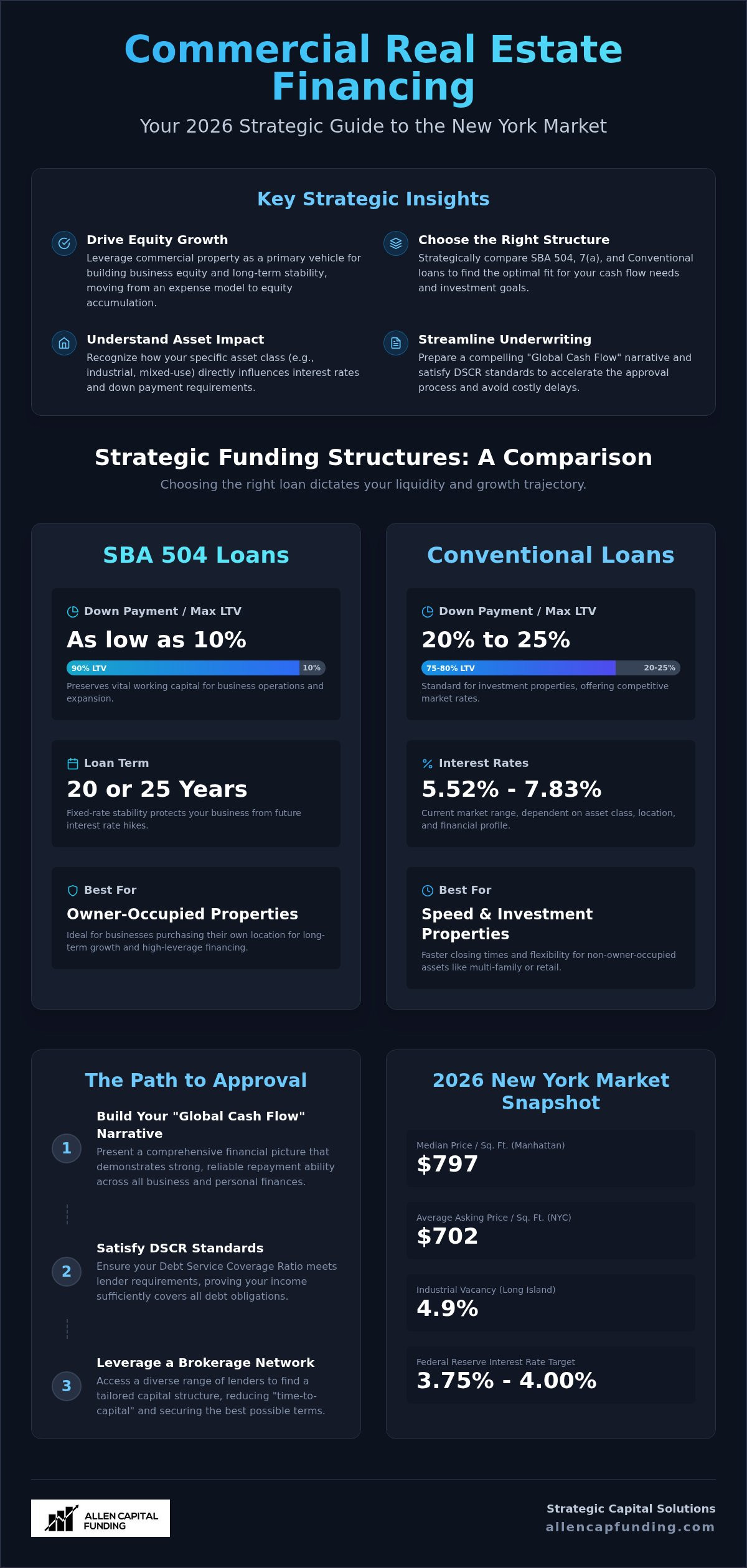
The New York market in 2026 is defined by a flight to quality and a push for adaptive reuse. While Manhattan saw a median price per square foot of $797 earlier this year, the competition for prime assets has never been higher. Traditional banks often present rigid hurdles, leading many investors to seek a Commercial mortgage through specialized channels that offer more flexibility. This shift marks a move from simple debt transactions toward strategic capital matching. Aligning your funding with your business exit strategy is the difference between a trapped asset and a growth engine. For those securing commercial real estate loans New York, success depends on understanding these shifting dynamics before signing a term sheet.
The Role of Capital in Business Expansion
Owning your location stabilizes long-term operational costs and builds immediate balance sheet strength. It removes the volatility of rent hikes in a city where asking prices average $702 per square foot. When you transition from leasing to owning, you aren't just securing a roof; you're building a tool for future liquidity. Equity growth becomes a secondary revenue stream that supports long-term stability. This equity can later be tapped for working capital or to fund further expansions. For those seeking commercial real estate loans New York, the focus is on high-leverage solutions that allow you to keep more cash in the business while building a tangible asset. It's about moving from an expense-heavy model to one focused on equity accumulation.
Why Strategic Facilitation Matters
Speed is the primary currency in 2026. A direct lender is limited by their own balance sheet and specific internal risk appetite. In contrast, a strategic loan broker acts as a facilitator, opening doors to a diverse network of institutional and private partners. This approach reduces "time-to-capital" friction, which is vital when competing for properties in high-demand areas like Long Island, where industrial vacancy sits at a tight 4.9 percent. Expert guidance helps you navigate the current interest rate environment, where the Federal Reserve has held rates between 3.75 percent and 4.00 percent. Strategic facilitation ensures you aren't just getting a loan; you're getting the right debt structure for your specific asset class, whether it's industrial, retail, or office. By matching the right lender to your specific profile, you remove the barriers that typically delay closings in a complex city like New York.
Comparing Strategic Funding Structures: SBA vs. Conventional Loans
Choosing the right debt structure is a strategic decision that dictates your company's liquidity for the next decade. For most entrepreneurs, the decision between government-backed programs and private capital depends on how much cash they want to keep on hand. While traditional banks might offer familiar faces, they often lack the flexibility required for complex commercial real estate loans New York. Understanding the trade-offs between SBA and conventional financing allows you to select a path that supports your specific growth trajectory without compromising your operational cash flow.
SBA 504: High Leverage for Long-Term Growth
Small business owners often prefer SBA 504 loans because they allow for a down payment as low as 10 percent. This high-leverage structure is a major advantage when you're purchasing high-value assets in Manhattan or Brooklyn. These loans provide fixed-rate stability for 20 or 25-year terms, which protects your business from future interest rate hikes. Eligible uses include land, existing buildings, and even long-term machinery. By financing up to 90 percent of the project cost, you preserve vital capital for hiring, marketing, or inventory expansion.
Conventional Mortgages for Investment and Speed
Conventional commercial mortgages are typically the better choice for non-owner-occupied properties or when speed is the primary objective. Government-backed loans involve significant paperwork and longer approval cycles that can stretch for months. Private capital can often close much faster, which is essential for beating out competing buyers in a market where sales volume is increasing. Conventional options usually require a 20 to 25 percent down payment, with interest rates currently ranging from 5.52 percent to 7.83 percent. While the LTV is lower, the lack of strict owner-occupancy rules makes these ideal for multi-family or retail investment properties.
Prepayment penalties are another critical differentiator to consider. SBA loans have specific, declining penalty structures that disappear after a set period. Conventional lenders might use more complex methods like yield maintenance or defeasance. These terms can significantly impact your ability to refinance if rates drop or if you decide to sell the property. Additionally, underwriters will scrutinize your Debt Service Coverage Ratio (DSCR) to ensure the property's income can comfortably cover the debt payments. If you're unsure which path fits your current balance sheet, a strategic financial check-up can help clarify your options before you commit to a specific lender.
Evaluating Property Types and Asset-Specific Financing
Lenders don't just underwrite your business; they underwrite the specific utility of the building you intend to buy. In the current market, the asset class you choose dictates your leverage, interest rate, and even the speed of your approval. While a warehouse in Queens might secure aggressive terms due to high demand, a traditional office space in Midtown may face stricter scrutiny. Identifying how these categories influence commercial real estate loans New York is essential for aligning your acquisition with the right capital partner. Recent data regarding New York City commercial real estate sales shows that market activity is increasingly concentrated in high-performing sectors that offer clear long-term stability.
Industrial and Warehouse Strategic Growth
Industrial assets remain the most favored class for institutional capital in 2026. With Long Island industrial vacancy rates sitting at a remarkably low 4.9 percent, lenders view these properties as exceptionally safe bets. Financing for logistics hubs and distribution centers often comes with higher Loan-to-Value (LTV) ratios because the tenant demand is consistent. Underwriters focus heavily on ceiling heights, loading dock access, and proximity to major transit corridors. If your property supports the "last-mile" delivery economy, you can often negotiate more flexible debt structures that preserve your operational cash flow.
Multi-Family and Mixed-Use Considerations
Multi-family investments continue to lead in sales volume, which reached $3.3 billion in Manhattan alone during the first quarter of 2026. Lenders like the diversified income streams that residential units provide, especially in a market where the median price per square foot has climbed nearly 20 percent year over year. When you're looking at mixed-use properties, the complexity increases. Underwriters will carefully analyze your Rent Roll to see the balance between stable residential leases and potentially volatile commercial tenants. Standard LTV thresholds for these assets typically hover around 75 to 80 percent, though high-quality renovations can sometimes unlock better terms.
Specialized assets like medical offices and flex-spaces are also seeing a rise in interest. These properties often benefit from "sticky" tenants who invest heavily in their own build-outs, making them less likely to move. Lenders reward this stability with competitive rates, though they may require higher reserves for tenant improvements. Whether you're targeting a single-tenant net lease or a multi-tenant industrial park, your financing must match the risk profile of the building's specific use case. Understanding these nuances early helps you present a more compelling narrative to your lending partners.
The Path to Approval: Preparing Your Financial Profile
The underwriting process for commercial real estate loans New York is a rigorous exercise that demands more than just a high credit score. Lenders in this market prioritize the "Global Cash Flow" narrative, which aggregates your business income, personal earnings, and the property's projected revenue. This holistic view allows underwriters to determine if your total financial ecosystem can support the debt. You should address your Debt Service Coverage Ratio (DSCR) early in the process. If this ratio is weak, a lender may reduce your loan-to-value (LTV) or increase your interest rate to mitigate their risk. Proactive preparation ensures you aren't blindsided by these adjustments during the final stages of a closing.
Your business history and personal credit are supporting pillars, but they aren't the only path to capital. If you're navigating the market with challenged credit, asset-based lending strategies can provide a vital alternative. These structures focus on the tangible value of the real estate rather than just your personal financial standing. By shifting the focus to the asset's performance and equity, you can often unlock funding that traditional institutions would decline. This shift in perspective is essential for maintaining momentum in a competitive environment where sellers expect fast, certain execution.
Educational resources from industry experts like Jet Lending, LLC can help you master these asset-based strategies through their regular series of investor-focused events and webinars.
Essential Documentation Checklist
Organizing your records before approaching a lender significantly reduces "time-to-capital" friction. Underwriters require a clear paper trail to verify your claims and assess long-term stability. Ensure you have the following documents ready for immediate review:
Tax Returns: Provide three years of both business and personal federal tax returns to establish a multi-year income trend.
Financial Statements: Include Personal Financial Statements (PFS) for all principal owners and detailed Debt Schedules.
Interim Reports: Supply current interim financial statements and accounts receivable/payable aging reports to show real-time liquidity.
Optimizing Your Balance Sheet for Underwriting
Clean up your financial profile before the formal application begins. Reducing short-term liabilities can immediately improve your debt-to-income ratios and signal fiscal responsibility to a lender. It's helpful to undergo a strategic financial check-up to identify potential red flags in your cash flow before an underwriter sees them. Additionally, using asset-based lending for small business can help you improve liquidity by leveraging existing inventory or equipment to clear high-interest debt. This preparation positions you as a low-risk borrower, which is critical when competing for commercial real estate loans New York. If you're ready to build a profile that wins over underwriters, speak with a dedicated financial guide today.
How Allen Capital Funding Facilitates Accelerated Success
In the complex 2026 financial market, your business needs more than a lender. It needs a bridge to the right capital. Traditional banks are often limited by their own internal risk appetites and rigid underwriting silos. This can lead to delays that kill deals in a fast moving city. Allen Capital Funding acts as your dedicated guide. We simplify the path to securing commercial real estate loans New York by leveraging a diverse network of institutional and private partners. This ensures you aren't forced into a one size fits all product that doesn't align with your long term equity goals; to explore these specialized private options, you can learn more about JGL Capital LLC.
Speed defines the winner. Our brokerage model allows us to scan the entire market to find the most competitive terms, rather than being restricted to a single bank's portfolio. We understand the nuances of the New York market, from Manhattan's high square foot costs to the tight industrial vacancies in the outer boroughs. This specialized knowledge allows us to position your file for a faster approval. By removing the friction often found in traditional lending, we help you move from application to closing with professional confidence.
A Partnership-Driven Approach to Capital
We remove the barriers that typically stall commercial acquisitions. Our team focuses on proactive facilitation, ensuring your application is positioned for success before it ever hits an underwriter's desk. We specialize in customizing commercial real estate loans NY to match your specific operational footprint. Whether you're expanding an industrial distribution center or acquiring a mixed use property, our goal is to protect your cash flow. We don't just process transactions; we build tailored capital structures that reflect your unique business goals.
Ready to Secure Your Commercial Future?
Success in the 2026 market requires expert navigation. Working with experienced SBA loan brokers New York allows you to access high leverage programs like the 504 and 7(a) with much higher certainty. Our network provides access to competitive commercial real estate financing NY options that traditional banks might overlook. We help you map out a strategy that balances speed, leverage, and long term stability. This ensures you're ready to beat out competing buyers and secure your asset with confidence.
Your next acquisition shouldn't be a source of stress. It should be a move toward accelerated success. By matching your business needs with the right debt structure, we help you transform real estate into a strategic asset. Securing commercial real estate loans New York is a sophisticated process, but you don't have to navigate it alone. Take the first step toward securing your business's future today. Book your online consultation to map out your 2026 real estate strategy with our expert team.
Securing Your Competitive Edge in the 2026 Market
The 2026 New York market moves with intense speed. Success requires a blend of precise financial preparation and the right asset-specific funding structure. You've explored how SBA programs can preserve your cash flow and how conventional debt offers the speed needed to beat out competing buyers. Matching your acquisition to the right lender isn't just about securing a competitive rate; it's about building a foundation for long-term equity growth and operational stability.
Allen Capital Funding acts as your proactive ally in this complex landscape. We provide expert SBA loan origination and access to a diverse national lending network to ensure you aren't restricted by a single bank's narrow criteria. Our team focuses on delivering tailored capital solutions that remove traditional barriers to progress and simplify the path to closing.
Don't let complex underwriting or rigid bank terms stall your momentum. If you're ready to secure commercial real estate loans New York with confidence, it's time to take the next step. Book a Strategic Consultation with Allen Capital Funding today to map out your funding path. We're here to facilitate your accelerated success and help you own your business's future.
Frequently Asked Questions
What are the current interest rates for commercial real estate loans in 2026?
Conventional commercial loan rates currently range from 5.52% to 7.83%, with the average NYC commercial mortgage rate sitting at 5.78% as of July 2026. SBA 504 blended rates typically fall between 6.0% and 7.0%, while SBA 7(a) rates range from 5.75% to 7.75%. Your specific rate will depend on the asset class, your credit profile, and the total loan-to-value (LTV) ratio.
How much down payment is required for a commercial real estate loan?
Down payment requirements depend on the loan program you select. SBA 504 and 7(a) loans offer a significant advantage with down payments as low as 10% for owner-occupied properties. Conventional commercial real estate loans New York typically require a 20% to 25% down payment. Specialized multifamily programs through HUD or FHA may allow for higher leverage, but these often involve more rigorous compliance standards.
What is the difference between an SBA 504 and an SBA 7(a) loan for real estate?
The SBA 504 program is specifically designed for fixed-asset financing, such as land or buildings, and offers 20 or 25-year fixed interest rates. The SBA 7(a) is a more flexible "general purpose" loan that can cover real estate, equipment, and working capital within a single package. While both offer up to 90% financing, the 504 is generally the preferred choice for large property acquisitions due to its long-term rate stability.
How long does the approval process take for a commercial mortgage?
Conventional mortgages typically close within 45 to 60 days because they involve fewer regulatory hurdles. Government-backed SBA loans generally take longer, often requiring 90 to 120 days from application to funding. You can accelerate this timeline by having your environmental reports, appraisals, and three years of tax returns organized before the formal underwriting process begins.
Can I get a commercial real estate loan with challenged credit?
Yes, you can secure funding by utilizing asset-based lending strategies that focus on property equity rather than personal credit scores. Bridge loans and private capital providers often step in when traditional banks decline a file due to credit issues. These solutions provide the necessary liquidity to acquire or stabilize an asset, though they typically carry higher interest rates and shorter terms than conventional debt.
What is a Debt Service Coverage Ratio (DSCR) and why does it matter?
The DSCR measures a property's ability to cover its annual debt payments using its net operating income. Most lenders require a minimum ratio of 1.25, which means the property generates 25% more income than is required to pay the mortgage. Underwriters use this ratio to assess default risk and determine the maximum loan amount your business can safely support without straining its cash flow.
What property types qualify for commercial real estate financing?
A wide variety of assets qualify for commercial real estate loans New York, including industrial warehouses, retail storefronts, office buildings, and multifamily complexes. Lenders also provide specialized financing for mixed-use developments, medical offices, and flex-spaces. Each property type is subject to different underwriting metrics, such as vacancy factor adjustments and specific LTV caps based on the asset's market demand.
Should I use a loan broker or go directly to a bank for CRE funding?
Using a loan broker gives you access to a diverse network of multiple lending partners, while a bank can only offer its own internal products. A broker acts as a strategic guide, matching your specific financial profile with the lender most likely to provide competitive terms. This partnership-driven approach is vital in a complex market where a single bank's rigid criteria might lead to an unnecessary decline.


Comments