


Commercial Real Estate Financing: The 2026 Strategic Guide to Business Property
Updated: 2 days ago
In 2026, the most valuable asset in your acquisition strategy isn't the property itself; it's the specific structure of the debt you use to secure it. You've likely found that the barrier to entry for traditional commercial real estate financing remains high, often leaving business owners trapped between slow institutional approvals and the confusion of comparing SBA 504 terms against conventional options. It's frustrating to feel like your growth is stalled by rigid requirements or the fear of over-leveraging your company's future.
We understand that you need more than just a loan; you need a strategic partner who recognizes your industry's unique demands. This guide helps you master the complexities of capital acquisition by providing an expert breakdown of current loan structures and qualification metrics. You'll learn how to leverage lower down payment options and competitive market rates that protect your liquidity. We're providing a clear roadmap to closing your deal, from passing a preliminary Financial Check-Up to navigating the latest DSCR requirements with confidence. Let's unlock the capital you need to move your business from its current state to its future goals.
Table of Contents
The Evolution of Commercial Real Estate Financing in 2026
In 2026, commercial real estate financing is defined as any capital arrangement used to purchase, develop, or refinance property intended for business operations or income generation. This includes a wide range of assets, from owner-occupied medical offices to multi-tenant industrial parks. The market has moved decisively away from the rigid lending standards of the past decade. Today, there's a significant shift toward flexible, asset-based lending models that prioritize a business's overall strategic health rather than just its credit score. This evolution allows entrepreneurs to secure funding that adapts to their specific growth cycles.
Many businesses now bypass traditional single-bank relationships in favor of a diversified brokerage model. Relying on one institution often limits your options to their specific risk appetite and internal caps. A national brokerage acts as a strategic bridge, connecting you to a broader spectrum of capital sources to find the most competitive terms. Understanding Commercial mortgage basics is essential for distinguishing between owner-occupied and investment property structures. Owner-occupied properties generally benefit from higher leverage and lower down payments, while investment property financing focuses heavily on the asset's independent ability to generate cash flow.
Why Real Estate is the Ultimate Business Asset
Owning your business property transforms a recurring monthly expense into a strategic wealth-building tool. When you pay rent, that capital is gone forever. When you own, every payment builds equity on your balance sheet. This ownership provides significant tax advantages, including interest deductions and depreciation, which can improve your annual cash flow. Beyond the immediate tax benefits, commercial property serves as a foundation for future growth. As you build equity, you can use the property as collateral to secure Credit Lines or Working Capital. This creates a cycle of liquidity that allows you to reinvest in your operations without diluting your ownership.
Market Trends Shaping 2026 Financing
The landscape of property valuation has changed. Hybrid work models continue to impact office and retail valuations, making lenders more selective in those sectors. This shift has increased the demand for flexible arrangements; for instance, you can discover JOIN ME flex office to see how virtual office solutions can support your business without the immediate need for a large-scale real estate loan. Conversely, industrial and warehouse spaces have become premium collateral due to the persistent demand for logistics and e-commerce infrastructure. Technology has also accelerated the pace of the industry. Digital underwriting tools now allow for faster approval timelines, often cutting weeks off the traditional closing process. Performing a Financial Check-Up before you begin your search is now a standard practice to ensure your data is ready for these accelerated digital reviews. This preparation ensures you don't miss out on prime properties in a fast-moving market.
Primary Loan Structures: SBA 504 vs. Conventional Commercial Mortgages
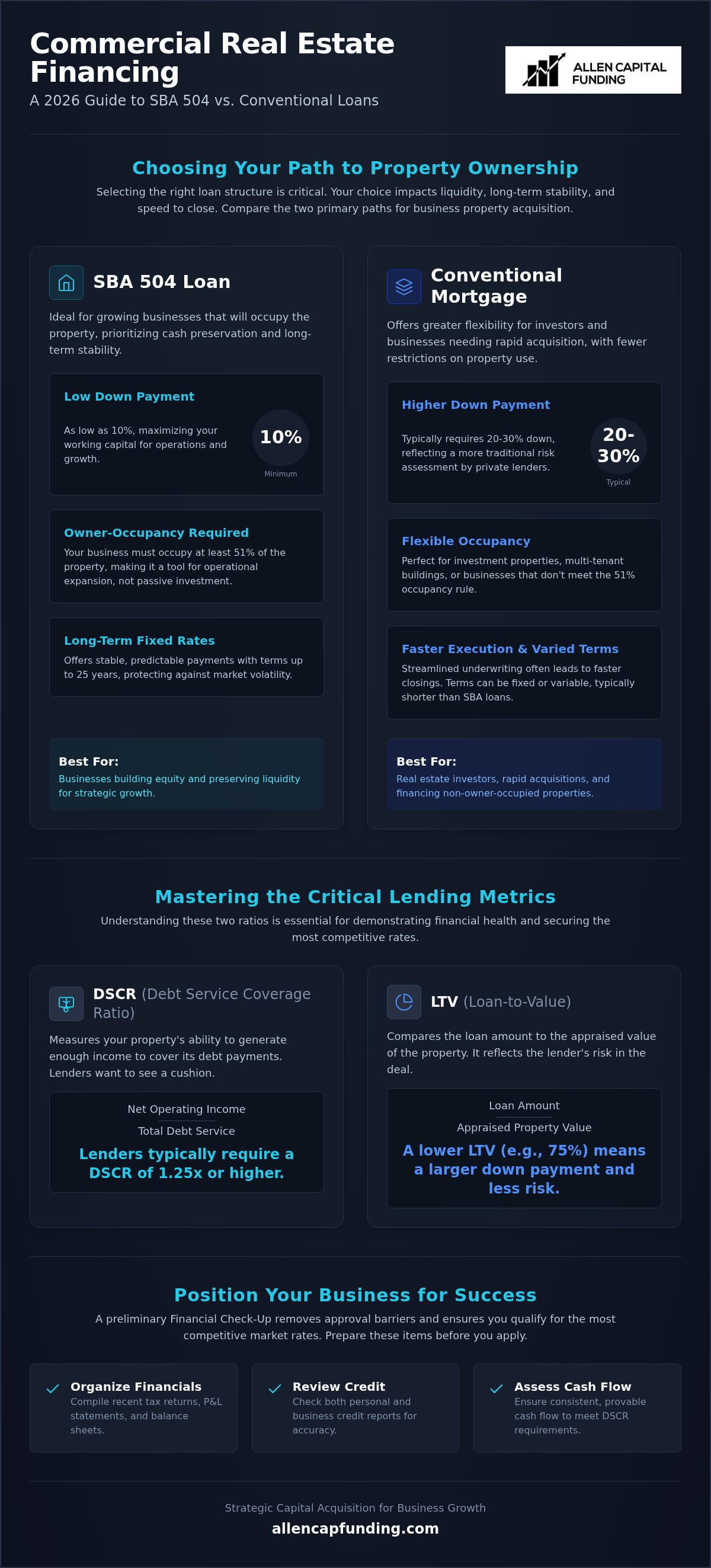
Selecting the right vehicle for commercial real estate financing often comes down to two primary paths: the SBA 504 program and conventional commercial mortgages. Each serves a distinct strategic purpose. If your goal is preserving liquidity while securing a permanent home for your business, the government-backed route is usually the strongest contender. Conversely, if you're looking for rapid execution or financing an investment property that you won't occupy, private capital through conventional channels offers the flexibility you need. Understanding the trade-offs between these two is the first step in aligning your debt with your long-term growth objectives.
The SBA 504 Advantage for Growing Businesses
For many entrepreneurs, the SBA 504 loan program represents the gold standard for owner-occupied expansion. Its primary appeal lies in the low down payment requirement, which is often as low as 10%. This allows you to keep more cash in your business for operations, inventory, or hiring. In the current 2026 economic environment, these loans provide a vital hedge against volatility by offering long-term, fixed-rate financing for up to 25 years. This stability is particularly valuable for businesses in manufacturing or logistics where long-term site control is essential.
To qualify for this structure, your business must occupy at least 51% of the property. There are also specific job creation or retention metrics to meet, though these are often manageable for established firms. The 504 structure involves a partnership between a certified development company and a private lender. This collaboration creates a secure, low-risk environment that allows lenders to offer more favorable terms than they might on a standalone basis.
Conventional Financing: When Speed and Flexibility Matter
Conventional loans don't come with the same regulatory "red tape" as government programs, making them the preferred choice when a deal needs to close quickly. While they typically require higher down payments, ranging from 20% to 35%, they offer broader utility. You can use conventional capital for non-owner-occupied investments, mixed-use buildings, or multi-tenant retail centers. These loans often feature a mix of fixed and variable rates, allowing for more customization based on your specific exit strategy or renovation timeline.
For a deeper look at how these structures apply to specific market conditions, you can explore our resource on Commercial Real Estate Loans in NY: The 2026 Strategic Funding Guide. While conventional lenders focus heavily on the property's income-producing potential, they also value the borrower's overall financial health. If you're unsure which path fits your current balance sheet, starting with a Financial Check-Up can help clarify your borrowing capacity before you commit to a specific loan structure.
Alternative Funding: Bridge Loans and Asset-Based Real Estate Strategies
While SBA and conventional loans provide long-term stability, they aren't always the right fit for immediate, high-stakes opportunities. Sometimes you need capital faster than a standard bank can move, or you're dealing with a property that doesn't yet meet stabilized underwriting criteria. This is where alternative commercial real estate financing structures, such as bridge loans and asset-based strategies, become essential tools for business growth. These options allow you to move with the speed of a cash buyer while maintaining your company's liquidity.
Bridge Loans for Time-Sensitive Opportunities
When dealing with these types of complex loan scenarios that require a more personalized, investor-focused approach, you might want to check out LoansByJB (The Nuhome Team) to see how their tailored solutions can support your acquisition strategy.
A bridge loan acts as short-term capital designed to close the gap between an immediate acquisition and long-term refinancing. These are particularly useful for "value-add" properties; these are buildings that require significant renovation or repositioning before they can qualify for permanent debt. Because bridge lenders focus more on the asset's potential than its current cash flow, they can often fund deals in weeks rather than months. This speed is a major advantage in competitive markets where delays can kill a deal.
The goal of a bridge loan is never long-term debt. Instead, it's a tactical maneuver. You use it to secure the property and complete necessary improvements. Once the asset is stabilized and its value has increased, you can transition to a permanent SBA or conventional loan. This exit strategy is a core part of the planning process at Allen Capital Funding, ensuring you don't get stuck with higher-interest short-term debt longer than necessary.
Asset-Based Lending in the CRE Space
One of the most overlooked strategies in 2026 is using your company's existing balance sheet to fuel real estate acquisition. If your business has significant Equipment Financing equity or high-quality accounts receivable, you can leverage these assets to bolster a real estate down payment. This hybrid approach allows you to secure property without draining your primary cash reserves. Understanding How Commercial Real Estate Financing Works in a multi-layered environment is key to maximizing your leverage.
We specialize in structuring these complex, multi-layered deals. We might combine Factoring or Purchase Order Financing with a real estate loan to create a custom capital stack that fits your specific industry needs. This strategy is part of a broader trend in Asset-Based Lending for Small Business: Unlocking Balance Sheet Liquidity in 2026. By conducting a thorough Financial Check-Up, we help you identify hidden collateral that traditional banks often ignore. This ensures you're strategically deploying every resource at your disposal to accelerate your success.
Critical Metrics: Understanding DSCR, LTV, and Financial Readiness
Lenders evaluate risk through specific ratios that determine your borrowing power and the ultimate cost of your capital. In 2026, the two most critical metrics for commercial real estate financing are the Debt Service Coverage Ratio (DSCR) and the Loan-to-Value (LTV) ratio. While your business growth might be impressive, these numbers provide the objective proof lenders need to approve a large capital draw. Understanding how to calculate these metrics before you walk into a meeting allows you to negotiate from a position of strength rather than uncertainty.
DSCR is the ratio of operating income to total debt service, typically requiring a 1.25x multiplier for approval. This means for every dollar of debt payment, your property or business should generate at least $1.25 in net income. Lenders use this to ensure you have a comfortable cushion to handle market fluctuations or unexpected maintenance costs. If your ratio falls below this threshold, you may face higher interest rates or be required to provide additional collateral to offset the perceived risk.
The LTV ratio measures the loan amount against the appraised value of the property. For conventional mortgages in 2026, this typically ranges between 65% and 75%, though stronger assets can sometimes reach 80%. A lower LTV often unlocks more competitive terms because it reduces the lender's exposure. Additionally, lenders look for synergy between your personal and business credit. Even for entity-based loans, your personal financial health acts as a secondary layer of security that can accelerate the approval process.
Calculating Your DSCR Before Applying
To find your Net Operating Income (NOI), subtract all operating expenses from your total revenue, excluding debt payments and taxes. Many business owners make the mistake of including personal expenses or one-time capital expenditures; this can artificially lower your DSCR and hurt your approval chances. Lenders often look at global cash flow, which combines the income from the property with the cash flow of your primary business. This holistic view provides a more accurate picture of your ability to service the debt over the long term.
The Application Roadmap: 5 Steps to Approval
Step 1: Organize three years of business and personal tax returns to demonstrate consistent financial performance.
Step 2: Secure a professional property appraisal and environmental report to verify the asset's value and safety standards.
Step 3: Draft a compelling executive summary that highlights your industry expertise and specific growth potential.
Step 4: Review your debt schedules and personal financial statements to ensure all data is accurate and up to date.
Step 5: Engage a broker to shop the deal across multiple capital providers to ensure you get the best market terms.
Ready to see where your business stands? Start with a Financial Check-Up to evaluate your readiness for a major property acquisition.
Strategic Partnership: How Allen Capital Funding Accelerates Acquisition
Securing commercial real estate financing shouldn't feel like a second full-time job. While individual banks are limited by their own internal policies and risk appetites, a strategic brokerage provides you with a single point of entry to a national network of capital sources. One application with Allen Capital Funding beats ten bank visits because we understand the specific nuances of different lenders. We don't just submit paperwork; we position your business to win by highlighting the strengths that matter to specific institutions. This approach removes the frustration of slow approval processes and helps you avoid the common pitfalls of over-leveraging your operations.
We provide tailored solutions by matching your specific industry to the right lender. A logistics company has different collateral needs than a retail outlet or a manufacturing plant. We recognize these distinctions and use our national reach to find the best market rates for your specific asset class. For a deeper look at how this expertise functions in a competitive environment, see our SBA Loan Brokers New York: Strategic 2026 Funding Guide. Our role is to act as a proactive, solution-focused ally that removes barriers and simplifies your path to progress.
Beyond the Transaction: Long-Term Financial Support
Our partnership doesn't end when the real estate deal closes. We act as a dedicated guide for your long-term growth, assisting with Credit Lines, Working Capital, or Equipment Financing as your operations expand. Property ownership is just the foundation; maintaining and leveraging that equity requires ongoing attention. We recommend regular Financial Check-Ups to ensure your balance sheet remains optimized for future opportunities. This proactive management helps you stay liquid and ready to pivot when new market advantages emerge. We're here to help you navigate the complexities of 2026 finance with professional confidence and supportive empowerment.
Ready to Scale? Your Next Steps
Preparation is the key to accelerated success in the current market. By evaluating your assets and financial readiness early, you position yourself to move quickly when the right property becomes available. Our team is ready to provide a customized capital roadmap that aligns with your specific future goals. We act as the bridge between your business's current state and its future success, removing the traditional hurdles of commercial acquisition. Don't let rigid bank requirements stall your expansion.
Schedule a consultation with Allen Capital Funding today to begin your strategic asset evaluation and unlock your business's full potential.
Building Your Business Legacy Through Strategic Acquisition
Mastering your property acquisition is about more than just securing a building; it's about engineering a capital structure that supports your long-term vision. By understanding critical metrics like DSCR and choosing between SBA and conventional paths, you move from a reactive search to a proactive strategy. Ownership remains the most effective way to build equity and secure your company's operational future. It transforms a recurring expense into a powerful asset on your balance sheet that drives long-term stability.
Our team provides the expert guidance you need to navigate this journey with confidence. Through our Expert SBA Loan Brokerage and Comprehensive National Lending Network, we remove the barriers that slow down traditional bank approvals. We specialize in Tailored Asset-Based Funding Solutions that respect your industry's unique needs and protect your cash flow. Secure your business's future with expert commercial real estate financing from Allen Capital Funding. You've worked hard to build your business; now it's time to own the ground it stands on and accelerate your success.
Frequently Asked Questions
What is the minimum credit score for commercial real estate financing in 2026?
Most lenders look for a minimum credit score of 660 to 680 for government-backed programs like SBA loans. For conventional commercial real estate financing, a score of 700 or higher typically unlocks the most competitive interest rates and terms. If your score is lower, you aren't necessarily disqualified. We often look at the total health of the business and available collateral to find a structure that works for your specific situation.
How much down payment is typically required for a commercial property loan?
Down payment requirements vary significantly based on the loan structure you choose. An SBA 504 loan often requires as little as 10% down, which is ideal for preserving your business's operating cash. Conventional loans usually require between 20% and 35% down depending on the property type and your financial strength. Bridge loans or asset-based solutions might offer different leverage options based on the value of the property and other business assets.
Can I use an SBA loan to purchase a property for my business if I don't occupy it all?
Yes, you can use an SBA loan to purchase a property even if your business doesn't occupy the entire space. For an existing building, your business must occupy at least 51% of the total square footage. If you are financing new construction, the requirement is 60% occupancy. This allows you to lease out the remaining space to other tenants, creating an additional income stream while you build equity in your primary location.
What is the difference between an owner-occupied and an investment CRE loan?
An owner-occupied loan is designed for properties where your business is the primary tenant. These loans generally offer higher leverage and lower down payments because the lender relies on your business's operational cash flow. An investment loan is for properties intended to generate rental income from third-party tenants. These typically require larger down payments and focus primarily on the property's ability to cover the debt service independently of your other business activities.
How long does the approval process take for commercial real estate financing?
The approval timeline depends on the complexity of the deal and the type of lender involved. Conventional bank loans usually take 30 to 45 days from application to closing. SBA loans are more document-intensive and typically require 60 to 90 days. If you have a time-sensitive opportunity, bridge loans or asset-based commercial real estate financing can often be approved and funded in as little as two weeks. We help accelerate this process.
What documents do I need to provide for a commercial real estate loan application?
You will typically need to provide a comprehensive package of financial information, including:
Three years of business and personal tax returns
Current year-to-date profit and loss statements
A personal financial statement for all major owners
Property-specific documents like a purchase agreement and rent rolls
Having these items organized before you start prevents delays and helps build immediate confidence with potential capital providers.
Is it better to get a fixed-rate or variable-rate commercial mortgage right now?
Choosing between fixed and variable rates depends on your long-term goals and the current economic outlook. A fixed-rate mortgage provides predictable monthly payments, which is excellent for long-term stability and budgeting. Variable rates might start lower but carry the risk of increasing over time. In a fluctuating market, many business owners prefer the security of a fixed rate for their primary location while using variable rates for shorter-term projects or value-add acquisitions.
Can I get commercial real estate financing with challenged business credit?
Challenged business credit doesn't have to stop your property acquisition. While traditional banks might be hesitant, alternative lenders often prioritize the value of the real estate and your overall business revenue. We specialize in asset-based solutions that look beyond a simple credit score. By performing a Financial Check-Up, we can identify strengths in your balance sheet that allow us to structure a deal that traditional institutions might otherwise overlook or decline.


Comments