


Commercial Real Estate Financing: A Strategic Guide to Funding Your 2026 Property Goals
Did you know that commercial mortgage origination volume is projected to surge by 27% to over $805 billion this year? As property valuations stabilize in 2026, the opportunity to scale your portfolio is significant, but the path to securing capital remains fraught with hurdles. You've likely faced the frustration of opaque bank requirements or approval timelines that move slower than the market itself. Balancing a high loan-to-value ratio with strict debt service coverage requirements shouldn't feel like a guessing game. Securing the right commercial real estate financing is about more than just a low rate. It's about building a capital stack that protects your cash flow while fueling growth.
You deserve a partner who offers more flexibility than a standard institutional lender. This guide simplifies the funding process by providing a clear framework to compare loan types and qualify efficiently. We'll break down the differences between SBA and conventional loans, show you how to use existing equity to fund expansion, and help you secure the best possible terms for your business. By the end of this article, you'll have a strategic roadmap to handle the current lending environment with confidence and speed.
Table of Contents
Navigating the 2026 Commercial Real Estate Financing Landscape
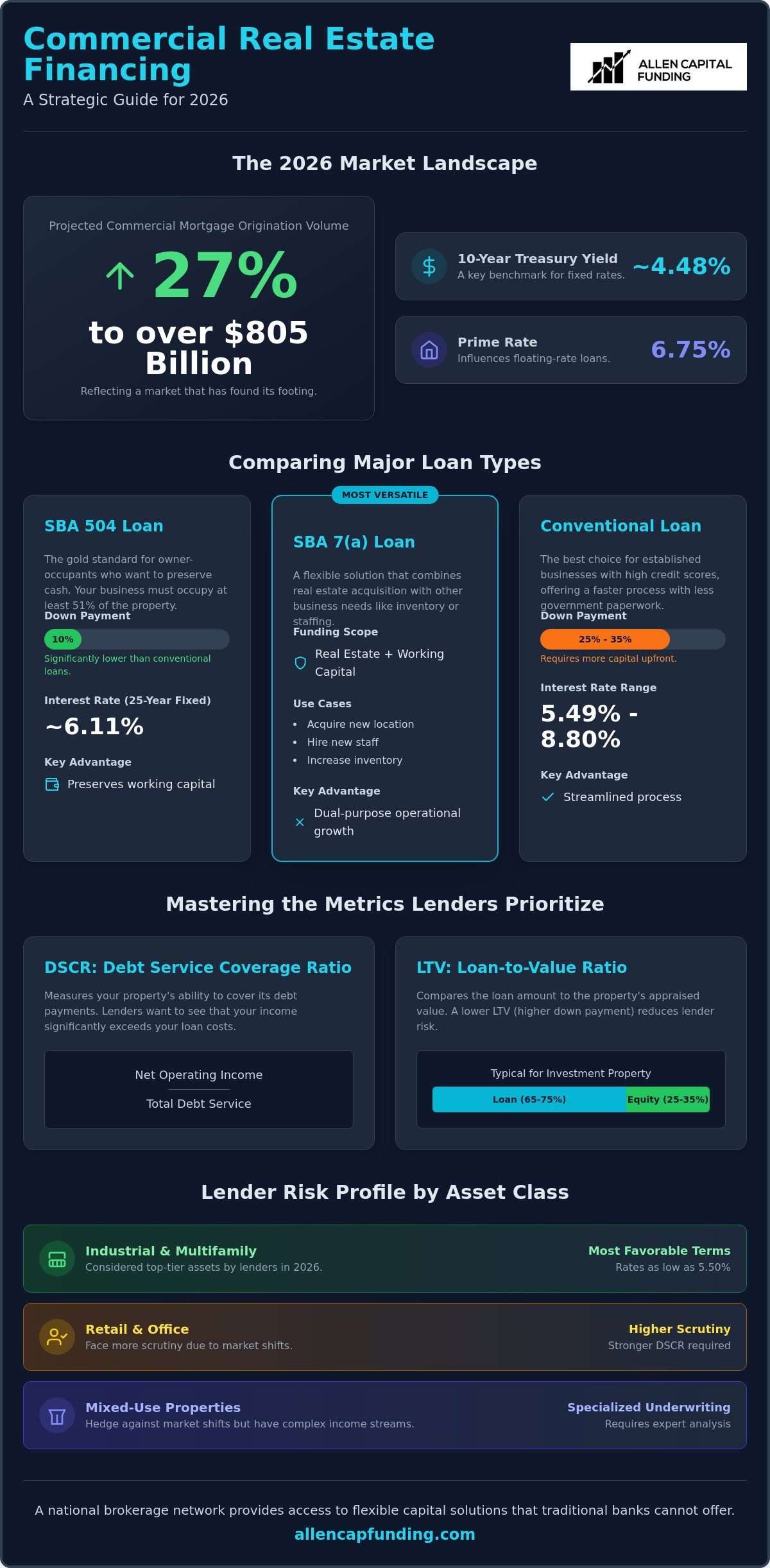
Commercial real estate financing serves as the primary engine for business expansion and wealth preservation. It isn't just a loan; it's a strategic framework used to acquire new locations, renovate existing assets, or refinance debt to improve monthly cash flow. As we move through 2026, the Mortgage Bankers Association predicts a 27% increase in total mortgage origination volume, reaching over $805 billion. This surge reflects a market that has found its footing after years of volatility. Understanding commercial mortgage basics is the first step toward leveraging this growth for your own business.
The decision between fixed and floating rates carries more weight this year than in previous cycles. With the 10-year Treasury yield hovering around 4.48% and the Prime Rate at 6.75%, the spread between different loan products determines your long-term profitability. Most lenders now prioritize high-quality assets and experienced sponsors. This shift means you need a clear strategy and a partner who understands how to navigate firmer underwriting standards.
Owner-Occupied vs. Non-Owner Occupied Properties
The intent behind your property purchase dictates your funding path. For owner-occupied spaces, the SBA 504 loan remains a premier choice. To qualify for this specific type of commercial real estate financing, your business must generally occupy at least 51% of the square footage. This structure allows for lower down payments and long-term fixed rates, which currently sit near 6.11% for 25-year terms.
Investment properties carry different risk profiles. Lenders typically require higher down payments, often 25% to 35%, because repayment depends on tenant income rather than your own business operations. Owning the roof over your business provides a strategic advantage by eliminating lease renewal uncertainty and allowing you to build equity that can eventually fund future expansions.
Key Asset Classes and Their Funding Profiles
Lenders view risk through the lens of the property type. Industrial and multifamily assets remain the favorites in 2026, often securing the most competitive rates, sometimes as low as 5.50%. Retail and office spaces face more scrutiny, requiring stronger debt service coverage ratios and higher tenant credit quality. Mixed-use properties offer a hedge against market shifts but often require specialized underwriting to account for multiple income streams.
The capital stack represents the total layers of funding used to finance a property, including senior debt, mezzanine financing, and borrower equity.
Comparing Major Loan Types: SBA, Conventional, and Bridge
Choosing the right vehicle for commercial real estate financing requires a clear understanding of your long-term goals. While interest rates have stabilized, the specific structure of your debt determines how much liquidity you keep in your business. You must weigh the benefits of low down payments against the speed of execution. The 2026 market offers several distinct paths depending on your timeline, credit profile, and the specific asset you intend to acquire.
The SBA 504 and 7(a) Advantage
The SBA 504 program remains the gold standard for owner-occupants who want to preserve their cash. Its primary benefit is the 10% down payment requirement, which is significantly lower than most other commercial products. As of June 2026, 25-year fixed rates for these loans are approximately 6.11%. This predictability is invaluable for manufacturing or industrial businesses that need to lock in long-term occupancy costs.
If your needs extend beyond just the building, the SBA 7(a) program provides a more versatile solution. You can use 7(a) funds for both real estate acquisition and working capital. This dual-purpose approach is perfect for growing small businesses that need to fund a new location while simultaneously hiring staff or increasing inventory. It's a foundational part of understanding commercial real estate loans and how they can be tailored to support operational growth.
Conventional Financing and Private Debt
Conventional bank loans are often the best choice for established businesses with high credit scores. You'll likely face a higher down payment requirement, typically between 25% and 35%, but you'll avoid the extensive government paperwork associated with SBA programs. Conventional mortgage rates currently range from 5.49% to 8.80% in 2026. These loans usually follow 20 or 25-year amortization schedules, providing a straightforward path for simple asset profiles.
Bridge loans and private debt serve as tactical short-term tools. With rates ranging from 9.00% to 14.00%, bridge funding is designed for speed and flexibility. It's the ideal solution for quick acquisitions or "value-add" renovations where you plan to stabilize the property and refinance into a long-term loan later. For larger industrial or multifamily deals, CMBS (Commercial Mortgage-Backed Securities) and agency lending offer securitized debt options that can handle high-volume capital needs. You can determine which of these paths fits your current profile by completing a financial check-up to assess your readiness.
Essential Qualifications: DSCR, LTV, and Financial Readiness
Lenders aren't just looking at your credit score when you apply for commercial real estate financing. They're evaluating the property's ability to survive economic shifts. In 2026, lenders heavily weigh "Global Cash Flow." This means they analyze your business income, property revenue, and personal debt obligations as one single picture. They want to see a holistic view of your financial strength before they commit capital to your project. Proactive documentation is your best tool for speed. Having your tax returns, rent rolls, and profit and loss statements ready can shave weeks off your approval timeline.
Mastering the DSCR Calculation
The Debt Service Coverage Ratio (DSCR) is the most critical number in your application. It measures whether the property generates enough income to cover its own mortgage. The formula is simple: Net Operating Income (NOI) divided by Total Debt Service. Most lenders require a minimum DSCR of 1.20x to 1.25x for stabilized assets. A 1.25x ratio means for every $1 of debt, the property earns $1.25 in profit. This 25% margin acts as a safety net for the lender. A strategic financial check-up identifies DSCR gaps by analyzing your current expenses and projected rental income before you submit your formal application.
LTV Benchmarks for 2026
Loan-to-Value (LTV) represents your "skin in the game." While multifamily properties might qualify for up to 80% LTV, most conventional commercial mortgages currently settle between 65% and 75%. If the appraised value comes in lower than the purchase price, you'll need to bridge that gap with additional cash or equity from other assets. Staying informed on Commercial lending market conditions helps you understand why these benchmarks shift based on asset class and location.
You should also understand Loan-to-Cost (LTC) if you're planning a renovation. LTC covers the purchase price plus the cost of improvements. If you're executing a "value-add" project, your lender will focus more on the future stabilized value than the current purchase price. Clear project bids and a solid track record make a high LTC request much more palatable to a credit committee. Secondary liens can sometimes help fill capital gaps, but they often increase the complexity of your primary real estate mortgage. It's about showing the lender that your property is a low-risk, high-performing asset from day one.
Strategic Acquisition: Integrating Real Estate with Equipment and Operations
Buying a property is only one part of the expansion puzzle. You must also consider the interior infrastructure, specialized machinery, and the capital required to keep operations running during the transition. Successful commercial real estate financing in 2026 requires a holistic approach that accounts for the total capital cost of a new location. If you focus only on the mortgage, you risk being "property rich and cash poor" before you even open your doors. Managing the synergy between your real estate and your operational needs is what separates a simple purchase from a strategic move in commercial real estate financing.
Asset-based lending provides another layer of flexibility for established firms. You can unlock equity in your existing machinery or inventory to fund property improvements. This is particularly useful for businesses that have already paid down equipment debt and want to renovate a new acquisition without taking on a massive new mortgage. It turns your current success into the fuel for your next property goal, allowing you to scale without over-leveraging your new real estate asset.
Funding the 'Fit-Out': Equipment and Real Estate
It's often a mistake to bundle specialized machinery or high-tech office fit-outs into your primary real estate loan. Doing so can eat into your property equity and limit your future borrowing power. Instead, structuring a separate commercial equipment finance package allows you to preserve that real estate equity for future growth. Think about an expanding logistics firm purchasing a new warehouse. By financing the fleet of delivery vehicles and sorting systems separately, the business protects its property value while keeping its operations modern and efficient. This modular approach ensures each asset is financed with terms that match its specific lifespan.
Liquidity Management During Acquisition
Closing costs and unexpected move-in expenses can rapidly drain your cash reserves. A business line of credit provides the necessary liquidity to cover these gaps without disrupting your daily operations. This flexible capital ensures you can handle the transition without financial stress. If you're managing large capital draws for a renovation, leveraging accounts receivable factoring can also help maintain steady cash flow during the move.
You should prepare a 2026 checklist for your acquisition that includes utility deposits, permit fees, immediate maintenance needs, and insurance premiums. Preparing for these large capital draws ensures you don't hit a liquidity wall mid-transition. This integrated strategy ensures your business remains agile while your property portfolio grows. To see how these pieces fit together for your specific expansion project, you can consult with our team about a tailored capital strategy today.
Accelerating Your Portfolio with Allen Capital Funding
Finding the right property is just the beginning. The real challenge lies in securing commercial real estate financing that doesn't restrict your future growth. Many business owners make the mistake of walking into their local branch and assuming they'll get the best deal. However, traditional banks are often limited by rigid internal policies and a single credit box. If your business has complex income streams or unique asset requirements, a "one-size-fits-all" loan will likely fail you. You need a partner who views your business as a strategic entity rather than a series of checkboxes on a spreadsheet.
Our team acts as a dedicated guide through the entire funding process. We don't just submit applications; we position your financial profile to highlight your strengths. Whether you're pursuing SBA loans, conventional mortgages, or asset-based solutions, we ensure your capital stack is optimized for long-term success. This professional guidance bridges the gap between your current state and your 2026 property goals. We move you from consultation to closing with calm efficiency and a focus on accelerated success.
Why a Loan Broker Outperforms a Single Bank
A single bank can only offer its own proprietary products. If their appetite for industrial or retail assets shifts, your application might be rejected regardless of your credit strength. We provide a distinct brokerage advantage by accessing a national network of lenders. This includes wholesale rates and niche lenders that don't market to the general public. You gain access to multiple funding pathways through a single application, saving you weeks of redundant paperwork. We understand which lenders are currently aggressive in the 2026 market, ensuring you secure the most competitive terms available for your commercial real estate financing.
Your Next Steps for Commercial Property Success
Taking the next step shouldn't be overwhelming. We've streamlined our process to respect your time and focus on results. Your journey starts with an online consultation where we'll discuss your tailored capital strategy. To make this first session as productive as possible, you should have your recent tax returns, year-to-date profit and loss statements, and any property-specific data ready for review. This proactive approach allows us to identify the best lending partners for your specific needs immediately.
We're here to remove barriers and simplify your path to progress. Our goal is to act as your proactive ally, ensuring your business has the capital it needs to thrive in an evolving market. Don't let opaque bank requirements delay your acquisitions or renovations. Explore our commercial real estate solutions today and see how a customized funding strategy can accelerate your success.
Building Your 2026 Property Legacy
Success in this year's market requires more than just finding the right location. It demands a sophisticated capital strategy that balances your immediate operational needs with long-term financial stability. You now have a clear framework for comparing SBA and conventional loans, mastering critical metrics like DSCR, and integrating your equipment needs with your property goals. The right commercial real estate financing structure doesn't just fund a purchase; it protects your cash flow and accelerates your growth.
Allen Capital Funding acts as your proactive ally in this complex landscape. We provide expert guidance on SBA 7(a) and 504 programs while offering access to a national network of lending partners for competitive 2026 rates. Our team specializes in asset-based and real estate capital solutions tailored to your unique business profile. We're ready to help you remove barriers and simplify your path to progress. Secure your strategic commercial funding with Allen Capital Funding today. Your future expansion is within reach, and we're here to ensure you have the capital to make it a reality.
Frequently Asked Questions
What is the typical down payment for a commercial real estate loan in 2026?
Down payment requirements generally range from 10% to 35% depending on the loan structure and property type. SBA 504 loans offer the most leverage for owner-occupants, requiring only a 10% down payment. Conventional lenders typically look for 25% to 35% down, though multifamily properties can sometimes qualify for 20% down if they show strong historical performance.
How does a DSCR of 1.25 affect my commercial loan eligibility?
A Debt Service Coverage Ratio (DSCR) of 1.25x is the standard minimum threshold most lenders require to approve a loan with favorable terms. This ratio demonstrates that your property generates 25% more net income than is required to cover the annual debt payments. Falling below this 1.25x mark may result in a lender requiring a larger down payment to reduce the loan amount and improve the coverage safety margin.
Can I use an SBA loan to buy an existing business that includes real estate?
Yes, the SBA 7(a) loan program is specifically designed for business acquisitions that include real estate, equipment, and working capital. This versatile option allows you to consolidate the entire purchase into a single loan with a term of up to 25 years for the real estate portion. It's an excellent tool for entrepreneurs who want to own the land and the operations under one predictable monthly payment.
What is the difference between an owner-occupied and an investment property loan?
The primary difference lies in the source of repayment and occupancy requirements. Owner-occupied loans require your business to occupy at least 51% of the property, and the lender evaluates your business operations to ensure you can pay the debt. Investment property loans rely on rental income from third-party tenants, usually requiring higher down payments and carrying slightly higher interest rates due to the perceived risk of tenant turnover.
How long does the commercial real estate financing process usually take?
The timeline typically ranges from 30 to 90 days from the initial application to the final closing. Bridge loans are the fastest option, often closing within 15 to 30 days for time-sensitive acquisitions. Conventional bank loans usually take 45 to 60 days, while SBA loans can take 60 to 90 days because of the additional federal documentation and specialized appraisal requirements involved.
Are there commercial real estate loans available for businesses with challenged credit?
Yes, private money lenders and bridge loan programs offer commercial real estate financing for borrowers with credit scores that don't meet traditional bank standards. These lenders focus more on the property's equity and potential value than on your personal credit history. While interest rates for these loans are higher, ranging from 9.00% to 14.00% in 2026, they provide the necessary capital to stabilize an asset before you refinance into a conventional loan.
What are the common closing costs associated with CRE financing?
You should budget between 2% and 5% of the total loan amount for closing costs. These expenses include the property appraisal, which often costs between $2,000 and $5,000 for commercial assets, as well as Phase I environmental reports, title insurance, and lender origination fees. Legal fees and recording taxes also contribute to the final amount, so it's vital to have liquid reserves ready before the closing date.
Should I choose a fixed or variable interest rate for my property loan in 2026?
Most borrowers in 2026 are opting for fixed-rate loans to protect against market volatility and lock in long-term stability. With the 10-year Treasury yield at approximately 4.48%, fixed rates for high-quality assets are currently very competitive. Variable rates may offer a lower starting point, but they carry the risk of increasing if the Prime Rate moves above its current 6.75% level, which could strain your property's cash flow over time.


Comments