


Commercial Property Loan Requirements: The 2026 Comprehensive Checklist
With 875 billion dollars in commercial mortgages maturing in 2026, securing capital requires absolute precision. Successful financing is won during the preparation phase, not the application phase. If you want to know exactly what financial benchmarks you must hit to qualify, understanding the current commercial property loan requirements is your first critical step.
It's natural to feel frustrated by opaque lending criteria or confused by complex metrics like the Debt Service Coverage Ratio. The fear of high down payment requirements often stalls great growth plans. You deserve a clear, predictable path instead of financial guesswork.
Master the complexities of commercial lending with this definitive checklist of borrower, property, and financial requirements for 2026. We will outline the exact LTV and DSCR benchmarks you need to hit to secure approval. You will discover how to assemble a closing-ready documentation pack and gain the confidence to choose the right loan product for your business.
Table of Contents
What Are Commercial Property Loan Requirements in 2026?
Lenders use a Commercial mortgage framework to filter risk and protect their capital. In 2026, these standards have evolved beyond simple checkboxes. Modern commercial property loan requirements act as a multi-pillar assessment designed to gauge the viability of a business's future. Lenders now prioritize strategic growth potential over static historical data. They want to see how the property fits into your long-term expansion plans. This shift means your business plan carries as much weight as your balance sheet.
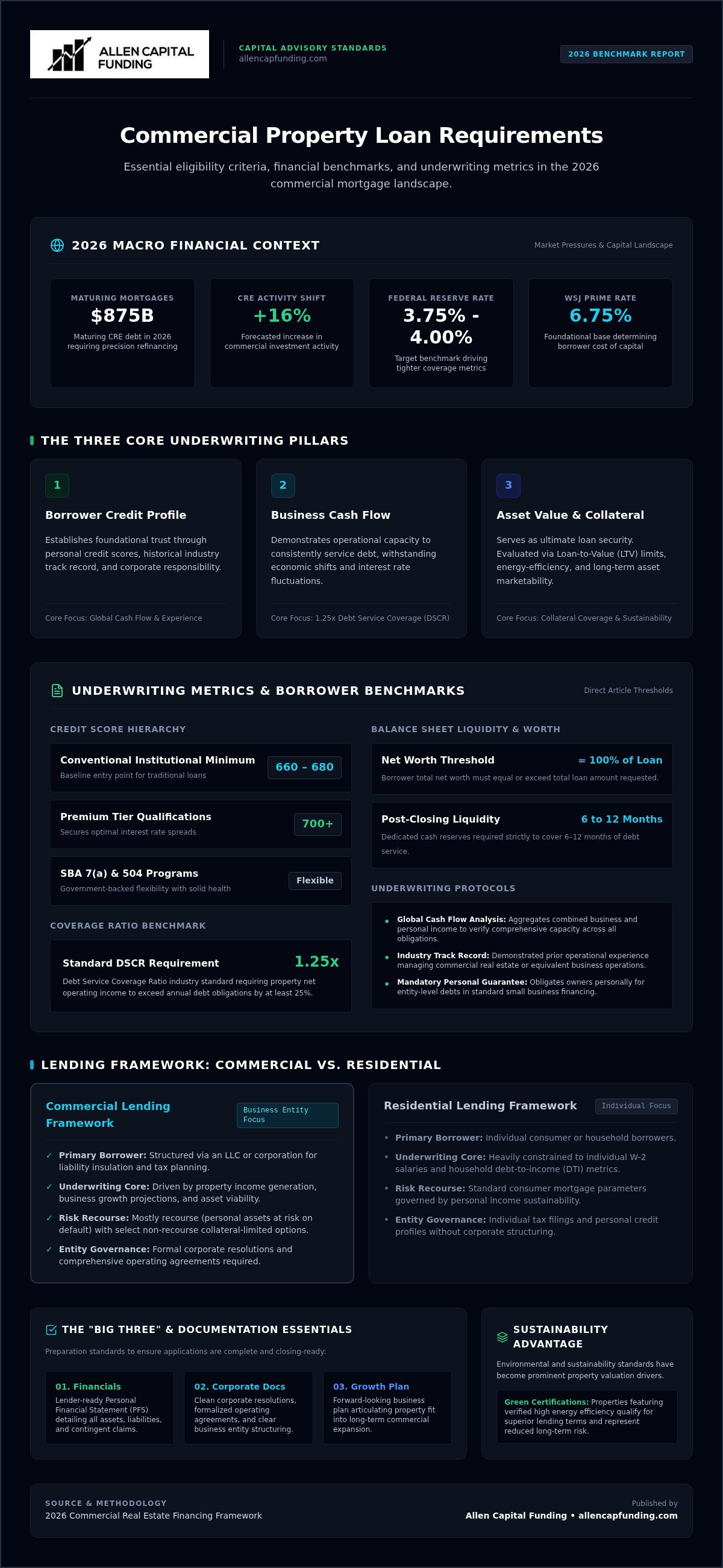
Success in this environment rests on three main pillars. First, the borrower's credit profile establishes foundational trust. Second, the business cash flow proves your ability to service debt consistently. Third, the asset value provides the ultimate security for the loan. Meeting these commercial property loan requirements involves aligning your acquisition with broader market trends, such as the 16% increase in CRE investment activity forecasted for this year. Lenders aren't just looking at your past; they're betting on your future performance.
Commercial vs. Residential: The Risk Paradigm
Residential loans focus on your personal salary and household debt. Commercial lending is fundamentally different. Lenders analyze the property's income-generating potential above all else. The primary borrower is usually a business entity, like an LLC, rather than an individual. Using a business entity allows for more sophisticated tax planning and liability protection. Lenders expect to see clear corporate resolutions and operating agreements. Most commercial loans are recourse, meaning the lender can pursue the borrower's other assets if the property value fails to cover the debt, while non-recourse loans limit the lender's recovery to the collateral itself.
The 2026 Economic Outlook for Borrowers
The current environment is dynamic and requires proactive planning. With the Federal Reserve setting interest rates between 3.75% and 4.00% as of September 2026, debt-coverage requirements have tightened across the board. Lenders now scrutinize whether your cash flow can withstand potential rate fluctuations. With the Wall Street Journal Prime Rate at 6.75%, the cost of capital is a major factor in every deal. Environmental and sustainability standards have also moved to the forefront of property evaluation. Properties with high energy efficiency or green certifications often qualify for better terms because they represent lower long-term risk. If traditional real estate equity isn't enough to meet your goals, you might explore Asset-Based Lending for Small Business to unlock liquidity from other parts of your balance sheet.
Borrower Eligibility: The Personal and Business Credit Checklist
Lenders evaluate your financial track record before they look at the real estate. To satisfy commercial property loan requirements, you must prove personal and corporate responsibility. Conventional institutional lenders generally expect a minimum personal credit score of 660 to 680, though premium tiers often demand a score of 700 or higher. Government-backed options, like SBA 7(a) and 504 structures, offer more flexibility but still require solid credit health. Knowing how commercial real estate financing works helps you prepare for these specific benchmarks early.
Lenders look for a proven track record in the industry, often called the experience requirement. If you are buying a retail center, they want to see that you have successfully managed commercial real estate or a similar business model. Lenders use global cash flow analysis to combine your personal and business income, ensuring your total revenue can support all combined obligations. Common 2026 standards also dictate that borrowers maintain a net worth at least equal to the loan amount, alongside post-closing liquidity reserves covering 6 to 12 months of debt service payments.
Personal Credit and Guarantee Standards
Your personal credit score directly impacts your interest rate spread, with lower scores translating to higher risk premiums. A lender-ready Personal Financial Statement (PFS) must detail all personal assets, liabilities, annual income sources, and contingent liabilities. For small business commercial loans, a personal guarantee is almost always mandatory. This guarantee holds you personally liable for the debt if the business entity defaults on its payments. Reviewing your profile via a strategic Financial Check-Up can help identify potential credit roadblocks before you submit your formal application.
Business Financial Health Benchmarks
Lenders prefer stabilized businesses with a mature operational history. Most programs require a minimum of 2 years in operation under the same management to qualify for standard commercial rates. Entity-level debt-to-income ratios are heavily scrutinized to ensure the corporation is not overleveraged. During a property purchase, maintaining operational liquidity can become a challenge. Utilizing a flexible Business Line of Credit can help supplement your working capital, keeping your daily business operations running smoothly while your primary capital is deployed toward the real estate down payment.
The Property Pillar: Collateral and Valuation Requirements
Lenders view the property as their ultimate safety net. Loan-to-Value (LTV) ratios determine how much capital you must bring to the table. In 2026, typical LTVs range from 65% to 75%. However, these benchmarks vary significantly by asset class. Industrial properties often command higher leverage due to their stability, while office and hospitality assets might see lower caps around 60%. The SBA 504 loan program remains a powerful exception, offering up to 90% LTV for owner-occupied properties. This flexibility allows businesses to preserve working capital for growth rather than tying it up in equity.
Property resilience is now a non-negotiable part of commercial property loan requirements. Lenders prioritize modern infrastructure and energy efficiency. They want to ensure the building won't face functional obsolescence before the loan matures. Mandatory inspections now frequently include assessments of digital infrastructure and climate adaptation features. A property that demonstrates long-term durability is far more likely to secure favorable terms in a selective market.
The Critical Role of DSCR
The Debt Service Coverage Ratio (DSCR) measures the property's ability to pay for itself. You calculate it using this step-by-step formula: Net Operating Income (NOI) / Annual Debt Service. A 1.25x ratio is the standard benchmark for most conventional lenders. You can improve your DSCR by increasing rental income through lease escalations or by reducing operational expenses. A DSCR below 1.15x is a major red flag that signals the property may not generate enough cash to cover its debt obligations comfortably. Meeting this threshold is essential to satisfying modern commercial property loan requirements.
Appraisals and Environmental Assessments
Every institutional deal requires a Phase I Environmental Site Assessment (ESA). This report identifies potential contamination or liability issues that could threaten the asset's value. Lenders also focus on the distinction between "as-is" and "as-stabilized" values. Renovation loans rely on the projected value after improvements are finished, while standard acquisitions focus on current market data. Understanding these valuation nuances is key to a successful closing. For a deeper look at property-specific tactics, consult our Commercial Real Estate Strategic Funding Guide.
The Essential Documentation Checklist for 2026 Applications
Preparation is the difference between a funded deal and a declined application. Lenders require a deep dive into your history to verify that you meet all commercial property loan requirements. The foundation of this process is the "Big Three," which consists of three full years of federal tax returns for both you and your business entity. These records demonstrate long-term stability and earnings consistency. You must also provide interim financial statements, specifically a current Profit & Loss (P&L) and a Balance Sheet. Lenders typically request 3 to 12 months of recent bank statements to verify liquid cash reserves and daily cash flow management.
Property-specific documentation is equally vital. You must present a current rent roll and copies of all existing leases to prove income reliability. Lenders will also scrutinize property tax bills to ensure there are no outstanding liens or unexpected carrying costs. From a legal perspective, you need your Articles of Incorporation, Operating Agreements, and your EIN confirmation. These documents establish the legal authority of the borrowing entity and its stakeholders.
Financial Record Organization
Clean books are the fastest route to a loan approval. Lenders look for year-to-date (YTD) comparisons to see how your current performance stacks up against previous years. This helps them identify growth trends or potential red flags early. A critical part of this process involves identifying "add-backs." You can add non-cash expenses like depreciation or one-time interest payments back into your income to show your true cash flow potential. Organizing these details ahead of time prevents delays during the underwriting phase.
Operational and Legal Paperwork
If you are an investor, you must provide a Schedule of Real Estate Owned (SREO). This document lists all other properties you own, their current debt, and their equity positions. Lenders also require management resumes for all key stakeholders to verify industry expertise. Before you start gathering these documents, it's a strategic advantage to undergo a professional review. You can schedule a Financial Check-Up to ensure your documentation pack meets the highest commercial property loan requirements before you submit your application.
Navigating Complex Requirements with Allen Capital Funding
Expertise matters when the stakes are high. Allen Capital Funding serves as a strategic guide, removing the barriers between your business and the capital it needs. Traditional bank branches often operate with rigid, one-size-fits-all products that fail to account for the unique growth stages of a modern company. By partnering with a national broker, you gain access to a solution-focused ally that understands the intricacies of commercial property loan requirements across diverse lending environments. We focus on strategic growth rather than just checking boxes.
Speed and efficiency are critical in a market where 875 billion dollars in mortgages are maturing this year. Our modular process accelerates your time-to-funding by organizing your documentation into a closing-ready pack from day one. This proactive approach ensures that once a suitable lender is identified, the transition from application to approval is seamless. We position your business to draw capital strategically, ensuring you have the liquidity to scale after the real estate transaction is complete.
The Broker Advantage vs. Traditional Banks
Local banks are often limited to their own balance sheet capacity and internal risk appetites. Allen Capital Funding provides a broader spectrum of capital, ranging from specialized SBA 7(a) and 504 programs to asset-based private lenders. This variety allows us to tailor the loan structure to your specific five-year business plan. We reduce your rejection risk by pre-vetting every aspect of your application against current commercial property loan requirements. This dedicated oversight identifies potential hurdles, such as DSCR benchmarks or liquidity gaps, before a lender ever sees your file.
Next Steps: Your Strategic Funding Path
Your path to accelerated success begins with a clear understanding of your current financial standing. Booking a consultation for a comprehensive profile review allows our team to identify the most efficient capital path for your specific goals. To prepare for this initial call, ensure you have your "Big Three" documents ready: three years of tax returns, your current year-to-date Profit and Loss statement, and a recent Balance Sheet. Having these essentials at hand allows us to provide immediate, actionable feedback. We invite you to explore tailored capital solutions that move your business from its current state to its future potential.
Accelerate Your Path to Commercial Ownership
Navigating the 2026 lending environment requires more than just a strong balance sheet; it demands a proactive, strategic approach to preparation. You now have the definitive checklist to master current commercial property loan requirements, from hitting essential DSCR benchmarks to assembling a closing-ready documentation pack. Success in this selective market is won by those who treat the application process as a strategic growth milestone rather than a bureaucratic hurdle.
Allen Capital Funding stands ready to act as your dedicated guide throughout this journey. Our specialized team offers expert guidance on SBA 7(a) and 504 loan structures, as well as complex asset-based financing solutions. We provide national reach with tailored, local-feel support to ensure your capital structure aligns perfectly with your long-term business plan. Don't let opaque criteria or high down payment fears stall your momentum. Take the next step toward securing the capital your business deserves. Secure your strategic funding consultation with Allen Capital Funding today. Your future growth is our priority, and we're here to bridge the gap to your success.
Frequently Asked Questions
What is the minimum credit score for a commercial property loan in 2026?
Most lenders look for a minimum personal credit score between 660 and 680 to satisfy commercial property loan requirements in 2026. While some institutional partners demand a score of 700 or higher for premium pricing, government-backed programs like SBA loans offer more flexibility. Your credit health acts as the first gatekeeper in the approval process. Maintaining a clean profile ensures you access the most competitive interest rate spreads available in the current market.
How much down payment is typically required for a commercial building?
A down payment of 25% to 35% is typical for conventional commercial mortgages. This requirement changes significantly if you qualify for the SBA 504 loan program, which allows for a lower down payment of only 10% for owner-occupied properties. The specific amount depends on the property type and your business's financial strength. Lenders use these equity requirements to mitigate their risk and ensure you have a vested interest in the asset's success.
Can I get a commercial loan if my business is less than two years old?
You can secure financing for a newer business, but it often requires specialized loan products or higher collateral levels. Most lenders prefer a minimum of two years in operation to offer stabilized interest rates and standard terms. If your business is younger, we may explore asset-based lending or bridge loans to provide the necessary capital. These options focus more on the value of the real estate and your strategic growth plan than on long-term historical performance.
What is the Debt Service Coverage Ratio (DSCR) and why does it matter?
The Debt Service Coverage Ratio (DSCR) is a formula that compares your property's Net Operating Income to its annual debt obligations. Lenders use a standard benchmark of 1.25x to ensure the property generates enough cash to cover its own loan payments comfortably. A higher ratio indicates a lower risk of default, which often leads to better loan terms. It's a critical metric that helps lenders determine the maximum loan amount they are willing to provide.
Are requirements different for SBA 504 loans vs. conventional loans?
The primary difference lies in the occupancy rules and the leverage allowed for the borrower. SBA 504 loans are specifically for owner-occupied properties and offer up to 90% LTV, whereas conventional loans usually cap at 75% LTV and allow for investment properties. Conventional loans also offer more flexibility in how you use the funds. Choosing the right path depends on whether you intend to run your business from the building or use it as a passive income stream.
Do I need a personal guarantee for a commercial real estate loan?
A personal guarantee is almost always required for small business commercial loans. This legal agreement holds you personally responsible for the debt if your business entity fails to make payments. While some large-scale institutional deals offer non-recourse options, these are rare for individual entrepreneurs. Providing a guarantee builds lender confidence and is a standard part of meeting commercial property loan requirements for most national and local financial institutions.
What property types are the hardest to finance under current requirements?
Office buildings and hospitality properties are currently the most difficult to finance. Lenders have become highly selective with office space, often capping LTV at 60% to 65% in 2026 due to market stabilization trends. Hospitality assets often face stricter DSCR requirements, sometimes needing 1.40x or higher to offset the volatility of the industry. Multifamily and industrial sectors remain the most resilient, frequently receiving more favorable terms and higher leverage from national lenders.
How long does it take to gather and process all required documentation?
Gathering all required documentation typically takes two to four weeks if you have organized records, but the full process can take longer. The speed depends on how quickly you can produce the "Big Three" documents: three years of tax returns, interim financials, and property-specific leases. Our modular approach helps streamline this timeline by pre-vetting your documents. A dedicated broker acts as a facilitator, removing barriers and accelerating the path to a final closing.


Comments