


Commercial Equipment Finance: 2026 Guide for Business Owners
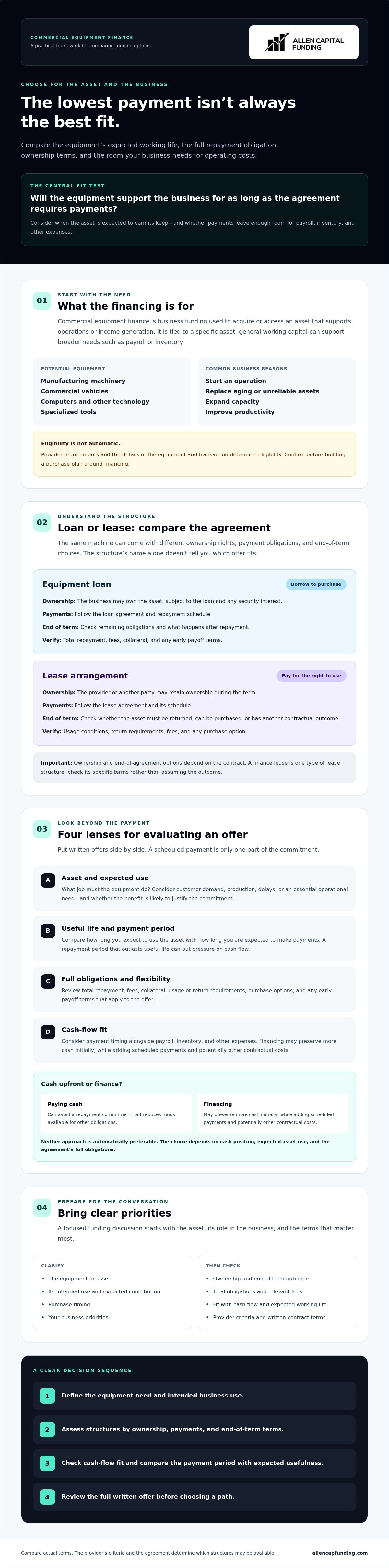
The right commercial equipment finance option isn’t necessarily the one with the lowest monthly payment. A repayment period that outlasts an asset’s useful life, or payments that leave too little room for operating costs, can put pressure on cash flow even when the purchase seems affordable. Start by considering how the equipment will support your business and when it is expected to earn its keep.
It’s natural to focus on purchase price and payment amount, but a useful comparison also accounts for the asset, how you plan to use it, the full repayment obligation, and how payments fit alongside payroll, inventory, and other expenses. A loan, lease, or other financing structure may suit different needs, so compare the actual terms rather than relying on the structure’s name.
This 2026 guide explains common commercial equipment finance structures and how to assess them against your business goals and the equipment’s expected working life. You’ll learn which terms to compare, how to consider cash-flow impact, and what information to prepare before speaking with a funding provider. With clear priorities, you can have a more focused conversation about funding options, including equipment financing guidance from Allen Capital Funding.
Table of Contents
What Commercial Equipment Finance Covers, and When Businesses Use It
Commercial equipment finance is business funding used to acquire or access equipment that supports a company’s operations or income generation. The funding is tied to a specific asset, unlike general working capital funding, which can help cover broader operating needs such as payroll or inventory. The agreement and funding provider determine the structure, payment obligations, and ownership outcome.
A business might explore financing when it needs an asset but prefers not to pay the full cost upfront. Depending on the arrangement, the business may borrow to purchase equipment or make payments for the right to use it. A finance lease is one type of lease structure. Check the contract for its terms and end-of-agreement outcomes rather than assuming how it works.
Which business assets may be considered for financing?
Potential assets include manufacturing machinery, commercial vehicles, computers and other technology, and specialized tools. A business may seek equipment to start an operation, replace aging or unreliable assets, expand capacity, or improve productivity. Eligibility depends on the provider’s requirements and the details of the equipment and transaction. Not every asset or business will qualify, so confirm eligibility before building a purchase plan around financing.
When does equipment finance make strategic sense?
Start with the job the equipment needs to do. Will it help meet customer demand, increase production, reduce delays, or fulfill an essential operational requirement? Then consider whether those benefits are likely to justify the payment commitment for as long as you expect to use the asset. Equipment with uncertain use or limited value to the business may not support a financing obligation.
Next, compare financing with paying upfront. Paying cash can avoid a repayment commitment, but it also reduces funds available for payroll, inventory, and other obligations. Financing may preserve more cash initially, while adding scheduled payments and potentially other contractual costs. Neither approach is automatically preferable. The right choice depends on your cash position, expected use of the asset, and the agreement’s full obligations.
Before moving forward, compare the equipment’s expected working life and contribution to the business with the proposed payment period. Allen Capital Funding offers equipment financing and guidance on business funding needs. A conversation can help you explore potential options, but the provider’s current criteria and the agreement determine which structures may be available.
How Commercial Equipment Financing Structures Differ
Two offers can fund the same machine but create different ownership rights, payment obligations, and end-of-term choices. With a loan, the business borrows to purchase the asset and repays the debt under the contract. With a lease, the business pays for the right to use the equipment, while ownership and any purchase option depend on the lease terms. Neither structure is automatically cheaper or more tax-efficient. Compare the full agreement with how long you expect to use the asset and whether owning it matters to your business.
Equipment loan or lease: what should a business compare?
Review written offers side by side, not just by scheduled payment. The table outlines common points to check; actual terms vary by provider and contract. For more on borrowing to purchase business assets, see this commercial equipment loans guide.
A business that expects to keep equipment throughout its useful life may prioritize a path to ownership. A company that values flexibility or expects to change its equipment may assess lease terms differently. For some long-term fixed-asset needs, the U.S. Small Business Administration provides information on SBA 504 loans, including their use for major fixed assets. Program requirements apply, so verify whether a particular project fits.
How collateral and contract terms affect the decision
The financed equipment may serve as collateral, depending on the lender’s requirements and the agreement. Read the contract for the payment schedule, fees, default provisions, insurance responsibilities, and end-of-term obligations. Ask what happens if payments are missed or the equipment is sold, replaced, or no longer needed. The contract, lender policies, and your business circumstances all shape the arrangement.
Tax treatment, accounting, and legal obligations can differ by structure and situation. Have qualified professionals review those questions before signing. To organize your funding priorities, you can explore equipment financing guidance from Allen Capital Funding and discuss options without assuming a particular structure or outcome.
How to Evaluate Commercial Equipment Finance Beyond the Payment
A manageable payment is only one part of an offer. Compare the full commitment with the equipment’s expected contribution and your business’s ability to make payments as conditions change. The lowest payment alone doesn’t identify the best fit; the right choice balances total obligations, cash-flow timing, flexibility, and the asset’s usefulness.
Use the same assumptions when reviewing written offers. Confirm that each quote covers the same equipment, upfront contribution, repayment period, and additional charges. Verify figures and contract terms directly with the provider, since labels and payment summaries may not show every obligation.
Total obligations: Review the full repayment amount, fees, required upfront funds, and any end-of-term costs.
Payment timing: Compare due dates and frequency with the timing of customer receipts and other expenses.
Flexibility: Check whether the agreement allows changes, early payoff, or other adjustments, and what conditions or costs apply.
Asset usefulness: Assess how the equipment supports revenue, efficiency, or essential operations during the commitment period.
For businesses considering a government-backed alternative for major fixed assets, the U.S. Small Business Administration explains eligible uses and requirements for SBA 504 loans. Compare the program’s fit with other written offers rather than assuming one structure suits every purchase.
Does the equipment’s useful life align with the financing term?
Compare the proposed repayment period with how long your business expects to use the asset. Account for maintenance needs, potential downtime, planned upgrades, and replacement timing. Clarify what happens at the end of the agreement, especially if payments continue after the equipment is no longer productive or if return, purchase, or other obligations apply. Base your estimate on the particular asset and operating conditions, not a general lifespan assumption.
Can projected cash flow support the commitment?
Map each proposed payment against existing debt, payroll, inventory, and other operating expenses. Use realistic revenue expectations, not only an optimistic forecast. If income varies with seasons or customer demand, check whether payment dates align with stronger cash periods and whether the agreement offers flexibility.
Test a downside scenario as well. What happens if revenue falls short or the equipment is unavailable during repairs? If the commitment strains cash under those conditions, revisit the amount, timing, or structure before proceeding. Allen Capital Funding can help businesses consider funding needs and equipment financing options. Explore equipment financing guidance as you prepare to compare offers.
How to Prepare for a Commercial Equipment Finance Application
A clear application starts with the business need, not a promise of eligibility or approval. Identify the equipment, explain how you plan to use it, and set a realistic purchase timeline. Then organize the information a funding provider may need to understand the asset and your business. Requirements vary by provider, transaction, and applicant, so confirm the current checklist before sending sensitive records.
What information should a business organize first?
Start with the equipment details. Gather a vendor quote or a clear description of the asset, vendor contact information if available, and a short explanation of how the equipment will support operations. Note whether the purchase is for replacement, expansion, or another business need, and when you expect to acquire it.
Next, prepare to discuss the company’s financial position and ownership. Providers may request current business financial information or details about owners, but the specific records depend on their process and the application. Use this checklist to identify what you can assemble now and what to verify:
Organize now: Equipment quote or description, intended use, purchase timing, and vendor details when available.
Have ready to discuss: Current business financial information and ownership details.
Verify with the provider: Which financial records, identity documents, ownership disclosures, or additional materials are required, in what format, and how to submit them.
Application preparation in brief: define the asset and its purpose, organize the information you have, then confirm the provider’s exact document requirements before submitting records.
What should owners ask before accepting an offer?
Request a complete written breakdown before agreeing to terms. Check total obligations, every stated fee, payment amounts and due dates, conditions that could change payments, and end-of-term responsibilities. Ask how collateral is handled, whether a personal guarantee applies, and what the agreement says about early payoff. Terms vary, so don’t rely on verbal summaries or assumptions based on another provider’s offer.
Compare the written offer with your equipment quote and business plans. If a term is unclear, ask for an explanation in writing. Legal, tax, and accounting implications may depend on the agreement and your circumstances, so consult qualified professionals when needed before signing.
Allen Capital Funding provides guidance on business funding options, including equipment financing. Discuss your equipment financing needs with the team as you prepare questions and organize information for a funding conversation.
Choosing a Commercial Equipment Finance Path for Your Business
A sound decision starts with the asset and ends with a careful review of the written offer. Commercial equipment finance should support a clear business need, fit your cash-flow plan, and make sense for how long you expect to use the equipment. Don’t decide based on one appealing feature, such as a lower scheduled payment. Compare total obligations, ownership outcomes, timing, and flexibility against your operational priorities.
Use this sequence to keep the decision focused:
Define the asset need: Identify the equipment, why the business needs it, and when it must be available.
Compare structures: Consider how ownership, payment terms, and end-of-term responsibilities match your plans.
Check cash-flow fit: Map payments against normal obligations and less favorable revenue scenarios.
Review the offer: Confirm all costs, conditions, collateral terms, and responsibilities in writing.
Choose a next step: Resolve open questions, seek professional review where useful, and proceed only when the terms are clear.
For a broader view of how equipment decisions connect to business growth planning, read the strategic business equipment financing guide. Use its planning perspective alongside the details of your asset, business, and funding offer.
When can a funding conversation help?
A conversation can help you organize the need and explore which funding options may fit the details you share. It can’t guarantee approval, a particular rate, or a funding timeline. Before speaking with a provider, prepare the equipment description or quote, intended use, purchase timing, and questions about payments or contract terms. Allen Capital Funding offers guidance on tailored business funding options, and prospective clients can book an online consultation.
What is the next step after comparing options?
List any unresolved points, then gather the relevant equipment and business details for follow-up. Ask the provider to clarify unclear terms and review the final agreement carefully before signing. If legal, tax, or accounting questions arise, consult a qualified professional.
With your priorities and questions in hand, you can explore available business funding options with Allen Capital Funding. The goal is an informed discussion and a financing path that aligns with your asset needs and business plans.
Make Your Next Equipment Decision With Confidence
The right commercial equipment finance path starts with the asset’s role in your business, then considers how ownership terms, total obligations, and the payment schedule fit your plans. Look beyond the monthly payment and compare written offers using the same assumptions. Before contacting a funding provider, prepare the equipment details, intended use, purchase timing, and questions about terms and required documents.
Equipment financing is among Allen Capital Funding’s business funding offerings. Its team provides guidance on tailored capital solutions, and online consultations are available to explore your funding needs. A conversation can help you consider options, without guaranteeing approval or particular terms.
Explore tailored business funding options with Allen Capital Funding and take a clear, informed next step toward equipping your business for what comes next.
Frequently Asked Questions
What is commercial equipment finance?
Commercial equipment finance is funding a business uses to acquire or access equipment for its operations. The asset might be machinery, a commercial vehicle, technology, or specialized tools. Unlike general working capital funding, which can support a range of business expenses, equipment financing is connected to a specific asset. The agreement determines payment obligations, collateral requirements, and whether the business may own the equipment during or after the financing term.
How does commercial equipment financing work?
A business identifies the equipment it needs and shares relevant details with a funding provider. If an offer is made and accepted, funding may support the purchase or provide access to the equipment through a lease arrangement. The business then follows the agreement’s payment schedule and other conditions. Terms, application requirements, and end-of-term outcomes vary, so review the written offer rather than assuming every provider uses the same process.
Is equipment financing different from an equipment loan?
Yes. Equipment financing is a broad term that can include different arrangements, while an equipment loan is one possible structure. With a loan, the business borrows to purchase the asset and repays according to the loan agreement. A lease generally provides use of equipment under a contract, with ownership and end-of-term options depending on its terms. Compare ownership, total obligations, payment timing, and final responsibilities before choosing.
Can a small business qualify for commercial equipment finance?
A small business may be considered, but eligibility isn’t guaranteed. Funding providers can assess factors such as the business’s financial position, credit history, time in operation, equipment details, and ability to meet payments. Criteria and documentation requirements vary. Before applying, clarify the equipment’s intended use, gather a quote or description if available, and ask the provider which records it needs to evaluate your specific request.
How much does commercial equipment finance cost?
The cost depends on the specific offer and may reflect the financing structure, repayment period, business and asset details, and any required fees or upfront contribution. There isn’t one universal cost for every business or piece of equipment. Compare written offers using the same purchase assumptions, and check the total repayment obligation, payment schedule, fees, and any end-of-term costs. Confirm all figures and conditions directly with the provider.
What should I compare before choosing equipment financing?
Compare more than the scheduled payment. Review total obligations, fees, payment timing, flexibility, collateral terms, ownership outcomes, and what happens at the end of the agreement. Consider whether the equipment’s expected usefulness and contribution to operations support the commitment. Check that offers cover the same asset and use consistent assumptions. Ask the provider to explain unclear terms, and seek qualified legal, tax, or accounting advice when needed before signing.


Comments