


Business Line of Credit vs Loan: 2026 Funding Guide
- anthonyarallen
- Aug 10
- 12 min read
Updated: Aug 14
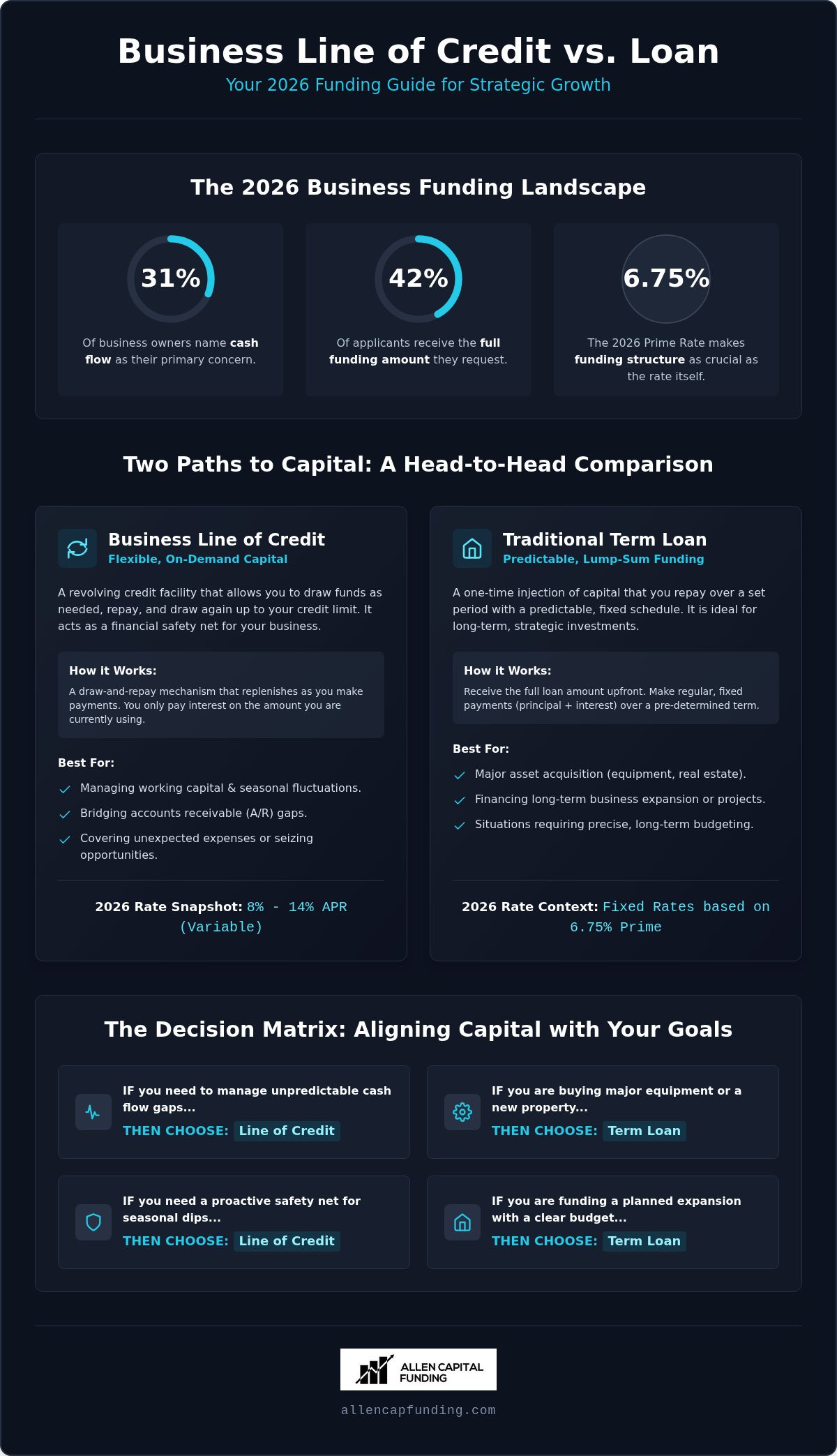
Recent data shows that 31% of small business owners currently name cash flow as their primary concern, yet only 42% of applicants receive the full amount of funding they request. It's frustrating to feel like your growth is stalled by rigid financial structures or unpredictable gaps between payables and receivables. You know your company needs capital to scale; however, the fear of over-leveraging debt often leads to hesitation. Choosing between a business line of credit vs loan shouldn't feel like a gamble with your company's future, especially with the 2026 Prime Rate holding steady at 6.75%.
This 2026 funding guide will help you master the critical differences between revolving credit and term loans to secure the optimal capital structure for your company's growth. We will break down current interest rate spreads, repayment schedules, and the strategic utility of each tool. You'll learn how to align your funding choice with your specific business goals, whether that means securing on-demand access to capital or establishing a predictable repayment plan for long-term expansion. By the end, you'll have the clarity needed to minimize borrowing costs and accelerate your success.
Table of Contents
Navigating the 2026 Business Funding Landscape: Line of Credit vs. Loan
The Strategic Power of a Business Line of Credit for Liquidity
Traditional Business Loans: Financing Long-Term Growth and Assets
The Decision Matrix: Choosing Between a Credit Line and a Loan
Securing the Right Capital with a Dedicated Funding Specialist
Navigating the 2026 Business Funding Landscape: Line of Credit vs. Loan
Choosing between a business line of credit vs loan is a strategic decision that goes beyond comparing interest rates. In the current 2026 market, where the Prime Rate sits at 6.75%, the "utility" of your capital often outweighs the decimal points on your APR. You need to decide if your business requires the immediate impact of lump-sum capital or the ongoing agility of revolving funds. Allen Capital Funding acts as a facilitator in this process, helping you identify which structure removes the specific barriers currently blocking your progress.
Market volatility in 2026 has made the choice of structure more critical than the rate itself. While a low rate is attractive, a rigid repayment schedule can be a liability if your revenue fluctuates. Conversely, a flexible line might have a slightly higher variable rate but provides the liquidity needed to seize sudden opportunities. We focus on "Capital Utility," ensuring the money you borrow works as hard as possible for your specific lifecycle stage. By bridging the gap between these two options, we help you avoid the trap of over-leveraging while maintaining the cash flow necessary for accelerated success.
What is a Traditional Business Loan?
A traditional term loan provides a one-time injection of capital that you repay over a set period with a predictable schedule. These instruments, particularly SBA loans, offer long-term stability for companies looking to make significant moves. Because the repayment terms are fixed, you can budget with total precision for years into the future. A traditional term loan serves as the primary vehicle for major asset acquisition, such as purchasing heavy equipment or expanding into new real estate.
What is a Business Line of Credit?
Unlike a one-time loan, a business line of credit offers a draw-and-repay mechanism that replenishes as you make payments. This flexibility allows you to access funds on-demand and only pay interest on the specific portion you use. Understanding what a business line of credit is helps you see it as a financial safety net rather than a static debt obligation. In 2026, lenders distinguish heavily between secured lines, which require collateral, and unsecured lines, which rely more on your credit score and AI-driven cash flow analysis. While bank-issued lines currently range from 8% to 14% APR, the true value lies in the speed of access and the ability to bridge cash flow gaps without reapplying for new debt.
The Strategic Power of a Business Line of Credit for Liquidity
Liquidity is the lifeblood of any scaling operation. While a term loan provides a fixed injection of capital, a line of credit offers a dynamic response to the unexpected. The most successful owners employ a "Safety Net" strategy. This involves establishing a line of credit before a financial need arises. Doing so ensures that when seasonal fluctuations hit or inventory surges occur, you have immediate access to capital. By the time you actually need the funds, the underwriting is already complete. This speed of execution allows you to pivot quickly without the weeks of waiting often associated with new loan applications. This proactive positioning transforms your balance sheet from a static document into a tool for operational excellence.
Choosing between a business line of credit and a business loan often comes down to how you plan to use the money. If your goal is to manage working capital during peak seasons, the revolving nature of a credit line is unmatched. You draw what you need, repay it, and the limit resets. This cycle is vital for businesses facing 30, 60, or 90-day gaps between delivering a product and receiving payment. It provides the flexibility to bridge those gaps without taking on permanent debt.
Revolving Credit for Operational Excellence
Many business owners use revolving credit to bridge accounts receivable gaps. It keeps operations running smoothly when clients are slow to pay. This agility is especially critical in 2026 as supply chain costs remain sensitive to inflation. Some credit line structures offer interest-only periods, which provide a significant advantage for preserving cash during tight months. Whether it's covering an unexpected payroll spike or an emergency repair, having this on-demand capital prevents you from depleting your essential reserves. It's about maintaining momentum. Short-term hurdles don't have to become long-term setbacks.
Unsecured vs. Secured Lines in 2026
In the current 2026 credit market, you will typically choose between secured and unsecured options. Secured lines require collateral, such as equipment or real estate, but they often come with higher credit limits and more favorable rates. Unsecured lines are a preferred choice for service-based businesses that lack heavy assets. Allen Capital Funding helps businesses with "challenged credit" find viable lines that still offer competitive terms. We act as your dedicated guide to ensure you don't over-leverage while still securing the flexibility you need. We prioritize speed and transparency in our process. If you're weighing a business line of credit vs loan for your next move, starting a conversation with a specialist can clarify the best path forward.
Traditional Business Loans: Financing Long-Term Growth and Assets
While the agility of revolving capital is essential for daily operations, long-term growth requires a different structural approach. Traditional business loans excel when you're funding ROI-positive investments that take years to fully realize their value. Unlike a line of credit, a term loan provides the total capital upfront, allowing you to execute large-scale expansions or acquisitions without delay. This structured debt offers fixed monthly payments, which simplifies long-term budgeting and protects your cash flow from the volatility of variable rates. When weighing a business line of credit vs loan, consider the "Matching Principle." This financial standard dictates that long-term assets should always be funded by long-term debt to maintain a healthy balance sheet.
Major Capital Expenditures and Asset Acquisition
Acquiring machinery, fleet vehicles, or commercial real estate requires a significant lump sum. For these large amounts, the interest rates on term loans are typically lower than those of credit lines. There's a strong synergy between term loans and equipment financing, as the asset itself often serves as collateral to secure the debt. This security reduces the lender's risk and results in more favorable terms for you. While the SBA notes that a revolving option is often a smart choice for your business when managing short-term needs, fixed loans are the superior choice for building permanent equity. They allow you to lock in capital at a specific cost, ensuring that your equipment or property pays for itself over time.
The Role of SBA Loans in 2026 Expansion
The SBA 7(a) and 504 programs remain the gold standard for established businesses looking to scale in 2026. These programs offer repayment terms that short-term lines simply can't match, such as 25-year terms for real estate and 10 years for working capital or equipment. Currently, fixed-rate SBA 7(a) loans range from 11.75% to 14.75%, providing a predictable ceiling on your borrowing costs. Navigating the rigorous SBA application process can be overwhelming for a busy owner. Allen Capital Funding acts as a dedicated guide, simplifying the paperwork and connecting you with the right lenders to accelerate your success. We help you determine the best business line of credit vs loan mix to ensure your expansion is both sustainable and well-funded. Our goal is to remove the barriers to capital so you can focus on your company's future.
The Decision Matrix: Choosing Between a Credit Line and a Loan
Selecting the right path requires a clear look at your timeline and the specific purpose of the funds. A simple "If/Then" framework helps clarify the decision. If your need is recurring or unpredictable, such as managing a sudden payroll spike or securing a "flash" discount from a vendor, a credit line is the logical choice. If your goal is a one-time, high-impact investment like an acquisition or a major facility upgrade, a structured term loan provides the necessary depth of capital. This distinction between a business line of credit vs loan ensures you don't use short-term tools for long-term problems, which can lead to significant cash flow strain.
Each option impacts your balance sheet and credit score differently. A line of credit affects your credit utilization ratio, similar to a credit card. High utilization can temporarily lower your score even if payments are on time. A term loan, conversely, adds to your total debt-to-income ratio but can build your score through consistent, long-term payment history. To see which structure fits your specific profile, you can schedule a Financial Check-Up with our team today.
When to Choose a Line of Credit
Managing unpredictable expenses is the primary strength of a revolving line. It's the ideal tool for businesses that need to seize "flash" opportunities, such as a sudden bulk discount on raw materials that only lasts 48 hours. It also supports short-term inventory purchases with quick turnover, allowing you to pay back the draw as soon as the stock sells. Many of our clients strive for the "Zero-Balance" goal. This involves keeping the line open and ready but unused, which ensures you have a safety net without incurring any interest costs until the moment you need it.
When to Choose a Business Loan
Executing a significant market expansion or buying another business requires the heavy-duty support of a term loan. These scenarios demand a large, one-time lump sum that a line of credit simply cannot provide. Term loans are also effective for debt consolidation. By rolling multiple high-interest short-term debts into a single, lower-rate loan, you can significantly lower your monthly overhead. The "Predictable Growth" goal is achieved by locking in rates for 5 to 10 years, which protects your business from future interest rate hikes and provides a clear roadmap for your financial future.
Securing the Right Capital with a Dedicated Funding Specialist
Dealing with a direct lender often limits your options to their specific risk appetite. If your profile doesn't match their internal criteria, you face an immediate rejection. Allen Capital Funding operates as a national brokerage, acting as a proactive ally rather than a gatekeeper. We leverage a vast network of partners to find the best terms for your unique situation. This approach removes the friction of submitting multiple applications and managing redundant paperwork. By working with a specialist, you gain an advocate who understands the nuances of a business line of credit vs loan and how they can coexist within a single capital stack.
Our proprietary Financial Check-Up identifies the exact blend of products your company needs to thrive. It's not just about finding a loan; it's about optimizing your entire financial structure. We analyze your cash flow velocity and growth goals to determine if you need the immediate firepower of a term loan, the flexible safety net of a credit line, or a combination of both. This strategic consultation removes the guesswork and ensures you aren't over-leveraging one area of your business to support another. We act as a bridge between your current state and your future goals, simplifying the path to progress.
The Brokerage Advantage in 2026
A national brokerage offers reach that local banks simply cannot match. We provide access to specialized products like factoring and purchase order financing, which are often essential for businesses with rapid turnover or large contracts. Our team advocates for your business, presenting your financial story to lenders in the most persuasive light possible. This advocacy often leads to more competitive rates and higher approval limits. You benefit from our national perspective without being restricted by local geographic constraints or a single lender's rigid box. We focus on speed and strategic advantage to keep your growth on track.
Take the Next Step Toward Accelerated Success
Preparing your financial profile is the first step toward a successful application. Gather your latest tax returns, profit and loss statements, and a clear breakdown of your accounts receivable. During your initial consultation, we will discuss your immediate capital needs and your long-term expansion goals. We focus on clarity and efficiency, moving you quickly from identifying a need to implementing a solution. Our goal is to remove barriers and act as your dedicated guide in the complex world of finance. Don't let capital gaps slow your momentum. Book a Strategic Financial Consultation with Allen Capital Funding to secure the funding your business deserves.
Accelerating Your Success with Strategic Capital
Mastering the choice between a business line of credit vs loan is the first step toward building a resilient financial foundation. You now understand how revolving credit provides the liquidity needed for operational agility, while term loans offer the structured stability required for major asset acquisition. The key is to stop viewing capital as a simple expense and start seeing it as a strategic tool for growth. By aligning your funding structure with your specific business lifecycle, you remove the barriers that prevent you from scaling.
Allen Capital Funding acts as your dedicated guide, providing expert guidance through the complex SBA and commercial lending landscape. We offer access to a national network of tailored funding options designed to support your long-term strategic goals. Our team focuses on finding the right blend of products to minimize your borrowing costs and maximize your potential. Don't let financial complexity slow your momentum. Secure your strategic funding with a custom capital solution from Allen Capital Funding today. Your company's future is within reach, and we are here to help you bridge the gap.
Frequently Asked Questions
Is it better to have a business line of credit or a loan for a startup?
A business line of credit is generally more effective for startups managing variable operating costs or unpredictable cash flow gaps. It provides a flexible safety net as you establish your revenue patterns and build a credit history. If your startup requires a massive upfront investment in heavy machinery or real estate, a term loan is the superior choice. Matching the capital structure to your specific startup stage prevents early over-leveraging.
Can I have both a business loan and a line of credit at the same time?
Yes, many successful companies utilize both products simultaneously to create a balanced capital stack. You might use a term loan to fund a major facility expansion while maintaining a line of credit for daily working capital needs. This combination ensures you have the long-term debt for assets and the short-term liquidity for operations. We often help clients layer these products to maximize their strategic advantage and financial flexibility.
How do interest rates differ between a line of credit and a term loan in 2026?
Secured lines of credit from banks currently feature interest rates between 8% and 14% APR. Unsecured lines are slightly higher, typically ranging from 10% to 16% APR. Traditional bank term loans show a broader spread from 8% to 17.25%. This comparison shows that the business line of credit vs loan decision depends heavily on whether you prioritize a lower fixed rate or the utility of revolving access.
What credit score is needed for a business line of credit vs a loan?
A personal FICO score of 720 or higher is typically required to access the most competitive rates for both products. While SBA loans now require a minimum SBSS score of 165, many online lenders offer lines of credit to owners with scores in the mid-600s. We recommend a professional Financial Check-Up to determine exactly where your credit profile stands. This step helps you target the lenders most likely to approve your request.
Does a business line of credit require collateral like a traditional loan?
Not always, as many lenders offer unsecured lines of credit based on your company's cash flow and credit strength. Secured lines do require collateral, such as inventory or accounts receivable, but they often provide higher limits and lower interest rates. Traditional term loans almost always require some form of asset backing to secure the lump sum. Choosing the right structure depends on your available assets and your comfort with pledging them.
How fast can I get funding for a line of credit compared to an SBA loan?
You can often secure a line of credit from an online lender within 24 to 48 hours of your application. This rapid turnaround is a major advantage for urgent operational needs or sudden opportunities. SBA loans are much slower, often taking several weeks or months to reach the funding stage. Choosing between a business line of credit vs loan often depends on how quickly you need the capital to move your business forward.
What happens if I don't use my business line of credit for several months?
Your line of credit typically remains open and available for future use even if the balance stays at zero. Some lenders may charge a small annual maintenance fee or an inactivity fee to keep the account active. It's a good practice to draw a small amount occasionally and repay it to demonstrate active management. This ensures the safety net is ready when a genuine financial emergency or growth opportunity arises.
Are there hidden fees associated with business lines of credit?
Common fees include annual maintenance charges, draw fees each time you access funds, and late payment penalties. Some online lenders also charge "origination fees" when the line is first established. It's vital to review the total cost of capital rather than just the interest rate before signing any agreement. We help you identify these costs upfront to ensure full transparency and prevent any surprises that could impact your bottom line.


Comments