


Business Line of Credit Requirements: 2026 Strategic Guide
- anthonyarallen
- 5 days ago
- 11 min read
What if the secret to securing flexible capital isn't just about having a perfect balance sheet? Many entrepreneurs find themselves stuck in a loop of application stress, fearing that a single credit pull rejection will derail their growth plans. You likely feel the weight of varying business line of credit requirements between traditional banks and modern fintech lenders. It's frustrating to gather weeks of documentation only to realize you applied for the wrong type of credit line for your specific situation.
You deserve a clear path to funding that respects your time and your business goals. This strategic guide helps you master the financial benchmarks and documentation needed to secure a flexible line of credit in today’s environment. We will break down the specific trade-offs between different credit options and provide a readiness checklist. By the end of this article, you’ll understand how to position your business for approval, even if you don't meet the rigid standards of large institutional lenders. We're here to bridge the gap between your current state and your future growth.
Table of Contents
The Logic Behind Business Line of Credit Requirements
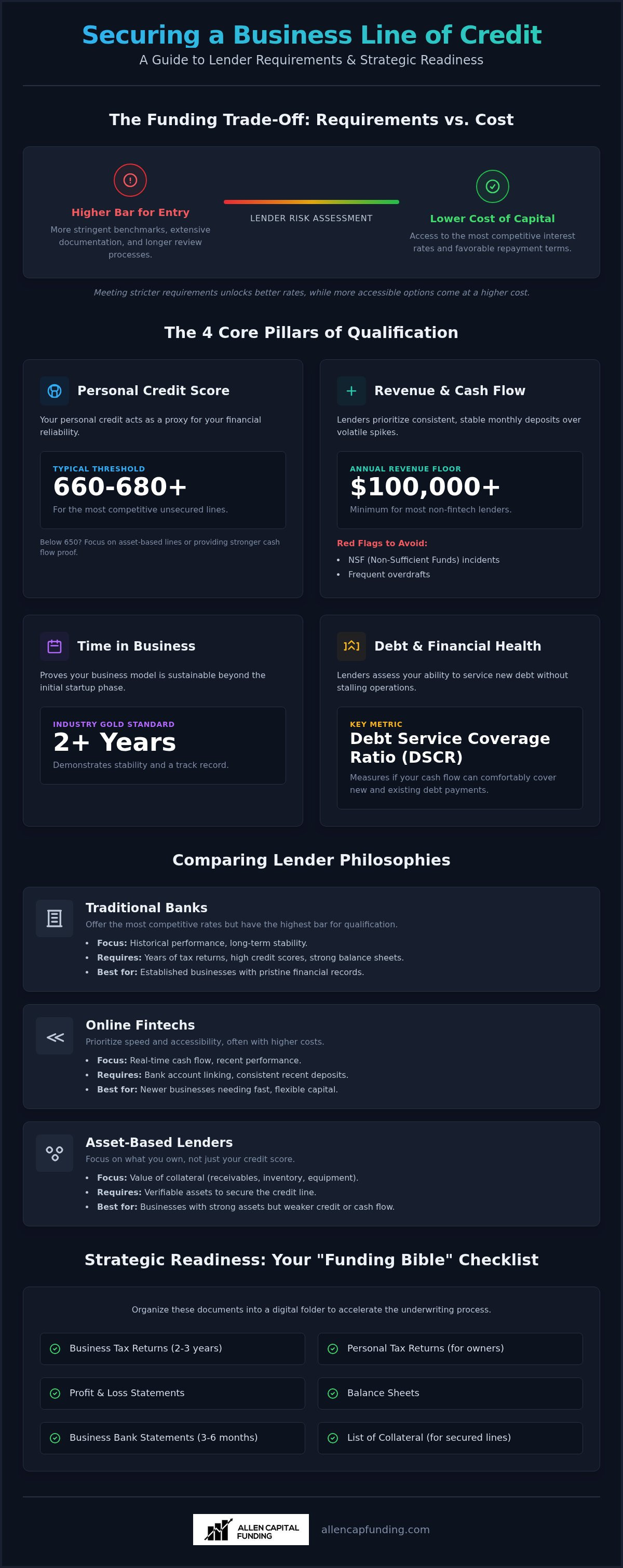
Understanding the "why" behind business line of credit requirements transforms the application process from a chore into a strategic move. Lenders establish these benchmarks to protect their own liquidity and ensure they only partner with sustainable operations. Unlike a standard loan where you receive a lump sum, a line of credit stays open for years. This creates an ongoing exposure for the institution. They need to know that if you draw funds during a market dip, you have the structural strength to pay them back. Because the lender can't control when you take the money, they use strict business line of credit requirements to filter for reliability.
There is a direct trade-off between the depth of requirements and the cost of capital. If you meet the most stringent benchmarks, you unlock the lowest interest rates available. Conversely, if you need a path with fewer hurdles, you'll likely face higher fees or shorter repayment windows. Underwriters view revolving lines differently than term loans because of the "evergreen" nature of the debt. Your credit limit isn't just a random number. It's a calculated figure based on how much debt your monthly cash flow can comfortably service without stalling your operations.
Risk vs. Reward in Revolving Capital
Lenders view revolving capital as higher risk than fixed-term loans. With a term loan, the bank knows exactly how much is at stake from day one. With a line of credit, your debt level fluctuates based on your own decisions. Underwriters look closely at your draw history and repayment behavior. They want to see that you use the capital for growth or bridging specific gaps, not as a permanent crutch for an unsustainable business model. In the 2026 lending environment, lenders prioritize businesses that demonstrate consistent, predictable revenue over those with volatile spikes.
Lender Types and Their Varying Philosophies
Traditional Banks: These institutions offer the most competitive rates. They maintain a high bar for qualification, often requiring years of tax returns and high personal credit scores.
Online Fintechs: These lenders prioritize speed and accessibility. They often have a lower bar for entry but charge moderate to higher costs. They use real-time data to assess your bank health rather than just looking at past years.
Asset-Based Lenders: These specialists focus on what you own. They leverage your accounts receivable, inventory, or equipment to secure the line, making them a strong option if your credit score isn't perfect.
The Core Financial Pillars of Qualification
Meeting business line of credit requirements involves more than just having a profitable year. Lenders evaluate four specific pillars to determine your eligibility: credit history, revenue, time in business, and debt ratios. These metrics allow underwriters to predict how your company will perform under the pressure of revolving debt. By preparing these areas in advance, you position yourself as a low-risk partner worthy of competitive rates. It's about showing that your business has the structural integrity to handle capital responsibly.
Credit Score Realities for 2026
In 2026, a personal FICO score between 660 and 680 is the typical threshold for the most competitive unsecured lines. Even though you're seeking capital for a company, your personal credit acts as a proxy for your reliability. Lenders believe that the way you manage personal debt reflects how you'll handle business capital. If your score sits below 650, don't panic. You can still find a path to funding by focusing on asset-based lines or providing a larger volume of bank statements to prove cash flow strength. Improving your utilization rate and fixing reporting errors are fast ways to boost your score before an application.
Revenue and Cash Flow Stability
While annual gross revenue matters, underwriters prioritize cash flow stability. They want to see consistent monthly deposits rather than a single, massive invoice once a quarter. Most non-fintech lenders look for a $100,000 annual revenue floor to consider an application. They also scrutinize your bank statements for "NSF" incidents or frequent overdrafts. These red flags suggest that your business struggles with daily liquidity, which makes a revolving line feel like a risky bet for the lender. Knowing how to get a business line of credit requires showing that your business generates enough surplus to cover new interest payments comfortably.
Time in business remains a critical factor, with the two-year mark serving as the industry gold standard. This milestone proves your model is sustainable beyond the initial startup phase. Additionally, lenders calculate your Debt Service Coverage Ratio (DSCR). They generally look for a ratio of 1.25 or higher, meaning your business earns $1.25 for every $1.00 of debt you owe. If your current ratios are tight, a financial check-up can help you identify which areas of your balance sheet need adjustment to meet lender standards.
Comparing Requirements: Secured vs. Unsecured Lines
Evaluating business line of credit requirements through the lens of collateral can save you weeks of wasted effort. Choosing between a secured and unsecured line is a strategic decision that depends on your balance sheet. Unsecured lines rely entirely on your credit strength and historical revenue. They are faster to close because they don't require asset appraisals or complex valuation processes. However, "unsecured" is often a misnomer in the lending world. Most lenders still require a personal guarantee from any owner with more than a 20% stake. This means you remain personally liable if the business fails to pay. Additionally, lenders often file a UCC-1 statement. This public notice "tags" your business assets, giving the lender a legal claim if you default. It essentially creates a lien on your business property even if the line itself isn't tied to a specific piece of equipment.
When to Choose a Secured Line of Credit
Secured lines are often the best path for businesses with heavy inventory or significant unpaid invoices. By leveraging your balance sheet liquidity, you can often secure lower interest rates and higher credit limits than an unsecured option would allow. This model of asset-based lending for small business bypasses traditional credit score hurdles by focusing on the value of the collateral. If you pursue an accounts receivable (AR) backed line, prepare to provide detailed AR aging reports. Lenders analyze these to ensure your customers have a history of paying on time, as your line's limit will fluctuate based on these active invoices. Using equipment or real estate as leverage can also unlock capital that would otherwise remain dormant.
The Burden of Proof for Unsecured Capital
Unsecured business line of credit requirements are typically much stricter than their secured counterparts. Because there is no physical collateral to seize, lenders offset their risk with higher FICO score demands, usually 680 or above. They also look closely at your industry via SIC codes. Some sectors, like construction or high-volume retail, are viewed as higher risk due to market volatility. This may lead to lower approval rates or smaller credit limits for businesses in those fields. While unsecured lines offer the advantage of speed and less paperwork, they generally cap out at lower amounts. If you need several hundred thousand dollars for a major expansion, a secured line might be the only way to reach that capital threshold without an impeccable credit profile. Understanding these trade-offs ensures you don't waste time on an application that doesn't fit your business structure.
Strategic Readiness: A Documentation Checklist
Organizing your financial life before you apply is the single best way to avoid rejection. Think of this process as building a "Funding Bible." This is a central digital repository for every record a lender might request. When you meet business line of credit requirements with a complete, organized package, you signal that your operation is professional and transparent. Start by ensuring your EIN is active and your business structure is formal, such as an LLC or Corporation. Lenders rarely extend revolving credit to sole proprietorships without a clear legal separation. You must also identify and prepare documentation for all majority owners. Anyone with a 20% stake or more will likely need to provide personal financial data and a guarantee.
Essential Document Preparation
Lenders prioritize current data over historical projections. You should have the last 3 to 6 months of business bank statements ready, including every single page. Redacted or missing pages are an immediate red flag. You'll also need the last 2 years of federal business and personal tax returns. If you are applying mid-year, interim financial statements are non-negotiable. These include your current Profit and Loss (P&L) statement and Balance Sheet. Accuracy here is vital. If your internal books don't match your tax returns, underwriters may suspect poor management or even fraud. Clean books show that you understand your margins and can handle the responsibility of a revolving line.
The "Soft" Requirements Lenders Look For
Beyond the numbers, lenders evaluate your strategic intent. A clear "Use of Funds" statement explains exactly what the capital will achieve. Are you bridging a 30-day gap in accounts receivable or purchasing bulk inventory for a peak season? Clarity builds trust. Lenders also check your digital footprint. They look at your website and online reputation to ensure you're a legitimate, active entity in your industry. Finally, ensure this business line of credit fits your 2026 growth map. A line of credit should be a tool for acceleration, not a desperate attempt to cover fundamental losses. If you're ready to organize your profile, you can secure your funding package by speaking with a dedicated advisor who understands these nuances.
Navigating Funding Hurdles with Allen Capital Funding
Securing capital shouldn't feel like a guessing game. Most business owners spend hours researching business line of credit requirements only to find conflicting information from different institutions. We act as your dedicated guide in this complex environment. Instead of submitting dozens of individual applications and risking multiple hard credit pulls, you submit one. We then match your specific profile to the lenders in our network that already value your industry and financial health. This model removes the fear of rejection because we only move forward with partners where you meet the baseline criteria. It's a partnership-driven approach that prioritizes your peace of mind.
We specialize in the complex maze of SBA Express and 7(a) requirements. These programs often have some of the strictest business line of credit requirements in the industry, involving layers of government-mandated paperwork. Our team handles the heavy lifting of documentation. We ensure your "Funding Bible" is presented in the best possible light to underwriters. If you have a non-traditional profile, such as lower personal credit or seasonal revenue spikes, we look for asset-based solutions that traditional banks often overlook. We see the potential in your business where others only see a credit score.
Strategic Financial Check-Ups
Our partnership starts with a comprehensive financial check-up. We pre-vet your application to protect your credit score from unnecessary inquiries. During this phase, we might determine that commercial equipment loans or factoring are better fits for your current goals than a standard line. We focus on your long-term capital strategy. We don't just want to facilitate a one-off transaction. We want to build a foundation for sustained, strategic growth that evolves with your company.
Accelerating Your Success
Efficiency defines our process. We understand that financial opportunities don't wait for slow bank committees. Our streamlined system moves you from application to draw faster than traditional institutional paths. You gain access to a national network of lending partners, giving you options that local branches simply can't match. This "Accelerated Success" model bridges the gap between your current needs and your future expansion. When you are ready to take the next step, Book a consultation with Allen Capital Funding today to see which solutions fit your business best.
Empowering Your Business for 2026 and Beyond
Securing a flexible line of credit is a strategic milestone that requires a blend of preparation and the right partnership. You've learned that business line of credit requirements aren't just barriers; they're benchmarks that help you identify which lender is the best fit for your current balance sheet. By organizing your documentation into a "Funding Bible" and understanding the trade-offs between secured and unsecured options, you position your company for accelerated success.
Navigating these financial standards doesn't have to be a solo journey. We provide expert guidance on SBA and commercial lending requirements to help you move from application to funding with confidence. Our team focuses on tailored funding solutions for strategic business growth, ensuring you find a path that respects your unique profile. When you're ready to unlock your next level of growth, secure your strategic capital with Allen Capital Funding. Your goals are within reach, and with the right preparation, the capital you need is ready when you are.
Frequently Asked Questions
Can I get a business line of credit with a 600 credit score?
Yes, but your options will likely be restricted to secured or asset-based lines. Traditional unsecured lines generally require scores above 660. With a 600 score, lenders focus on your collateral, such as accounts receivable or equipment, to mitigate risk. You'll likely face higher interest rates or more frequent reporting requirements. Focusing on your cash flow stability can help offset a lower personal score during the underwriting process and improve your chances.
What are the minimum revenue requirements for a business credit line?
Most non-fintech lenders require a minimum of $100,000 in annual gross revenue to qualify for a standard line. While some online lenders might accept lower figures, $100,000 is the industry baseline for significant growth capital. Underwriters also look for consistent monthly deposits of at least $8,000 to $10,000. This ensures your business has the daily liquidity needed to manage revolving debt payments without straining your operational cash flow.
Do I need to be in business for 2 years to qualify for a line of credit?
The two-year mark is the industry gold standard, but it's not the only path to funding. Many fintech and asset-based lenders offer lines to businesses with at least six months to one year of operational history. If you have less than two years in business, lenders will scrutinize your revenue growth and personal credit more heavily. Reaching the two-year milestone simply unlocks more competitive rates and higher credit limits from traditional banks.
What is the difference between a secured and unsecured business line of credit?
A secured line requires you to pledge assets like inventory or equipment as collateral, while an unsecured line relies on your credit strength. Secured lines often provide lower interest rates and higher limits because the lender has a fallback if you default. Unsecured lines offer faster access and less paperwork but demand higher credit scores. Both types usually require a personal guarantee, meaning you're personally responsible for the debt regardless of collateral.
What documents are required for a business line of credit application?
You'll typically need three to six months of bank statements, two years of tax returns, and current financial statements. These documents help lenders verify your cash flow and profitability. If you're applying for a secured line, you'll also need accounts receivable aging reports or equipment appraisals. Having your "Funding Bible" organized digitally ensures you can meet these business line of credit requirements quickly, which is essential for fast approval in a competitive market.
Is a personal guarantee always required for a small business line of credit?
Yes, nearly all small business lines of credit require a personal guarantee from owners with a 20% or greater stake. Even if the line is "unsecured," the lender wants assurance that you're personally committed to repayment. This guarantee allows the lender to pursue personal assets if the business cannot fulfill its obligations. It's a standard industry practice designed to align the interests of the business owner with the lending institution's security needs.
How long does it take to get approved once requirements are met?
Approval times vary by lender, ranging from a few hours to several weeks. Online fintech lenders often provide a decision within 24 to 48 hours once they have your bank data. Traditional banks and SBA-backed lines take longer, often requiring two to four weeks for a full underwriting review. Working with a broker can accelerate this process by ensuring your documentation is perfect before it reaches the lender's desk, preventing unnecessary delays.
Can a new business (startup) qualify for a line of credit in 2026?
Startups can qualify, but they face much stricter business line of credit requirements than established firms. Most lenders look for at least six months of revenue and a strong personal credit score above 680. If your business is brand new, you might need to explore equipment financing or credit lines specifically designed for startups. These often have lower initial limits that grow as you demonstrate a consistent history of on-time repayments.


Comments