


Business Line of Credit New York: A Strategic 2026 Funding Guide
In 2026, the most successful companies won't treat debt as a last resort but as a precision tool for aggressive market capture. Relying on traditional bank loans often means waiting weeks for an answer while your competitors move ahead. You likely already know that unpredictable cash flow cycles can stall even the most promising growth plans. It's frustrating to watch opportunities slip away because your capital is tied up in accounts receivable or seasonal inventory. You need a solution that moves as fast as the market does.
Securing a strategic business line of credit New York offers the flexibility you need to optimize liquidity without the burden of fixed monthly installments. This guide shows you how to secure immediate access to working capital and choose the right credit structure for your specific industry. We'll examine the benefits of interest-only payments on drawn amounts and how a tailored financial partnership helps you scale with confidence. By the end, you'll have a clear roadmap to bridge the gap between your current state and your future goals.
Table of Contents
What is a Business Line of Credit for New York and National Enterprises?
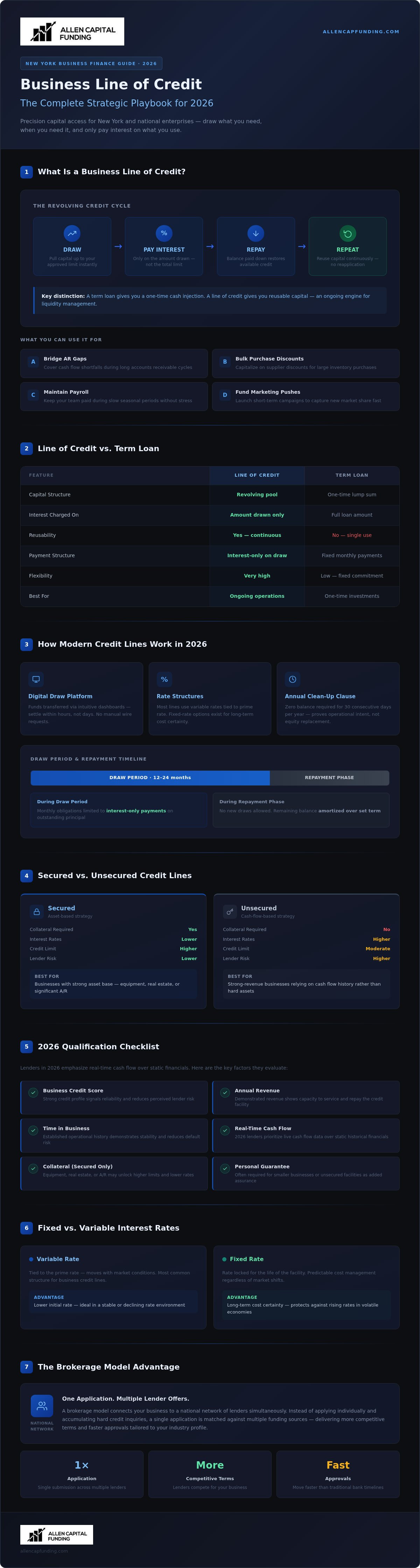
A business line of credit New York is more than just a loan; it's a dynamic financial tool designed for maximum flexibility. Think of it as a pre-approved pool of capital that sits ready for your command. You draw what you need, when you need it, up to a predetermined limit. The most significant advantage is the interest structure. You only pay interest on the funds you've actually withdrawn, not the total credit limit. As you repay the balance, those funds become available again, creating a continuous cycle of liquidity that fuels ongoing operations.
This revolving nature differentiates credit lines from traditional debt. While a standard loan provides a one-time injection of cash, a line of credit offers reusable capital. It's an essential resource for managing seasonal inventory surges or covering operational gaps that occur when your growth outpaces your current cash on hand. Having this safety net in place ensures that you never have to pass on a strategic opportunity because your capital is tied up in accounts receivable.
How Revolving Credit Supports Strategic Liquidity
The "draw, repay, repeat" cycle is the engine behind strategic liquidity. It allows you to maintain momentum during rapid growth phases without the stress of constant re-application. A line of credit acts as a reliable buffer against the unexpected. Whether it's a sudden equipment repair or an unplanned shift in market demand, you have immediate access to the necessary funds. This flexibility has a direct impact on your balance sheet health, as it shows lenders and partners that you have the liquidity to handle volatility. Use this tool to:
Bridge gaps during long accounts receivable cycles.
Capitalize on bulk purchasing discounts from suppliers.
Maintain payroll during slow seasonal periods.
Fund short-term marketing pushes to capture new market share.
Business Line of Credit vs. Traditional Term Loans
Term loans provide a lump sum of cash upfront, which is often ideal for fixed, one-time investments like real estate or heavy machinery. However, they lack the agility required for daily management. With a term loan, you start paying interest on the entire amount from day one. In contrast, a business line of credit New York offers superior operational agility. You don't have to pay for capital you aren't using.
Cost of capital considerations also favor the credit line for short-term needs. Many modern credit lines offer interest-only payment periods on the drawn amounts, keeping your monthly overhead manageable. While a term loan is a commitment to a single project, a line of credit is a commitment to your company's ongoing potential. Choosing the right one depends on your objective: stability for long-term assets or flexibility for the road ahead.
The Mechanics of Modern Business Credit Lines in 2026
The infrastructure of business finance has shifted toward instant accessibility. In 2026, digital draw platforms have replaced the manual wire requests of the past. Business owners now manage their liquidity through intuitive dashboards, allowing for immediate fund transfers that settle within hours. This speed is a defining feature of a modern business line of credit New York. While the speed of access has increased, the underlying cost management remains centered on interest rate structures. Most lines utilize variable rates tied to the prime rate, though fixed-rate options exist for those prioritizing long-term cost certainty.
Some agreements also include an "annual clean-up" clause. This requires the business to maintain a zero balance for a specific period, usually thirty consecutive days, once per year. This practice demonstrates that the credit line is being used for operational agility rather than as a permanent replacement for equity. To see how these mechanics apply to your specific industry, you can start with a Financial Check-Up to evaluate your current funding readiness.
Draw Periods and Repayment Cycles
The draw period represents the window where you can actively pull capital from your facility. This typically lasts between twelve to twenty-four months. During this time, your monthly obligations are often limited to interest-only payments on the outstanding principal. Once the draw period ends, the facility may enter a repayment-only phase. At this stage, you can no longer pull new funds, and the remaining balance is amortized over a set term. Understanding these cycles helps you avoid liquidity crunches when the facility transitions.
Collateral and Personal Guarantee Requirements
Lending standards in 2026 emphasize real-time cash flow over static historical data. To secure a business line of credit New York, lenders typically require tax returns, recent bank statements, and a debt schedule. For unsecured lines, a personal guarantee is a standard requirement. This ensures that the business owner remains committed to the facility's success. Secured lines may use business assets like accounts receivable or equipment as secondary security, which often unlocks higher credit limits and more favorable terms. This layered approach to security allows for more tailored funding solutions that reflect the actual strength of your operations.
Comparing Secured vs. Unsecured Business Lines of Credit
Choosing between a secured and unsecured business line of credit New York depends on your company's balance sheet and growth timeline. A secured line requires you to pledge specific assets as collateral. Conversely, an unsecured line relies almost entirely on your historical cash flow and creditworthiness. Both structures provide the revolving capital you need, but their impact on your risk profile and borrowing capacity varies significantly. Understanding these differences allows you to select the facility that best supports your 2026 expansion goals.
The risk profiles of these two options differ in how they affect your personal liability. While a secured line ties up specific business assets, an unsecured line often places more weight on the business owner's personal credit and a personal guarantee. This means that even without physical collateral, you remain committed to the repayment of the facility. Determining which structure aligns with your current asset base is a critical step in maintaining a healthy debt-to-equity ratio.
When to Leverage Asset-Based Secured Lines
Manufacturing, wholesale, and retail firms often find secured lines more advantageous. By leveraging accounts receivable, inventory, or heavy machinery, you can often unlock much larger capital pools than an unsecured option would allow. If you're looking to specifically acquire or use machinery as leverage, reading our Commercial Equipment Loans: A Strategic Guide can help you understand how physical assets strengthen your funding position.
Key benefits of secured credit lines include:
Access to higher credit limits based on professional asset valuation.
Potentially lower interest rates due to the reduced risk for the lender.
More flexible terms for businesses with a high volume of inventory or receivables.
The Speed Advantage of Unsecured Revolving Credit
Service-based businesses or consulting firms with minimal physical assets usually prefer unsecured revolving credit. The primary driver for approval here is consistent revenue and a strong track record of financial responsibility. Because there's no need for time-consuming asset appraisals or lien filings, the approval process is significantly faster. This speed makes it the ideal business line of credit New York for firms that need to act quickly on market shifts or immediate payroll needs.
You're essentially trading a slightly higher interest rate for the benefit of zero collateral requirements and rapid funding. For many entrepreneurs, the ability to secure capital without encumbering their equipment or inventory is worth the incremental cost. This structure keeps your assets clear for other strategic uses while providing the liquidity needed to bridge operational gaps.
Qualifying for a Business Line of Credit: A 2026 Checklist
In 2026, qualifying for a top-tier credit facility requires more than just a healthy bank balance. Lenders look for a combination of historical stability and future potential. Most established enterprises need at least two years of operational history to access the most competitive rates. While some fintech options exist for younger firms, a strategic business line of credit New York usually demands a proven track record. Revenue benchmarks vary, but most national partners want to see at least $250,000 in annual gross sales to justify a significant revolving limit.
Credit health remains a dual-track evaluation. Lenders assess both the business's credit profile and the principal owner's personal score. Generally, a personal score above 680 is the baseline for prime terms. Beyond the numbers, your financial story must be documented through up-to-date tax returns and internal financial statements. This transparency builds the trust necessary for a long-term partnership. It shows that you're prepared for the responsibilities of revolving debt.
Essential Documentation for a Successful Application
Accuracy in your paperwork is non-negotiable. You'll need current Profit & Loss statements and balance sheets that reflect your company's true health. Bank statements from the last six months are also required to prove daily operational liquidity. These documents show how you handle cash inflows and outflows on a granular level. Working with a professional SBA Loan Broker can streamline this process. They act as a bridge, ensuring your file meets the specific underwriting criteria of national lending partners before you submit.
Improving Your Qualification Odds
If your profile isn't quite ready, you can take active steps to strengthen it. Start by cleaning up any errors on your business credit report and paying down high-interest short-term debt. Reducing your debt-to-income ratio makes you a much more attractive candidate for a revolving facility. A strategic financial check-up is the best way to identify these gaps before they lead to a rejection. It allows you to address weaknesses in your funding profile with precision. This proactive approach ensures you're positioned for success when you finally apply.
When you're ready to secure a flexible business line of credit New York, the right guidance makes all the difference. You don't have to navigate these complex requirements alone. Get started with a professional funding assessment today to unlock your company's growth potential.
Securing Your Capital Strategy with Allen Capital Funding
Traditional banks often force entrepreneurs into rigid, one-size-fits-all products. If your company doesn't fit their exact profile, you're left without the liquidity you need to scale. Allen Capital Funding operates differently. As a professional brokerage firm, we provide access to a vast network of national lending partners. This model ensures that you aren't limited by a single institution's appetite for risk. We find the most competitive business line of credit New York by matching your specific financial profile with the right lender.
Our team provides expert guidance through the entire origination and closing process. We don't just hand you a form and walk away. We act as your dedicated ally, removing barriers and simplifying the path to capital. This long-term partnership is focused on your strategic growth, not just a one-time transaction. We understand that your funding needs will evolve as your business expands, and we're here to facilitate that transition at every stage.
A Consultative Approach to Business Finance
We start every relationship by understanding your specific goals. Generic applications ignore the nuances of your industry and the strategic intent behind your request for capital. By focusing on your objectives first, we can identify the most effective funding structures for your needs. This might involve traditional revolving lines or more specialized Asset-Based Lending to unlock maximum balance sheet liquidity. Our consultative model ensures that every dollar of capital works toward your long-term success.
Expertise in complex capital markets is essential in 2026. Our team handles the heavy lifting of lender negotiations and documentation review. This allows you to stay focused on running your business while we secure the bridge to your future goals. We pride ourselves on being a proactive, solution-focused ally for companies nationwide. We bridge the gap between where you are and where you want to be.
Ready to Fuel Your Growth?
Securing the right funding shouldn't be a source of stress. Our consultation process is designed for efficiency and clarity. We respect your time and prioritize accelerated success. From the initial inquiry to a customized capital offer, we move with the speed that modern commerce demands. You'll work with experts who understand the business line of credit New York landscape and know how to position your company for the best possible terms.
Don't let unpredictable cash flow cycles hold your company back from its full potential. Take the next step toward a more flexible and robust capital strategy. Book a consultation with our funding experts today and discover how a strategic credit line can optimize your cash flow for 2026 and beyond.
Fueling Your Strategic Vision for 2026
Winning in 2026 requires a proactive approach to capital management. You've seen how a revolving facility provides the liquidity needed to bridge operational gaps and capitalize on market shifts. Whether you choose a secured or unsecured structure, the key is aligning your funding with your long-term growth objectives. By preparing your documentation and understanding your credit profile, you position your company for prime terms and higher limits.
Allen Capital Funding acts as your dedicated guide through this complex landscape. We offer expert guidance from a dedicated brokerage team and provide access to a nationwide network of specialized lenders. Our focus is on providing tailored capital solutions for every growth stage of your journey. Don't let rigid bank policies slow your momentum. Secure your business line of credit with Allen Capital Funding today to ensure you have the resources to scale.
Building a sustainable business line of credit New York is a strategic move that pays dividends in operational agility. We're ready to help you unlock your company's full potential with precision and speed. Your future goals are within reach.
Frequently Asked Questions
How does a business line of credit differ from a business credit card?
A business line of credit provides direct access to cash, whereas a credit card is primarily for purchasing goods and services. While cards are convenient for daily expenses, a business line of credit New York offers significantly higher capital limits and typically more favorable interest rates. This makes it a more effective tool for large-scale inventory purchases or managing payroll gaps. Credit lines also allow for interest-only payments on the drawn amount, providing better cash flow control.
What is the typical interest rate for a business line of credit in 2026?
Interest rates in 2026 are generally variable and tied to the prime rate. Your specific rate depends on your company's credit history, annual revenue, and whether the line is secured or unsecured. Prime borrowers with strong financial statements often secure the most competitive market-based rates. Because these rates fluctuate with the economy, it's essential to understand how your monthly obligations might change over time. Consulting with a dedicated broker helps you compare current market offerings.
Can I get a business line of credit with a lower credit score?
You can secure a line of credit with a lower score by opting for a secured facility. Lenders may look past a personal credit score if your business demonstrates consistent cash flow or has valuable assets like accounts receivable and inventory. In these cases, the collateral reduces the lender's risk, making approval more likely. While unsecured lines typically require higher scores, asset-based solutions provide a viable path for many growing enterprises to access the revolving capital they need.
How long does it take to get approved for a revolving credit line?
Approval times have decreased significantly due to modern digital underwriting platforms. Many lenders can provide a preliminary offer within a day or two after receiving your complete documentation. Once you accept the terms, funds are often available for draw within a few business days. The speed of the process depends on the complexity of your file and how quickly you can provide bank statements and tax returns. Working with a dedicated broker often accelerates this timeline.
What are the common fees associated with maintaining a line of credit?
Common costs include origination fees, annual maintenance fees, and draw fees. An origination fee is a one-time charge at the start of the facility, while maintenance fees keep the line active even when not in use. You might also encounter draw fees each time you move funds to your bank account. It's important to review your agreement carefully to understand how these costs affect your overall capital strategy and long-term liquidity planning.
Is a personal guarantee always required for a business line of credit?
Most unsecured credit lines require a personal guarantee to ensure the owner's commitment to repayment. This is a standard industry practice in 2026, especially for small to medium-sized enterprises. However, some highly collateralized secured lines may offer more flexibility regarding this requirement. Lenders use the guarantee to mitigate risk when physical assets aren't pledged. Understanding your personal liability is a key part of choosing the right financial structure for your company's expansion and long-term security.
How much can a small business typically borrow through a credit line?
Borrowing limits are typically determined by a percentage of your annual gross revenue and the strength of your cash flow. Lenders evaluate your debt-to-income ratio and historical stability to set a responsible limit that aligns with your operational capacity. As your company grows and demonstrates a track record of timely repayments, you can often request a limit increase to support larger strategic projects. This ensures your available capital scales alongside your business's needs without overextending your balance sheet.
Can I use a business line of credit to purchase equipment?
You can certainly use a business line of credit New York to purchase equipment, but it may not always be the most cost-effective choice. While a credit line offers speed for small equipment needs, dedicated equipment financing often provides longer repayment terms for heavy machinery. Using a line of credit for equipment is best for short-term needs where you plan to repay the balance quickly. For long-term assets, a specialized loan structure is usually the more strategic option.


Comments