


Business Line of Credit in New York: A 2026 Strategic Funding Guide
- anthonyarallen
- Aug 12
- 12 min read
Updated: Aug 15
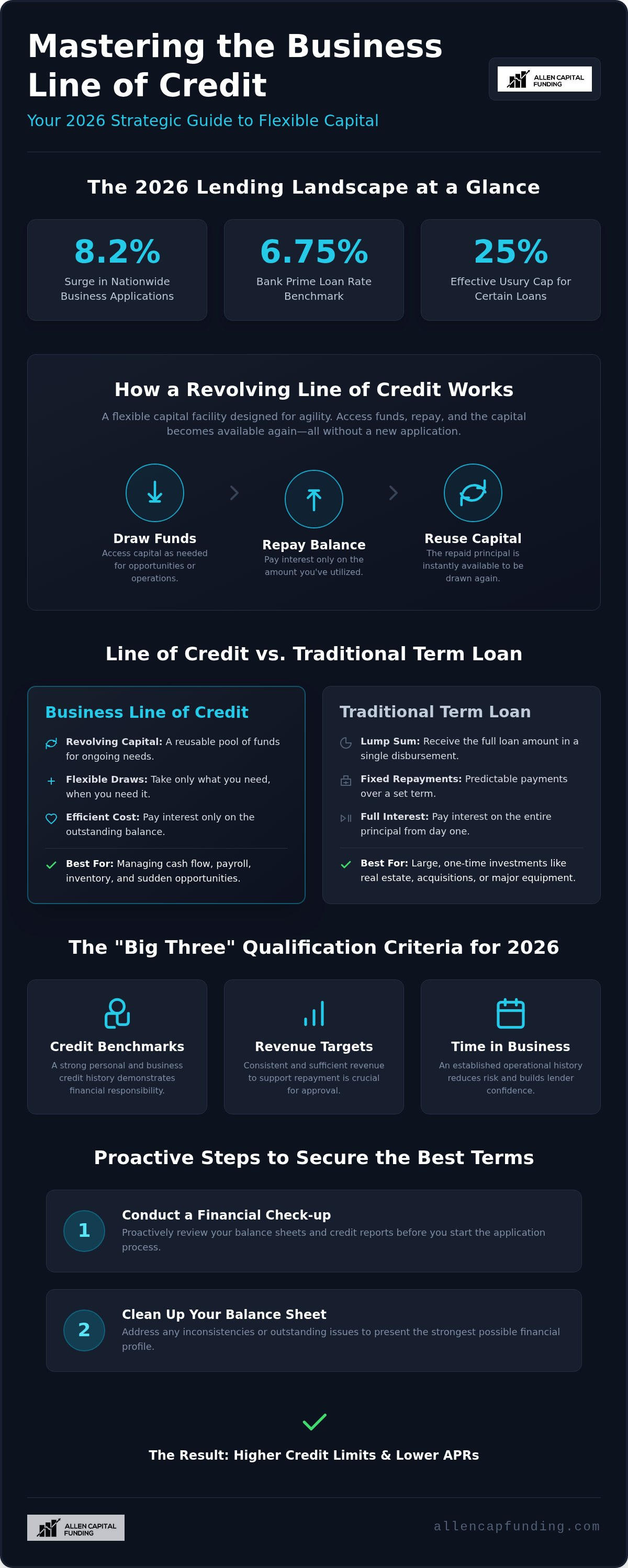
In a year where business applications nationwide have surged by 8.2%, the difference between a thriving enterprise and one that stalls often comes down to the speed of your capital. You've likely felt the pressure of cash flow gaps during inventory cycles or the frustration of an onerous bank application process that moves slower than the pace of modern business. It's a common challenge; waiting for a traditional "maybe" isn't an option when a sudden market opportunity hits your desk. This guide will show you how to master a business line of credit that leading lenders prioritize in 2026, turning revolving debt into a tactical advantage for expansion.
We'll break down the latest 2026 benchmarks, including the 6.75% prime rate and the 25% effective usury cap. You'll learn how to stabilize your cash flow and build a stronger business credit profile through strategic borrowing. From navigating complex financial regulations and disclosures to finding a partner who understands your specific industry, this overview provides the clarity you need to move forward with confidence and secure the on-demand capital your business deserves.
Table of Contents
Understanding the Business Line of Credit for New York Companies
A business line of credit New York owners leverage is more than just a loan; it's a revolving capital facility designed for agility. Think of it as a financial safety valve that stays open even when you aren't using it. Understanding the Business Line of Credit starts with recognizing its "draw-and-repay" mechanism. Unlike traditional term loans that provide a single lump sum, a line of credit allows you to access funds up to a specific limit, repay them, and then draw them again as needed. You only pay interest on the capital you actually use, making it a highly cost-effective tool for maintaining operational excellence.
In the high-velocity markets of Manhattan, Brooklyn, and beyond, liquidity is a competitive necessity. New York businesses often prioritize these lines because they provide capital on-demand. Whether you're a tech startup in Silicon Alley or a logistics firm in Queens, having immediate access to cash allows you to act on market opportunities that your competitors might miss while they wait for bank approvals. It's about having the power to say "yes" to a new contract or bulk inventory purchase without checking your bank balance first.
How Revolving Credit Supports Daily Operations
Daily operations in New York require constant movement. A strategic line of credit helps manage payroll during seasonal revenue dips or bridges the gap between accounts receivable and payable. If a large client is late on an invoice, you don't have to scramble to cover your own vendor costs. Many firms also look into asset-based lending for small business to back their credit lines, using inventory or equipment to secure higher limits and better terms. This flexibility ensures that your growth isn't tethered to the timing of your last sale.
The 2026 Outlook for Flexible Business Capital
The lending environment in 2026 shows a clear shift toward speed. Digital-first brokerage models are now outpacing traditional branch banking by offering faster underwriting for a business line of credit New York companies can actually use in real-time. While the Bank Prime Loan rate sits at 6.75%, your ability to secure a favorable rate depends on your preparation. We see more entrepreneurs utilizing a proactive financial check-up to clean up their balance sheets before applying. This strategic step often leads to higher credit limits and lower APRs. As credit availability for small to mid-sized enterprises evolves, those who treat their line of credit as a tactical asset rather than a last resort will find themselves in the strongest position to scale.
Key Differences: Business Lines of Credit vs. Traditional Term Loans
Choosing between a lump sum and a revolving facility is a foundational decision for any growing firm. A traditional term loan drops the full amount into your account at once, which is ideal for one-time, large-scale investments. In contrast, the business line of credit New York entrepreneurs often prefer provides a reservoir of capital you can tap into as needs arise. While the term loan is a one-and-done transaction, the line of credit offers a "re-usability" factor. Once you repay what you've borrowed, those funds become available again without the need for a new application.
The interest cost structures vary significantly between these two instruments. On a term loan, you pay interest on the total principal from the moment of disbursement. With a line of credit, interest only accrues on the utilized balance. This distinction is vital for managing the true cost of capital. If you have a $100,000 line but only draw $20,000 to cover an inventory gap, you aren't paying for the $80,000 sitting in reserve. This makes the line of credit a far more efficient tool for short-term goals and operational agility.
When to Choose a Term Loan Over a Line of Credit
Financing fixed assets requires a different approach than managing daily cash flow. If you're looking at commercial real estate loans NY, a term loan provides the long-term stability and fixed rates you need for property acquisition. Similarly, large-scale acquisitions often benefit from commercial real estate financing NY structures. These are projects with fixed costs and predictable timelines where a lump sum is more appropriate than a revolving line.
The Strategic Advantage of Interest-Only Payments
Many lines of credit offer interest-only payment periods on the funds you've drawn. This preserves your monthly cash flow during the early stages of a project or a seasonal lull. The U.S. Small Business Administration provides excellent resources on the Qualification Criteria for a Small Business Line of Credit, highlighting why this flexibility is a smart choice for many. To avoid a debt trap, maintain a disciplined repayment strategy and treat the line as a tactical tool. If you're unsure which path fits your 2026 growth trajectory, consulting with a strategic advisor can help clarify your options.
Strategic Advantages of an Unsecured Business Line of Credit
An unsecured business line of credit New York companies utilize differs from traditional financing because it requires no specific collateral. Unlike asset-backed loans, you don't pledge real estate or heavy machinery to secure the funds. This is a game-changer for Manhattan consulting firms, Brooklyn tech startups, and service providers across the state that lack physical assets but possess strong cash flows. For these businesses, value lies in intellectual property and human capital rather than a warehouse full of goods.
The primary benefit here is speed. Because there are no lengthy collateral appraisals or title searches, the underwriting process moves at an accelerated pace. You can often secure approval and access funds in a fraction of the time it takes for a secured loan. While it's true that interest rates for unsecured capital are typically higher, often ranging from 18% to 22% with online lenders, the flexibility often outweighs the cost. New York's 25% criminal usury cap ensures these rates stay within a defined legal limit, providing a layer of protection while you leverage capital for rapid growth. You aren't locking up your company's future by tying its assets to a single lender.
Preserving Personal and Business Assets
Choosing an unsecured path keeps your most valuable assets free of liens. This allows you to maintain a cleaner balance sheet, making it easier to secure other types of financing, such as equipment leases, later on. It also protects your personal wealth. By decoupling personal real estate from business debt, you mitigate individual risk. Approval for these facilities hinges heavily on your credit profile. Maintaining a score above 680 generally unlocks the most competitive terms in the 2026 market, though some lenders offer options for scores as low as 600.
Scaling Without Collateral Constraints
An unsecured business line of credit is a tactical weapon for offensive marketing and rapid inventory builds. If a high-margin opportunity appears, you can deploy capital immediately without waiting for an asset-heavy valuation. This is particularly effective for businesses transitioning through growth phases. You might start with an unsecured line to fuel initial expansion and move toward a secured facility as your business matures and your asset base grows. This progression ensures you always have the right capital structure for your current stage of success without being slowed down by collateral requirements.
Qualification Criteria for a Small Business Line of Credit
Securing a business line of credit New York lenders approve requires meeting specific benchmarks known as the "Big Three." First, most traditional banks look for at least two years of operating history, though online lenders in 2026 often accept businesses with only six months of track record. Second, your annual revenue should typically exceed $100,000 to demonstrate sufficient cash flow for repayment. Finally, your credit score remains a vital component. While a FICO score of 680 or higher unlocks the best variable rates indexed to the 6.75% prime rate, alternative options exist for scores as low as 600.
Modern underwriting has moved beyond manual reviews. Lenders now use real-time data integrations to scan bank statements and tax returns instantly. This process includes a "Global Cash Flow" analysis, which evaluates the combined income and debt of both the business and its owners. Transparent financial reporting is no longer optional; it's the key to accelerated approval. If your books are clean and your tax returns are up to date, you're positioned to secure higher limits with fewer hurdles.
Preparing Your Financial Profile for Large Capital Draws
In 2026, the debt-to-income ratio is a specific metric that measures your total monthly debt obligations against your gross monthly income to evaluate your ability to manage additional capital. Before you apply, focus on cleaning up your balance sheet by resolving old liabilities or non-performing assets. If you've previously worked with SBA loan brokers New York businesses trust, that existing debt will be factored into your total capacity. Reducing high-interest short-term debt before seeking a new business line of credit New York facility can significantly improve your borrowing power.
Navigating Credit Challenges and Bad Credit Options
Challenged credit doesn't have to be a barrier to progress. The market has shifted toward revenue-based underwriting, where your daily sales volume carries more weight than a historical credit score. Many entrepreneurs use a smaller, initial line of credit to rebuild institutional trust. By making consistent, on-time payments on a $10,000 or $20,000 draw, you prove your reliability and pave the way for larger facilities in the future. This methodical approach turns a temporary setback into a long-term strategic advantage. To see which criteria your business meets today, you can request a financial check-up with our expert team.
Accelerating Success with Allen Capital Funding’s Strategic Capital
Allen Capital Funding acts as a dedicated facilitator for entrepreneurs who demand more than just a transaction. We specialize in "accelerated success," providing the professional confidence and expert guidance necessary to secure a business line of credit New York companies can use to dominate their sectors. Unlike traditional banks that are limited by their own internal balance sheets, our brokerage model provides a distinct advantage. We leverage a national network of lending partners to find the most competitive rates and flexible terms available in 2026. This reach ensures you aren't stuck with a generic product that doesn't fit your unique cash flow cycle.
We position ourselves as a steady hand in the often-complex world of commercial finance. By simplifying the path to capital, we allow you to focus on what you do best: running your business. Our team acts as a proactive ally, removing barriers and streamlining the progression from initial inquiry to final funding. Similarly, for New Yorkers facing legal or accessibility hurdles, ADA Help - NY disability discrimination claims provides a vital resource for those seeking a free case check. This partnership-driven approach fosters a sense of security, knowing that your growth is supported by a strategic consultant who is deeply invested in your long-term results. We don't just provide capital; we provide a bridge between your current state and your future goals.
Tailored Funding Options Beyond the Standard Bank Box
Traditional institutions often try to fit every business into the same rigid criteria. At Allen Capital Funding, we recognize that your growth goals require a "best-fit" product, not a standard bank box. Customization is the core differentiator in 2026 commercial lending. Whether you need a high-limit unsecured facility or a smaller line to manage seasonal dips, we identify the specific structure that aligns with your operational reality. Securing a business line of credit New York lenders offer shouldn't feel like a battle against bureaucracy. You'll have a dedicated guide throughout the entire application and closing process, ensuring that every detail is handled with calm efficiency.
Your Next Steps Toward Strategic Liquidity
Securing your financial future begins with a clear understanding of your current position. We've made it easy to book an online consultation for a comprehensive financial check-up. During the initial discovery phase, our team listens to your goals and evaluates your revenue patterns to build a custom funding roadmap. This methodical process respects your time and delivers essential information without distraction. We move quickly because we understand the urgency of financial decision-making. Don't let cash flow gaps dictate your pace of expansion. Unlock your business's potential with a strategic line of credit today.
Mastering Your Revolving Capital Strategy for 2026
Navigating the 2026 financial landscape requires more than just capital; it requires a tactical approach to liquidity. You've learned how a business line of credit New York owners trust provides the "draw-and-repay" flexibility needed to bridge cash flow gaps and seize immediate market opportunities. By prioritizing unsecured options and maintaining a clean financial profile, you keep your business agile and your personal assets protected from unnecessary liens. Strategic funding is the bridge between your current operations and your long-term vision.
Success in a competitive market depends on having a steady, reliable hand to guide you through complex lending environments. Our team provides tailored capital solutions designed for national growth and a fast-paced, efficient application-to-funding process. Our industry-standard specialists offer the expert guidance you need to move from a broad overview to specific funding results. Secure your strategic business line of credit with Allen Capital Funding today. Your next phase of expansion is within reach, and we're here to ensure you have the tools to accelerate it.
Frequently Asked Questions
How does a business line of credit differ from a credit card?
A line of credit offers direct access to cash in your bank account, while a credit card is primarily a transactional tool. Lines of credit typically provide higher capital limits and lower interest rates than a card's cash advance feature. This makes the line of credit a superior choice for large inventory purchases or payroll coverage where cash liquidity is essential for your daily operations.
Can a new business qualify for a line of credit in 2026?
New businesses can definitely qualify for revolving capital in 2026. While traditional banks often require two years of history, many online and alternative lenders now accept firms with at least six months of operating track record. You'll need to show strong monthly revenue and a personal credit score of at least 600 to offset the lack of long-term business history.
What are the typical interest rates for a business line of credit in New York?
Interest rates for a business line of credit New York facility are often variable and tied to the 6.75% prime rate. Your final rate depends on your business's credit profile, annual revenue, and the specific lender's risk assessment. While rates fluctuate, New York's criminal usury law generally sets a maximum effective cap of 25% for incorporated businesses, ensuring a level of protection for borrowers.
Is a personal guarantee required for an unsecured business line of credit?
Most unsecured business lines still require a personal guarantee from the business owners. Even though you aren't pledging specific physical collateral like real estate, the guarantee provides the lender with a secondary path for repayment. This requirement is standard across the industry for small to mid-sized enterprises to ensure the borrower remains committed to the established repayment schedule.
How long does it take to get approved for a business credit line?
The time to approval varies by lender type. Digital-first models and online lenders often provide decisions within a few business days by using automated data integrations. Traditional banks follow a more manual underwriting process that can take several weeks. Preparing your digital financial records in advance is the most effective way to ensure an efficient and fast-paced application experience.
Can I use a business line of credit to pay off other high-interest debt?
You can use a business line of credit to pay off other high-interest debt, such as expensive merchant cash advances or credit card balances. This strategy often reduces your total monthly interest expense and simplifies your balance sheet. By consolidating multiple payments into a single revolving line, you improve your company's global cash flow and create more room for strategic growth investments.
What happens if I don't use the funds in my business line of credit?
If you don't draw funds from your business line of credit New York facility, you won't owe any interest. Most lenders only charge interest on the capital you actually use. You might encounter a nominal annual maintenance fee to keep the line open and available. This structure makes the line of credit an ideal safety net for managing unexpected emergencies without incurring daily costs.
How do I increase my credit limit as my business grows?
Increasing your credit limit is a straightforward process that involves proving your business's growth. Most lenders conduct an annual review where they look for consistent revenue increases and a flawless repayment history. You can also request a limit increase proactively by providing updated financial statements that show improved debt-to-income ratios. Demonstrating that your business has scaled successfully makes you a lower risk for higher capital draws.


Comments