


Business Financial Check-Up: Capital Readiness 2026
Updated: Aug 15
Your financial statements are more than just a tax season obligation; they are the key to your company's next phase of expansion. If you've ever felt a pang of anxiety while looking at your debt-to-income ratio or worried that a messy balance sheet might trigger a loan rejection, you aren't alone. Performing a comprehensive business financial check-up is the most effective way to transition from uncertainty to strategic readiness. With the Federal Reserve holding rates steady in early 2026 after three cuts late last year, the current environment offers a unique window for those who are prepared to act.
It's understandable to feel overwhelmed by the technicalities of credit lines or equipment financing. You deserve a clear roadmap that turns your raw data into a compelling case for lenders. We'll show you exactly how to audit your company's health to unlock strategic funding opportunities and accelerate your growth. This guide provides a step-by-step preview of the metrics you need to master, ensuring you're positioned to leverage everything from SBA fee waivers for manufacturers to the $2.5 million Section 179 deduction limit. By the end, you'll have the clarity required to turn your financial health into a competitive advantage.
Table of Contents
Why a Strategic Business Financial Check-Up is Your Growth Foundation
A business financial check-up is a systematic, deep dive into your financial statements to evaluate liquidity, leverage, and overall funding readiness. It goes far beyond simple bookkeeping or checking your bank balance. By performing a detailed financial statement analysis, you can see exactly how your assets and liabilities compare to your long-term strategic goals. In the fast-moving economy of 2026, waiting for an annual review is a mistake that could cost you thousands in missed opportunities. Market conditions change rapidly. For example, the Federal Reserve's decision to hold rates steady after three cuts in late 2025 means your cost of capital might be different than it was just six months ago.
Regular audits help you find "hidden" capital that is often buried in your balance sheet. This capital might be trapped in slow-moving inventory, underutilized equipment, or aging accounts receivable. Identifying these inefficiencies allows you to clean up your profile before applying for a business line of credit. When your financials are pristine and your ratios are optimized, lenders see significantly less risk. This leads to better terms, higher limits, and much faster approvals. Conducting a business financial check-up every quarter ensures you stay ahead of regulatory changes and shifting interest rate environments.
Moving Beyond Basic Accounting
Setting Your 2026 Growth Benchmarks
Success isn't just about top-line revenue growth; it's about your net profit margin and how it stacks up against national industry standards. If your revenue is climbing but your margins are shrinking, you have an efficiency problem that more capital won't fix. Establishing clear benchmarks now creates a solid foundation for major future moves, such as commercial real estate financing. You must know your current baseline to map a realistic path toward your 2026 expansion goals. Strategic growth requires data, not just intuition.
The 5-Step Strategic Audit: How to Conduct Your Financial Check-Up
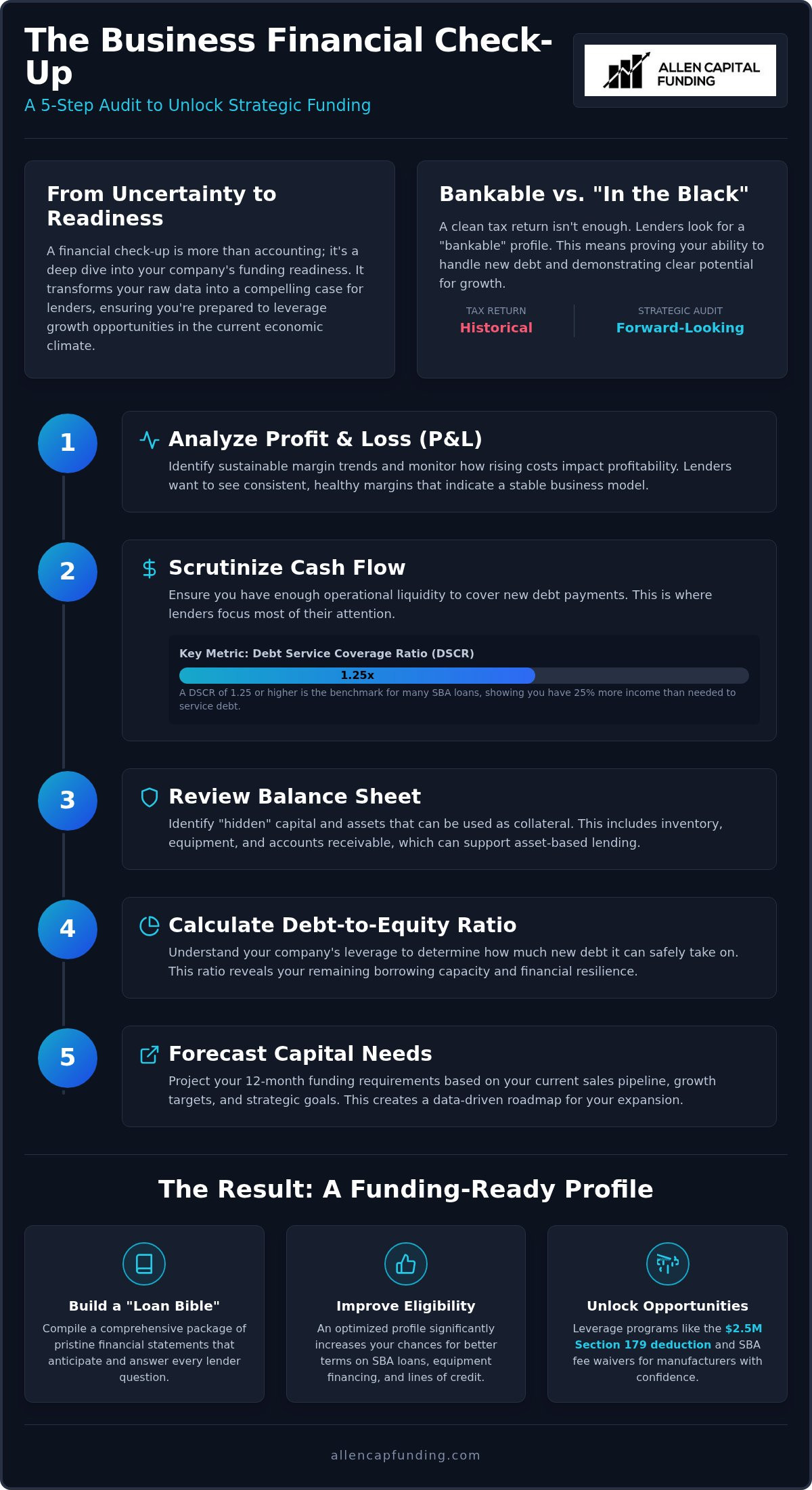
Conducting a business financial check-up requires more than a glance at your bank balance. It's a structured process that reveals whether your company can handle new debt or if it needs to restructure current obligations. By following these five steps, you'll transform raw data into a strategic roadmap for capital acquisition.
Step 1: Analyze your Profit and Loss (P&L) statement to identify sustainable margin trends. Rising costs in 2026, such as the 72.5 cents per mile mileage rate, can erode profits if not monitored.
Step 2: Scrutinize your Cash Flow Statement to ensure you have enough operational liquidity for debt service.
Step 3: Review your Balance Sheet to identify collateral that could support asset-based lending.
Step 4: Calculate your Debt-to-Equity ratio to determine your remaining borrowing capacity.
Step 5: Forecast your 12-month capital needs based on your current sales pipeline and growth targets.
Step 1 & 2: Profitability and Cash Flow Mastery
Lenders prioritize your Debt Service Coverage Ratio (DSCR). This metric measures your ability to use operating income to pay off debt. A DSCR of 1.25 or higher is typically the benchmark for many SBA loans. You should also consult the SBA guide to managing finances to understand how your cash flow cycles impact this ratio. Many businesses show a "paper profit" on their P&L but lack the liquid cash to cover a sudden equipment failure. Identifying seasonal cash flow gaps now allows you to secure working capital before the need becomes an emergency.
Step 3 & 4: Asset Evaluation and Leverage
Your balance sheet often holds untapped potential. Auditing your existing machinery or fleet can reveal business equipment finance opportunities through sale-leaseback arrangements. Similarly, evaluating your accounts receivable can lead to factoring or purchase order financing solutions that don't rely on traditional credit scores. In 2026, your personal credit remains a factor for most small business loans, but strong business assets can often offset a lower personal score. If you're unsure how your assets stack up, a professional financial check-up with an expert can provide the clarity you need to move forward with confidence.
Analyzing Your Debt Capacity and Capital Structure for 2026
Your capital structure is the specific mix of debt and equity you use to finance your operations and growth. Finding the "optimal" structure for your industry is a primary goal of any business financial check-up. If you rely too heavily on high-interest, short-term debt, you risk suffocating your cash flow. Conversely, being too conservative with debt can prevent you from scaling when market conditions are favorable. A strategic audit helps you determine if your current leverage is working for you or against you by calculating the actual return on investment for every dollar borrowed.
One of the most valuable outcomes of this audit is identifying opportunities for debt consolidation. Many businesses accumulate expensive bridge loans or high-rate credit lines during periods of rapid change. By using your check-up data, you can often consolidate these high-cost obligations into a single, low-rate SBA loan. This move immediately improves your monthly cash flow and reduces your total interest expense. Before taking on new debt in 2026, always ask: Will this capital generate a higher return than its cost? If you're borrowing at 10% to fund a project with a 20% return, the debt is a powerful tool for wealth creation.
The Role of SBA Loans in Your Capital Mix
SBA 7(a) loans remain the gold standard for long-term working capital because they offer flexibility that traditional commercial products often lack. For those looking to move from leasing to owning, the SBA 504 program provides a path to real estate acquisition with attractive fixed rates, which were approximately 5% to 6% in April 2026. These SBA loans provide longer repayment terms and lower down payments than traditional bank loans, which keeps more cash in your operating account. If your check-up reveals you're a manufacturer, you may even qualify for specific 2026 fee waivers on 7(a) loans under $950,000.
Optimizing Your Equipment Lifecycle
Deciding whether to pay cash or use strategic business equipment financing is a critical part of your 2026 financial plan. While cash avoids interest, it also depletes the liquidity you might need for unexpected emergencies or payroll. Financing allows you to preserve that cash while taking full advantage of the $2.5 million Section 179 deduction limit available this year. Additionally, the permanent 100% bonus depreciation rule for qualifying assets provides a massive tax shield. Your check-up should include an assessment of the trade-in value of your current machinery to see if an upgrade could actually lower your total cost of ownership through improved efficiency.
Preparing Your Financial Profile for High-Impact Capital Draws
Preparing your profile for a capital draw is where the data from your business financial check-up meets the reality of the lending market. Lenders don't just want to see that you're profitable; they want to see that you're organized and proactive. Creating a "Loan Bible" is the most effective way to demonstrate this. This collection should include your last three years of federal tax returns, current year-to-date Profit and Loss statements, and updated balance sheets. Having these documents organized and ready for submission allows you to move with the speed that 2026 market opportunities require, often cutting weeks off the traditional approval timeline.
A compelling "Use of Proceeds" statement is equally vital to your success. Instead of making a generic request for working capital, you should specify exactly how the funds will scale your operations. For example, detail how a new credit line will allow you to fulfill a specific $500,000 contract in your sales pipeline or how new equipment will reduce your per-unit production cost by a specific percentage. This level of detail transforms a simple loan request into a strategic investment opportunity for the lender. Additionally, ensure your legal and organizational documents, such as your operating agreement and business licenses, are current and compliant with 2026 regulations to avoid last-minute hurdles.
The Lender's Perspective: What They See in Your Audit
Lenders evaluate every application through the "5 Cs of Credit": Character, Capacity, Capital, Collateral, and Conditions. Capacity refers to your ability to repay the debt, while Conditions takes into account the broader economic environment, such as the Federal Reserve's current interest rate stance. If your business financial check-up reveals a financial dip in previous years, don't hide it. Instead, use your updated business plan to provide a clear narrative. Explain the specific pivot you made or the one-time expenses that occurred. Transparent reporting is especially critical when seeking large-scale commercial real estate loans, where underwriters scrutinize long-term stability and debt-service coverage ratios over several years.
Polishing Your Funding Application
A professional audit significantly reduces your "time to fund" by eliminating the back-and-forth that often delays approvals. By having a pre-vetted financial profile, you're ready to pounce when a competitor's asset goes up for sale or a prime real estate location opens up. You can present your sales pipeline as future proof of your repayment ability, showing that your projected growth is backed by signed contracts and historical performance. When you're ready to secure the capital your audit has justified, schedule your comprehensive financial check-up to ensure your application is lender-ready and positioned for maximum leverage.
Executing Your Growth Strategy with Allen Capital Funding
A business financial check-up is only as valuable as the actions it inspires. At Allen Capital Funding, we take the raw data from your audit and transform it into a tailored capital strategy designed for your specific growth goals. While a single local bank is limited by its own balance sheet and rigid internal policies, we operate as a national broker with access to a vast network of institutional lending partners. This reach ensures you aren't forced into a one-size-fits-all product. Instead, we match your unique financial profile with the lenders most likely to offer competitive terms in the current 2026 market. We don't just find you a loan; we find you the right strategic advantage.
Our process is methodical and efficient, respecting the urgency that often accompanies financial decision-making. We begin with a deep-dive consultation to understand your audit results and identify any immediate capital needs. From there, we work on profile optimization. This involves addressing any "red flags" identified during your check-up, such as debt-to-income ratios that need balancing or messy financial statements that require clarity. Finally, we handle the multi-lender submission process. This creates a competitive environment where lenders vie for your business, ensuring you receive the most favorable structure possible for your company's future.
Working with us gives you access to a diverse portfolio of capital products that a single institution simply cannot match. Whether your audit suggests a need for long-term SBA 7(a) funding, immediate working capital through factoring, or specialized equipment financing to take advantage of 2026 tax deductions, we have the connections to make it happen. We understand the nuances of the 2026 lending environment, including the specific SBA fee waivers for manufacturers and the updated Section 179 limits. This expertise allows us to position your business as a top-tier candidate for high-impact capital draws.
Your Dedicated Guide to Accelerated Success
Expert guidance is essential for navigating the complex 2026 lending landscape. With interest rates holding steady and increased regulatory focus from the CFPB, the "right" move today might differ significantly from last year's strategy. We act as your dedicated facilitator, removing the barriers that often slow down growing entrepreneurs. Our partnership-driven approach means we stay invested in your long-term financial health, acting as a steady hand through every stage of your expansion. We provide the clarity you need to feel capable and well-supported as you make major financial commitments.
Next Steps: Book Your Professional Consultation
Your journey toward capital readiness starts with a simple discovery call. During this initial session, we'll review your audit findings and discuss your funding timeline. You can expect a transparent assessment of your borrowing capacity and a clear explanation of which products fit your current health. You don't have to navigate these complex decisions alone. Submit your preliminary check-up results today for a preliminary funding assessment and take the first step toward your next major milestone.
Position Your Business for Strategic Growth in 2026
Conducting a business financial check-up is the first step toward transforming your company's data into a powerful growth engine. You've learned how to move beyond basic accounting by auditing your debt-to-equity ratios and organizing a comprehensive "Loan Bible" that speaks the language of lenders. These preparations ensure that when a strategic opportunity arises, you're ready to secure the capital needed to seize it. Whether you're targeting expansion through real estate or modernizing your fleet with high-impact equipment financing, your readiness is your greatest competitive advantage.
Navigating the 2026 lending landscape doesn't have to be a solo effort. As an expert SBA loan brokerage with a national network of over 50 lending partners, Allen Capital Funding provides the tailored solutions and specialized guidance your business deserves. We remove the barriers to progress by matching your optimized profile with the best possible funding products. Ready for a capital injection? Book your 2026 Financial Strategy Consultation with Allen Capital Funding. We're here to act as your dedicated facilitator and bridge the gap between your current state and your future goals. Your next chapter of success starts with a single strategic decision.
Frequently Asked Questions
How often should a small business perform a financial check-up?
You should perform a strategic review at least once every quarter. Market conditions in 2026 move quickly, especially following the interest rate cuts seen in late 2025. Quarterly reviews allow you to identify margin erosion or cash flow gaps early, giving you enough time to adjust your strategy before you need to apply for new capital.
What are the most important ratios to track during a business audit?
The Debt Service Coverage Ratio (DSCR) is the most critical metric for lenders. You should also monitor your current ratio to assess liquidity and your debt-to-equity ratio to understand your leverage. Tracking these metrics during a business financial check-up ensures you remain within the "bankable" ranges required for institutional funding.
Can a financial check-up help me get a lower interest rate on a loan?
Yes, it can. By identifying and resolving issues like high credit utilization or messy financial statements before you apply, you present a lower risk to lenders. A cleaner financial profile often leads to more competitive interest rates on products like credit lines and SBA loans because you've demonstrated strong fiscal management.
What is the difference between a financial check-up and a formal audit?
A financial check-up is a proactive, strategic tool used to prepare for growth and capital draws. In contrast, a formal audit is usually an external compliance requirement performed by a CPA to verify accounting accuracy. While an audit looks backward for errors, a check-up looks forward to ensure your business is ready for its next major investment.
How does my debt-to-income ratio affect my ability to get a business line of credit?
Your debt-to-income ratio is a primary indicator of your capacity to handle new debt. Lenders use this to determine if your business generates enough surplus cash to manage additional monthly payments. If this ratio is too high, you might face lower credit limits or higher interest rates to offset the perceived risk of over-leveraging.
What financial documents do I need to prepare for an SBA loan application in 2026?
You'll need three years of federal corporate tax returns, a current year-to-date P&L statement, and a detailed balance sheet. It's also vital to include a "Use of Proceeds" statement. For 2026, manufacturers should specifically check if they qualify for the SBA fee waivers on 7(a) loans under $950,000 to reduce their upfront costs.
How can I improve my business's 'bankability' if my check-up shows weaknesses?
Focus on consolidating high-interest, short-term debt into a single, lower-rate loan to immediately improve your cash flow. If your traditional credit metrics are weak, you can leverage business financial check-up data to pursue asset-based lending or equipment financing. These products rely more on the value of your collateral than your historical credit score.
Does Allen Capital Funding provide help with the financial check-up process?
Yes, we act as a dedicated guide for businesses seeking to optimize their funding potential. Our team helps you interpret your financial data and identifies the best path toward capital acquisition. We then use that information to connect you with our national network of over 50 lending partners to secure the most favorable terms available.


Comments