


Business Equipment Finance: Complete Strategic Guide 2026
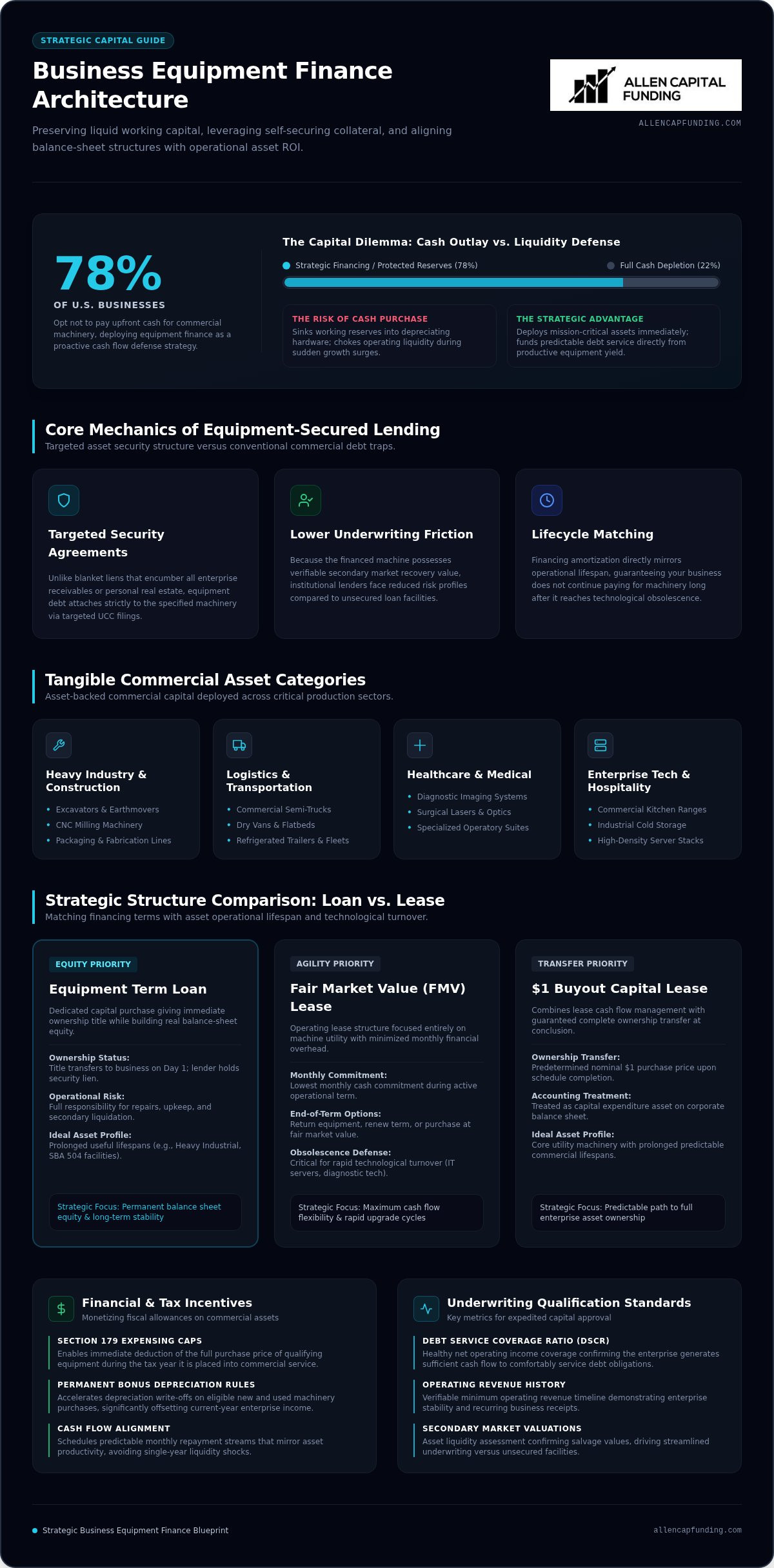
Approximately 78% of U.S. businesses choose not to pay upfront cash for commercial machinery, and it isn't because they lack capital. Sinking working reserves into depreciating hardware can severely choke your day-to-day liquidity just when unexpected growth opportunities arise. When approached as a strategic advantage, business equipment finance isn't merely an operational debt; it's an essential cash flow preservation tool that puts mission-critical assets to work right away.
You already understand the frustration of balancing ambitious expansion against unpredictable operating expenses, particularly when facing rigid bank approvals and the threat of rapid technological obsolescence. This strategic guide shows you how to acquire vital machinery, specialized commercial vehicles, and technology while protecting your liquid reserves. You'll discover how to design predictable monthly payments aligned with asset ROI and capture significant tax incentives like Section 179 deductions. Here is your comprehensive blueprint to securing the tools your business needs to scale.
Table of Contents
Understanding Business Equipment Finance: Principles and Asset Types
Every enterprise requires physical tools to generate revenue, but exhausting liquid reserves to purchase them outright exposes operations to severe cash flow shocks. Structured business equipment finance solves this problem by using the acquired machinery, vehicle, or technology as the underlying collateral. Grounded in the foundational principles of business financing, this model aligns capital expenditure directly with operational productivity. Instead of draining working capital needed for payroll, inventory, or emergency reserves, companies deploy new assets immediately while funding predictable payments from the income those very machines produce.
Core Mechanics of Equipment-Secured Lending
In traditional commercial borrowing, institutions frequently require blanket liens across all enterprise receivables or personal real estate. Business equipment finance functions differently. The financed machinery serves as the specific collateral under an asset-backed security agreement, significantly reducing the lender's credit exposure.
Targeted Security Agreements: Unlike blanket liens that encumber all corporate assets, equipment debt attaches strictly to the specified machinery via targeted UCC filings.
Lower Underwriting Friction: Because the asset possesses verifiable secondary market value, lenders face lower default risks compared to unsecured facilities.
Lifecycle Matching: Financing terms mirror the equipment's operational lifespan, preventing you from paying for machinery long after it becomes obsolete or fully depreciated.
Eligible Asset Classes Across Commercial Sectors
Because physical collateral secures the agreement, this funding framework supports a wide variety of tangible, revenue-generating commercial assets across key industries:
Heavy Industry and Construction: Excavators, earthmovers, CNC milling systems, packaging machinery, and industrial fabrication lines.
Logistics and Transportation: Commercial semi-trucks, dry vans, refrigerated trailers, and regional delivery fleets.
Healthcare and Medical Practices: Diagnostic imaging hardware, surgical lasers, digital scanning systems, and specialized dental chairs.
Hospitality and Enterprise Tech: Industrial kitchen ranges, commercial refrigeration units, server stacks, and automated point-of-sale arrays.
Structuring debt directly against these essential assets keeps working capital fully intact, letting you scale operations without sacrificing financial flexibility.
Equipment Loans vs. Equipment Leases: Strategic Comparison Framework
Choosing between an equipment loan and an equipment lease comes down to whether your operational strategy prioritizes long-term equity or technological agility. Both structures protect cash reserves, but they treat balance-sheet exposure, ongoing tax write-offs, and salvage recovery differently. Understanding these structural differences ensures your debt service aligns directly with how fast the machinery generates revenue.
Equipment Loans and Full Ownership Mechanics
An equipment loan provides dedicated term capital to purchase machinery immediately. Your business holds title to the asset from day one, while the lender retains a security lien until you pay off the principal balance. Each scheduled payment builds real corporate equity. However, your enterprise assumes full operational risk. Maintenance costs, repairs, and eventual secondary market liquidation rest entirely on your shoulders. For assets with prolonged useful lives such as heavy industrial manufacturing equipment, traditional loans or specialized federal facilities like SBA 504 Loans provide excellent long-term cost stability.
Lease Structures: Operating Leases vs. Capital Leases
Leasing arrangements break down into two core structures that offer distinctly different balance-sheet impacts and end-of-term options:
Fair Market Value (FMV) Leases: Often classified as operating leases, these agreements deliver the lowest monthly commitment. You pay for the asset's utility during the term. At completion, you can return the machinery, renew the lease, or purchase it at fair market value. This structure protects companies against technological obsolescence in rapid-turnover sectors like IT servers and diagnostic software.
Dollar Buyout ($1 Buyout) Leases: Functionally equivalent to capital loans, these agreements transfer full ownership to your company for a nominal one-dollar fee once all scheduled lease rentals are completed. You capitalize the equipment on your balance sheet from day one, taking advantage of standard depreciation benefits while avoiding large initial cash outlays.
Evaluating this choice requires looking at your replacement cycle, tax position, and growth trajectory. Integrating proven strategic business equipment financing frameworks helps identify whether borrowing or leasing best supports your balance-sheet ratios. If you are weighing multiple operational investments, completing a comprehensive Financial Check-Up can clarify which funding model optimizes your working reserves before acquiring new machinery.
Financial and Tax Advantages of Equipment Financing
Strategic capital allocation is about maximizing cash flow velocity. When you leverage business equipment finance, you immediately put high-output machinery into production while spreading the acquisition cost across its productive lifespan. This approach creates a favorable spread between the revenue generated by the asset and the fixed monthly payment required to service it, accelerating your cash-on-cash returns.
Leveraging Section 179 and Accelerated Depreciation
Federal tax regulations offer aggressive incentives for enterprises deploying commercial assets. For tax years beginning in 2026, the Section 179 expensing cap allows businesses to deduct up to $2,560,000 of qualifying equipment during the year it's placed in service. This deduction begins phasing out dollar-for-dollar only after total equipment purchases exceed $4,090,000, with specialized caps like $32,000 applied to qualifying commercial SUVs. Under the One Big Beautiful Bill Act, 100% bonus depreciation remains a permanent fixture, allowing complete first-year write-offs on eligible new and used hardware.
Combining these upfront deductions with deductible interest payments dramatically lowers your net acquisition cost. In many cases, the first-year tax savings exceed the actual cash disbursed for monthly financing payments during that same twelve-month period.
Optimizing Working Capital and Cash Flow Velocity
Protecting cash reserves creates an operational buffer against market volatility. Draining liquidity for machinery restricts your ability to hire key staff, manage supplier delays, or purchase raw inventory. Coordinating structured business equipment finance alongside tools like asset-based lending for small business allows you to unlock balance-sheet value without starving day-to-day operations.
Sustained Liquidity: Keep working capital intact for emergencies while acquiring production-ready tools that drive revenue.
Synchronized Inflows: Structure repayment terms so monthly obligations align directly with the revenue cycles generated by the new machinery.
Layered Capital Structures: Pair equipment-secured loans with a dedicated business line of credit or long-term SBA 504 Loans to cover seasonal overhead while expanding physical footprint.
Underwriting Standards: How to Qualify for Equipment Capital
Securing business equipment finance requires navigating clear underwriting benchmarks. Traditional commercial banks often enforce slow approval channels that prioritize institutional bureaucracy over commercial realities. In contrast, specialized lending networks evaluate the underlying health of your business operations and the intrinsic resale value of the machinery you plan to deploy.
Financial Documentation and Underwriting Metrics
Lenders evaluate your historical capacity to support debt obligations alongside day-to-day overhead. Underwriting criteria typically measure three core financial benchmarks:
Debt Service Coverage Ratio (DSCR): Lenders generally expect a DSCR of 1.20x to 1.25x. This benchmark confirms your net operating income exceeds total scheduled debt service by at least 20% to 25%.
Operating History and Revenue: Most funding programs require at least one year in active operation and consistent monthly revenue averaging $15,000 or higher.
Core Financial Statements: Underwriters review recent balance sheets, year-to-date profit-and-loss statements, and recent business bank statements. Personal credit profiles remain relevant for owners holding substantial equity, though strong cash flow frequently offsets minor credit dings.
Evaluating Equipment Value and Vendor Credentials
Because the physical asset secures the funding agreement, lenders don't just evaluate your balance sheet; they also inspect what you're buying. Underwriters examine formal vendor invoices, itemized specification sheets, and serial numbers to confirm collateral value:
New vs. Used Valuation: New machinery carries clear manufacturer pricing. Used equipment often requires certified third-party appraisals or desktop inspections to verify remaining useful operating life.
Secondary Market Strength: Machinery with an active, liquid resale market reduces lender exposure. For borrowers with credit scores in the 600 to 650 range, strong collateral value frequently bridges the approval gap.
Rigid bank committees shouldn't slow your growth when new production capacity is on the line. Review your borrowing capacity and accelerate your asset acquisition by partnering with Allen Capital Funding for equipment financing today.
Securing Strategic Financing: Execution and Advisory Alignment
Executing an equipment acquisition requires choosing the right capital partner. Walking into a traditional commercial bank often limits your options to a single, narrow credit box. If your enterprise falls outside their rigid balance-sheet ratios or the machinery represents a niche asset class, you face outright rejection or delays that stall business momentum. Partnering with a specialized advisory network broadens your reach, matching your transaction with capital sources specifically structured for your operational profile.
Navigating Direct Lenders vs. Capital Advisory Networks
Traditional banks focus on institutional risk containment rather than customized growth. When you apply through a single institution, you get one set of covenants and underwriting rules. Advisory networks function differently by tapping into extensive national lending relationships. This network access delivers distinct strategic advantages:
Asset-Specific Matching: Different institutional lenders specialize in distinct asset categories, whether that involves specialized medical lasers, yellow-iron construction equipment, or commercial freight fleets. Advisors route your deal directly to underwriters who understand your equipment's true collateral value.
Customized Repayment Terms: Advisors can negotiate tailored payment structures that protect cash flow during cyclical slowdowns, including seasonal payment skips, balloon structures, or stepped step-up schedules aligned with production ramp-ups.
Covenant Protection: Expert advisory alignment ensures loan documentation avoids restrictive operational covenants or punitive prepayment penalties that constrain future expansion.
Streamlining Approval to Asset Deployment
The path from asset selection to physical deployment follows a fast, methodical sequence when properly managed:
Invoice Verification and Credit Package: You submit the equipment quote alongside core financial statements. Fast-track underwriting protocols review your package promptly.
Agreement Execution: Closing contracts define terms, collateral pledges, proof of required coverage (such as commercial vehicle policies through SI Insurance), and specific UCC-1 financing statements without encumbering unrelated enterprise accounts.
Vendor Disbursement: Once delivery occurs and you complete final inspection sign-offs, the funding source disburses payment directly to your vendor.
Strategic business equipment finance should accelerate revenue generation, not tie up internal bandwidth with red tape. Allen Capital Funding provides national access to tailored commercial capital, delivering custom equipment financing and holistic advisory support designed to keep your reserves fully liquid. Schedule a consultation to structure the funding your business needs to grow.
Scale Your Operational Capacity With Confidence
Securing high-performing machinery shouldn't require draining your cash reserves or settling for restrictive bank terms. Strategic business equipment finance transforms capital procurement into a proactive lever for growth. By matching asset lifecycles with customized debt or lease structures and capturing valuable accelerated depreciation incentives, you position your enterprise to expand production while keeping working capital liquid for everyday operations.
Achieving this balance requires an experienced partner who understands the commercial realities of your industry. Allen Capital Funding provides direct access to an extensive national commercial lending network, offering fast-track underwriting protocols and tailored advisory support that matches your specific machinery with competitive capital sources. Don't let equipment bottlenecks stall your momentum. Schedule a Consultation with Allen Capital Funding today to structure funding that propels your business forward.
Frequently Asked Questions
What is the primary difference between an equipment loan and an equipment lease?
An equipment loan grants immediate legal ownership with the asset capitalized on your balance sheet, while a lease allows you to rent the machinery for a defined term with purchase or return options. With a loan, your scheduled monthly payments build equity until the security lien lifts. Leases often provide lower monthly payments and give you flexibility to upgrade quickly without taking on salvage disposal risks.
How much down payment is typically required for commercial equipment finance?
Down payment requirements generally range from zero down to 20% of the total purchase invoice, depending on your company's credit strength and the equipment's secondary market value. Well-established businesses with strong cash flow frequently qualify for 100% business equipment finance structures. For higher-risk profiles or highly customized assets, lenders typically request a 10% to 20% down payment to establish equity and reduce initial risk exposure.
Can my business qualify for equipment financing with less-than-perfect credit?
Yes, businesses can qualify for equipment financing with less-than-perfect credit because the machinery itself acts as tangible collateral. Lenders evaluate consistent monthly cash flow and asset resale liquidity alongside credit scores. Even with credit ratings near 600, you can secure competitive approvals by demonstrating strong Debt Service Coverage Ratios or by putting down an upfront deposit to offset underwriting risk.
How does Section 179 tax deduction apply to financed business equipment?
Financed commercial equipment qualifies for the full Section 179 deduction during the tax year it's placed in service, even if you spread payments over multiple future years. You can write off the complete purchase price upfront against taxable income up to current IRS limits. This allows your tax savings during the first year to potentially exceed the initial cash outlay disbursed for scheduled finance payments.
Can equipment financing be used to purchase used commercial machinery?
Yes, equipment financing programs actively support the acquisition of used commercial machinery, vehicles, and industrial tools. Underwriters typically verify the equipment's operating condition, maintenance logs, and remaining useful life through certified appraisals or vendor inspection reports. Terms are structured around the secondary lifespan of the used unit, ensuring you avoid paying for equipment after it reaches operational retirement.
How fast can a business secure approval and funding for heavy equipment?
Securing business equipment finance can move remarkably fast, with credit decisions typically issued within 24 to 48 hours for standard applications. Digital underwriting and application-only tiers accelerate reviews for small-to-mid ticket equipment. Complex, multi-unit machinery packages or custom industrial installations may require several business days to finalize detailed appraisal reviews and lien filings before issuing funds directly to your equipment vendor.
What happens to the equipment at the end of an equipment lease agreement?
Your end-of-term options depend entirely on whether you structured an operating or capital lease agreement. With a Fair Market Value lease, you can return the machinery, renew your agreement, or purchase the unit at fair market value. With a dollar buyout lease, your business automatically takes full legal ownership of the machinery for a nominal one-dollar fee once all scheduled payments are complete.


Comments