


Benefits of Invoice Factoring: A Strategic Guide to Business Liquidity in 2026
- anthonyarallen
- Aug 4
- 12 min read
Updated: Aug 14
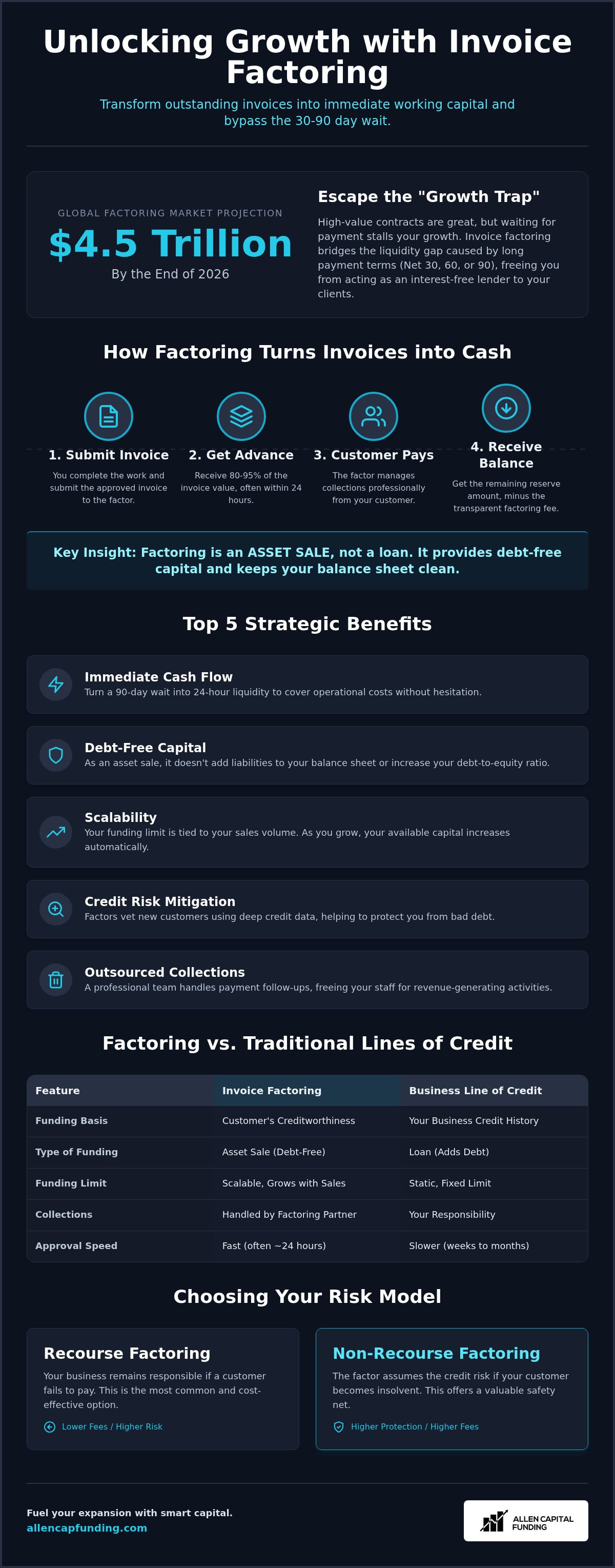
By the end of 2026, the global factoring market is projected to reach a staggering $4,547.1 billion in revenue. This massive growth isn't just a trend; it's a strategic shift by B2B firms that are tired of acting as interest-free lenders to their own clients. You've likely felt the frustration of watching high-value contracts sit in your accounts receivable while your own growth stalls. Waiting 30, 60, or even 90 days for payment often forces you to turn down new opportunities and shoulder the heavy burden of collections.
This guide explores the strategic benefits of invoice factoring, showing you how to transform those outstanding invoices into immediate working capital without adding a single dollar of debt to your balance sheet. Our team at Allen Capital Funding understands that liquidity is the lifeblood of your operations. We'll show you how to unlock cash today to accelerate your growth tomorrow. You'll learn how this scalable funding model works, its impact on your liquidity, and why modern technology like AI and blockchain is making it faster than ever to fuel your expansion.
Table of Contents
What is Invoice Factoring? Understanding the Liquidity Gap
Success often creates its own set of challenges. For many B2B companies, a surge in orders leads directly to a cash flow bottleneck known as the "Growth Trap." You've likely seen it: your sales team lands a major contract, but you won't see the payment for 60 or 90 days. Meanwhile, you must pay suppliers, meet payroll, and fund the next project. This is where understanding the Factoring (finance) model becomes essential for maintaining operational momentum.
Invoice factoring is the strategic sale of your accounts receivable to a third party, known as a factor, at a slight discount. Unlike a traditional bank loan, this isn't debt. It's an asset sale. You are simply accelerating the value of work you've already completed. In 2026, this has become a primary tool for manufacturing and service-based industries that need to remain agile without cluttering their balance sheets with liabilities. One of the primary benefits of invoice factoring is its ability to eliminate the waiting game inherent in net-30 or net-90 terms.
The Mechanics of a Factoring Transaction
The process is straightforward and designed for speed. When you submit an invoice, the factor provides an initial advance. In today's market, this typically ranges from 80% to 95% of the total invoice value. The remaining balance goes into a reserve account. Once your customer pays the factor, the reserve is released to you, minus a small factoring fee. This rebate ensures you receive the full value of your work while gaining the liquidity you need immediately. It's a clean, efficient cycle that mirrors your sales volume.
Factoring vs. Invoice Financing: Key Differences
It's easy to confuse these terms, but the distinction matters for your financial strategy. Factoring involves the actual sale of the asset. Because the factor now owns the invoice, they often provide professional collections support, which reduces your administrative burden. For businesses managing particularly challenging accounts, you can learn more about Whole King Company Limited, a specialist in commercial debt recovery with over 25 years of experience. Invoice financing, or discounting, is usually a loan where your invoices serve as collateral. Many firms prefer factoring because it removes the debt obligation and outsources the tedious task of chasing payments. This allows you to focus on scaling your business while we handle the back-end logistics of your receivables.
By treating your invoices as a liquid asset rather than a future promise, you gain a level of control that traditional lending rarely offers. This approach is particularly effective for businesses with high-credit customers but limited cash reserves. It turns your strongest relationships into your most reliable source of capital.
Top 5 Strategic Benefits of Invoice Factoring for Growth
Waiting for payments shouldn't be the reason your company misses a major opportunity. When you leverage the benefits of invoice factoring, you shift from a reactive stance to a proactive one. This financial tool provides five distinct advantages that traditional lending often lacks.
Immediate Cash Flow: You can turn a 90-day wait into 24-hour liquidity. This speed allows you to cover immediate operational costs without hesitation.
Debt-Free Capital: Factoring is an asset sale, not a loan. It keeps your balance sheet clean and doesn't increase your debt-to-equity ratio. Many experts categorize this as a smart form of Alternative Business Funding for high-growth firms.
Scalability: Your funding limit is tied to your sales volume, not a static credit limit. As you land more contracts, your available capital increases automatically.
Credit Risk Mitigation: Factors have access to deep credit data. They help you vet new customers before you sign a contract, protecting you from bad debt.
Outsourced Collections: Managing receivables is time-consuming. Letting a professional team handle follow-ups frees your staff to focus on revenue-generating activities.
Non-Recourse vs. Recourse Factoring
Choosing the right risk-sharing model is vital for your long-term stability. In recourse factoring, your business remains responsible if a customer fails to pay. This is the most common and cost-effective option. Non-recourse factoring offers more protection because the factor assumes the credit risk if your customer becomes insolvent. While fees for non-recourse options are slightly higher, they provide a safety net that many firms find invaluable during periods of economic volatility. Consider a Financial Check-Up to determine which model fits your current risk profile.
Accelerating the Sales Cycle
Liquidity velocity is the speed at which a business converts sales into usable cash. By increasing this velocity, you gain a competitive edge. You can win larger contracts by offering the net-60 terms that big corporations demand without starving your own operations of cash. Additionally, having upfront liquidity allows you to negotiate early-payment discounts with your own suppliers, often saving more than the cost of the factoring fee itself. This creates a cycle of accelerated success where your capital works as hard as your sales team.
Factoring vs. Business Lines of Credit: Which Is Better?
Choosing between these two financial tools depends on your current liquidity needs and your long-term expansion goals. While a traditional bank line of credit is a revolving debt tool, factoring is a strategic asset-based solution. One of the primary benefits of invoice factoring is that it prioritizes your customers' ability to pay rather than just your personal credit score or years in business. This shift in focus opens doors for companies that banks might otherwise overlook.
Speed is often the deciding factor for modern entrepreneurs. Banks typically take weeks or even months to approve a line of credit because of their extensive underwriting processes. In contrast, factoring can provide cash in as little as 24 hours once your account is established. With 20% of global factoring solutions expected to utilize blockchain technology by the end of 2026, the security and speed of these transactions are only increasing. You don't have to wait for a committee's approval to fund your next project.
Cost structures also vary significantly between the two. A line of credit charges interest on the amount you draw, while factoring uses a discount fee based on the face value of the invoice. While the raw interest rate on a bank loan might appear lower, it doesn't include the value of the collections services and credit protection that often come with a factoring partnership. You're paying for a comprehensive liquidity engine, not just a loan.
When to Choose a Line of Credit
A line of credit is an excellent choice for established firms with high credit scores and predictable, shorter-term cash needs. It's particularly useful for general operational expenses like office rent, research and development, or marketing campaigns that aren't tied to a specific invoice. If you want to maintain total control over every customer interaction and don't require help with collections, this revolving debt model might be your best fit. For a deeper look at how to manage revolving debt, read our business line of credit guide.
When Factoring Wins the Strategy Battle
Factoring is the superior choice during rapid-growth phases where a bank's static credit limit can't keep up with your new orders. Because your funding limit grows automatically with your sales volume, you'll never outgrow your capital source. It's the ideal solution for startups or companies with "challenged" credit that serve strong, investment-grade customers. By leveraging the benefits of invoice factoring, you turn your balance sheet into a weapon for growth. If you're looking for a middle ground that uses various assets to secure capital, you might also consider asset-based lending for small business as a hybrid alternative.
How to Evaluate a Factoring Partner in 2026
Selecting a factoring partner is a strategic decision that impacts your brand reputation as much as your bank account. To truly capture the benefits of invoice factoring, you must look beyond the initial advance rate. A partner should act as a seamless extension of your back office, providing both capital and professional support. In 2026, the best providers offer a blend of deep industry expertise and advanced technology to ensure your liquidity remains consistent.
Fee transparency is your first point of evaluation. While industry standard fees for B2B transactions currently range from 0.50% to 3.50% per 30 days, "headline" rates can be deceptive. You should ask for a full breakdown of secondary costs, such as ACH transfer fees, processing charges, or credit check costs. A reputable partner provides a clear, all-in cost structure that allows you to calculate your ROI with precision. They should also demonstrate specific knowledge of your sector, whether that's the complex progress billing of construction or the rapid cycles of the staffing industry.
Technology integration has become a non-negotiable standard. By 2025, 40% of factoring transactions were already utilizing Artificial Intelligence for risk assessment, and that trend has only accelerated. You should expect a digital portal that offers real-time tracking of your invoice status and automated reporting. This transparency ensures you aren't left guessing when funds will hit your account or which customers have cleared their balances.
Spotting Red Flags in Factoring Contracts
Hidden clauses can quickly turn a growth tool into a financial burden. Be wary of "minimum volume" requirements that penalize your business if you don't factor a specific dollar amount each month. You should also identify long-term lock-in clauses that might prevent you from transitioning to cheaper capital as your business matures. Verify if the factor requires all-asset filings or just a lien on the receivables. Protecting your other assets is vital for maintaining future borrowing flexibility.
The Importance of Fast Funding Turnaround
The modern industry standard for competitive businesses is a 24-hour funding window. Digital verification and automated KYC processes now allow factors to move at the speed of your operations. If a provider takes several days to process a standard invoice, they're likely using outdated manual systems that could stall your growth. Maximizing the benefits of invoice factoring requires a partner that values your time as much as you do. If you're ready to see how a tailored liquidity strategy can transform your cash flow, schedule a Financial Check-Up with our team today.
Conclusion: Unlocking Your Future Growth with Allen Capital Funding
Strategic liquidity is the difference between a business that survives and one that dominates its market. Throughout this guide, we've explored how the benefits of invoice factoring extend far beyond simple cash flow. It's about weaponizing your balance sheet to outpace competitors who are still waiting on net-60 checks. You're not just paying a fee; you're investing in the ability to say "yes" to every high-value opportunity that comes your way. By converting your accounts receivable into immediate working capital, you gain the freedom to expand without the weight of traditional debt.
Think of your unpaid invoices as a hidden gold mine. Every outstanding payment represents capital that could be hiring new staff, purchasing equipment, or securing your next major contract. In the fast-paced environment of 2026, waiting for a client to pay is an opportunity cost you can't afford. Factoring provides the "liquidity velocity" required to keep your operations moving at the speed of your ambition. It turns a passive list of receivables into an active engine for growth.
The Allen Capital Advantage: Tailored Capital Solutions
Navigating the vast landscape of lenders is often overwhelming for a busy business owner. This is where Allen Capital Funding provides a distinct advantage. We don't just offer one-size-fits-all solutions. Our brokerage model allows us to tap into a national network to find the most competitive rates and terms tailored to your specific industry needs. We act as your dedicated guide, simplifying the complex world of finance so you can focus on what you do best. A great starting point is our Financial Check-Up. This process helps us determine if factoring or another solution like working capital is the most efficient bridge to your future goals. We're committed to acting as your proactive ally in every stage of your expansion.
Ready to Accelerate Your Success?
Don't let your growth be dictated by your clients' payment schedules. We invite you to book a consultation with our team to explore how we can unlock your liquidity and facilitate accelerated success. Our national reach and deep expertise across diverse sectors ensure that you receive a funding structure that scales alongside your sales volume. Whether you're a startup looking for your first major boost or an established firm managing rapid expansion, we have the tools to help you succeed. Explore our strategic capital solutions today and take the first step toward a more liquid, debt-free future.
Empower Your Business with Strategic Liquidity
Navigating the financial demands of a growing company requires more than just hard work. It demands a capital strategy that moves at the speed of your ambition. You've seen how bridging the liquidity gap and choosing a partner with deep industry expertise can stabilize your operations. By leveraging the benefits of invoice factoring, you transform static receivables into a dynamic growth engine that scales automatically with your sales volume. This approach ensures you never have to turn down a lucrative contract due to a lack of upfront cash.
Our team at Allen Capital Funding acts as your proactive, solution-focused financial ally. We provide expert guidance on tailored capital solutions and offer national access to specialized lending partners. You don't have to navigate complex financing alone. We're here to simplify the path to your future goals. Your next level of success is within reach when you have a steady, reliable hand helping you unlock your working capital. Let's build a foundation for your accelerated success together.
Book a Strategic Funding Consultation with Allen Capital Funding today and discover the capital your business deserves.
Frequently Asked Questions about Invoice Factoring
Is invoice factoring considered a loan?
No, invoice factoring isn't a loan. It's the sale of an asset, specifically your accounts receivable, to a third party at a discount. Because it's a purchase and sale agreement, it doesn't add debt to your balance sheet or affect your debt-to-equity ratio. This distinction is one of the key benefits of invoice factoring for businesses that want to maintain a clean financial profile while accessing immediate cash.
Will my customers know that I am using a factoring company?
Yes, in most cases, your customers will be notified. This process involves a "Notice of Assignment" that instructs them to send payments to the factor's lockbox rather than your office. Professional factoring companies handle this communication with high levels of courtesy and professionalism. Most B2B customers are familiar with this practice. They often view it as a sign that your company is proactively managing its cash flow to support future growth.
How much does invoice factoring typically cost in 2026?
Factoring fees are generally structured as a discount rate. In the 2026 market, these rates typically range between 0.50% and 3.50% for every 30 days an invoice remains outstanding. Your specific rate depends on your industry, your monthly volume, and the creditworthiness of your customers. High-volume firms with investment-grade debtors often see rates on the lower end of that spectrum. We recommend a Financial Check-Up to determine the most accurate cost structure for your specific situation.
Can I factor invoices if my business has bad credit?
Yes, you can. Approval for factoring is primarily based on the credit strength of your customers, not your own business credit score or financial history. This makes it an accessible solution for startups or companies that have faced past financial challenges but currently serve reliable, high-credit clients. It's a strategic way to leverage your customers' reputations to fuel your own business's liquidity and stability.
What happens if my customer never pays the invoice?
The outcome depends on whether you have a recourse or non-recourse agreement. In a recourse arrangement, your business is responsible for buying back the invoice if the customer fails to pay after a certain period. With non-recourse factoring, the factor assumes the credit risk if the customer becomes insolvent. It's important to review these terms carefully with your partner to ensure your risk management strategy aligns with your industry's specific needs and volatility.
How fast can I get funded after submitting an invoice?
Funding typically occurs within 24 hours after an invoice is verified. Modern digital platforms and automated verification tools have streamlined the process significantly. Once your account is initially set up, you simply upload your invoices through a portal and receive the advance directly into your bank account via ACH or wire transfer. This rapid turnaround is essential for businesses that need to meet immediate payroll or supplier obligations without delay.
Do I have to factor all of my invoices, or can I choose specific ones?
You can often choose specific invoices through a process called selective or spot factoring. While some traditional agreements might require you to factor your entire ledger, many modern providers offer the flexibility to factor only what you need. This allows you to manage your costs more effectively by only accelerating payments for your largest or longest-term invoices. It gives you total control over which assets you convert into cash at any given time.


Comments