


2026 Commercial Real Estate Loan Requirements Guide
- anthonyarallen
- Aug 3
- 12 min read
Updated: Aug 13
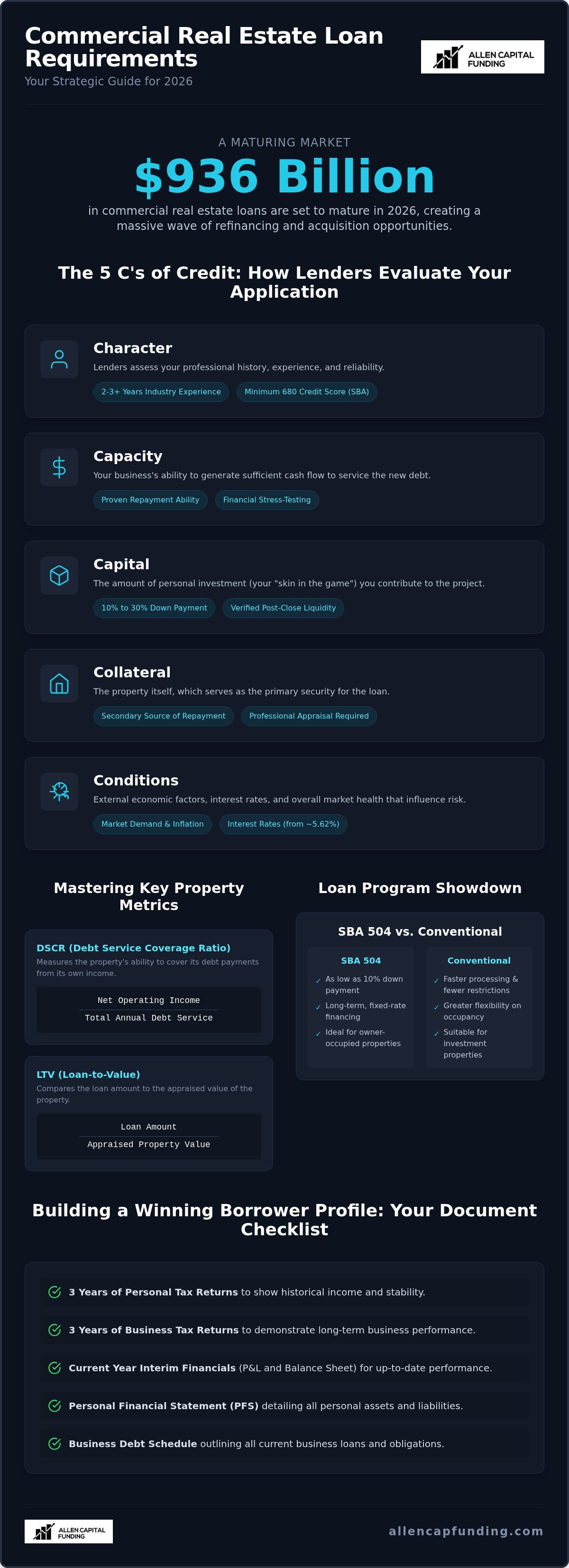
Nearly $936 billion in commercial real estate loans are set to mature in 2026, creating a massive wave of refinancing and new acquisitions across the country. This shift means lenders are processing more applications than ever, making it vital to nail your commercial real estate loan requirements on the first attempt. You've likely felt the frustration of opaque approval criteria or the fear that a single missing document could kill your deal. It's common to feel stuck between the 10% down payment benefits of an SBA 504 loan and the speed of conventional financing.
We understand that securing capital is about more than just numbers; it's about the strategic growth of your business. This guide provides a comprehensive breakdown of exactly what lenders require to approve your property financing in today's market. You'll master the complexities of property valuation, learn the specific credit benchmarks for 2026, and walk away with a clear checklist of required documents. Whether you are starting with a financial check-up or comparing the new $10 million combined SBA borrowing limits to private credit lines, we're here to help you move forward with confidence and clarity.
Table of Contents
The 5 C’s of Commercial Lending: Understanding Lenders’ Core Requirements
Financial and Personal Documentation: Building a Winning Borrower Profile
Evaluating the Asset: Property-Specific Requirements and DSCR
Comparing Loan Programs: SBA 504 vs. Conventional Financing Requirements
Navigating the Process: How to Choose the Right Lending Partner for Your Strategy
The 5 C’s of Commercial Lending: Understanding Lenders’ Core Requirements
Underwriting isn't just a math problem; it's a risk assessment. Lenders use the 5 C’s of credit to determine if your project fits their specific risk appetite. While property value matters, your personal and business history often carries equal weight. Understanding these commercial real estate loan requirements helps you present a narrative that builds trust with institutional partners.
Character and Capacity: The Human Element of Risk
Lenders prioritize "Character" by looking for a minimum of 2 to 3 years of direct industry experience. They want to see that you've successfully managed similar operations through various market cycles. Your personal credit profile also plays a massive role in commercial real estate loan requirements; for example, most SBA lenders require a minimum score of 680 to proceed. Before you commit to a property, completing a Financial Check-Up can identify potential red flags in your history that might derail an application later. Capacity refers to your business’s ability to handle the debt. Lenders stress-test your financials to ensure you can still make payments if interest rates rise or revenues dip slightly.
Capital and Conditions: External Factors of Approval
Capital involves your "skin in the game." Most lenders require a 10% to 30% down payment, but they also look for "verified liquidity." This means you must show enough cash reserves to cover several months of operating expenses after the deal closes. Collateral is the property itself, serving as the secondary source of repayment. You can learn more about Commercial mortgage basics to understand how assets are valued during this phase. Conditions represent the external economic factors, such as inflation rates and market demand, that influence lender appetite in 2026.
Current market interest rates, which started around 5.62% for conventional mortgages in mid-2026, dictate the "Conditions" of your offer. If the economy shows signs of volatility, banks may tighten their standards or require higher debt coverage. Unlike some competitors who only focus on the property, we look at the full picture. We ensure your capital position and the current economic climate align with your long-term strategy. This holistic approach removes barriers and simplifies your path to closing.
Financial and Personal Documentation: Building a Winning Borrower Profile
Documentation is the bridge between your business vision and a lender's approval. While the 5 C's provide the framework, your financial package provides the proof. Meeting modern commercial real estate loan requirements involves more than just a quick credit check; it requires a deep dive into your historical performance and current trajectory. Banks have begun to ease underwriting standards slightly according to the January 2026 Senior Loan Officer Opinion Survey, yet they remain rigorous regarding document verification. You must present a clean, organized, and transparent profile to move through the process efficiently.
The Core Financial Package
Lenders typically require three years of both personal and business tax returns to identify long-term trends. They look for consistency between your filed taxes and your internal bookkeeping. If your 2025 returns show a loss due to heavy depreciation but your interim 2026 Profit and Loss (P&L) statement shows strong growth, you must explain that transition clearly. This is where "add-backs" become vital. By identifying one-time expenses, non-cash charges like depreciation, or interest payments, you can show a higher qualifying income.
A Personal Financial Statement (PFS) is also mandatory. This document lists every asset and liability you own, including cash, stocks, and other real estate. Besides the PFS, you must provide a business debt schedule. This list should include all current business liabilities, original loan amounts, and monthly payment terms. Working with a professional SBA loan specialist ensures these documents are formatted to meet specific institutional standards, preventing deal-killing gaps in your file.
Legal and Organizational Documents
Precision matters when proving your business is a legal entity. You will need to provide your Articles of Incorporation or Operating Agreements alongside your EIN confirmation. Lenders also require a "Use of Proceeds" letter. This narrative justifies your capital request by explaining exactly how the funds will be used, whether for acquisition, renovations, or refinancing. If you have past credit issues, don't hide them. Providing a written explanation for "challenged credit" offers necessary context and shows proactive management.
General commercial real estate loan requirements often vary by lender, so having these files ready in a digital vault accelerates the timeline. For more details on standard benchmarks, you can review commercial real estate loan requirements to see how your profile compares to industry averages. If you are unsure if your current documents are sufficient, a strategic capital review can help you organize your profile before you submit a formal application.
Evaluating the Asset: Property-Specific Requirements and DSCR
Lenders view the property as more than just a building; it's a financial engine. While your personal financials prove character, the asset's performance proves capacity. This is why commercial real estate loan requirements center heavily on the property's ability to generate consistent cash flow. In 2026, lenders are underwriting deals more conservatively to account for the federal funds rate holding steady between 3.50% and 3.75%. You must show that the property is a viable secondary source of repayment if your primary business revenue fluctuates.
Mastering the DSCR Calculation
The Debt Service Coverage Ratio (DSCR) is the most critical metric in any commercial deal. DSCR is the ratio of available cash flow to debt obligations. In 2026, standard commercial real estate loan requirements typically demand a DSCR between 1.25x and 1.35x. This buffer ensures the property can still cover its mortgage if vacancies rise or operating costs spike. Lenders calculate this by finding the Net Operating Income (NOI). To find your NOI, subtract all operating expenses like maintenance, insurance, and management fees from your gross rental income. They don't include your mortgage payment or income taxes in this specific calculation. If you're pursuing the SBA 504 loan program, these metrics are scrutinized to ensure your business can comfortably occupy at least 51% of the space.
Appraisals and Environmental Due Diligence
Third-party reports act as the final gatekeepers for your financing. A commercial appraisal differs significantly from a residential one. Instead of just looking at nearby sales, the appraiser uses the "Income Approach" to value the property based on the revenue it generates. This is especially important for multi-tenant buildings or investment properties. For these deals, lenders require updated rent rolls and copies of all active leases to verify the stability of the income stream.
Beyond verifying the income stream, maintaining the physical safety of your new asset is a critical operational priority; for instance, you can discover A Aable Locksmith to help secure your commercial property with professional locksmith services in the Florida region.
Environmental assessments are equally vital, particularly for industrial or retail sites. A Phase I Environmental Site Assessment identifies potential soil or groundwater contamination that could become a massive liability. For those seeking commercial real estate loans NY, these reviews often involve complex zoning laws and historical land-use checks. Loan-to-Value (LTV) ratios also come into play here. LTV represents the gap between the purchase price and the loan amount. While some SBA programs allow for 90% LTV, conventional lenders often cap their exposure at 70% to 75%, requiring you to bridge the gap with more equity.
Comparing Loan Programs: SBA 504 vs. Conventional Financing Requirements
Choosing between an SBA 504 loan and a conventional mortgage depends on your cash flow goals and property use. While both options have strict commercial real estate loan requirements, they serve different strategic purposes. For most business owners, the decision rests on how much capital they want to keep in their operating account versus how quickly they need to close the deal. Banks began easing underwriting standards in early 2026, yet the gap between government-backed and private money remains significant.
The SBA 504 Advantage for Owner-Users
The SBA 504 program is the gold standard for businesses that plan to occupy their property. Its most attractive feature is the 10% down payment requirement, which is much lower than the 20% to 30% typically demanded by banks. As of July 2026, the SBA increased the combined borrowing limit for 7(a) and 504 loans to $10 million, allowing for larger, more complex projects. However, you must satisfy the 51% occupancy rule for existing buildings or 61% for new construction. This program also allows for slightly lower credit scores if your net operating income is robust. You can find more details on these structures in our SBA Loan Brokers New York guide.
When Conventional Financing Wins
Conventional loans are the better fit for investment properties or non-owner-occupied buildings that don't qualify for SBA support. While commercial real estate loan requirements for conventional deals often include higher down payments, they offer faster closing timelines and more flexible prepayment terms. Conventional rates in mid-2026 typically range from 5.62% to 9.00% depending on the asset class and borrower strength. If you're short on the 25% down payment required by a bank, you might consider asset-based lending for small business to unlock liquidity from your existing equipment or inventory.
Interest Rates: SBA 504 offers 25-year fixed rates, with debenture rates around 5.04% in July 2026, while conventional loans often use floating rates or shorter five-year fixed periods.
Prepayment Penalties: SBA 504 has a structured 10-year declining penalty scale. Conventional penalties are often negotiable or follow a simpler "step-down" format like 3-2-1.
Project Costs: SBA 504 allows you to roll renovations and heavy equipment into the total loan amount. Conventional loans usually focus strictly on the real estate value.
Ready to see which program fits your 2026 growth plans? Contact Allen Capital Funding today for a personalized loan comparison.
Navigating the Process: How to Choose the Right Lending Partner for Your Strategy
Selecting a lending partner is just as critical as meeting the commercial real estate loan requirements themselves. You might have a perfect credit score and a robust 1.35x DSCR, but if your chosen bank doesn't lend to your specific industry, you'll still face a rejection. In 2026, transparency is the cornerstone of successful lending. You need a partner who doesn't just provide a term sheet but acts as a strategic consultant throughout the lifecycle of your deal. Finding a steady, reliable hand ensures that you aren't just getting a loan; you're gaining a partner in your business's growth.
Evaluating Lender Fit
Ask yourself if the institution specializes in your specific property type. A bank that thrives on industrial warehouse deals might hesitate on a multi-tenant retail plaza. Small business lending banks often have more flexible, localized commercial real estate loan requirements compared to national institutions. These local partners understand regional market nuances that a computer model in a distant headquarters might miss. Many business owners also find value in a lender who offers strategic business equipment financing. Having your real estate and equipment capital under one roof simplifies your balance sheet and streamlines your reporting process.
The Broker Advantage in Meeting Requirements
While some online forums suggest that brokers only add an extra layer of fees, the reality in 2026 is that a broker acts as your lead underwriter. We "scrub" your financials to ensure you meet the 5 C's before a lender ever sees your application. This "pre-flight" check is essential for your success. Submitting a full application with documentation gaps can lead to a formal decline; this stays in a bank's internal records for years. A broker identifies these gaps early and helps you package your narrative to highlight strengths like management experience or property potential.
We also provide access to "non-bank" or private lenders, including hard money lenders Kansas City. These entities often have requirements based primarily on asset value rather than personal tax returns. This flexibility is vital for business owners with complex tax structures or those who are rapidly scaling. Your next step should be a preliminary review of your specific goals. Booking a consultation allows you to map your real estate strategy to the right capital source without the risk of a premature formal application. We act as a proactive, solution-focused ally to remove barriers and simplify your path to progress.
Secure Your Future in Commercial Real Estate
Meeting commercial real estate loan requirements in 2026 involves more than just submitting a stack of paperwork; it requires a strategic approach to your business narrative. By mastering the 5 C's of credit and ensuring your property meets modern DSCR benchmarks, you position your business for a seamless approval. Whether you are leveraging the new $10 million SBA borrowing limits or seeking the speed of a conventional bank loan, preparation remains your greatest asset. Organizing your financial package today prevents the deal-killing delays that often frustrate unprepared borrowers.
At Allen Capital Funding, we act as your dedicated guide through this complex landscape. We provide access to a national network of specialized commercial lenders and offer deep expertise in both SBA 504 and conventional loan packaging. Our team excels at providing dedicated support for businesses with complex financial profiles, ensuring every detail of your application is optimized for success. We're here to remove barriers and accelerate your progress toward property ownership.
Ready to secure your property? Book a strategic consultation with Allen Capital Funding today.
Your growth is our priority, and we're ready to help you bridge the gap to your future goals. Let's start building your success story together.
Frequently Asked Questions
What is the minimum credit score for a commercial real estate loan?
Lenders typically require a minimum credit score of 680 for most programs, especially SBA 504 and 7(a) loans. While some conventional lenders might consider lower scores if you have significant collateral or high cash flow, a score above 680 ensures you meet standard commercial real estate loan requirements and qualify for better interest rates. Maintaining a strong personal credit profile is vital because lenders view it as a reflection of your character and financial responsibility.
How much down payment is required for a commercial property in 2026?
Most borrowers need a down payment of at least 10% for an SBA 504 loan, while conventional bank loans usually require 20% to 30%. This "skin in the game" reduces the lender's risk and influences your final interest rate. If you're purchasing an investment property that you don't plan to occupy, expect lenders to demand a higher down payment to offset the increased risk associated with tenant turnover.
Can I get a commercial loan if my business is less than two years old?
You can secure a loan for a newer business, but the underwriting process is much stricter. Lenders will focus heavily on your previous industry experience and may require a larger down payment or additional collateral. Providing a detailed business plan with conservative financial projections is essential to prove your business has the capacity to handle new debt before it reaches the two-year mark.
What is a Debt Service Coverage Ratio (DSCR) and why is it important?
DSCR measures your property's ability to cover its annual debt payments using its net operating income. It's a fundamental part of commercial real estate loan requirements because it shows lenders there's enough cash flow to handle the mortgage even if expenses rise. In 2026, most lenders look for a DSCR between 1.25x and 1.35x to ensure a safe margin of error for the borrower.
Does a commercial real estate loan require a personal guarantee?
Most commercial loans require a personal guarantee from any individual owning 20% or more of the business. This agreement means you're personally responsible for the debt if the business fails to make payments. While some non-recourse loans exist for very large institutional deals, small to mid-sized business owners should expect to sign a guarantee as a standard part of the closing process.
What are the typical closing costs for a commercial property loan?
Closing costs generally range from 2% to 5% of the total loan amount. These costs cover third-party reports like appraisals and environmental assessments, as well as legal fees and loan origination charges. It's important to budget for these expenses early so they don't impact your liquidity reserves required by the lender at closing.
How long does the approval process take for a commercial mortgage?
The approval and closing process usually takes between 45 and 90 days. Conventional bank loans can sometimes move faster if your documentation is organized, while SBA loans often take the full 90 days due to government processing requirements. Starting with a financial check-up helps you identify potential delays before you enter the formal application phase.
What is the difference between an SBA 7(a) and an SBA 504 loan for real estate?
The primary difference lies in the loan structure and use of funds. The SBA 504 loan is designed specifically for fixed assets like real estate and offers 25-year fixed interest rates, which were around 5.04% in July 2026. The SBA 7(a) is more flexible and can be used for working capital or debt refinance, but it often carries variable interest rates that can fluctuate over time.


Comments