
How to Apply for an SBA 7(a) Loan and Prepare to Qualify
A strong SBA 7(a) application starts with a lender, not a direct application to the SBA. Knowing how to apply for an SBA 7(a) loan means preparing your business and personal financial information, explaining how the funds will be used, and showing that cash flow can support repayment.
The process can feel document-heavy, and a solid business idea alone may not answer a lender’s main concerns: your credit history and ability to repay. This guide walks you through approaching a lender, organizing application materials, presenting your credit profile and projections, and understanding submission and approval. You’ll also see how to make the case for your loan purpose clearly, so you can move forward with a more prepared application.
Table of Contents
Collateral and intangible business value
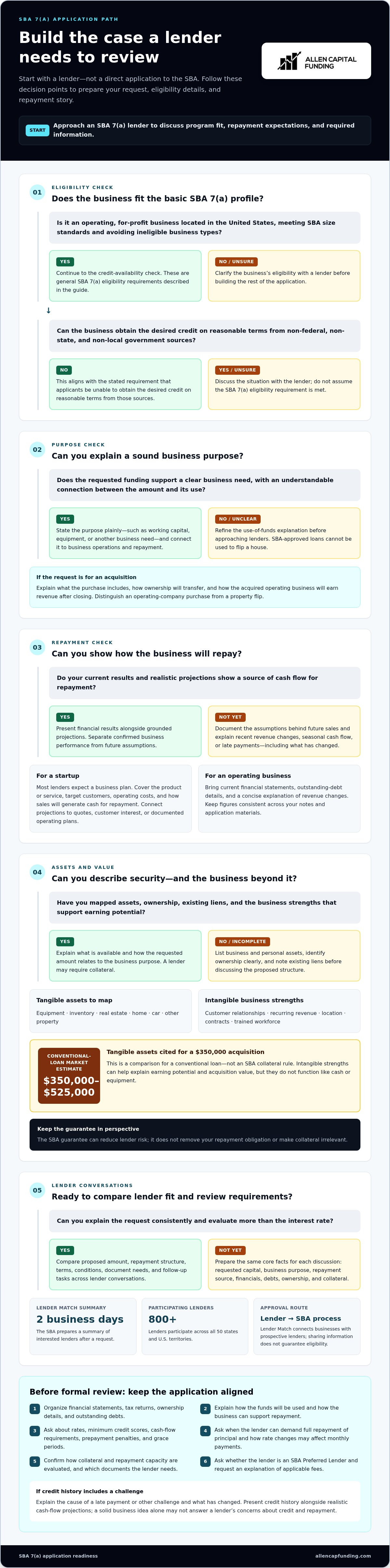
Map the assets and the funding purpose. List business assets that could support a loan, such as equipment, inventory, or real estate, alongside assets you own personally. Lenders may require borrowers to pledge collateral, such as a home, car, inventory, or other property. Identify existing liens and ownership clearly. This gives the lender a practical view of available security and helps you explain how the requested amount relates to the business purpose.
Show what the business is worth beyond its physical assets. Customer relationships, recurring revenue, location, contracts, and a trained workforce can help explain the business’s earning potential. These intangible strengths don't function like cash or equipment, but they can support your explanation of repayment capacity and acquisition value. For context, a market estimate for a conventional loan on a $350,000 acquisition puts required tangible assets at $350,000 to $525,000. Treat that as a comparison, not an SBA collateral rule.
Prepare the business before seeking funding. Reconcile financial records, document ownership, list debts, and make sure your stated use of funds matches the business’s operations. SBA 7(a) eligibility generally requires an operating, for-profit business located in the United States, meeting SBA size standards and avoiding ineligible business types. Applicants must also be unable to obtain the desired credit on reasonable terms from non-federal, non-state, and non-local government sources. Write down how your project serves a sound business purpose.
Build a business plan that supports startup funding. Most lenders expect a business plan when a business applies for startup funding. Explain the product or service, target customers, operating costs, and how sales will generate cash for repayment. If you lack a long operating history, use grounded assumptions and show how you reached them. Industry experience isn't required for an SBA loan, but firsthand knowledge can reassure a lender. Connect projections to actual quotes, customer interest, or documented operating plans.
Frame an acquisition around the operating business. Explain what the purchase includes, how ownership will transfer, and how the acquired business will earn revenue after closing. SBA 7(a) financing supports a variety of purposes, but SBA-approved loans cannot be used to flip a house. A business acquisition plan should therefore distinguish an operating company purchase from a property flip. The SBA guarantee can reduce lender risk, but it doesn't remove your repayment obligation or make collateral irrelevant. Ask the lender how collateral and intangible value affect the proposed structure and competitive rates.
Speaking with a lender and pre-qualification
Use lender conversations to assess program fit, repayment expectations, and the documents your application will require. Prepare the same core facts for each discussion so you can compare terms clearly.
Prepare to Talk to LendersBefore the first call, summarize the capital you’re requesting, its business purpose, and the repayment source. Bring current financial statements, details of outstanding debt, and a concise explanation of recent revenue changes. Note whether the request supports working capital, equipment, or another business need. Be ready to discuss collateral and ownership, too. Consistent figures across your notes and documents help lenders assess the request without avoidable confusion.Prepare a brief explanation of challenges, such as seasonal cash flow or a late payment. Describe the cause and what has changed. Separate confirmed business results from projections, and identify the assumptions behind future sales. This gives lenders a clearer basis for assessing whether the program and proposed monthly payments fit your operating cash flow.
Find and Approach a Local LenderApply for an SBA 7(a) loan through a local lender, not directly through the SBA. To find an SBA-approved lender, use SBA Lender Match to submit business information and connect with prospective lenders. The SBA prepares a summary of interested lenders two business days after a request. More than 800 lenders participate across all 50 states and U.S. territories.Compare the lenders that respond, explain your funding purpose, and ask to discuss pre-qualification. Lender Match can connect businesses with prospective SBA lenders, but sharing information does not guarantee eligibility for their programs. Ask each lender what it needs to assess your request and how it handles the application. Keep a record of responses and requested follow-up materials.
Ask Prospective Lenders Key QuestionsAsk each lender about interest rates, minimum credit scores, cash flow requirements, prepayment penalties, grace periods, and when it can demand full repayment of principal. These terms affect the loan’s cost and flexibility. Request an explanation of how rate changes may affect monthly payments and how the lender evaluates collateral and repayment capacity.Also ask which documents it needs for your loan size and processing method, and what could delay its review. The lender provides applicants with the full eligibility requirements for its loan. Record the answers in a comparison sheet, including the proposed loan amount, repayment structure, and follow-up tasks. Don’t compare offers by interest rate alone: repayment terms and conditions matter, too.
Discuss Preferred Lender Authority, Rates, and FeesAsk whether the lender is an SBA Preferred Lender. Preferred Lenders can make final credit decisions and approve loans on behalf of the SBA, which affects how the approval process works. Confirm who will review your application and which decisions remain with the lender. This clarifies the steps from pre-qualification to formal submission.Ask the lender to explain applicable fees and provide an itemized account before you accept the terms. Compare the full repayment obligation, not just the rate.
Application documents
Build a core financial file. Gather three years of income statements, balance sheets, and federal income tax returns. Use the same reporting periods across each document, then check totals for consistency. For example, confirm that reported revenue aligns with the tax return and balance sheet figures. Add current financial information requested by the lender, and label each file by period and document type. An organized file helps the lender review your application and identify follow-up questions efficiently.Keep supporting records with your financial statements. A lender may request additional materials based on the loan amount and its processing method. Use a checklist to track what you’ve submitted, what remains outstanding, and when you provided each item. This record reduces the risk of sending conflicting versions during underwriting.
Complete the required SBA forms. SBA Form 1919 is required for every Standard 7(a) loan. Review each response for accuracy, especially details about ownership, business activity, and the requested funding purpose. If an answer changes after submission, tell the lender promptly and provide corrected information. The application documents required for an SBA 7(a) loan vary based on loan size and the lender’s processing method, so use the lender’s document list as your working checklist.Separate signed forms from financial attachments, and keep a complete copy of the submitted package. Before sending it, check that names, dates, and figures match across the application, tax returns, and business records. Consistent information gives underwriting a clearer picture of the request and helps prevent avoidable clarification cycles.
Prepare documents for a business acquisition. If the application will fund a purchase, organize materials for both sides of the transaction. As the buyer, prepare ownership information, your acquisition plan, and a clear account of how the business will operate after the sale. Ask the seller for relevant business financial records and information needed to assess operations. The lender uses this combined picture to understand the purchase, the business’s cash flow, and the proposed repayment source.For startup funding, include a business plan. Most lenders expect one when a business applies for startup financing. Explain the business model, expected customers, operating costs, and how projected revenue will support repayment. Tie each projection to a stated assumption, such as planned staffing or a documented sales strategy. Keep the plan consistent with the amount and use of funds in the loan application.
Track underwriting and funding milestones. Submit a complete package, then respond to lender requests with the specific document or explanation requested. Application documents may change with loan size and processing method, so keep the lender’s latest checklist current. SBA loan applications typically take 30 to 90 days from application to funding. Treat that range as a planning window, and track key steps such as initial submission, underwriting questions, approval, closing documents, and funding.Before signing, compare the final loan terms with your application, including the approved amount, interest rates, and repayment terms. Confirm that the use of funds still matches your business plan. A mismatch between requested working capital and actual operating needs can complicate the final review. Keep copies of the signed documents and the lender’s funding instructions for your records.
SBA loan submission and approval
After approving your application, the lender submits it to the SBA for final review. Common reasons for denial include weak repayment capacity, an ineligible business, or an unsupported loan purpose.
Submit the SBA Loan ApplicationSubmit a complete, consistent application package, then respond promptly to follow-up requests. Confirm that the requested loan amount, business purpose, ownership details, and financial figures match across your forms and records. Mismatches between the application and supporting documents can slow review or raise questions about the request.Ask the SBA lender which review stage comes next and who will contact you. SBA turnaround times are 5-10 business days for a Standard 7(a) loan and 2-10 business days for a 7(a) small loan. Those periods cover SBA review, not the entire path from application to funding. Track submission dates and outstanding requests so nothing stalls between lender and government review.
Review Collateral and CreditBe ready to explain your credit history, existing obligations, and the cash flow available for repayment. Lenders assess credit risk and whether the business can reasonably support the proposed payments. They also consider available collateral as part of the credit decision. Gather clear information about assets and existing liens, and answer questions directly rather than leaving gaps in the file.Collateral does not replace the lender’s review of your ability to repay. Explain how the business will generate cash after receiving the loan, and connect that explanation to actual operating results or realistic projections. If the lender asks about a past credit issue, describe its cause, current status, and effect on business finances. Clear context lets the lender assess the full application instead of relying on an unexplained entry.
Address Common Application Denial ReasonsReview eligibility and repayment capacity before submitting your application. It may face challenges if the business misses SBA size standards, operates in an ineligible category, lacks a sound business purpose, or cannot demonstrate an ability to repay. The request may also fail to meet the requirement that the applicant cannot obtain the desired credit on reasonable terms from non-federal, non-state, and non-local government sources.Check that the requested funding matches the project and that projected cash flow supports repayment. Resolve inconsistent records, explain existing debt, and clarify how the loan will benefit business operations. If a lender identifies a weakness, ask which application details support that concern and whether revised documentation would address it. Don’t alter projections just to secure approval: base assumptions on the business’s actual revenue plans and costs.
Credit history and financial projections
Review your credit profile before applying. SBA 7(a) applicants must be creditworthy and show a reasonable ability to repay. Lenders use credit scores to assess risk and set interest rates. A score of at least 650 is identified as a basic eligibility criterion for the SBA loans discussed here, but lenders also weigh payment history, current debt, and the business’s financial picture.Prepare explanations for late payments, disputed entries, or large changes in balances. Connect each explanation to records, such as a payment plan or updated account statement. Good character and business creditworthiness matter alongside the score. Industry experience isn't required, but firsthand knowledge can help reassure a lender that you can operate the business.
Build projections from operating evidence. Start with recent revenue, regular expenses, existing debt payments, and expected changes after funding. Separate confirmed figures from forecasts, and record the assumption behind each estimate. For example, a planned purchase that adds capacity should connect to a realistic sales plan, not an unexplained jump in revenue.Project cash flow across the repayment period, then account for slower sales or higher operating costs. Show how the business will make payments while meeting payroll, supplier obligations, and other existing commitments. Lenders assess reasonable repayment ability using cash flow projections, so explain which revenue sources support each payment and when those funds are expected.
Match the forecast to the loan purpose. For a real estate purchase, distinguish property costs from ongoing expenses, then show how the location supports business revenue. For working capital, connect the requested amount to operating needs such as inventory or supplier timing.Test your plan under more than one operating scenario. If sales arrive later than expected, identify which expenses can be managed and whether cash flow would still support payments. Don’t present best-case projections as the only outcome. A clear base case, supported by business records and stated assumptions, helps a lender determine whether the proposed financing fits the project.
Present credit and projections as one repayment story. Use a brief summary to link your credit history, current obligations, funding purpose, and forecast. Explain any gap between past performance and projected results. For example, if revenue is expected to rise after a purchase, show the operating change behind that increase. Consistent figures help the lender assess eligibility and identify questions before underwriting progresses.Prepare this summary alongside your financial records, then refine it as the lender asks for detail. A business financial check-up can help organize the credit and cash flow picture before an application. Focus on evidence, practical assumptions, and the business’s ability to meet payments under the proposed terms.
Allen Capital Funding: Credit Lines
Allen Capital Funding offers Credit Lines and SBA Loans for businesses weighing funding options after reviewing their credit, repayment capacity, and projected cash flow. A credit line may suit recurring or changing working capital needs, while an SBA loan may fit a larger, defined business purpose. The right structure depends on how the funds support operations and how the business expects to repay them.
If preparing your application has clarified your funding need but you’re weighing which option fits, Allen Capital Funding can help you consider business financing options. Bring your planned use of funds, current financial picture, and cash flow projections to guide the discussion. Contact Allen Capital Funding to discuss your business’s funding needs.
Move Your Funding Plan Forward
Your next step is to turn your preparation into a focused funding decision. Knowing how to apply for an SBA 7(a) loan is useful, but the broader goal is choosing financing that fits your business purpose and repayment capacity. Allen Capital Funding offers SBA Loans and Credit Lines, along with Real Estate financing, for businesses assessing funding options. Consider which path aligns with the investment you’re planning and the cash flow available to support it.
Before you move ahead, write down the business outcome you want the financing to support. That focus can help keep lender discussions practical and make it easier to compare options against your operating priorities. If you’re ready to discuss your next step, contact Allen Capital Funding. Bring your funding goal and the questions you want answered. A deliberate plan can help you approach your next financing decision with clarity and confidence.
Frequently Asked Questions
How do I apply?
To understand how to apply for an SBA 7(a) loan, start with an SBA-approved lender; the SBA doesn’t issue the loan directly to your business. Prepare a concise request describing the business purpose, amount sought, and expected repayment source. The lender reviews eligibility and financial information, then explains its application process. If approved, the lender submits the application to the SBA for final review when required and coordinates the next steps.
What is a 7(a) loan?
An SBA 7(a) loan is financing delivered through participating lenders and supported by an SBA guarantee. The program is the agency’s primary option for long-term financing across various business purposes. The lender makes the loan and assesses the borrower’s ability to repay; the SBA guarantee protects the lender for a portion of its loss if repayment fails. It doesn’t remove the borrower’s responsibility to repay the debt.
What are the SBA 7(a) loan eligibility requirements?
A business generally must operate for profit in the United States, meet SBA size standards, and avoid ineligible business types. Applicants must show creditworthiness, a reasonable ability to repay, and a sound business purpose. They must also be unable to obtain the desired credit on reasonable terms from non-federal, non-state, and non-local government sources. Under the eligibility criteria described here, applicants must have net worth below $20 million and average net income under $6.5 million after taxes for the preceding two years.
What can SBA 7(a) loan funds be used for?
SBA 7(a) funds can support a range of business purposes, including working capital, equipment, real estate, and eligible business acquisitions. For example, an established company might use funds to purchase equipment that supports its operations, while an acquirer could finance the purchase of an operating business. The use must serve a sound business purpose and align with the lender’s review. SBA-approved loans can’t be used to flip a house.
How much can you borrow with an SBA 7(a) loan, and what are the maximum loan terms?
Repayment terms can vary depending on the loan’s purpose. A business seeking equipment, working capital, or real estate financing should connect its requested amount to the project and expected repayment capacity. The lender reviews the purpose and repayment plan when structuring the loan, so the maximum amount doesn’t mean every applicant can borrow that full amount.
What documents are needed to apply for an SBA 7(a) loan?
Prepare business financial statements and federal tax returns, plus the lender’s application forms and supporting records. Listed financial documentation may include three years of income statements, balance sheets, and federal income tax returns. SBA Form 1919 is required for every Standard 7(a) loan. Requirements vary by loan size and processing method. Startups should also prepare a business plan, since lenders commonly expect one for startup funding.
What are the steps to apply for an SBA 7(a) loan?
First, define the business purpose and estimate the amount of funding needed. Next, approach an SBA-approved lender and review its eligibility criteria and document checklist. Submit the application with complete financial records, then respond to underwriting questions and provide any requested details. If the lender approves the request, it submits the application to the SBA for final review when applicable. After approval, review the closing documents and follow the lender’s funding instructions.
How long does SBA 7(a) loan approval and funding take?
SBA 7(a) applications typically take 30 to 90 days from application to funding. SBA turnaround time is 5-10 business days for a Standard 7(a) loan and 2-10 business days for a 7(a) small loan; those are SBA review windows, not the full funding timeline. Lender underwriting, document completion, follow-up questions, and closing steps also affect the overall process. Keep requested records organized to support timely review.



Comments